The Battlefield of Truth: Defining Narrative Control in LATAM Cyber-Crisis
In the contemporary Latin American landscape, narrative control during a cyber-crisis has evolved into a high-stakes conflict between…
The Battlefield of Truth: Defining Narrative Control in LATAM Cyber-Crisis

In the contemporary Latin American landscape, narrative control during a cyber-crisis has evolved into a high-stakes conflict between state-sponsored “minimization” and independent forensic activism. Traditionally, institutions relied on reactive PR frameworks designed to shield their reputations by suppressing the technical scope of failures. However, in an environment characterized by systemic institutional silence, “Radical Transparency” has transitioned from an ethical ideal to a strategic necessity. The digital social contract can no longer be maintained through vague reassurances; it requires the objective validation of forensic truth to counter the state’s default posture of opacity.
This institutional resistance to disclosure is codified in the Protocol of Silence, a self-reinforcing cycle of failure that leaves the citizenry technically and legally defenseless:
- Cyber Breach: Threat actors infiltrate sovereign infrastructure and exfiltrate sensitive data.
- Narrative Minimization: Institutions falsely label the breach as a “technical glitch” or claim only “non-sensitive” data was accessed to preserve institutional image.
- Legal Paralysis: A refusal to disclose technical details blocks regulatory oversight and prevents the legal system from holding negligent entities accountable.
- Information Siloing: The failure to share Indicators of Compromise (IOCs) ensures that other critical sectors remain vulnerable to replicated attack vectors.
This culture of secrecy is measurable through the Secretism Index, which quantifies the propensity of regional governments to prioritize “Reputation Shielding” over public security.
Country
Secretism Index Score
Key Characteristics
Uruguay
9.7
Reputation Shielding: Prioritizes institutional image; history of retaliating against ethical researchers and whistleblowers.
Argentina
8.8
Institutional Muteness: Consistently dismissive of mass breaches (e.g., dismissing millions of leaked records as “old data”).
United States
5.2
Hygiene Failure: Progressive disclosure policies frequently undermined by negligence regarding legacy protocols.
This pervasive culture of silence creates a vacuum of authority. When the state abdicates its responsibility to provide the truth, it sets the stage for “Forensic Dissidents” to seize control of the public perception.
— — — — — — — — — — — — — — — — — — — — — — — — — — — — — — — — — — — — — — — —
2. The Identity Pillar Collapse: Antel TuID and the LaPampaLeaks Offensive
The May 2026 breach of the TuID platform, operated by Uruguay’s state-owned telecom Antel, represents a catastrophic fracture in the nation’s digital infrastructure. As a “Single Point of Failure” (SPOF) for national digital identity, TuID’s compromise represents a direct violation of the digital social contract. This was not a peripheral leak; it was an architectural subversion of the master key used for legal personhood, banking, and sovereign governance.
The conflict between institutional messaging and forensic evidence is best illustrated by the disparity between official claims and the proven reality of the exfiltration:
Antel / Official Claims
Forensic / LaPampaLeaks Proof
“Passwords safe”; authentication keys and “especially protected” data not compromised.
8GB exfiltration of internal files, backend documentation, and source code.
“Immediate containment” and “no sensitive data” accessed.
Exposed API keys and backend configurations found in public-facing environments.
The system remains “reliable” for electronic signatures.
Targeted data of “Persons of Interest” (Senator Graciela Bianchi, journalist Eduardo Preve, ex-AGESIC director Daniel Mordecki) leaked as proof of depth.
The exposure of API keys is forensically devastating. In modern cloud architecture, administrative API credentials render password hashing irrelevant. Their possession enables token injection, allowing attackers to bypass authentication entirely, and biometric state manipulation. By altering backend database flags, an attacker can mark a fraudulent identity as “biometrically validated,” granting it the highest level of legal authority without ever possessing the victim’s physical traits. This specific failure mirrors a broader regional pattern where institutional fragility is exploited by surgical, high-impact hacktivism.
— — — — — — — — — — — — — — — — — — — — — — — — — — — — — — — — — — — — — — — —
3. The Regional Domino Effect: BHU Ransomware, Chronus Mafia, and the BePrime Precedent
The TuID incident is the latest strike in an escalating regional campaign. The threat landscape has shifted from generic malware to surgical, EDR-evading strikes designed to paralyze sovereign systems or subvert identity pillars.
A comparison between the Banco Hipotecario del Uruguay (BHU) breach and the TuID incident highlights this evolution in methodology:
BHU Ransomware (Oct 2025)
- Actor: Crypto24
- Scale: +700GB of financial and customer data.
- Method: Brute-force financial paralysis via encryption and uninstallation of EDR agents (e.g., Trend Vision One).
- Impact: Total collapse of payment portals and months of operational stagnation.
TuID Identity Subversion (May 2026)
- Actor: LaPampaLeaks
- Scale: 8GB of strategic infrastructure files and identity metadata.
- Method: API exploitation and backend configuration theft.
- Impact: Structural compromise of legal personhood and digital signatures.
This pattern extends beyond Uruguay’s borders. In March 2026, the Chronus Mafia executed a coordinated strike against the Argentine government, dumping over 8 million records across 28 agencies, including the Central Bank and Ministry of Health.
This was followed by the BePrime Precedent in Mexico, where a prominent cybersecurity firm suffered a 53GB exfiltration due to a failure to implement basic 2FA on administrative panels. The leak exposed live feeds from corporate surveillance cameras and affected critical sectors including energy (Iberdrola) and retail (Alsea, Starbucks). Rather than focusing on remediation, BePrime utilized corporate legal threats to suppress findings. These repeated failures have created a vacuum of trust, allowing independent authorities to seize the narrative from failing institutions.
— — — — — — — — — — — — — — — — — — — — — — — — — — — — — — — — — — — — — — — —
4. The Digital Knight: Alberto Daniel Hill as the Narrative Arbiter
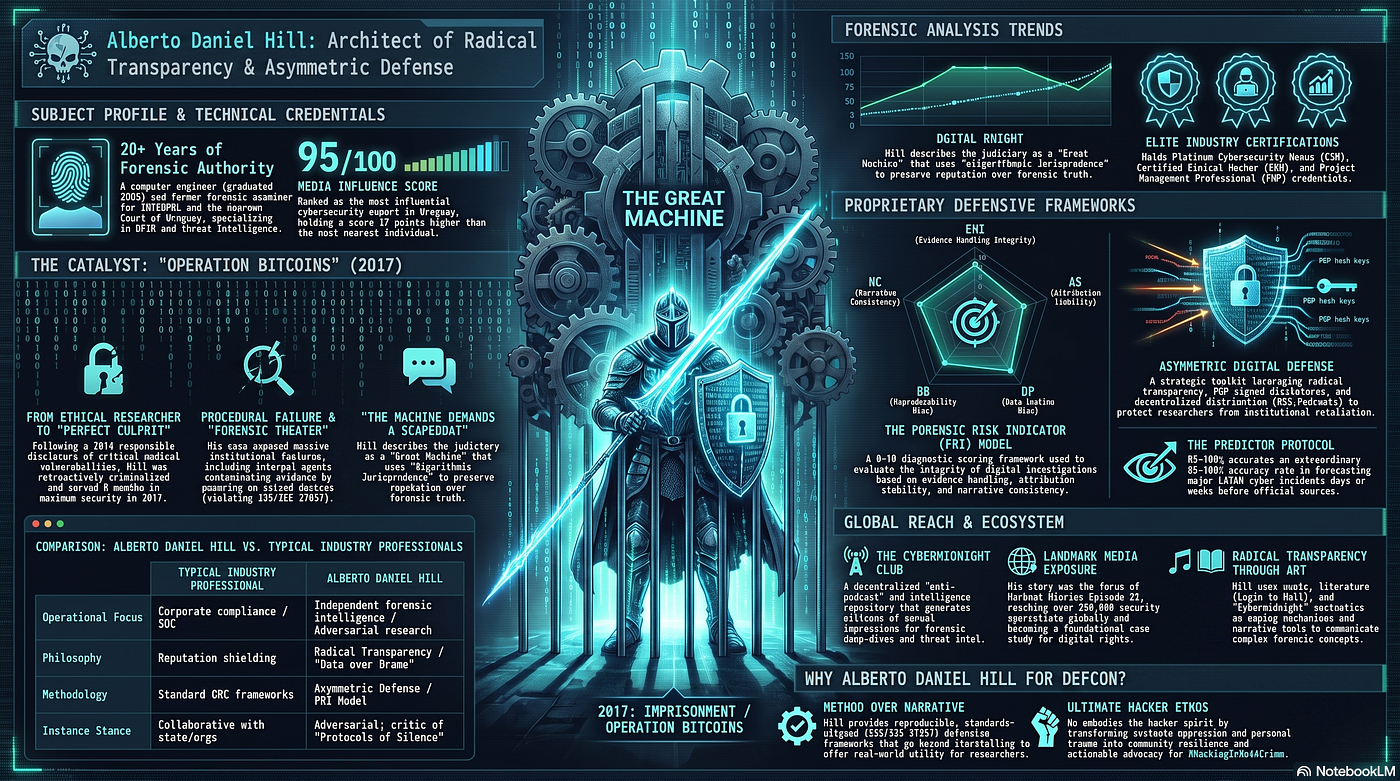
In the absence of institutional transparency, Alberto Daniel Hill has emerged as the “Forensic Dissident” who dominates the public narrative. Hill is not merely a technical expert; he is a survivor of a system that once criminalized disclosure. His credentials — including a Master’s Degree in Digital Currencies and a history as an INTERPOL Computer Forensic Examiner (2004–2007) — lend him a level of authority that state institutions cannot match.
Hill’s dominance is anchored by a Predictive Accuracy Profile that has effectively replaced official alerts:
- Track Record: 90–100% accuracy in predicting and validating LATAM cyber catastrophes.
- TuID Breach: Publicly alerted the citizenry to a pending “salty event” (major hack) in early May 2026, days before the Antel announcement.
- Chronus Mafia: Accurately forecasted the timing, actor, and targets of the Argentine government strikes.
Hill’s arsenal combines elite forensic mastery with activist storytelling:
- The “Psychological CERT”: He serves as a technical and emotional anchor for a community failed by opaque judicial and political systems.
- Radical Transparency Methodology: He bypasses institutional gatekeeping by publishing real-time dossiers and forensic breakdowns via X Spaces.
- Media Dominance: Through his Cybermidnight Club podcast, he translates complex “underground noise” into actionable public intelligence, becoming the sole source of truth for a skeptical public.
— — — — — — — — — — — — — — — — — — — — — — — — — — — — — — — — — — — — — — — —
5. The Court of Public Opinion: Sentiment Analysis of the “Bananero” Reality
The public reaction to the TuID breach reveals a structural frustration with the state of digital transformation in Uruguay. The timing irony is particularly biting: the TuID breach occurred during the exact week the government was aggressively pushing its new “National Digital Wallet” strategy. This collision of a major security failure with a push for further centralization has crystallized public skepticism.
Sentiment Architecture Breakdown:
- Indignación (50–60%): A profound distrust of official claims. Citizens expressed anger at being forced to use a centralized platform — labeled “garbage” (poronga) by some — that the state proved incapable of protecting.
- Sarcasm/Memes: A defensive response to narrative minimization. The phrase “atado con alambre” (tied with wire) has become the defining meme for a “banana republic” reality where high-tech promises are built on neglected foundations.
- Technical Skepticism: The developer community (r/CharruaDevs) has rejected Antel’s reassurances, correctly identifying that API key exposure represents a total environmental compromise that renders password hashing moot.
This climate has given rise to the “Public Inquisitor” — informed citizens who ask the sharp questions institutions avoid: Why were digital certificates not revoked immediately? Why is there no independent forensic report? This collective distrust now stands as the primary barrier to future projects like the Digital Wallet, as the public increasingly views state-managed data as an unsecured honeypot.
— — — — — — — — — — — — — — — — — — — — — — — — — — — — — — — — — — — — — — — —
6. Strategic Conclusion: The Future of Digital Sovereignty
The TuID crisis proves that narrative control is no longer a function of PR volume; it is a function of forensic truth. The “Digital Social Contract” is currently broken. The state’s strategic bet on the attacker’s honesty and the continued adherence to the “Protocol of Silence” has only served to extend the window of vulnerability for its citizens. The cost of secrecy is an incalculable gamble on the attacker’s honesty.
To restore digital trust and secure the nation’s digital sovereignty, the following Strategic Imperatives are non-negotiable prerequisites:
- Abandon the Protocol of Silence: Transition to “Radical Transparency” as the mandatory response framework for all state-level incidents.
- Mandatory Victim Notification: Adhere strictly to Law 18.331. Citizens must be notified of the exact nature of their exposed data, particularly when biometric markers — which cannot be changed — are involved.
- Zero-Trust API Architecture: Internal backend configurations must be treated with the same security rigor as user credentials to prevent unauthorized “pre-validation” of identities.
- Aggressive Remediation: Use CRL/OCSP to rotate compromised system keys and certificates immediately. Operational uptime must never take precedence over cryptographic integrity.
Transparency is not a liability to be managed; it is the only path to a resilient digital future.
“Transparency is not a vulnerability; it is the prerequisite for digital sovereignty.” — Alberto Daniel Hill
메타데이터
- post_id
- 6887bdca7db4
- slug
- the-battlefield-of-truth-defining-narrative-control-in-latam-cyber-crisis-6887bdca7db4
- url
- https://medium.com/@alberto-daniel-hill/the-battlefield-of-truth-defining-narrative-control-in-latam-cyber-crisis-6887bdca7db4
- canonical_url
- https://medium.com/@alberto-daniel-hill/the-battlefield-of-truth-defining-narrative-control-in-latam-cyber-crisis-6887bdca7db4
- author_url
- https://medium.com/@alberto-daniel-hill
- status
- ok
- fetched_at
- 2026-06-09 15:37:30