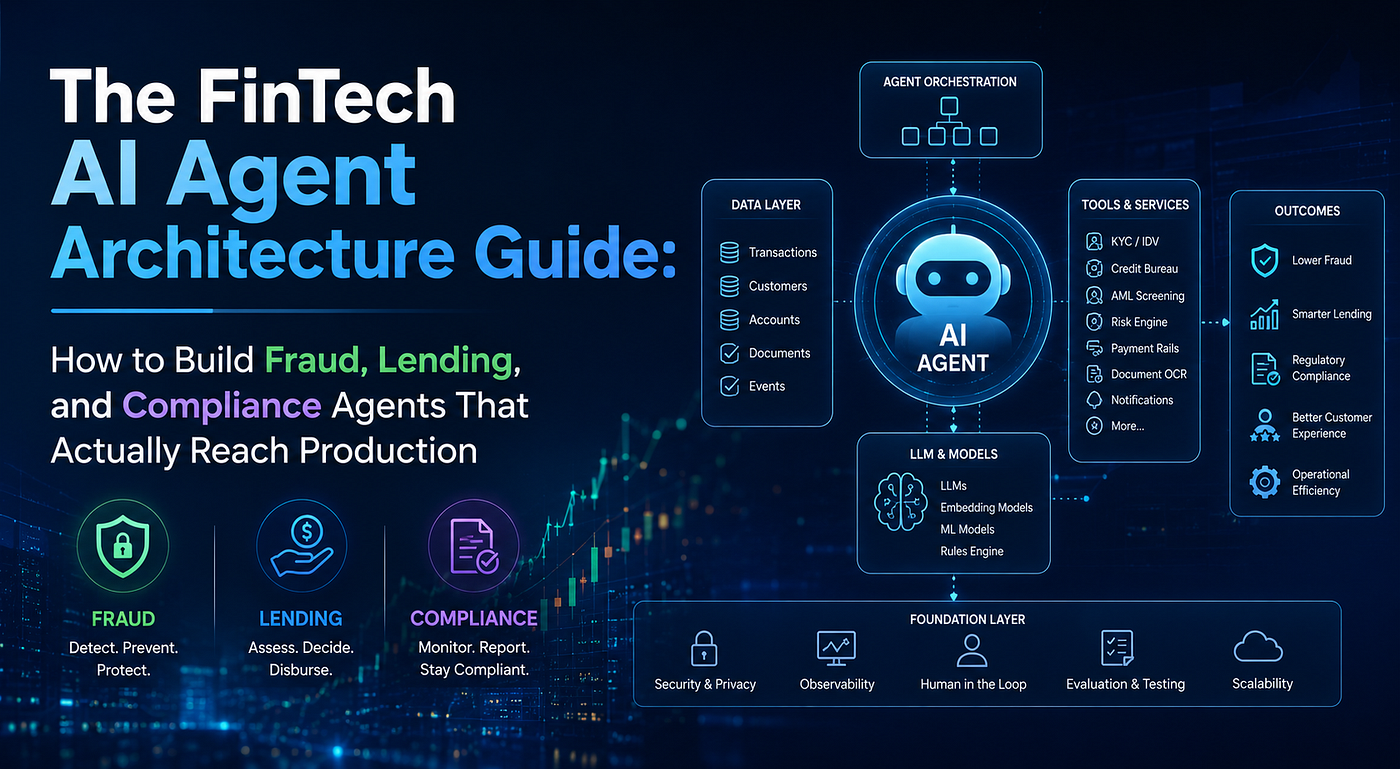
The FinTech AI Agent Architecture Guide: How to Build Fraud, Lending, and Compliance Agents That…
The CTO of a mid-market lending platform spent eight months building an AI underwriting agent. The model was genuinely capable. Tested…
The FinTech AI Agent Architecture Guide: How to Build Fraud, Lending, and Compliance Agents That Actually Reach Production
The CTO of a mid-market lending platform spent eight months building an AI underwriting agent. The model was genuinely capable. Tested against historical loan portfolios, it matched senior underwriter decisions on 91% of cases and outperformed the existing scoring model on thin-file applicants by a meaningful margin. The board approved a production pilot. The compliance team raised one question before it launched: ‘Can you show us exactly why the agent approved or declined each application, in a format our regulators will accept?’
The engineering team did not have a ready answer. The agent’s decision logic was embedded in a transformer architecture that produced outputs without the structured, human-readable decision rationale that the Equal Credit Opportunity Act required for adverse action notices. The model had been built for accuracy. The compliance architecture had not been built at all. The production pilot was delayed six months while the team retooled the agent’s output layer to generate compliant decision rationale alongside each credit decision. The board’s eight-month timeline became fourteen months, and the competitive advantage that had justified the investment had narrowed considerably.
FinTech AI agents fail in production for a category of reasons that has no equivalent in other verticals. The model accuracy problem is real but solvable. The latency problem is real and technically demanding. The compliance architecture problem is the one that stops production deployments — and it is almost always discovered after the agent is built rather than before it, because the engineering teams building FinTech AI agents have deep AI expertise and insufficient compliance architecture experience, or deep compliance expertise and insufficient AI architecture experience, but rarely both. This guide provides the architectural framework for all three use case categories that Codiste’s FinTech engineering practice works with most: fraud detection, lending and credit underwriting, and KYC/AML compliance. For each, we cover the specific technical requirements that distinguish a production-ready agent from a capable prototype.
The FinTech AI Agent Market: Why the Stakes Are Unusually High
The financial services AI agent market operates under conditions that make both the opportunity and the production failure risk larger than in most other industries.
- **$61.6B **projected AI in FinTech market by 2032, growing from $12.2B in 2024 — the investment wave is creating enormous competitive pressure to deploy
- **3–5× **ROI within 18 months documented by FinTech companies implementing AI fraud detection — the financial case is compelling and well-documented
- **90% **reduction in manual underwriting review time when AI handles initial loan application processing — Banco Covalto achieved >90% reduction in credit approval response time
- **73% **of fintech startups that fail cite choosing generic development partners over industry-specific FinTech specialists as a contributing factor — the domain expertise gap is real
- **$8.3B **in fintech fraud losses in 2023, with conventional detection techniques failing against synthetic identities and deepfake attacks — creating the demand for AI-native fraud architecture
The competitive pressure these numbers create is the primary reason FinTech AI agents fail in production: organizations deploy quickly to capture competitive advantage and discover compliance gaps after the agent is live rather than before. The ECOA adverse action notice problem the CTO encountered is not unusual — it is representative of a class of compliance failures that are consistently cited in post-mortem analysis of failed FinTech AI deployments. Building compliance architecture into the agent from the first design session is not overhead. It is the discipline that determines whether the 18-month ROI timeline materializes or the organization spends that 18 months rebuilding an agent that was not production-ready when it launched.
FinTech Agent Architecture 1: Real-Time Fraud Detection
The Sub-100ms Requirement That Defines the Architecture
Fraud detection in payments and transaction processing is the FinTech AI agent use case with the most demanding latency requirement: the agent must assess transaction risk and produce a decision before the transaction completes — typically within 100 to 300 milliseconds of transaction initiation. This latency requirement is not a performance preference. It is an architectural constraint that eliminates a significant portion of the AI approaches that work well for other use cases.
Large language model architectures, which excel at complex reasoning and natural language interaction, typically operate at 500ms to 2,000ms response latency — outside the window for synchronous fraud decision in payment processing. Fraud detection agents that require LLM inference for each transaction decision face an architectural incompatibility with the latency requirements of the use case. The production architecture for real-time transaction fraud scoring uses gradient boosting models (XGBoost, LightGBM) or specialized neural architectures trained for low-latency inference, with LLM agents reserved for the asynchronous investigative functions — fraud ring analysis, case summarization, appeal processing — where latency is not the binding constraint.
Production fraud architecture: fast model for sync decisions, # LLM agent for async investigation class FraudDetectionSystem: def init(self): # Sub-100ms: gradient boost for real-time scoring self.realtime_scorer = LightGBMScorer(latency_budget_ms=80) # Async: LLM agent for complex investigation self.investigation_agent = LLMFraudAgent() def score_transaction(self, txn): # Synchronous path — must complete in <100ms score = self.realtime_scorer.score(txn) if score.requires_investigation: self.investigation_agent.queue(txn) # async return score.decision
Graph Neural Networks for Fraud Ring Detection
The fraud pattern that rule-based systems and standard ML models miss most consistently is the fraud ring — a coordinated network of accounts, merchants, and transaction patterns that appear individually legitimate but are fraudulent in aggregate. Detecting fraud rings requires representing and reasoning about the relationships between entities, not just the features of individual transactions. Graph neural networks are the architectural approach that makes this possible: representing accounts, merchants, devices, and transactions as nodes in a network graph, and using GNN layers to propagate and aggregate relationship signals across the network.
A fraud ring detection agent built on GNN architecture can identify patterns such as: multiple accounts sharing device fingerprints or IP addresses that individually appear legitimate; merchant accounts receiving unusual patterns of small-value transactions from geographically dispersed accounts; and account networks where the timing and amount patterns of transactions suggest coordinated behavior rather than independent activity. These are the patterns that generated $8.3 billion in losses in 2023 from fraud that rule-based systems failed to catch — because rule-based systems reason about individual transactions, not about the network of relationships that reveals coordinated fraud.
Explainability as a Regulatory Requirement
Every fraud decision that results in a customer-facing action — a declined transaction, a blocked account, a required verification step — generates a potential regulatory and customer service interaction that requires the agent’s decision rationale to be explainable in terms a human can understand and defend. In the EU, GDPR Article 22 provides individuals the right to an explanation for decisions made by automated processing. In the US, the Equal Credit Opportunity Act and Fair Credit Reporting Act create similar requirements for credit-related decisions. Fraud detection agents that cannot generate human-readable decision rationale for each decision are not production-ready for regulated financial services, regardless of their accuracy.
The explainability architecture for fraud agents uses SHAP (SHapley Additive exPlanations) values to attribute each model decision to specific input features — ‘this transaction was scored as high risk because the device fingerprint matches 3 previously flagged accounts, the transaction amount is 4.2 standard deviations above this merchant’s normal range, and the billing address does not match the card’s registered address.’ This rationale is generated automatically alongside each decision, stored in the audit log, and surfaced to customer service agents when a customer contacts the institution to dispute a declined transaction.
-> FinTech AI agent development: fraud detection architecture at Codiste
FinTech Agent Architecture 2: Lending and Credit Underwriting
Compressing the Underwriting Timeline from Days to Minutes
Traditional mortgage and commercial lending underwriting involves a human underwriter reviewing 150 to 300 pages of documentation — tax returns, bank statements, employment verification, property appraisal, title search results — against GSE guidelines and the lender’s overlay policies, making conditional approval decisions, and ordering additional documentation when required. The average underwriting decision takes 24 to 72 hours. A lending AI agent trained on GSE guideline requirements, integrated with document ingestion APIs and credit bureau feeds, and designed to match the underwriter’s decision workflow can complete the initial document review and conditional decision in under 30 minutes.
Banco Covalto’s deployment achieved more than a 90% reduction in credit approval response times using AI agents integrated with lending workflow automation. This is not a theoretical benchmark — it is a documented production result from a mid-sized financial institution that made this architecture work at scale. The architectural components that made it work: document understanding models trained on the specific document types in the lending workflow (paystubs, bank statements, tax returns, business financials); decision engines built around the specific guideline sets the institution underwrites against; conditional logic that identifies documentation deficiencies and generates cure requests automatically; and human-in-the-loop workflow design that routes edge cases and above-threshold decisions to senior underwriters with full AI analysis pre-populated.
The Alternative Data Advantage in Credit Scoring
Traditional credit scoring relies on credit bureau data that systematically excludes the 26% of US adults who are credit invisible or have insufficient credit history for reliable scoring. AI lending agents that incorporate alternative data — bank transaction patterns, utility payment history, rent payment data, telco payment records, and business cash flow analytics — can extend credit more accurately to this underserved population without increasing default risk.
The technical architecture for alternative data credit scoring requires: data ingestion pipelines for each alternative data source with appropriate permissioning and consent management; feature engineering that transforms raw transaction data into predictive risk signals; model architectures that appropriately weight alternative data alongside traditional credit bureau signals; and bias monitoring infrastructure that continuously evaluates whether the model’s alternative data features are producing fair outcomes across protected class dimensions. This last requirement is not optional in the US regulatory environment — CFPB guidance on AI lending tools explicitly requires fairness testing and documentation. Building the bias monitoring infrastructure after the model is deployed is significantly more expensive than building it alongside the model.
Alternative data pipeline with bias monitoring class CreditScoringAgent: def score(self, applicant): bureau_features = self.bureau_connector.get(applicant.id) alt_features = self.alt_data_pipeline.get(applicant.id) score = self.model.predict(bureau_features + alt_features) # ECOA-required adverse action rationale if score.decision == ‘decline’: score.adverse_action_reasons = self.explainer.top_reasons(score) # Continuous bias monitoring self.bias_monitor.log(applicant.demographics, score) return score
The ECOA Adverse Action Architecture
The Equal Credit Opportunity Act requires that any adverse action on a credit application — a decline, a counter-offer, a conditional approval — be accompanied by specific, actionable reasons for the decision. These reasons must be provided to the applicant within a defined timeframe and must be specific enough to allow the applicant to understand what factors drove the decision and what they could change to improve their creditworthiness. ‘Model output indicates elevated risk’ is not a compliant adverse action reason. ‘Your debt-to-income ratio of 52% exceeds our maximum threshold of 45%’ is.
The ECOA adverse action architecture for lending agents generates compliant decision rationale as a structured output layer on top of the model’s scoring output. The rationale generation is not post-hoc explanation — it is a designed component of the agent that maps model feature contributions to human-readable ECOA-compliant reason codes and specific factor descriptions. This architecture is built in during the agent design phase, not added as a retrofit after the model is deployed. The CTO whose eight-month project became fourteen months had not built this layer into the initial architecture. The six-month retrofit was spent building what should have been designed from the start.
-> Codiste’s compliance-first approach to lending AI agent architecture
FinTech Agent Architecture 3: KYC/AML Compliance Automation
The 80/20 Routing Architecture
Know Your Customer and Anti-Money Laundering compliance screening is the highest-volume, most structured compliance function in financial services — and the one most suitable for AI agent automation with appropriate human oversight. The key architectural insight for KYC/AML agents is the 80/20 rule: approximately 80% of customer onboarding screening cases are straightforward, with clear screening results and unambiguous risk assessments that do not require human judgment. The remaining 20% involve ambiguous matches, complex ownership structures, politically exposed persons, or elevated risk indicators that require trained compliance analyst review.
The production KYC/AML agent architecture routes these two populations differently. The 80% of clear-pass cases are processed autonomously by the agent, completing screening, generating the compliance documentation, and updating the customer record without any analyst involvement. The 20% of complex cases are enriched by the agent — screening results assembled, entity resolution performed, adverse media collected, risk indicators summarized — and presented to a compliance analyst with all relevant context pre-populated. The analyst reviews the agent’s work and makes the final determination. This architecture makes the analyst’s time available for the cases that genuinely require their expertise while the routine case volume is handled automatically.
Entity Resolution at Scale
The most technically demanding component of KYC/AML agent architecture is entity resolution — the process of determining whether the name in a customer application matches a name on a sanctions list, a politically exposed persons list, or an adverse media database, accounting for transliteration variations, spelling differences, name order differences across cultures, and partial name matches. A rule-based system that requires exact name matches generates false negatives (missing actual matches) and a fuzzy match system with low thresholds generates false positives (flagging legitimate customers) at rates that make either approach operationally unworkable at scale.
AI-powered entity resolution uses trained NLP models that understand name equivalence across languages, transliteration schemes, and cultural naming conventions. The model produces a match confidence score for each potential match, along with the specific evidence supporting the match determination. This confidence score is the primary routing variable: high-confidence no-match cases are cleared automatically; high-confidence match cases are escalated immediately; ambiguous cases in the middle confidence range are routed to analyst review with all matching evidence presented for human determination. The confidence threshold calibration is itself a compliance decision — setting it too low creates operational overhead from excessive analyst review; setting it too high creates compliance risk from missed matches.
⚠ CALIBRATION REQUIREMENT: KYC/AML confidence thresholds must be tuned against your specific customer population, not vendor benchmarks. Threshold calibration is a compliance function, not an engineering optimization — involve your compliance team in setting and reviewing thresholds before production deployment.
Audit Trail Architecture for Regulatory Examination
KYC/AML programs are subject to regulatory examination that requires demonstrating, for each customer onboarding decision, exactly what screening was performed, what results were returned, what risk assessment was made, who reviewed the case and when, and what documentation supported the decision. An AI agent that performs this screening without generating complete, tamper-proof audit records of its actions is not compliant regardless of how accurate its screening decisions are.
The audit trail architecture for KYC/AML agents records every agent action as a structured log event: the screening sources queried, the queries submitted, the results returned, the confidence scores assigned, the routing decision made, and if applicable the analyst who reviewed and the determination they reached. These log events are written to an immutable audit store with cryptographic integrity protection, retained for the period required by applicable regulations (typically 5 to 7 years), and organized for efficient retrieval by regulators who may request documentation of specific customer decisions during examination. This audit infrastructure is not optional and should be designed before any agent screening logic is built.
-> agent architecture and compliance documentation framework at Codiste
The 3 Production Failure Modes Unique to FinTech AI Agents
Failure Mode 1: Model Drift in Dynamic Fraud Environments
Fraud patterns evolve continuously as fraudsters adapt their techniques in response to detection. A fraud model trained on historical patterns that is not continuously updated will experience accuracy degradation over time as the attack patterns it was trained to detect become less prevalent and new attack patterns emerge that it has not been trained on. This model drift is predictable and documented — research on fraud detection model performance shows meaningful accuracy degradation within 3 to 6 months of deployment without active retraining.
The production architecture for fraud agents includes continuous learning infrastructure: regular model retraining on recent transaction data, including newly confirmed fraud cases and feedback from analyst review of borderline cases; drift detection monitoring that alerts when the model’s precision-recall performance begins to degrade below threshold; and version management that allows rapid model rollback if a new model version underperforms in production. Organizations that deploy fraud agents without this continuous learning infrastructure are deploying a capability that will degrade predictably over time.
Failure Mode 2: Regulatory Guideline Updates in Lending Agents
Lending underwriting guidelines change — GSE guidelines update, the institution’s overlay policies evolve, new regulatory requirements add documentation or eligibility criteria. A lending agent trained on guidelines as of its deployment date and not updated when guidelines change is an agent that makes decisions against outdated criteria. This is not a theoretical risk. GSE guidelines update multiple times per year. An institution running a lending agent that is not updated with guideline changes is making loan decisions against incorrect standards, creating both regulatory exposure and fair lending risk.
The production architecture for lending agents includes guideline version management: the agent’s decision engine is parameterized against a versioned guideline specification that can be updated independently of the underlying model; guideline updates are tested in a staging environment against historical loan portfolios before deployment; and the agent’s decision audit trail records which guideline version was applied to each loan decision, enabling retroactive review if a guideline error is discovered. This architecture makes guideline updates a controlled operational process rather than an engineering project that disrupts production.
Failure Mode 3: Sanctions List Latency in KYC/AML Agents
Sanctions lists are updated continuously by OFAC and international sanctions authorities. An agent screening against a cached list that is hours or days behind the current version is an agent that may fail to detect a newly designated entity. Financial institutions are required to screen against current sanctions lists — running a KYC/AML agent against a stale list creates regulatory exposure even if the underlying screening technology is sophisticated.
The production architecture for KYC/AML agents uses real-time sanctions list feeds rather than periodic batch downloads: OFAC and relevant international sanctions databases are accessed via API at the time of each screening, ensuring the agent is always screening against the current list. Where real-time API access is not available from a specific list provider, the list update frequency and the screening timing are designed so that the gap between list update and agent availability never exceeds the institution’s regulatory tolerance, typically less than 4 hours for high-risk screening contexts.
-> Talk to Codiste’s FinTech AI engineering team about your production deployment
Compliance Architecture Is Not a Constraint. It Is the Moat.
The CTO whose lending agent took fourteen months to reach production instead of eight did not lose those six months to bad engineering. The model was well-built. The loss came from a compliance architecture that was not designed into the system from the beginning — an ECOA adverse action rationale layer that had to be retrofitted into an agent architecture that had not been designed to accommodate it.
The FinTech AI agents that Codiste’s engineering team ships — fraud detection agents with sub-100ms scoring and SHAP explainability, lending agents with ECOA-compliant decision rationale and bias monitoring, KYC/AML agents with 80/20 routing and immutable audit trails — are built to compliance requirements from the first architecture session. Not because compliance is a constraint on what the agent can do, but because compliance architecture is the differentiator that makes FinTech AI agents valuable in production rather than capable in a prototype.
The financial institution that deploys a fraud agent with regulatorily defensible explainability has a competitive moat that the institution deploying an accurate-but-opaque model cannot match — because the explainable agent can be used across all customer-facing decision workflows, and the opaque model cannot. The lending platform with ECOA-compliant adverse action rationale can scale its AI underwriting to every loan type and customer segment. The platform that retrofitted compliance post-deployment is managing the risk of the decisions made in the gap between deployment and retrofit. Compliance architecture is not the cost of FinTech AI deployment. It is the investment that makes production-scale deployment possible.
Building a FinTech AI agent that needs to be production-ready from day one? Talk to Codiste’s FinTech engineering team before architecture decisions are made ->
메타데이터
- post_id
- 688ef0dd563f
- slug
- the-fintech-ai-agent-architecture-guide-how-to-build-fraud-lending-and-compliance-agents-that-688ef0dd563f
- url
- https://medium.com/@yash.p_60148/the-fintech-ai-agent-architecture-guide-how-to-build-fraud-lending-and-compliance-agents-that-688ef0dd563f
- canonical_url
- https://medium.com/@yash.p_60148/the-fintech-ai-agent-architecture-guide-how-to-build-fraud-lending-and-compliance-agents-that-688ef0dd563f
- author_url
- https://medium.com/@yash.p_60148
- status
- ok
- fetched_at
- 2026-06-28 04:42:08





