Florida Homeowners Should Vote With Clear Eyes on the November Property Tax Amendment
The proposed homestead exemption offers real relief, but it does not eliminate all property taxes, and Florida voters should understand…
Florida Homeowners Should Vote With Clear Eyes on the November Property Tax Amendment
The proposed homestead exemption offers real relief, but it does not eliminate all property taxes, and Florida voters should read the details before November.
Florida homeowners are heading toward one of the most important property tax votes in many years.
In November 2026, Florida voters are expected to decide whether to approve a constitutional amendment that would greatly expand the Florida homestead exemption. Like all Florida constitutional amendments, it will need 60% voter approval to pass.
My view is simple.
This bill is beneficial for many Florida homeowners. It is especially beneficial for those who already live here, already own their home, and already have a Florida homestead exemption.
But it is not a clean, total elimination of property taxes.
This is real tax relief.
It is not magic.
It is not total abolition.
It is not a free home forever.
Before my Florida neighbors vote, they should understand what this amendment does, what it does not do, and what may come next.
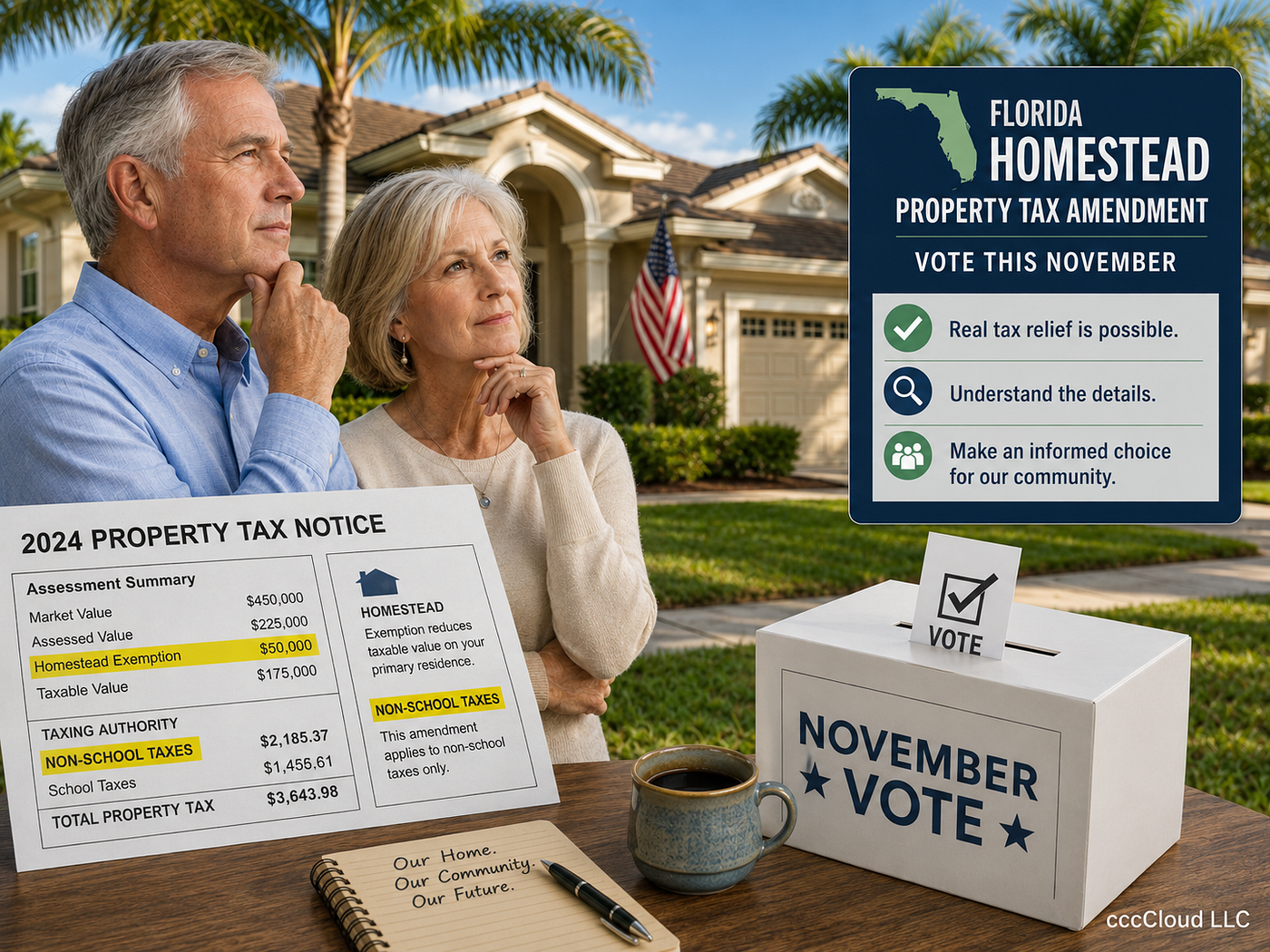
OpenAI DALL-E3 by Author
The Good: Real Relief for Existing Florida Homeowners
The central benefit is straightforward.
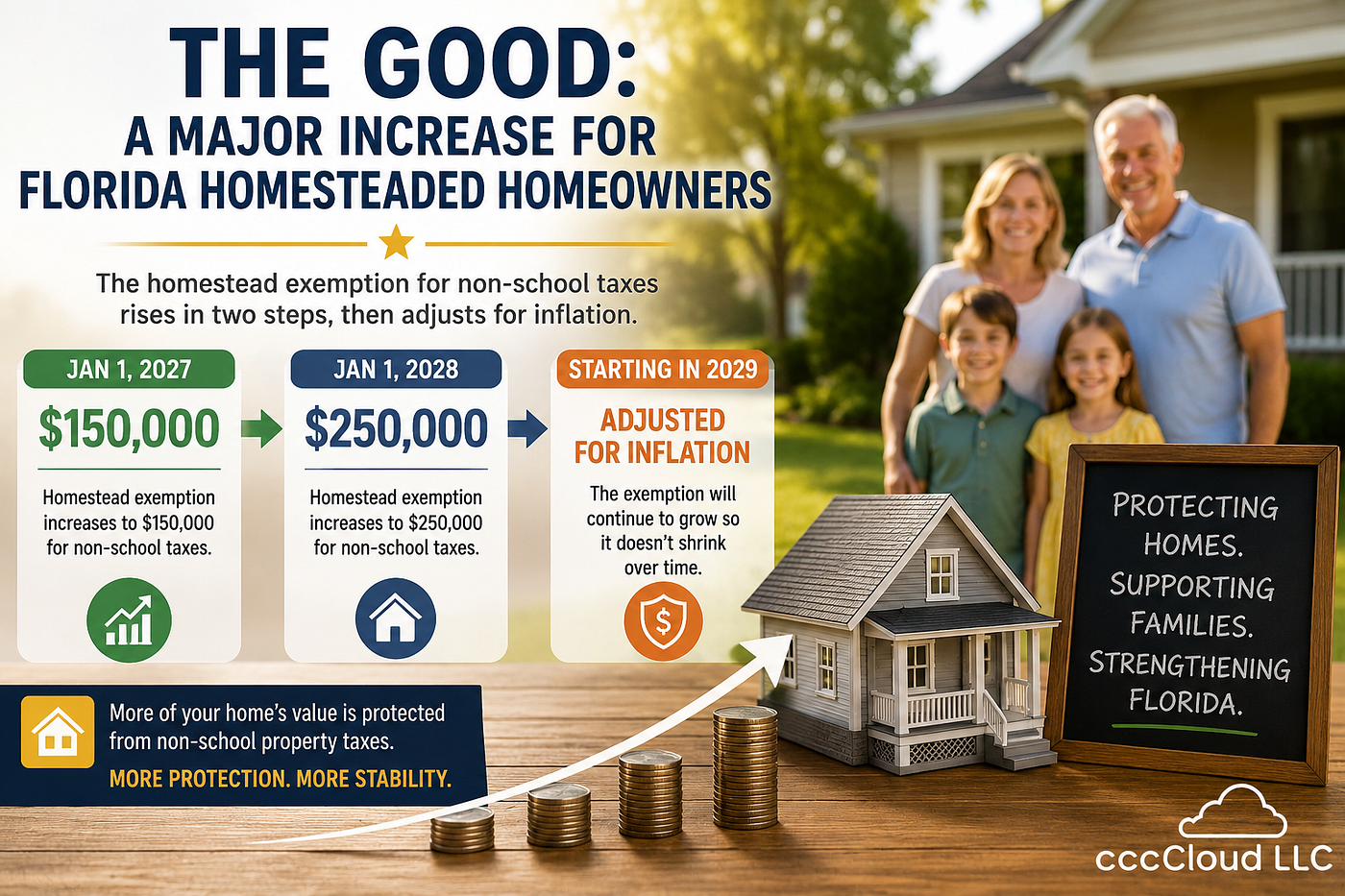
If the amendment passes, the homestead exemption for non-school property taxes would increase in two major steps.
In 2027, the exemption would rise to $150,000.
In 2028, the exemption would rise to $250,000.
Starting in 2029, that exemption would also adjust for inflation.
That matters.
For decades, homeowners have watched the cost of ownership rise. Insurance has gone up. Maintenance has gone up. Utilities have gone up. HOA fees have gone up. Food has gone up. Everything connected to daily life has become more expensive.
Property taxes are one more weight on the back of the homeowner.
For many Florida residents, especially long-time homeowners and retirees protected by Save Our Homes, this amendment could sharply reduce the non-school portion of the property tax bill. For some homeowners, the non-school portion could eventually fall to zero.
That is no small thing.
A home should not feel like rented ground from the government.
A person who worked, saved, bought a home, paid the mortgage, maintained the property, and built a life should not be slowly priced out by rising taxes.
That is the moral center of this amendment.
Florida should protect homeowners, especially those who have planted roots here.
OpenAI DALL-E3 by Author
The Catch: School Taxes Are Not Eliminated
Now comes the part every homeowner must understand.
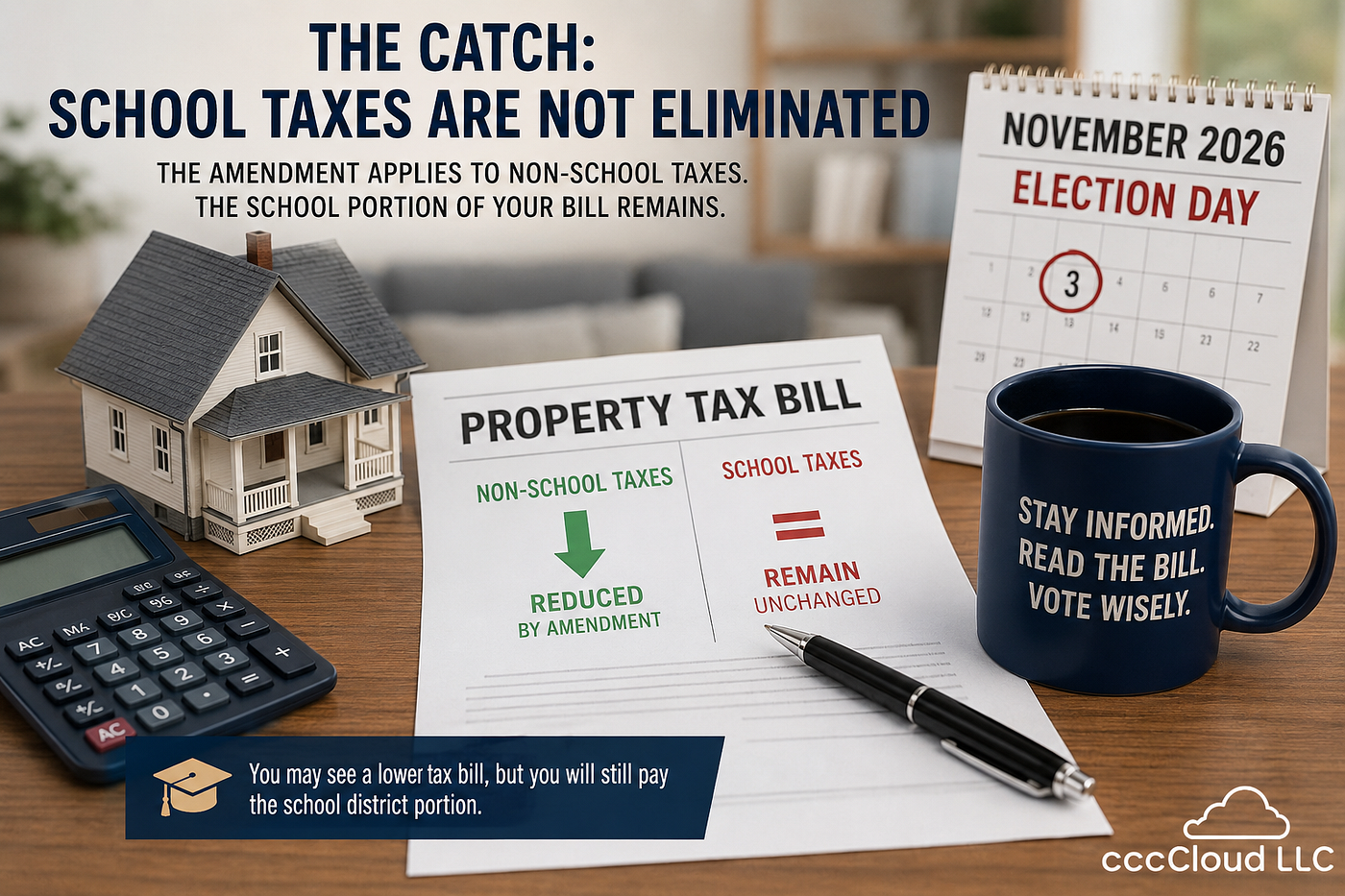
This amendment does not eliminate all property taxes.
It applies to non-school property taxes.
That phrase expresses the whole truth.
The school district portion of the property tax bill remains. It does not disappear under this amendment. Even if the county, city, and other non-school ad valorem taxes are greatly reduced or eliminated, the school portion remains.
So when someone says, “Florida is getting rid of property taxes,” that is not accurate.
The better statement is this:
Florida may greatly reduce or eliminate the non-school property tax burden for many homesteaded homeowners.
That is still satisfactory
That is still meaningful.
But it is not the same thing as a zero property tax bill.
For many homeowners, the school tax portion is a large part of the total property tax bill. Depending on where you live, it can represent a third or more of the annual bill.
So even if this amendment passes, homeowners should still expect a tax bill.
It may be smaller.
It may be much smaller.
But it will not be zero.
OpenAI DALL-E3 by Author
Existing Residents Benefit More Than New Residents
There is another major issue: timing.
If you already have a Florida homestead exemption established by the end of 2026, you are in the best position.
But if someone establishes Florida homestead status on or after January 1, 2027, that homeowner may have to wait five years before receiving the full new exemption.
That creates a hard line in the sand.
Two neighbors could live on the same street, in similar homes, with similar assessed values. One established homestead in 2026. The other was established homestead in 2027. The first homeowner may receive the new benefit much sooner. The second homeowner may have to wait five years.
That may seem harsh, but I understand why it was written that way.
Florida does not want to create a rush of new arrivals who move here only to immediately receive the largest tax benefit while long-term residents carry the history and cost of the state.
This amendment is aimed first at permanent Florida homeowners who are already here.
That does not make the waiting period painless.
But it does make the political logic clear.
Anyone thinking about moving to Florida should pay close attention. Establishing Florida residency before the deadline may become financially important.
The Investor and Rental Property Provision
This amendment is not only about homesteaded homeowners.
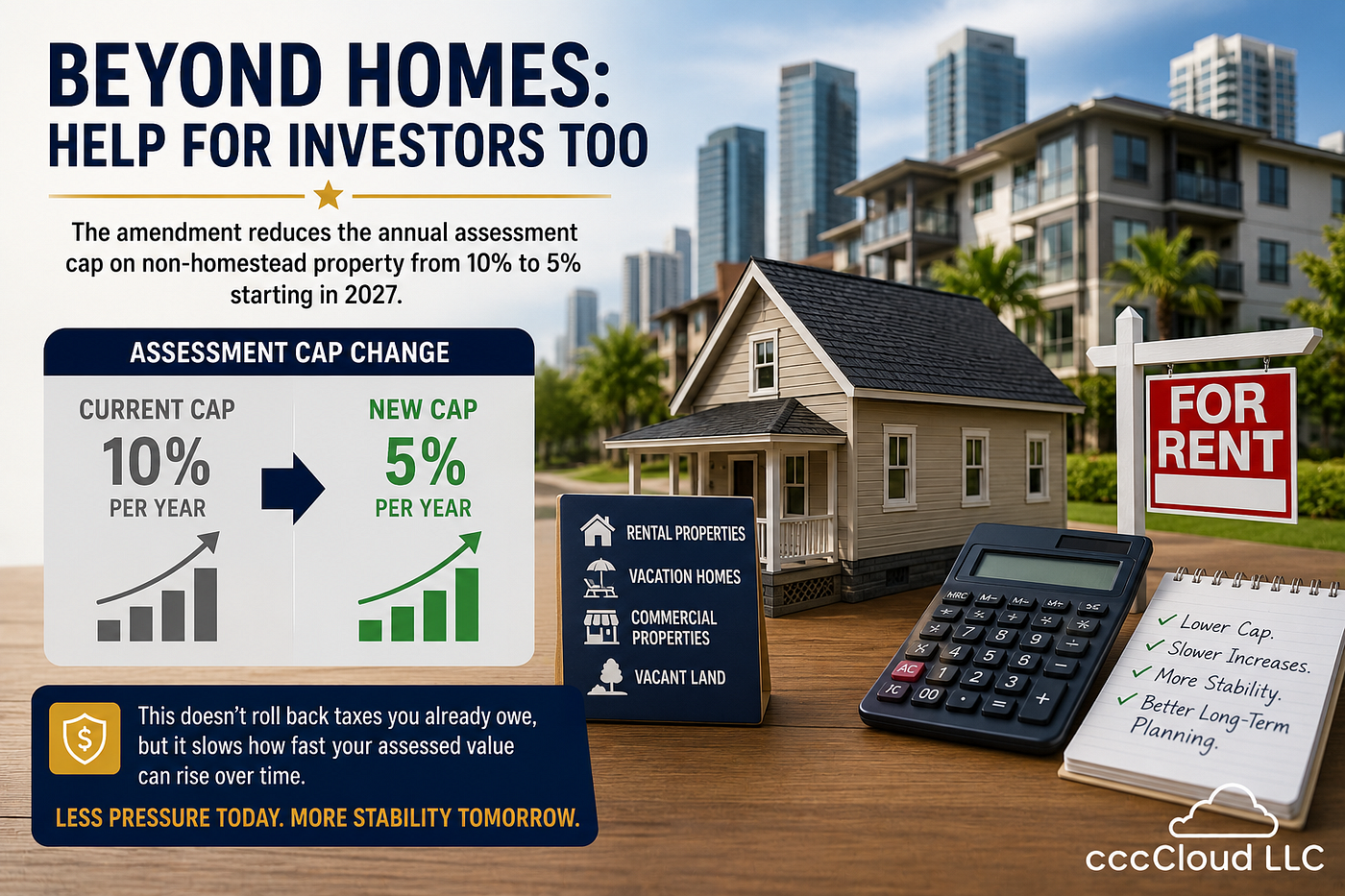
It also helps owners of non-homestead property by reducing the annual assessment cap from 10% to 5%.
That includes rental properties, vacation homes, commercial property, and vacant land.
This does not roll back taxes already owed.
It does not create an immediate tax cut.
But it does slow how fast assessed value can rise in the future.
For long-term property owners, that matters. A lower annual cap can create better planning, more stability, and less future tax pressure.
For renters, however, the picture is less clear.
The amendment appears to leave room for the Legislature to provide renter relief, but that is not the same as a guarantee.
Homeowners receive a constitutional benefit.
Renters receive a possible future political benefit.
That distinction matters.
And here is my concern. If local governments lose revenue from homesteaded properties, they may look harder at commercial property, rental property, special assessments, and fees. If landlords face higher operating expenses elsewhere, some of that pressure may eventually show up in rent.
That is not a reason by itself to reject the amendment.
But it is a reason to tell the truth.
A tax cut in one place often creates pressure somewhere else.
OpenAI DALL-E3 by Author
The Local Government Problem
This section is where the amendment becomes more complicated.
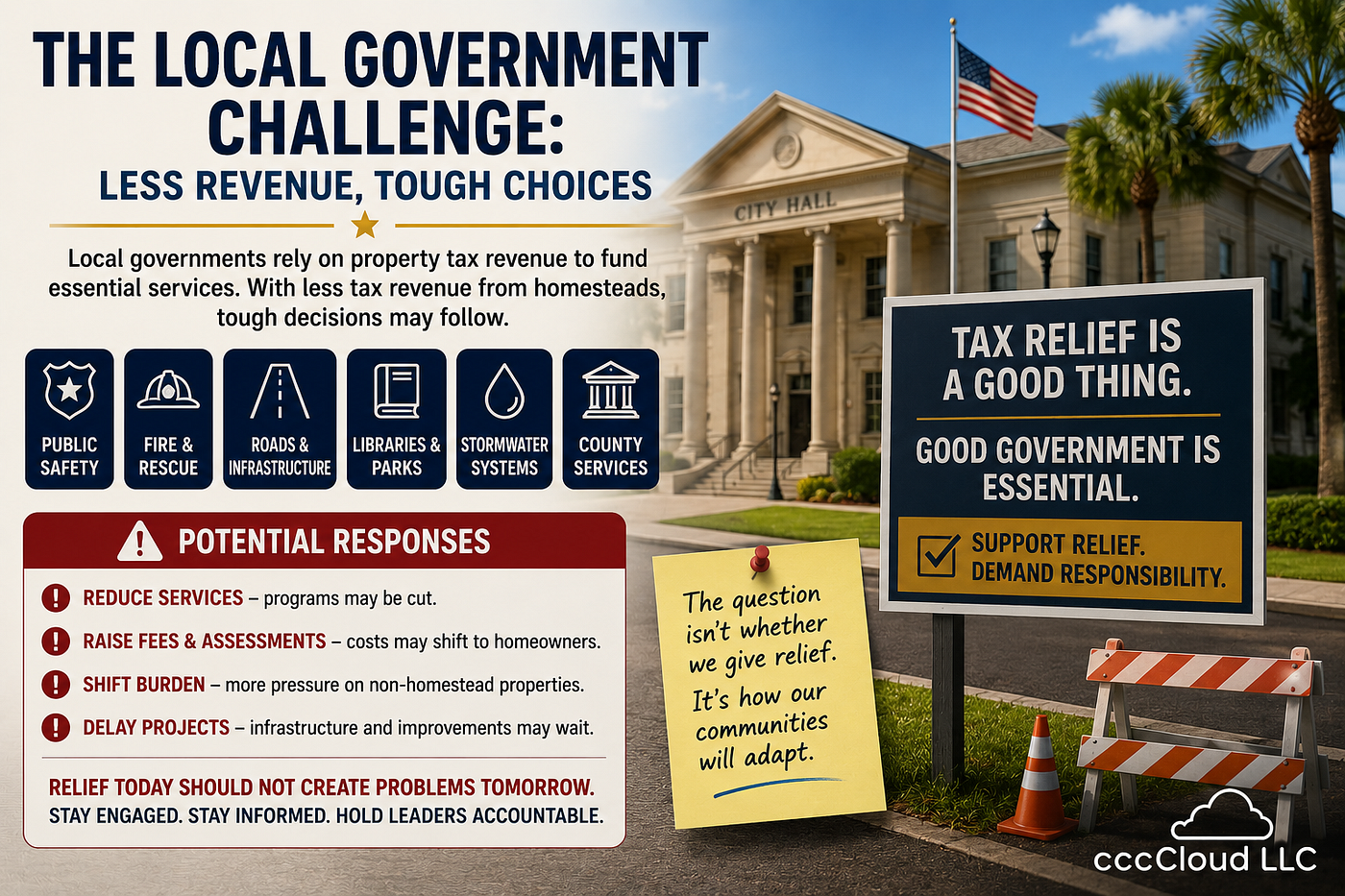
Counties, cities, and local taxing authorities rely on property tax revenue to fund basic services.
Police.
Fire rescue.
Emergency medical response.
Roads.
Drainage.
Libraries.
Parks.
County operations.
Infrastructure.
Those services do not fund themselves.
Now, some people will say, “Excellent, let local governments cut waste.”
I agree with that to some extent.
Government at every level has become far too comfortable spending other people’s money. Property taxes rise. Assessments rise. Budgets grow. Citizens complain for a season and then the process repeats.
That is not healthy government.
That is slow extraction.
But I also believe in telling the whole truth.
There are real services that must continue. Fire rescue must show up. Police must show up. Stormwater systems must work. Roads must be maintained. Local government cannot simply disappear.
So the real question is not whether homeowners deserve relief.
They do.
The real question is whether local governments will respond by cutting waste and prioritizing essential services, or whether they will quietly replace lost property tax revenue with higher fees, assessments, and other charges.
That is where citizens must remain awake.
OpenAI DALL-E3 by Author
Watch the Bottom Line, Not Just the Headline
One of my biggest concerns is what I call the fee back door.
A homeowner may see the property tax line go down but later see other charges rise.
Fire assessments.
Stormwater fees.
Solid waste charges.
Special district assessments.
Local service fees.
These charges may appear on the same tax bill, but they are not always treated the same way as property taxes based on value. The new homestead exemption may not protect homeowners from them.
That is why homeowners should not celebrate by looking at only one line on the bill.
Look at the total amount due.
That is the number that matters.
If property taxes go down by $1,000 and fees rise by $300, the homeowner still wins.
If property taxes go down by $1,000 and fees rise by $900, the homeowner barely wins.
If property taxes go down by $1,000 and fees rise by $1,200, the homeowner loses while the politicians still claim victory.
That is not cynicism.
That is arithmetic.
The Larger Question: Do We Own Our Homes or Rent Them From the State?
At the heart of this amendment is a more profound question.
What does it mean to own a home?
For generations, homeownership represented stability. A family could work, save, buy a home, raise children, improve the property, retire, and pass something down.
That was the American promise.
Not luxury.
Not speculation.
Just rooted life.
But when property taxes rise forever, ownership becomes conditional.
You may hold the deed, but if the government can increase the carrying cost year after year until you can no longer afford to remain, then ownership has been weakened.
That is especially challenging for seniors.
A retired homeowner cannot always go out and earn more money because the county budget increased. A widow cannot always absorb another assessment. A fixed-income household cannot simply create new income because the government created new spending.
That is why I support the direction of this amendment.
It moves Florida toward protecting homeowners from being taxed out of their homes.
That is the right direction.
But the right direction still deserves honest scrutiny.
My Position
I believe this amendment is worth serious support, especially for existing Florida homesteaded homeowners.
It is not perfect.
It does not eliminate all property taxes.
It does not touch school taxes.
It may create pressure on local government budgets.
It may lead to higher fees and assessments.
It provides renters no guaranteed protection.
It leaves future implementation details in the hands of the Legislature.
Those are real concerns.
But here is the other side.
A “no” vote does not create a better bill.
A “no” vote does not force Tallahassee to return with a cleaner, stronger, more effective plan for property tax reform.
A “no” vote may simply preserve the current system, where property taxes continue to rise and homeowners continue to bear the burden.
This amendment provides Florida homeowners meaningful relief.
It places a larger portion of the homestead beyond the reach of non-school property taxes.
It indexes that protection for inflation.
It begins to restore the principle that a primary residence deserves special protection.
That matters.
Final Thought for My Florida Neighbors
Do not vote based on slogans.
Do not vote based on fear.
Do not vote based on some political mailer that tells only half the story.
Understand the difference between school and non-school taxes. Know whether you are already homesteaded. Watch what your county and city say they may do next. And after the amendment passes or fails, keep watching your local government.
Because the fight does not end in November, it continues beyond that month.
If this amendment passes, the next fight will be implementation.
The next fight will be fees.
The next fight will be whether local government cuts waste or simply changes the name of the charge.
My view is this:
Florida homeowners deserve relief.
Existing homesteaded residents deserve protection.
Seniors should not be taxed out of homes they spent a lifetime earning.
But voters should walk into November with their eyes open.
This amendment is not everything promised.
But it is something real.
And in government, something real is often worth taking, provided we do not stop watching the people who write the next chapter.
Reference, Membership, and Support
Here is the link to the original **Bitcoin White Paper**.
Become a Medium member and read more stories from **MP Di Fulvio**.
For disciplined Bitcoin accumulation, consider Dollar-Cost-Average Bitcoin through **DCA-SWAN**.
Professional Bitcoin technical services are available through **cccCloud LLC** to help Bitcoin users better understand purchasing, accumulation strategy, self-custody, wallet setup, hardware-wallet security, node usage, and long-term protection of their Bitcoin.
Bitcoin contributions may be sent using the following Silent Payments address:
sp1qqdu0agkd6hntv4az88q5y76gkl4qdgxp6na2x8ncwa8nsgjh9uyqxqagnakr6avuzf5qqz238lkgyj8rpkzuxhat9aujr35h0a32vv0xmc59me9p
“This content is for informational and educational purposes only. It is not financial, legal, medical, tax, or investment advice. I am not a licensed financial advisor, attorney, physician, or securities professional. My work is based on protocol-level technical analysis, systems engineering, security research, and Bitcoin/blockchain experience. Verify independently, use sound judgment, and consult qualified professionals before making major decisions.”
메타데이터
- post_id
- 68963503caea
- slug
- florida-homeowners-should-vote-with-clear-eyes-on-the-november-property-tax-amendment-68963503caea
- url
- https://medium.com/@miked348/florida-homeowners-should-vote-with-clear-eyes-on-the-november-property-tax-amendment-68963503caea
- canonical_url
- https://medium.com/@miked348/florida-homeowners-should-vote-with-clear-eyes-on-the-november-property-tax-amendment-68963503caea
- author_url
- https://medium.com/@miked348
- status
- ok
- fetched_at
- 2026-07-25 23:49:38