Alphaville (1965): The Future That Has Already Arrived
Take a popular B-movie actor, steal the character he usually plays, tell the producer he’s getting another installment of his hero’s…
Alphaville (1965): The Future That Has Already Arrived
Take a popular B-movie actor, steal the character he usually plays, tell the producer he’s getting another installment of his hero’s adventures. Then, in a fit of reckless improvisation, make an artistic masterpiece that, sixty years later, looks like a charming yet bleak prophecy. That is Jean-Luc Godard’s Alphaville.
Alphaville is Godard’s madness. And even the way it was made feels like a headlong raid without a map. A fictitious treatment so the backers wouldn’t quite grasp what was happening, and simply an actor under contract. Eddie Constantine was then at his peak. European cinemas — especially German ones, which largely financed the film — must have expected something else; unaccustomed to this kind of humor, they were likely puzzled by the final result. The character Constantine usually played, Lemmy Caution, belongs to commercial cinema wrapped in noir. By 1965, when Godard undertakes his film, Constantine is a middle-aged man, his face bearing the marks of what Caution consumes in excess: cigarettes and whisky. A perfectly roughened voice.
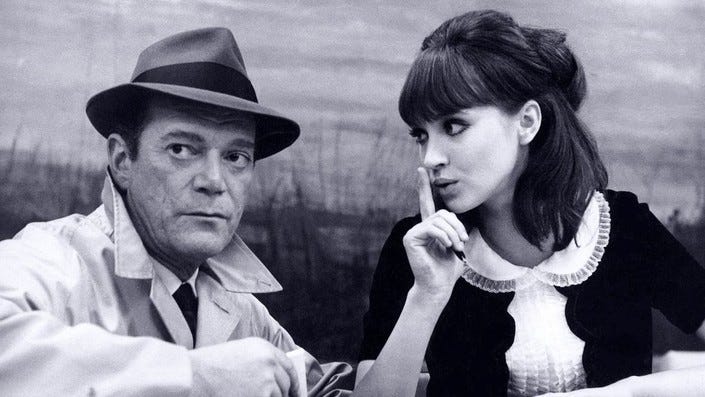
Even in the title, Jean-Luc Godard signals that this is another adventure of Lemmy Caution. And indeed, he conducts it in his own way. The story unfolds in the future. Caution represents the “outer countries,” as Godard calls them, and arrives in Alphaville with two objectives: to find a missing agent, Henry Dickson, and to capture Professor von Braun, also known as Leonard Nosferatu, who designed the computer Alpha 60 that governs the city.
We are thus transported into a dystopian world in which the computer created by von Braun controls the city. And although Braun appears to be the dictator, he is in fact only the executor of the machine’s commands — this machine being, by the standards of the 1960s, an image of artificial intelligence. In Alphaville, everything must be clean and logical, stripped of emotion, and a crucial element of governing the city is the control of language, in which words expressing feelings, metaphors, and poetry are forbidden.
The unruly and the unfit are offered the option of suicide; if they refuse, a special tribunal sentences them to death. Executions take place in a swimming pool: the condemned is first shot with a rifle, then falls into the water, where he is finished off with knives by beautiful women in bathing suits. This is, in fact, one of the most striking elements of this dystopia, in which beautiful women abound, led by von Braun’s daughter, Natacha (Anna Karina, of course).
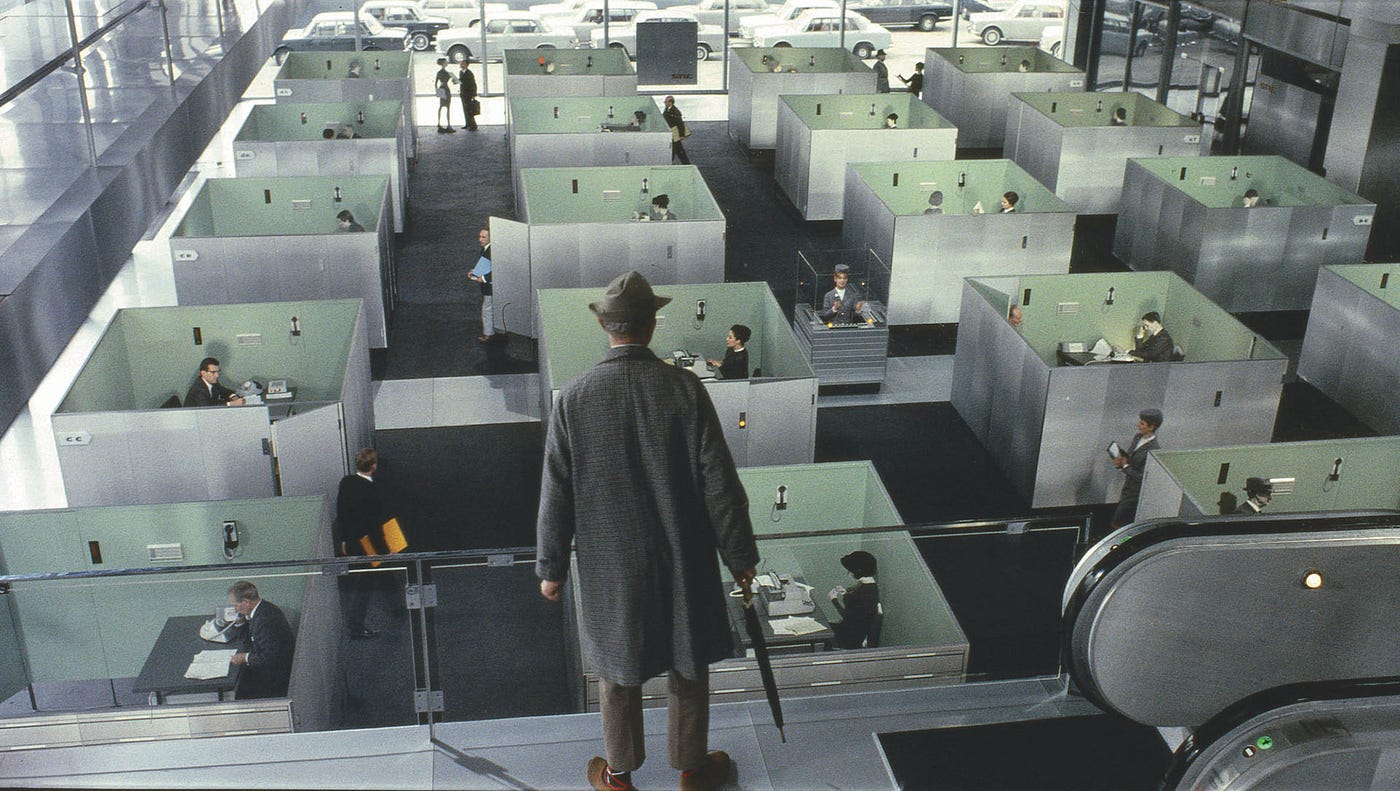
This city of the future is, at the same time, stripped of the usual trappings of science fiction. Godard films in contemporary Paris, mostly at night, playing with light and darkness, and drawing heavily on Journey to the End of the Night by Céline. This is not Lang’s Metropolis (1927), because Godard tells us: the future is already here.
He simultaneously reverses the utopia of H. G. Wells, familiar from *Things to Come*. There, technology and the enlightened scientist bring peace and freedom; logic is not tyranny, and machines do not dehumanize the world. In Godard, by contrast, the professor-engineer, with the telling name von Braun — an obvious reference to the Nazi rocket scientist — is the despotic executor of a soulless machine’s decisions.
Godard, in fact, refers here to two masterpieces at once. That Things to Come is one of them is clear. But the other, more significant aesthetically, is The Testament of Dr. Mabuse (1933) by Fritz Lang.
Mabuse, known from Lang’s earlier film, is now confined to a psychiatric hospital, where he subjugates the doctor. Through him, he spreads chaos and crime, writing instructions on paper and thus sketching out the plan of a thousand-year empire of crime. What matters is that, sunk in catatonia, Mabuse writes with perfect logic, while from his mouth emerges only a hoarse babble — yet one capable of possessing others and becoming their inner voice. This is almost literally carried over into the voice of the computer Alpha 60 in Godard’s film: an old, diseased voice that issues commands.
Fritz Lang shot his film just before the rise of the Third Reich and was unable to premiere it because of the Nazi ban — an element that becomes crucial in the case of Alphaville. Jean-Luc Godard sets up a barricade: on one side, the machine, logic, tyranny, and German Nazism; on the other, the noir hero, emotion, conscience, and poetry. As if Godard had forgotten that Joseph Goebbels, too, loved poetry.
This is not an incidental remark. One may read the film in a somewhat schoolgirl fashion: that poetry is the best form of resistance against totalitarian power. Such a reading stems from the fact that the idea of poetry appears almost magical to us. But to rise above this, one must ask what role poetry actually plays in the film.
The crucial moment is the confrontation with Alpha 60 in the hotel: Lemmy Caution recites fragments of Paul Éluard (Capitale de la douleur), and then poses a classic paradox (paraphrase): “Why do men never change, even though their past is a future that closes in on itself?” Lemmy believes that if he presents the algorithm with a paradox, it will loop and thereby destroy itself. It is not poetry as such that matters here, nor what it carries, but rather the indeterminacy that arises from paradox.
The greatest weakness of man in relation to the machine — the illogical nature of human beings — is at the same time his greatest strength. An old, half-drunk detective who shoots before he thinks prevails over the brilliant Professor von Braun.
And yet this still remains a naïve reading, and in that form it is false. It is as crude as the opposing utopia, the faith in technology and in professors in the Wellsian mold. It ceases to be so once we fully grasp that Godard is not sketching any vision of the future, nor any distant totalitarian system. By filming in his own Paris, in his own time, without the apparatus of science fiction, as we have already noted, he says that the future is now, that the world he shows already exists. This technological totalitarianism is a present condition.
When he made the film, France was undergoing rapid modernization, building its first high-rises and working on its own jet aircraft. But unlike the later mannerisms of New Wave filmmakers, Godard does not place political commentary in the mouths of his characters. His diagnosis is far deeper and concerns the human condition. At one point, Lemmy even quotes Bergson almost directly, revealing the director’s intention: “I believe in the immediate data of consciousness.”
The true message of the film is, in essence, a conservative diagnosis. It tells us that modernization, once it moves beyond the sphere of a useful tool and becomes a discourse, carries within it a totalitarian logic, and that it rests on the manipulation of language. This means that, in the name of modernization and of creating a happy man within modernity, a vast operation is carried out on language, eliminating from its vocabulary the words that are not useful for the realization of the social project. These words are essential for consciousness. Godard plays here with the ambiguity of conscience, which means both consciousness and moral conscience — two realities inaccessible to machines.
Godard does not defend poetry as a magical elixir, nor conscience as a universal virtue. He shows that modernization as a total discourse must first kill conscience — that irreducible unity of awareness and moral judgment which allows man to say: I am, I love, and above all, why. Without it, what remains is only an obedient function, an anonymous cog in the system. That is why Lemmy does not win through revolution; he wins through a fragile, momentary return to being a subject who feels and who questions.
One can put it more starkly. Godard does not warn against totalitarianism, because how can one warn against what is already visible? What he really says is this: modernization as discourse is totalitarianism. It is the moment when man, instead of defining his own emotional states, his fundamental values, and that essential uncertainty, accepts that some of his natural instincts may be deemed unmodern, treated as errors the machine does not tolerate, and thus fit for deletion — like the condemned in the execution scene.
One could end the interpretation here, or, to remain fashionable, draw analogies with contemporary tools of artificial intelligence and say that Godard’s vision has become even more striking and true. One could, perhaps one should.
I will end, however, with Lemmy’s words: Go to hell with your logic.
If you enjoyed this essay, consider supporting my work — a coffee is always welcome.
I invite you to visit my French blog. My texts are also translated into Polish by a prestigious “Wszystko co najważniejsze.”
메타데이터
- post_id
- 68acbb17423d
- slug
- alphaville-the-future-that-has-already-arrived-68acbb17423d
- url
- https://medium.com/its-only-a-movie/alphaville-the-future-that-has-already-arrived-68acbb17423d
- canonical_url
- https://medium.com/its-only-a-movie/alphaville-the-future-that-has-already-arrived-68acbb17423d
- author_url
- https://medium.com/@margotrousseaucliqouet
- status
- ok
- fetched_at
- 2026-06-13 09:11:36