CrewAI vs OpenAI Agents SDK: Which Agent Framework Wins?
One framework thinks like a team. The other thinks like a developer. After building production AI systems with both, here’s where each one…
CrewAI vs OpenAI Agents SDK: Which Agent Framework Wins?
One framework thinks like a team. The other thinks like a developer. After building production AI systems with both, here’s where each one shines and where each one quietly gets in your way.
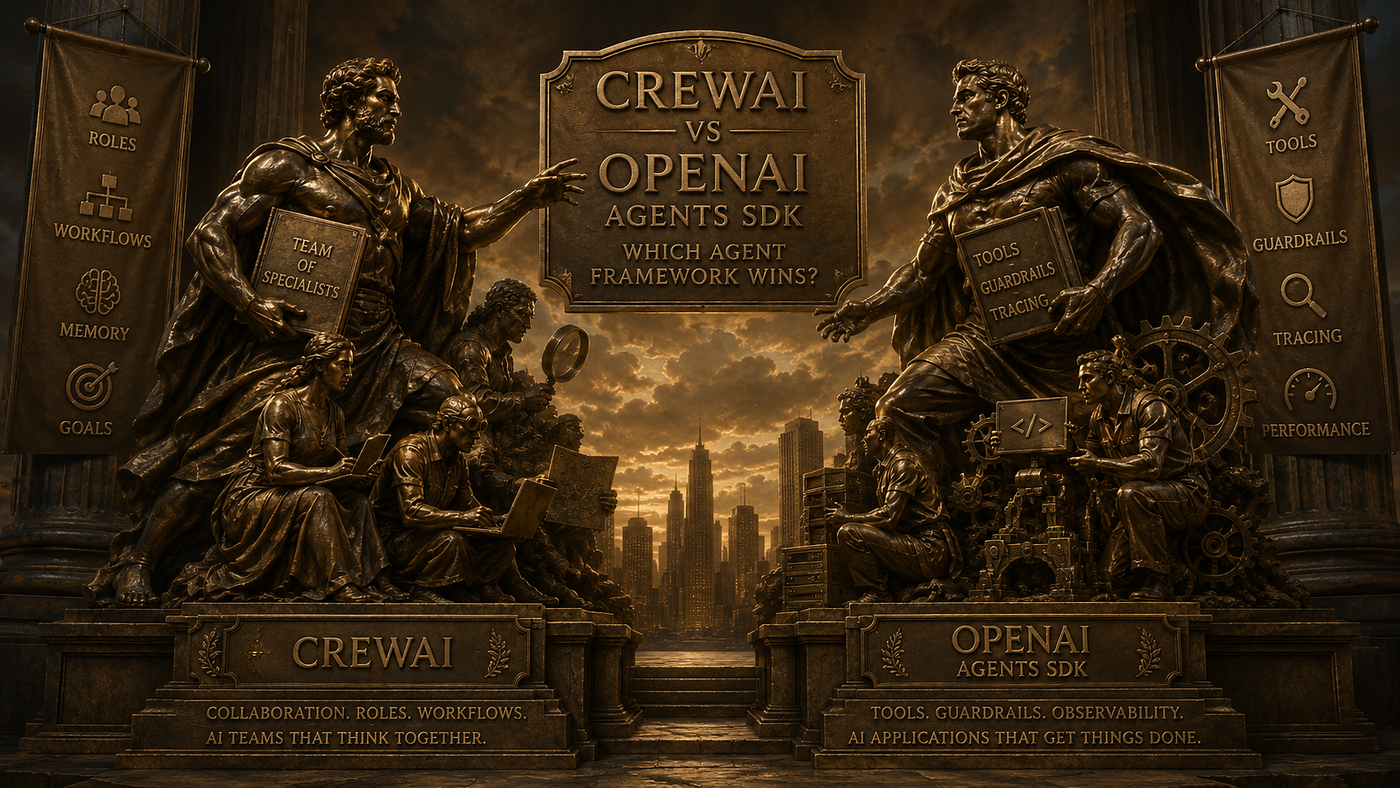
CrewAI vs OpenAI Agents SDK: an in-depth production comparison covering architecture, code, scalability, observability, developer experience, and real-world engineering tradeoffs.
Every AI Team Eventually Reaches This Fork
The first version of your AI application is almost always simple.
One prompt.
One model.
One API call.
Life is good.
Then reality arrives.
The product manager wants internet search.
Support asks for CRM integration.
Legal needs approval before responses are sent.
Engineering wants observability.
Finance asks why GPT usage tripled overnight.
Suddenly your “simple chatbot” has become an orchestration problem.
That’s where agent frameworks enter the conversation.
Today, two names appear everywhere:
- CrewAI
- OpenAI Agents SDK
At first glance they seem to solve the same problem.
They don’t.
They represent two completely different philosophies of building AI software. CrewAI focuses on coordinating specialized agents working together, while the OpenAI Agents SDK emphasizes lightweight agents with tool use, handoffs, tracing, and guardrails.
One builds AI teams.
The other builds AI applications.
That difference changes almost every engineering decision you’ll make.
Before Looking at Code, Understand the Mental Model
The biggest mistake I see isn’t choosing the wrong framework.
It’s misunderstanding what problem each framework is trying to solve.
CrewAI starts with a human analogy.
Researcher
      │
      ▼
Architect
      │
      ▼
Developer
      │
      ▼
Reviewer
Every agent has:
- a role
- a goal
- responsibilities
- memory
- tools
Execution becomes a workflow between specialists.
OpenAI Agents SDK starts somewhere completely different.
 User
   │
Agent
   │
Tool Calls
   │
Responses
Instead of assigning multiple personalities,
you give one intelligent agent access to carefully designed tools.
Delegation happens only when necessary.
It feels much closer to traditional backend engineering.
That difference sounds philosophical.
It becomes painfully practical after your codebase reaches 20,000 lines.
My Production Rule
If your architecture diagram looks like an org chart, CrewAI usually feels natural.
If it looks like an API gateway, OpenAI Agents SDK usually wins.
Project Structure
The biggest indicator of long-term maintainability isn’t the framework.
It’s how quickly developers understand the repository.
A production OpenAI Agents SDK project often stays surprisingly clean.
app/
├── api/
│   ├── routes.py
│   └── dependencies.py
│
├── agents/
│   ├── support.py
│   ├── billing.py
│   └── escalation.py
│
├── tools/
│   ├── postgres.py
│   ├── search.py
│   ├── redis.py
│   └── slack.py
│
├── services/
│   ├── ticket_service.py
│   └── customer_service.py
│
├── core/
│   ├── logging.py
│   ├── telemetry.py
│   └── settings.py
│
└── main.py
Nothing magical.
Everything has a place.
That’s exactly what backend engineers appreciate.
Building the First Agent
Instead of writing hundreds of lines of orchestration code,
start with a useful agent.
from agents import Agent
from app.tools.search import search_documents
from app.tools.customer import get_customer

support_agent = Agent(
    name="Support Assistant",
    instructions="""
    Help customers resolve billing
    and subscription issues.
    Always search documentation
    before answering.
    """,
    tools=[
        search_documents,
        get_customer,
    ],
)
Notice what’s missing.
No workflow engine.
No graph.
No orchestration layer.
No coordinator.
That’s intentional.
The SDK encourages starting simple before introducing complexity.
Now Compare That with CrewAI
CrewAI immediately asks you to think in roles.
from crewai import Agent

researcher = Agent(
    role="Documentation Researcher",
    goal="Find accurate support information",
    backstory="""
    Senior technical writer
    specializing in product documentation.
    """,
)

support_engineer = Agent(
    role="Customer Support Engineer",
    goal="Resolve customer issues",
    backstory="""
    Experienced SaaS support engineer
    with deep billing knowledge.
    """,
)
Then the tasks.
from crewai import Task

research = Task(
    description="Find documentation for issue",
    agent=researcher,
)

resolve = Task(
    description="Generate customer response",
    agent=support_engineer,
)
Finally the crew.
from crewai import Crew

crew = Crew(
    agents=[
        researcher,
        support_engineer,
    ],
    tasks=[
        research,
        resolve,
    ],
)
Even this tiny example demonstrates the philosophical split.
OpenAI SDK asks:
“What tools does my agent need?”
CrewAI asks:
“Who should perform this work?”
Neither is wrong.
They’re solving different problems.
The Backend Problem Nobody Talks About
Framework discussions usually obsess over prompts.
Production engineers worry about something else.
State.
Stateless demos are easy.
Stateful systems become expensive very quickly.
Imagine this workflow.
User uploads PDF
↓
Research Agent
↓
Database Lookup
↓
Summarization
↓
Manager Approval
↓
Email Delivery
↓
Audit Log
Every interruption matters.
Every retry matters.
Every timeout matters.
Every token costs money.
That’s where orchestration starts becoming backend engineering rather than prompt engineering.
Production FastAPI Integration
Let’s expose our agent through a real API.
from fastapi import APIRouter
from pydantic import BaseModel

router = APIRouter()

class ChatRequest(BaseModel):
    message: str

@router.post("/chat")
async def chat(request: ChatRequest):

    response = await support_agent.run(
        request.message
    )

    return {
        "response": response.final_output
    }
Tiny.
Readable.
Easy to test.
Exactly how production endpoints should feel.
Dependency Injection Beats Global Agents
Bad:
agent = support_agent

def ask(message):
    return agent.run(message)
Good:
class AgentService:

    def __init__(self, agent):
        self.agent = agent

    async def respond(self, message):

        return await self.agent.run(message)
Now testing becomes trivial.
fake_agent = Mock()

service = AgentService(fake_agent)
Small architectural decisions compound.
Especially after six months.
Tools Should Stay Boring
One anti-pattern I see repeatedly is putting business logic inside tools.
Bad:
@function_tool
async def refund_customer(
    customer_id: int
):
    ...
Inside that function:
- validate customer
- update PostgreSQL
- send Slack notification
- create invoice
- publish Kafka event
- write audit logs
That’s not a tool.
That’s an entire backend hidden behind one function.
Instead:
class BillingService:

    async def refund(
        self,
        customer_id: int
    ):
        ...
Tool:
@function_tool
async def refund_customer(
    customer_id: int,
):
    return await billing_service.refund(
        customer_id
    )
Agents shouldn’t own your business logic.
They should orchestrate it.
That’s the difference between an AI application and an AI-shaped monolith.
Reliability Is What Separates Demos from Products
Every AI framework looks impressive when everything succeeds.
Production systems are interesting because things fail.
- APIs timeout
- databases restart
- Redis disappears
- users spam refresh
- models hallucinate
- external services return HTTP 500
Your framework isn’t judged by its happy path.
It’s judged by its failure path.
One lesson I’ve learned repeatedly:
Intelligent systems still need boring infrastructure.
Add Timeouts Everywhere
Bad
result = await support_agent.run(message)Production
import asyncio

async def run_agent(message: str):

    try:
        return await asyncio.wait_for(
            support_agent.run(message),
            timeout=20,
        )

    except asyncio.TimeoutError:
        raise RuntimeError(
            "Agent execution timed out."
        )
Large language models aren’t databases.
Sometimes they simply take longer.
Protect your APIs.
Protect your users.
Retries Belong Around Infrastructure Not Around the Model
Don’t blindly retry every agent response.
Retry network operations instead.
from tenacity import retry
from tenacity import stop_after_attempt
from tenacity import wait_exponential

@retry(
    stop=stop_after_attempt(3),
    wait=wait_exponential(),
)
async def fetch_customer(customer_id):

    return await repository.get(customer_id)
If the LLM generated an incorrect answer,
running it three more times rarely fixes bad architecture.
Idempotency Saves Money
Users double-click buttons.
Browsers retry requests.
Mobile networks reconnect.
Without idempotency,
your agent may execute the same expensive workflow twice.
class RequestRepository:

    async def already_processed(
        self,
        request_id: str,
    ) -> bool:
        ...

    async def mark_processed(
        self,
        request_id: str,
    ):
        ...
Usage
async def process_request(
    request_id: str,
    message: str,
):

    if await repo.already_processed(
        request_id
    ):
        return

    await support_agent.run(message)

    await repo.mark_processed(
        request_id
    )
This tiny pattern can save thousands of unnecessary model calls every month.
Logging Is More Valuable Than Clever Prompting
When production incidents happen,
nobody asks,
“What was the prompt?”
They ask,
“What happened?”
Structured logging answers that question.
import structlog

logger = structlog.get_logger()

logger.info(
    "agent_started",
    customer_id=42,
    workflow="refund",
)
Later
logger.info(
    "tool_called",
    tool="search_documents",
)

logger.info(
    "response_generated",
    tokens=923,
)
Logs tell stories.
Console prints tell fairy tales.
Observability Is Where the OpenAI Agents SDK Quietly Shines
One feature that doesn’t get enough attention is tracing.
The SDK can automatically capture:
- LLM generations
- tool calls
- handoffs
- guardrail execution
- custom spans
making it much easier to debug complex workflows in production.
Minimal setup:
from agents import Runner

result = await Runner.run(
    support_agent,
    "Refund order #1829"
)
With tracing enabled, you gain visibility into how an agent reached its answer instead of only seeing the final output. (OpenAI GitHub)
That becomes incredibly valuable once dozens of tools are involved.
Health Checks Matter
Your Kubernetes cluster doesn’t care whether the model is smart.
It cares whether your service is alive.
from fastapi import APIRouter

router = APIRouter()

@router.get("/health")

async def health():

    return {
        "status": "healthy"
    }
Simple.
Necessary.
Never skip it.
Background Jobs Beat Waiting for HTTP
Imagine this workflow:
- Analyze 300-page PDF
- Extract entities
- Query PostgreSQL
- Search documentation
- Generate summary
- Email customer
Please don’t do that inside one HTTP request.
Instead
User
 │
 ▼
FastAPI
 │
 ▼
RabbitMQ
 │
 ▼
Worker
 │
 ▼
Agent
 │
 ▼
Database
The API stays responsive.
The user gets progress updates.
Your infrastructure stays healthy.
Example with Celery
from celery import shared_task

@shared_task

def process_document(
    document_id: int,
):

    return run_document_agent(
        document_id
    )
FastAPI
@router.post("/documents")

async def upload(file):

    task = process_document.delay(
        file.id
    )

    return {
        "task_id": task.id
    }
Production systems rarely wait.
They delegate.
Cache Everything That Doesn’t Need Intelligence
LLMs are expensive.
Databases aren’t.
Redis certainly isn’t.
import redis.asyncio as redis

cache = redis.Redis()

async def customer_profile(
    customer_id,
):

    key = f"profile:{customer_id}"

    cached = await cache.get(key)

    if cached:
        return cached

    customer = await repository.get(
        customer_id
    )

    await cache.setex(
        key,
        600,
        customer.json(),
    )

    return customer
Every cached request is one less unnecessary tool call.
When CrewAI Starts Feeling Better
Despite everything I’ve shown,
there are projects where CrewAI feels significantly more natural.
Think about:
- financial research
- legal review
- scientific literature
- security investigations
- autonomous report generation
These problems naturally divide into specialists.
Research
↓
Analysis
↓
Fact Checking
↓
Writing
↓
Review
That mirrors how humans already solve those problems.
CrewAI embraces this model.
Instead of fighting it,
it makes the workflow explicit.
When OpenAI Agents SDK Wins Instantly
Now compare a SaaS backend.
Customer asks:
“Why was my invoice higher this month?”
The agent:
- queries PostgreSQL
- checks Stripe
- reads documentation
- explains taxes
- offers refund
That’s one agent.
Multiple tools.
Minimal orchestration.
Exactly the workflow the SDK was designed for, with managed tools, sessions, handoffs, and guardrails available when complexity grows.
A Rule I’ve Started Following
If your system mostly coordinates people-like specialists, CrewAI feels elegant.
If your system mostly coordinates software components, OpenAI Agents SDK usually stays simpler.
That single distinction has saved me from several architecture rewrites.
메타데이터
- post_id
- 6919ff9d4e2d
- slug
- crewai-vs-openai-agents-sdk-which-agent-framework-wins-6919ff9d4e2d
- url
- https://medium.com/@komalbaparmar007/crewai-vs-openai-agents-sdk-which-agent-framework-wins-6919ff9d4e2d
- canonical_url
- https://medium.com/@komalbaparmar007/crewai-vs-openai-agents-sdk-which-agent-framework-wins-6919ff9d4e2d
- author_url
- https://medium.com/@komalbaparmar007
- status
- ok
- fetched_at
- 2026-07-06 19:19:11