I Built Self-Healing AI Observability Systems on AWS That Could Detect Model Drift Before Users…
How I used AWS Kinesis, OpenTelemetry, Bedrock telemetry, vector analytics, and streaming observability pipelines to monitor autonomous AI…
I Built Self-Healing AI Observability Systems on AWS That Could Detect Model Drift Before Users Ever Noticed
How I used AWS Kinesis, OpenTelemetry, Bedrock telemetry, vector analytics, and streaming observability pipelines to monitor autonomous AI systems in real time.
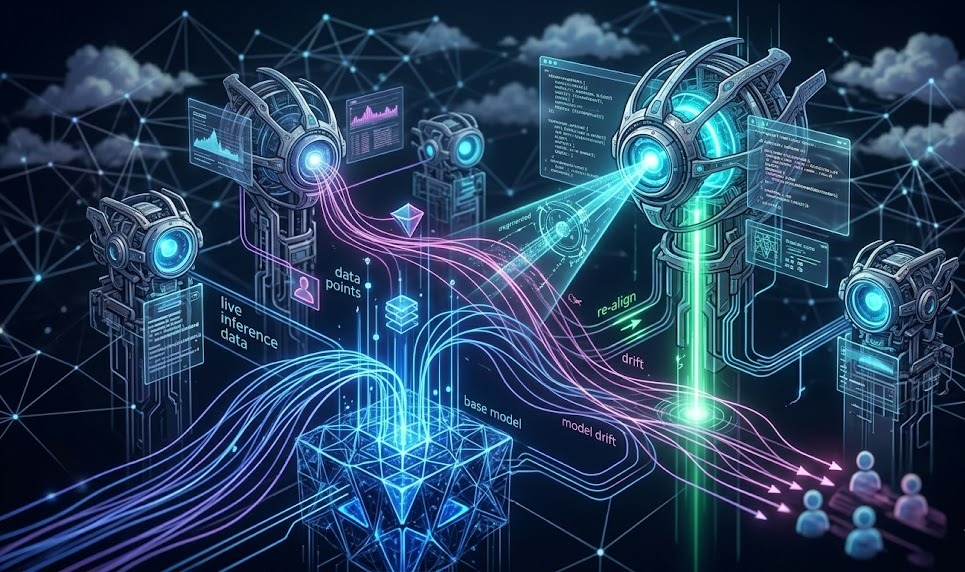
The first thing that surprised me about production AI systems was how quietly they fail.
Traditional infrastructure usually crashes loudly.
Servers go down.
APIs throw errors.
Containers restart.
Something visibly breaks.
AI systems are completely different.
They slowly become… weird.
Responses become slightly less accurate.
Retrieval pipelines drift semantically.
Agents start making strange decisions.
Reasoning quality subtly degrades.
Latency spikes inconsistently.
Costs quietly explode.
And the scary part?
Most traditional monitoring systems never detect any of it.
That realization completely changed how I approached AI infrastructure.
Because once you deploy:
- autonomous agents
- RAG systems
- vector databases
- multimodal pipelines
- streaming inference
- multi-agent orchestration
…you are no longer monitoring software.
You are monitoring probabilistic behavior.
And behavioral observability is an entirely different engineering discipline.
So I started building real-time AI observability pipelines on AWS using Kinesis, OpenTelemetry, distributed tracing, vector telemetry, and streaming analytics systems capable of detecting AI degradation before users even noticed something was wrong.
That ended up becoming one of the most interesting infrastructure problems I’ve worked on.
Why Traditional Observability Completely Fails for AI Systems
Traditional systems are deterministic.
AI systems are probabilistic.
That changes everything.
A traditional backend request looks like this:
Request
   ↓
Service
   ↓
Database
   ↓
Response
Simple.
AI systems look more like this:
Prompt
   ↓
Embedding Generation
   ↓
Vector Retrieval
   ↓
Context Assembly
   ↓
LLM Reasoning
   ↓
Tool Calls
   ↓
Memory Updates
   ↓
Agent Coordination
   ↓
Final Response
Now suddenly you need visibility into:
- retrieval quality
- hallucination frequency
- reasoning latency
- semantic drift
- memory consistency
- prompt effectiveness
- tool execution reliability
- agent coordination
- inference costs
This is not normal infrastructure monitoring anymore.
It’s cognitive systems telemetry.
And honestly, most AI teams are severely under-monitoring their systems right now.
AWS Kinesis Became the Backbone of My Entire Telemetry Architecture
The biggest breakthrough came when I stopped treating logs as static events.
Instead, I started treating AI observability as a real-time streaming problem.
AWS Kinesis became the nervous system of the entire architecture.
Every AI component continuously emitted telemetry:
- prompts
- embeddings
- vector similarity scores
- reasoning traces
- token usage
- inference latency
- retrieval metrics
- hallucination indicators
- agent actions
The architecture evolved into:
AI Services
     ↓
Kinesis Streams
     ↓
Streaming Analytics
     ↓
Behavioral Dashboards
This changed debugging completely.
Because now I could observe AI behavior continuously instead of waiting for users to complain.
Here’s a simplified telemetry publisher:
import boto3
import json
from datetime import datetime

kinesis = boto3.client(
    "kinesis",
    region_name="us-east-1"
)

event = {
    "timestamp": datetime.utcnow().isoformat(),
    "service": "retrieval_pipeline",
    "latency_ms": 184,
    "retrieval_score": 0.87,
    "tokens_used": 932,
    "hallucination_risk": 0.11
}

response = kinesis.put_record(
    StreamName="ai-telemetry-stream",
    Data=json.dumps(event),
    PartitionKey="telemetry"
)

print(response)
Once observability became streaming-first, the entire operational model improved dramatically.
OpenTelemetry Made Distributed AI Tracing Actually Possible
This became one of the most important upgrades.
Modern AI systems are deeply distributed.
A single user request might trigger:
- embedding services
- retrieval systems
- multiple LLMs
- agent orchestration
- vector searches
- memory retrieval
- external tools
Without distributed tracing, debugging becomes almost impossible.
I instrumented every stage using OpenTelemetry.
The trace architecture looked like this:
User Query
     ↓
Embedding Service
     ↓
OpenSearch Retrieval
     ↓
Bedrock Inference
     ↓
Agent Tool Execution
     ↓
Final Response
Now I could trace:
- reasoning bottlenecks
- failed retrievals
- recursive agent loops
- expensive inference chains
- degraded workflows
Here’s a simplified tracing setup:
from opentelemetry import trace
from opentelemetry.sdk.trace import TracerProvider

trace.set_tracer_provider(
    TracerProvider()
)

tracer = trace.get_tracer(__name__)

def process_request(query):

    with tracer.start_as_current_span(
        "ai_pipeline"
    ) as span:

        span.set_attribute(
            "query",
            query
        )

        result = generate_response(query)

        return result

def generate_response(query):

    return f"Generated response for {query}"

print(
    process_request("Explain Kinesis")
)
This became essential for multi-agent systems.
Because once agents coordinate recursively, debugging without traces becomes a nightmare.
Retrieval Monitoring Became More Important Than Model Monitoring
This surprised me more than anything.
Most AI quality problems were not caused by the model.
They were caused upstream by retrieval systems.
Especially in RAG pipelines.
The real problems looked like:
- irrelevant context injection
- semantic retrieval drift
- embedding inconsistencies
- chunk fragmentation
- noisy vector matches
So I started monitoring retrieval quality directly.
The telemetry pipeline tracked:
- cosine similarity distributions
- retrieval confidence
- chunk utilization
- embedding drift
- semantic overlap
- context relevance
The architecture became:
User Query
      ↓
Embedding Generation
      ↓
Vector Search
      ↓
Retrieval Analytics
      ↓
Streaming Telemetry
This changed debugging completely.
Because most hallucinations were actually retrieval failures disguised as reasoning failures.
That distinction matters enormously.
Real-Time Drift Detection Became One of the Most Valuable Features
One of the hardest parts of production AI:
Behavioral drift happens slowly.
The system doesn’t “break.”
It gradually becomes worse.
That’s terrifying operationally.
So I built streaming drift detection pipelines.
The system continuously analyzed:
- retrieval quality trends
- hallucination frequency
- reasoning latency
- token efficiency
- semantic stability
Here’s a simplified drift detector:
import statistics

scores = [
    0.91,
    0.88,
    0.84,
    0.79,
    0.63
]

average = statistics.mean(scores)

if average < 0.75:

    print(
        "Warning: Retrieval drift detected"
    )
This became incredibly useful.
Because now degradation could be detected proactively instead of reactively.
That’s huge for AI infrastructure.
AI Cost Observability Became Operationally Critical
Autonomous AI systems can burn money unbelievably fast.
Especially when:
- agents recurse endlessly
- retrieval expands uncontrollably
- prompts bloat
- inference chains multiply
I learned this lesson painfully.
So I started streaming cost telemetry continuously.
Every inference tracked:
- token counts
- embedding usage
- retrieval operations
- model routing
- GPU consumption
- agent execution chains
Here’s a simplified cost estimator:
class CostMonitor:

    def estimate(
        self,
        input_tokens,
        output_tokens
    ):

        input_cost = input_tokens * 0.0000015
        output_cost = output_tokens * 0.000002

        return input_cost + output_cost

monitor = CostMonitor()

cost = monitor.estimate(
    2400,
    1800
)

print(
    f"Estimated cost: ${cost}"
)
This became one of the most important operational dashboards in production.
Because autonomous AI systems without cost visibility become financially dangerous very quickly.
Vector Telemetry Opened an Entirely New Category of Monitoring
This part became fascinating.
I started monitoring embeddings themselves.
Not just application metrics.
Things like:
- vector cluster density
- semantic fragmentation
- embedding drift
- neighborhood instability
- retrieval collapse
The architecture evolved into:
Embeddings
     ↓
Vector Analytics
     ↓
Semantic Drift Detection
     ↓
AI Health Monitoring
This exposed issues no traditional observability system would ever detect.
Especially retrieval degradation.
It felt less like monitoring software…
…and more like monitoring machine cognition.
Which honestly sounds insane until you actually need it.
Multi-Agent Systems Made Observability Exponentially Harder
Single AI systems are manageable.
Multi-agent systems become chaos generators surprisingly quickly.
Suddenly you need visibility into:
- task ownership
- recursive coordination
- agent handoffs
- memory propagation
- workflow dependencies
- execution trees
The traces became huge.
Planner Agent
      ↓
Retrieval Agent
      ↓
Execution Agent
      ↓
Validation Agent
      ↓
Reporting Agent
Without centralized streaming observability, debugging becomes nearly impossible.
Especially when autonomous systems start recursively generating more workflows.
Which they absolutely will.
AI Dashboards Became Behavioral Dashboards Instead of Infrastructure Dashboards
This was a major mindset shift.
Traditional dashboards monitor systems.
AI dashboards monitor behavior.
I started building dashboards that tracked:
- hallucination rates
- retrieval accuracy
- reasoning latency
- semantic drift
- agent reliability
- memory consistency
- inference costs
- workflow stability
These dashboards felt completely different from traditional DevOps dashboards.
Because they measured cognitive behavior instead of raw infrastructure metrics.
That distinction matters enormously.
Most AI Failures Are Gradual Losses of Coherence
This was probably the biggest realization overall.
Traditional systems fail catastrophically.
AI systems often fail subtly.
A retrieval pipeline becomes slightly noisier.
An agent becomes slightly less consistent.
A memory system becomes slightly stale.
And eventually the entire platform feels worse without obvious infrastructure failures.
That’s why behavioral observability matters so much.
Because gradual cognitive degradation is incredibly difficult to detect without dedicated telemetry systems.
What I’d Do Differently If I Rebuilt Everything Today
After building large-scale AI observability systems on AWS, a few lessons became painfully obvious.
First:
Infrastructure monitoring alone is useless for modern AI systems.
Second:
Streaming telemetry dramatically improves operational visibility.
Third:
Retrieval observability matters just as much as model observability.
And finally:
AI infrastructure increasingly requires behavioral analytics instead of traditional monitoring.
One sentence I wrote after debugging a recursive multi-agent failure at 3 AM:
“AI systems don’t usually crash. They slowly lose coherence.”
That still feels painfully accurate.

Final Thoughts
I genuinely believe AI observability will become one of the most important infrastructure categories of the next decade.
Because autonomous systems require deep visibility into:
- reasoning
- retrieval
- memory
- coordination
- semantic drift
- behavioral stability
AWS provides an incredibly strong ecosystem for building these systems.
Especially with:
- Kinesis
- OpenTelemetry
- Lambda
- CloudWatch
- OpenSearch
- Bedrock
- EventBridge
- streaming analytics
The most exciting part?
We’re still incredibly early.
Right now, most organizations are still monitoring AI systems like traditional web applications.
Meanwhile, real-time AI observability pipelines are quietly becoming the operational nervous systems behind autonomous intelligent infrastructure.
메타데이터
- post_id
- 693c92b01b5f
- slug
- i-built-self-healing-ai-observability-systems-on-aws-that-could-detect-model-drift-before-users-693c92b01b5f
- url
- https://awstip.com/i-built-self-healing-ai-observability-systems-on-aws-that-could-detect-model-drift-before-users-693c92b01b5f
- canonical_url
- https://awstip.com/i-built-self-healing-ai-observability-systems-on-aws-that-could-detect-model-drift-before-users-693c92b01b5f
- author_url
- https://medium.com/@maximilianoliver25
- status
- ok
- fetched_at
- 2026-06-10 08:17:25