Why Manual Delivery Coordination No Longer Scales
Delivery Operations Break Down Faster Than Most Businesses Expect
Why Manual Delivery Coordination No Longer Scales
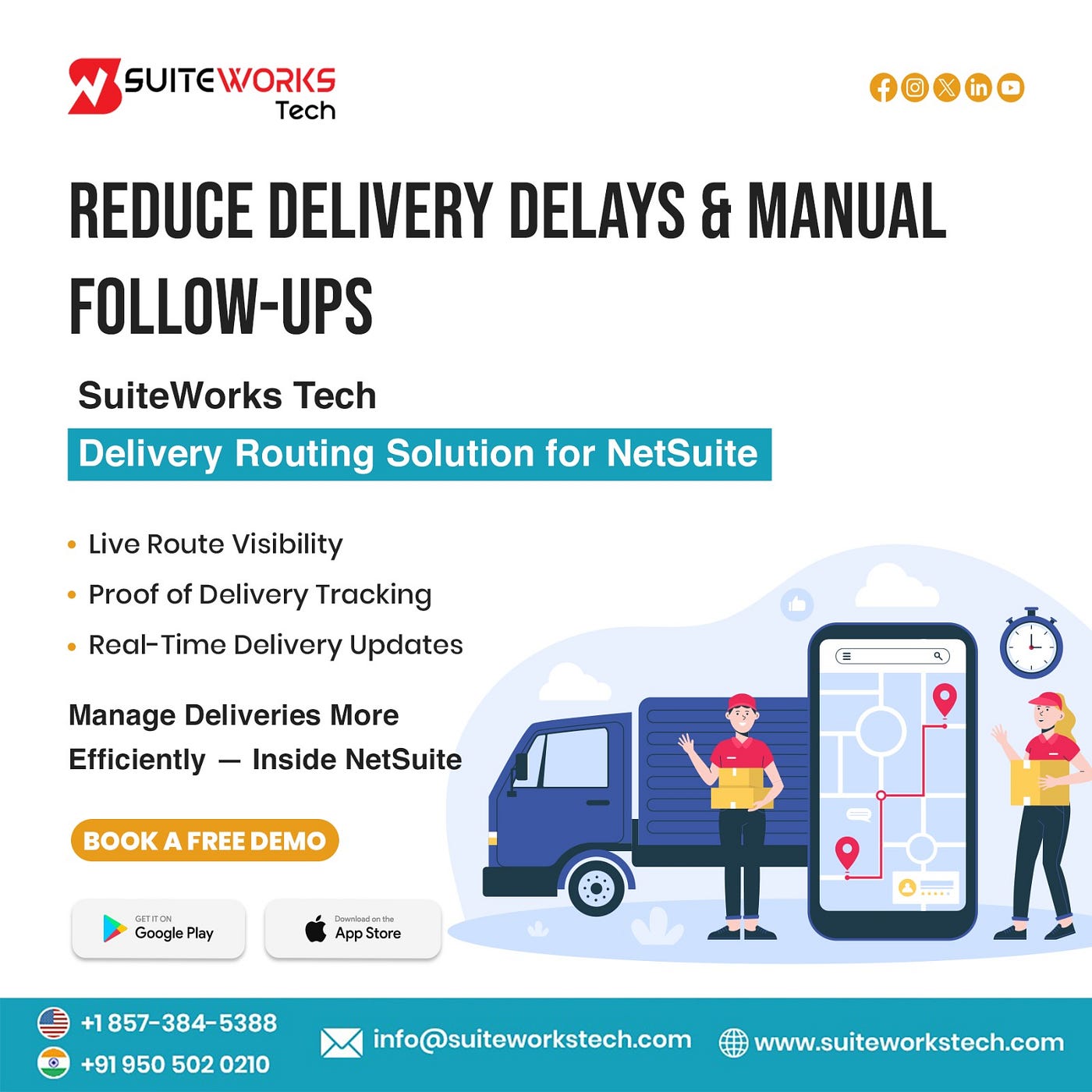
Delivery Operations Break Down Faster Than Most Businesses Expect
For many growing businesses, delivery management starts simple.
A few drivers. A few daily routes. A dispatcher coordinating deliveries over calls or spreadsheets. Status updates handled manually. Proof of delivery collected through paper slips or messages.
At first, the process works.
But as order volumes increase, operational cracks begin to appear.
Dispatchers spend more time coordinating drivers than managing logistics. Customers repeatedly call asking for delivery updates. Drivers miss route changes. Failed deliveries become harder to track. Delivery confirmations arrive late — or sometimes not at all.
What once felt manageable slowly becomes operationally expensive.
And for businesses already running on NetSuite, one major challenge becomes clear:
Delivery operations are happening outside the ERP system that runs the rest of the business.
The Hidden Cost of Disconnected Delivery Workflows
Many businesses still rely on disconnected systems for delivery management:
- spreadsheets for route planning
- phone calls for driver coordination
- third-party apps for tracking
- manual updates inside NetSuite afterward
The problem isn’t just inefficiency.
It’s visibility.
When delivery information lives across multiple systems, operations teams lose real-time insight into what’s actually happening in the field.
Questions start piling up:
- Which deliveries are delayed?
- Which driver completed the route?
- Was proof of delivery collected?
- Why did a delivery fail?
- Has NetSuite been updated yet?
Without centralized delivery visibility, logistics teams spend more time reacting to problems than preventing them.
Why Real-Time Delivery Visibility Matters
Modern delivery operations move too fast for manual coordination.
Businesses need real-time access to:
- route progress
- delivery status
- failed delivery updates
- driver activity
- proof of delivery records
Not hours later.
Not at the end of the day.
But as deliveries happen.
This is where businesses are shifting toward delivery workflows that operate directly inside NetSuite instead of around it.
Bringing Delivery Routing Directly Into NetSuite
The Delivery Routing Solution for NetSuite from SuiteWorks Tech was built to solve this exact operational gap.
Instead of treating delivery management as a disconnected process, the solution brings route planning, driver management, proof of delivery, and delivery tracking directly into the NetSuite environment.
The result is a more connected logistics workflow where dispatchers, drivers, and operations teams work from the same system in real time.
A Simpler Workflow for Dispatch Teams
Each day typically begins with route planning.
In many companies, this still involves manually assigning deliveries, updating spreadsheets, messaging drivers, and coordinating routes through multiple systems.
The Delivery Routing Solution simplifies that process.
Dispatchers can create and assign routes directly inside NetSuite. Drivers instantly receive route details through the mobile app, including:
- assigned stops
- customer information
- delivery instructions
- navigation access
This removes unnecessary back-and-forth communication before routes even begin.
The Driver Experience Matters More Than Most Businesses Realize
One overlooked challenge in logistics operations is driver usability.
If delivery apps are difficult to use, updates become inconsistent. Drivers skip steps. Proof of delivery gets delayed. Communication gaps increase.
The mobile delivery app connected to the SuiteWorks Tech solution focuses on simplicity.
Drivers can:
- view routes
- access stop details
- navigate using Google Maps
- update delivery status
- capture signatures
- upload delivery photos
- report failed deliveries
Everything syncs back into NetSuite automatically.
No duplicate entry. No paperwork later. No separate reporting process at the end of the day.
Proof of Delivery Shouldn’t Slow Operations Down
Proof of delivery is critical for logistics operations, but many businesses still handle it inefficiently.
Paper signatures, manual uploads, delayed confirmations, and missing records create avoidable operational friction.
With digital proof of delivery built directly into the workflow, businesses gain:
- delivery verification
- timestamp tracking
- GPS confirmation
- customer signatures
- delivery photo records
without adding extra administrative work.
The operational difference becomes significant as delivery volumes scale.
Failed Deliveries Become Easier to Manage
Failed deliveries are unavoidable.
What creates problems is the lack of visibility around them.
Without structured exception tracking, dispatchers often spend valuable time trying to understand:
- why the delivery failed
- what happened onsite
- whether the customer was contacted
- if a reattempt is required
Drivers using the mobile app can immediately record failed deliveries with reasons and supporting images.
That information syncs directly into NetSuite, allowing teams to respond faster without relying on scattered updates through calls or messages.
Logistics Teams Need Fewer Systems — Not More
One reason many delivery workflows become inefficient is software overload.
Businesses often end up managing:
- ERP systems
- route planning tools
- delivery tracking apps
- spreadsheets
- messaging platforms
The operational complexity grows quickly.
A fully native NetSuite delivery routing solution reduces that fragmentation by centralizing delivery operations within the ERP system businesses already use daily.
For operations teams, that means:
- fewer disconnected workflows
- reduced manual coordination
- improved data consistency
- better operational visibility
without introducing additional system complexity.
Delivery Efficiency Is No Longer Just About Speed
For modern logistics teams, delivery efficiency now includes:
- operational visibility
- customer communication
- delivery verification
- exception management
- driver coordination
- real-time updates
Businesses that continue relying on manual delivery workflows often struggle to scale efficiently as order volumes increase.
The companies adapting fastest are the ones building connected logistics operations where delivery execution and ERP visibility work together in real time.
Final Thoughts
As delivery operations grow, manual coordination becomes increasingly difficult to sustain.
What starts as a manageable process eventually creates operational bottlenecks that affect dispatch teams, drivers, customer experience, and overall efficiency.
A connected delivery workflow inside NetSuite helps businesses move beyond reactive logistics management.
By combining:
- route planning
- driver management
- delivery tracking
- proof of delivery
- real-time synchronization
within one centralized system, businesses gain the visibility and operational control needed to scale delivery operations more effectively.
To learn more about the Delivery Routing Solution for NetSuite, visit: SuiteWorks Tech Delivery Routing Solution
메타데이터
- post_id
- 693f28558ebb
- slug
- why-manual-delivery-coordination-no-longer-scales-693f28558ebb
- url
- https://medium.com/@SuiteWorks-Tech/why-manual-delivery-coordination-no-longer-scales-693f28558ebb
- canonical_url
- https://medium.com/@SuiteWorks-Tech/why-manual-delivery-coordination-no-longer-scales-693f28558ebb
- author_url
- https://medium.com/@SuiteWorks-Tech
- status
- ok
- fetched_at
- 2026-06-09 15:37:30




