The Reverse Bicycle: What It Reveals About Your Mind
You’ve ridden bikes for years — but do you know how they work? A reverse-steering test reveals how little we understand what feels…
The Reverse Bicycle: What It Reveals About Your Mind
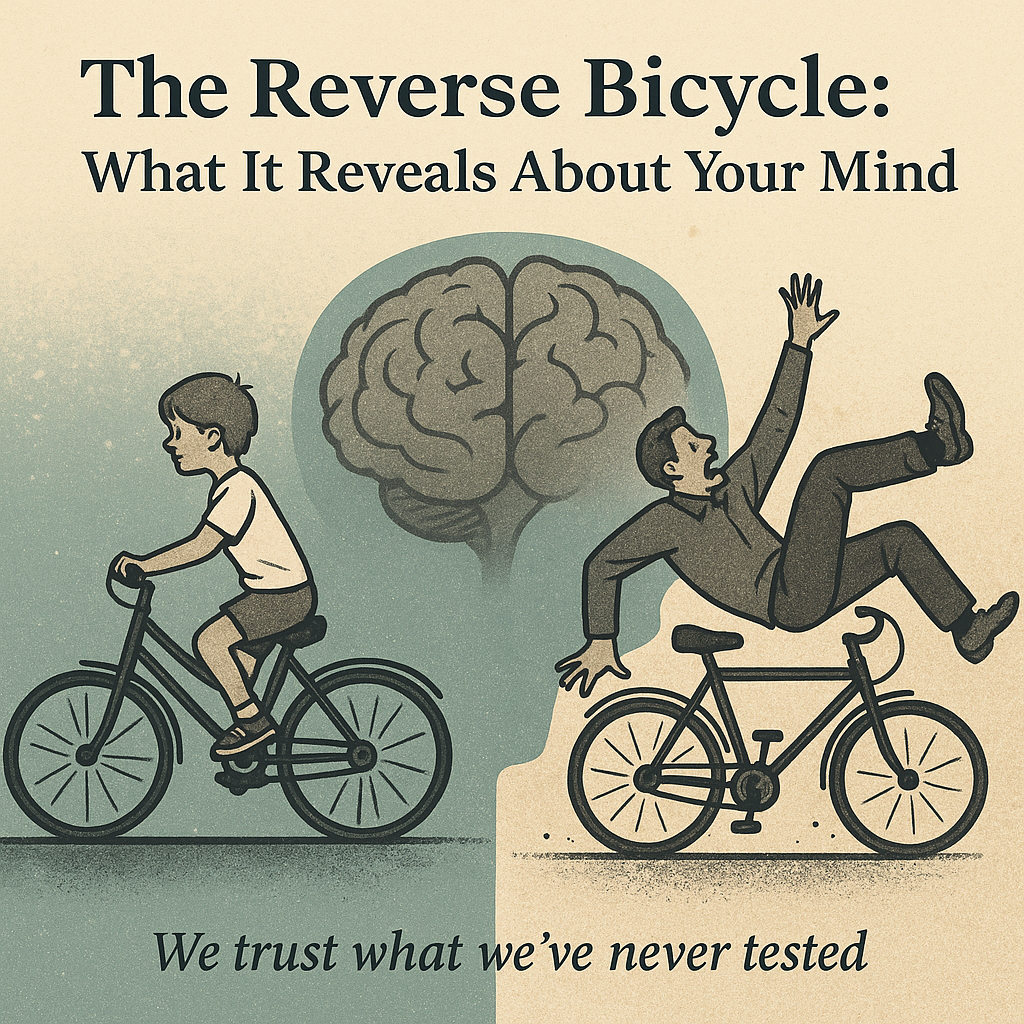
We trust what we’ve never tested.
You ride it. But do you understand it?
You’ve been riding a bike since you were a kid. But… could you explain how it actually works?
Most people can’t. And when asked to try — they get it wrong.
This isn’t just about bicycles. It’s about the way you think you know things you don’t.
Why do we trust our understanding — when it’s built on illusion?
🚲 What Keeps a Bicycle Upright?
The physics of bicycle balance most of us never questioned
In one of the most shared science videos of the past decade, a simple experiment shocked millions: Reverse the steering of a bike — and even expert riders can’t ride it.
Why?
Because balance isn’t just physical. It’s cognitive. We ride bikes with confidence, yet few of us understand the real principles: gyroscopic precession, trail effect, mass distribution.
MIT once tested this. Adults who’d been cycling their whole lives couldn’t explain how bikes stay upright.
*This is called the illusion of explanatory depth. We think we know. Until we try to explain.*
🧠 Even familiar knowledge might be unfamiliar territory.
🛠 The Reversed Steering Test
A small cognitive twist that reveals deep mental patterns
Engineer Destin Sandlin ran the reversed steering experiment: He built a bike that turns left when you turn the handlebars right.
Result?
It took him 8 months to re-learn how to ride. And when he tried switching back — he failed again.
New knowledge doesn’t overwrite the old. It competes with it.
🌀 Learning is not just gaining. It’s undoing.
🧠 Why Your Brain Lies (Gently)
The illusion of knowledge explained through daily thinking
Cognitive scientists Sloman and Fernbach showed that most of our knowledge is distributed. We think we know because someone in our environment knows.
You don’t understand Wi-Fi, GPS, or combustion engines in depth. Yet you use them daily — confidently.
We operate on functional illusions. And that’s evolutionarily useful.
You don’t need to know — you just need to believe you do.
🪞 What Else Are You Getting Wrong?
From bicycles to belief systems we never inspect
If you’re wrong about bicycles, what else might you be wrong about?
— Your memory? — Your emotions? — Your political convictions?
The reversed bike is just a metaphor. A gateway into your unexamined certainty.
Certainty feels like truth. But it may just be fluency.
🪐 What feels obvious may not be accurate.
🜔 The Courage to Unlearn
Why real wisdom starts with humble doubt
It’s uncomfortable to realize you know less than you thought. But it’s also liberating.
Letting go of false understanding isn’t loss. It’s clearance — for better insight.
The reversed bicycle teaches this: Stability can be deceptive.
What keeps you upright may be what keeps you from growing.
🜕 Are You Riding in Reverse?
One last question — before you scroll away
What’s your own “reversed bicycle”? What belief, habit, or “truth” might fall apart under inspection?
The question is not: what do you know? It’s: what have you never thought to question?
💬 What’s your own “reversed bicycle”? Share it in the comments.
If this article made your mental balance wobble — don’t just scroll — follow ThinkDigest.
Where you ride into uncertainty. And find meaning on the way.
메타데이터
- post_id
- 6948c8474f2e
- slug
- the-reverse-bicycle-what-it-reveals-about-your-mind-6948c8474f2e
- url
- https://medium.com/@thinkdigest/the-reverse-bicycle-what-it-reveals-about-your-mind-6948c8474f2e
- canonical_url
- https://medium.com/@thinkdigest/the-reverse-bicycle-what-it-reveals-about-your-mind-6948c8474f2e
- author_url
- https://medium.com/@thinkdigest
- status
- ok
- fetched_at
- 2026-08-22 15:30:10