Scaling AI Systems — Challenges in Production
Day 28 — AIpril : From Prompt to Production
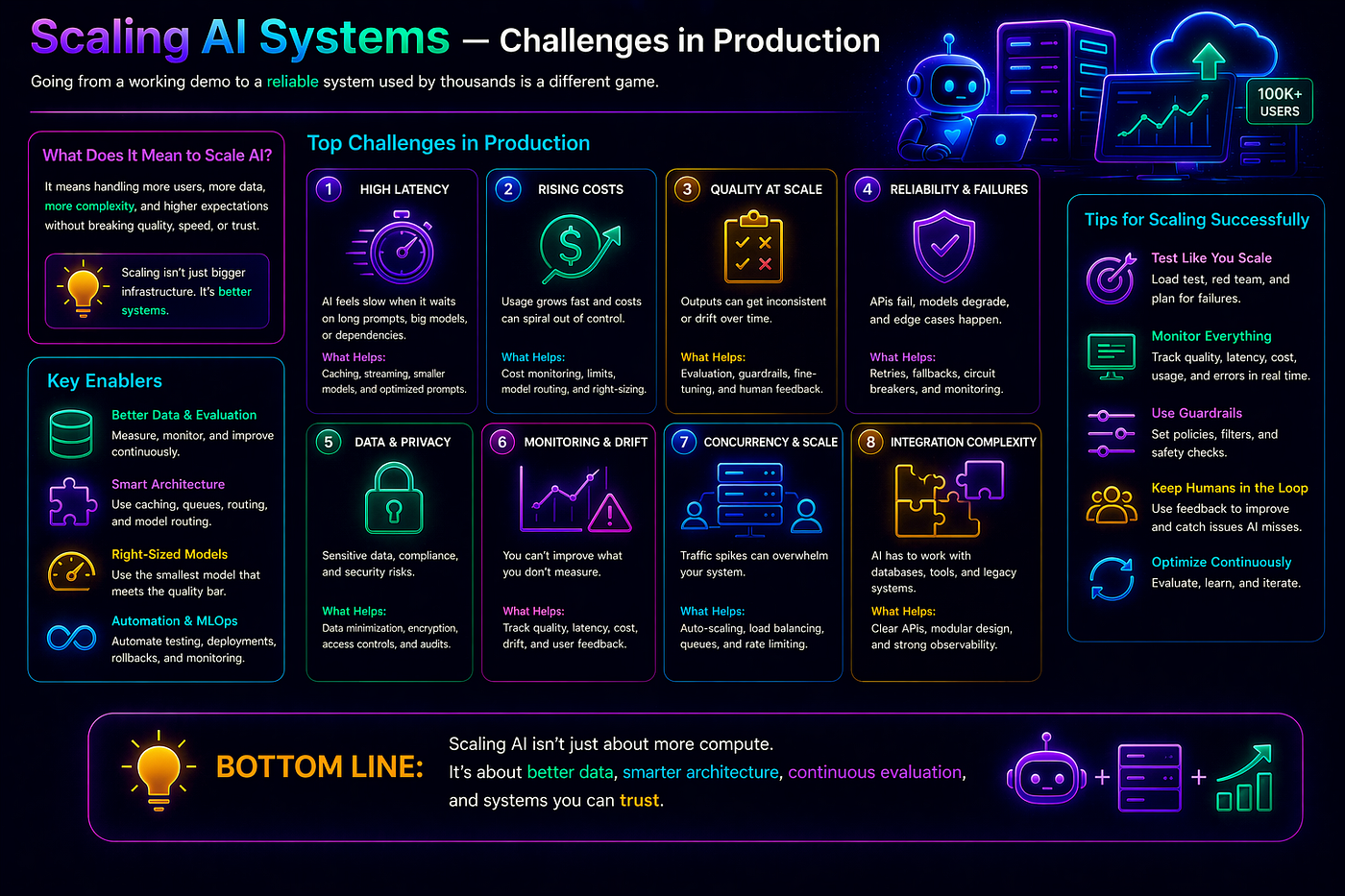
Scaling AI Systems — Challenges in Production
Day 28 — AIpril : From Prompt to Production
So far, we’ve built a complete AI system:
- retrieval
- memory
- workflows
- agents
- evaluation
- guardrails
At this stage, everything works.
But here’s the reality:
A system that works for 10 users often breaks at 10,000.
Welcome to the hardest phase:
Scaling AI systems.
Step 1: What Does Scaling Mean?
Scaling is not just about handling more users.
It includes:
- higher traffic
- larger data volumes
- more concurrent requests
- consistent performance
Step 2: Why AI Systems Are Hard to Scale
AI systems are different from traditional systems:
- LLM calls are expensive
- latency is higher
- outputs are non-deterministic
- pipelines are complex
This creates unique challenges.
Step 3: Latency Challenges
Each step adds delay:
- retrieval
- reasoning
- tool calls
- multi-step workflows
At scale:
latency compounds
Solutions:
- caching
- parallel execution
- optimizing workflows
Step 4: Cost Challenges
LLM usage scales with:
- number of users
- number of tokens
- number of steps
Without optimization:
costs can grow exponentially
Solutions:
- caching responses
- reducing prompt size
- using smaller models when possible
Step 5: Reliability Issues
At scale, failures are inevitable:
- API timeouts
- tool failures
- incorrect outputs
You must design for:
- retries
- fallbacks
- graceful degradation
Step 6: Consistency Problems
AI outputs can vary.
At scale, this leads to:
- inconsistent user experience
- unpredictable behavior
Solutions:
- stronger prompts
- guardrails
- evaluation pipelines
Step 7: Data and Retrieval Scaling
As data grows:
- retrieval becomes slower
- noise increases
- relevance drops
Solutions:
- better chunking
- metadata filtering
- indexing strategies
Step 8: Monitoring and Observability
You cannot scale what you cannot see.
You need to track:
- latency
- error rates
- token usage
- user feedback
This enables:
continuous improvement
Step 9: Concurrency and Load
Handling multiple users requires:
- parallel processing
- queue systems
- load balancing
Without this:
systems become slow or fail
Step 10: System Design for Scale
Scalable systems use:
- modular architecture
- distributed components
- asynchronous processing
This aligns with:
graph-based system design
Step 11: Trade-Offs at Scale
Goal                    Trade-Off
Speed                   Less reasoning
Cost                    Smaller models
Accuracy                Higher latency
Flexibility             More complexity
Scaling is about:
balancing constraints
Step 12: From Prototype to Production
A prototype:
- focuses on functionality
A production system:
- focuses on reliability
- cost efficiency
- performance
This transition requires:
engineering discipline
The Scaling Layer
Users → System Load → Optimization → Reliable PerformanceThis layer ensures:
- systems remain usable under pressure
Why This Matters
Once you understand scaling:
- You design systems that survive real-world usage
- You control cost and performance
- You move beyond demos
And most importantly:
You realize that building AI is only half the challenge — running it is the real test.
What’s Next
Next, we build something end-to-end: “Real Project — Build an AI Copilot (End-to-End System)”
Because the best way to understand systems is to build one.
AIpril Series Thought
A system is not successful because it works once. It is successful because it works reliably, at scale! :)
메타데이터
- post_id
- 6985078a678e
- slug
- scaling-ai-systems-challenges-in-production-6985078a678e
- url
- https://medium.com/@arvita-writes/scaling-ai-systems-challenges-in-production-6985078a678e
- canonical_url
- https://medium.com/@arvita-writes/scaling-ai-systems-challenges-in-production-6985078a678e
- author_url
- https://medium.com/@arvita-writes
- status
- ok
- fetched_at
- 2026-07-25 02:51:09






