What Do Jehovah’s Witnesses Think About LGBTQ+ People?
A Former Member’s Perspective
What Do Jehovah’s Witnesses Think About LGBTQ+ People?
A Former Member’s Perspective
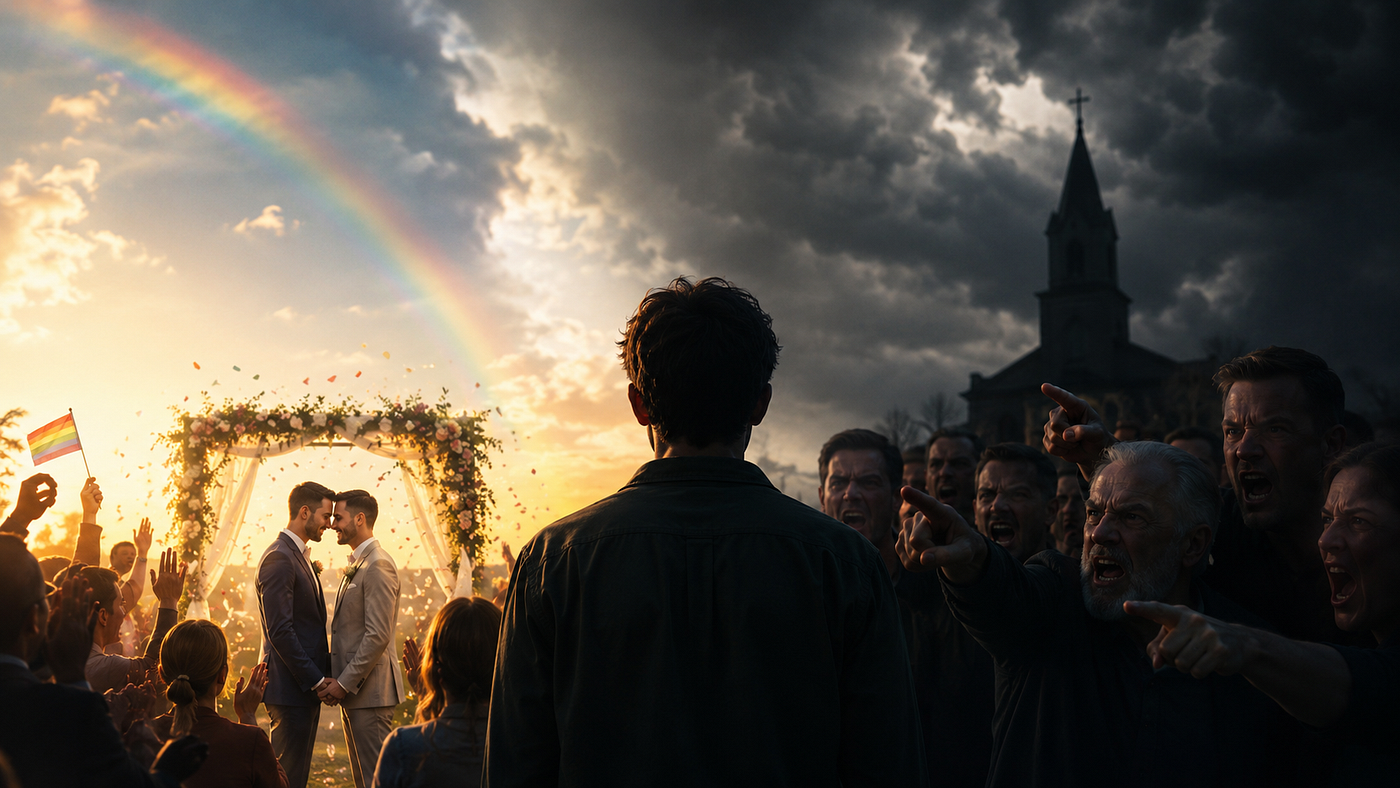
Photo by Maksim Chernishev on Unsplash
Dear reader,
This is the month when the world — or at least the part of it most attuned to social issues — pauses to reflect and celebrate the battles won and those still to be fought for the rights of LGBTQ+ people.
It is right to do so, and I say this without exaggeration, because this is precisely what commemorations are for: to slow down just enough to remind us where we started.
This month, I feel I must make my own small contribution. Not out of any militant calling — being intellectually honest, I consider myself a heterosexual who has never experienced this kind of harassment due to sexual orientation, but who has experienced bullying for being part of a religious minority — but out of a desire to bear honest witness, which is something different and sometimes more uncomfortable.
A brief introduction
I was born into a family of Jehovah’s Witnesses, and it was in that home that I learnt to read. The first books and magazines that passed through my hands had colourful illustrations, simple sentences and language that would make more than one secular parent shudder today.
On one point, however, there were no nuances. Homosexuals, it was written in black and white, would not enter the Kingdom of God. Sodomites and perverts. Neither a passing opinion nor a marginal interpretation left to the individual preacher. It was doctrine, and it was reiterated with that terrible calm that only truths deemed eternal possess.
Anyone who claims today that Jehovah’s Witnesses treat LGBTQ+ people with compassion and acceptance is either misreading their own literature or counting on the fact that others do not read it at all. And that is precisely where I must begin.
Let’s put the matter in its proper context. The language used by the Witnesses today does indeed sound softer than it once did. I concede that, and I concede it willingly, because it would be unfair to pretend otherwise. The harshest words have been tucked away, and in their place has come a more cautious, more polished prose, better suited to the TikTok stage.
The trouble is that the doctrine, in the meantime, has remained exactly where it was. And the doctrine continues to demand, in no uncertain terms, three specific things of its LGBTQ+ members. Lifelong sexual abstinence. Suppression of desire towards one’s own sex. Judicial discipline, with all its social and family consequences, for those who decide to live openly according to their sexual orientation.
I should add, for the sake of clear communication, that these lines are not the product of my own militant reinterpretation nor of malicious conjecture. They are written, word for word, in their publications. Anyone who does not believe me should take their texts and read them. I have gone to the trouble of re-reading them for you, and it is a task I recommend to anyone who wishes to discuss this matter seriously.
What Jehovah’s Witnesses Teach About Homosexuality
Jehovah’s Witnesses uphold a doctrinal position that firmly condemns every homosexual practice as a serious sin, while officially stating that they respect the dignity of the individual and reject homophobia.
The sources indicate that Jehovah’s Witnesses base their view on a strict interpretation of the Bible. For example, they cite the biblical book of 1 Corinthians, where it is written that sodomites will not inherit the Kingdom of God (1 Corinthians 6:9–10). Jehovah’s Witnesses define homosexuality broadly, including not only full sexual intercourse, but any “erotic activity” or “behaviour aimed at obtaining sexual pleasure” with a person of the same sex, such as kissing or intimate caressing (The Watchtower, 1983).
The doctrinal logic lies in the belief that God instituted marriage exclusively between one man and one woman, and that human beings have the moral capacity to control their impulses (Awake, 2016). Jehovah’s Witnesses make a fundamental distinction between “inclinations”, which may be deep or persistent, and “practices”: they argue that, although a person may continue to feel attraction towards someone of the same sex, they have the responsibility to “deaden” such desires through prayer and Bible study, choosing not to act on them (JW.org, 2026).
An analysis of the sources reveals a marked evolution in the tone of the rhetoric, while the doctrinal substance remains unchanged. While publications from the 1970s and 1980s used explicitly harsh language, defining homosexuality as “detestable”, “unnatural” and linking it to “perversions” or masturbation, more recent material adopts a more “tactical” approach, comparing the management of homosexual impulses to that of anger or aggression.
It is worth noting, however, that over time psychiatry’s judgement on homosexuality has moved from classifying it as a serious mental illness to fully recognising its normality. Initially considered a sociopathic personality disorder, it was declassified as an illness in 1973 by the American Psychiatric Association and in 1990 by the World Health Organization (WHO). This consideration does not excuse the harsh language used in the past, but it may offer a broader view of how homosexuality was perceived in the scientific world.
However, a critical tension remains. On the one hand, Jehovah’s Witnesses claim not to promote prejudice (Awake, 2016), but on the other hand, they classify homosexual activity as a disfellowshipping offence, meaning expulsion from the community, and describe the homosexual lifestyle as intrinsically “frustrating”, “miserable” and based on “lies” (The Watchtower, 1983). This view reduces sexual orientation to a mere “fleshly impulse” to be repressed, ignoring modern biological or psychological perspectives, which Jehovah’s Witnesses dismiss as “worldly propaganda”.
In conclusion, the position of Jehovah’s Witnesses imposes on members with homosexual tendencies a dichotomous choice: total abstinence and the repression of their desires in order to remain in communion with the organisation, or the spiritual and social marginalisation resulting from living out their sexual identity.
What Christianity Says
Contemporary Christianity does not present a monolithic position on homosexuality. Instead, it shows a deep polarisation ranging from firm doctrinal condemnation based on tradition to full theological and pastoral inclusion.
As an example, the Catholic Church and the Orthodox Churches officially define homosexual acts as “intrinsically disordered” or sinful, excluding the possibility of equating same-sex unions with marriage (Catechism of the Catholic Church, para. 2357; Standing Conference of the Canonical Orthodox Bishops in the Americas, 2003).
By contrast, several denominations of historic Protestantism, such as the Church of Sweden, the Evangelical Lutheran Church in America (ELCA) and the United Church of Canada, have undertaken paths of substantial inclusion of LGBTQ+ people.
The Church of Sweden has opened church marriage to same-sex couples and has recognised that there should be no obstacle in principle to a homosexual person holding office in the Church (Church of Sweden, 2009). The ELCA, while maintaining a certain internal “structured diversity”, adopted a position in 2009 that allows for the pastoral recognition of homosexual relationships and the inclusion of LGBTQ+ ministers (ELCA, 2009). The United Church of Canada, instead, has declared since 1988 that all people, regardless of sexual orientation, are welcome as full members and may be considered for ordained ministry (The United Church of Canada, 2019).
This theological divergence is based on different approaches to the authority of the Scriptures and to the concept of “Natural Law”: while conservative religious groups, including Jehovah’s Witnesses in this respect, read biblical prohibitions, such as those in Leviticus or in Paul’s letters, as immutable principles of divine creation, progressive currents use modern hermeneutics to contextualise such passages historically, privileging the evangelical message of universal love and the intrinsic dignity of every person regardless of sexual orientation.
This comparison shows that Christianity cannot be treated as a single doctrinal bloc when discussing homosexuality. However, the contrast between “conservative” and “progressive” churches should not be oversimplified. Even within more inclusive denominations, acceptance may vary between official policy, local congregations and individual clergy. Similarly, conservative churches may claim to distinguish between homosexual orientation and homosexual practice, but this distinction can still place LGBTQ+ believers in a position of permanent self-denial. The key issue, therefore, is not only what each church teaches in theory, but how these teachings affect the lived experience, dignity and social belonging of LGBTQ+ members.
What It Means to Be LGBTQ+ Inside the JW System
LGBTQ+ individuals living within the Jehovah’s Witness system describe an existence defined by suffocating secrecy, intense cognitive dissonance, and a forced internal fragmentation required to maintain their religious standing.
Evidence from personal memoirs and sociological studies indicates that being a Witness in this context is a “living paradox,” where members must “partition” their minds to stay “no part of the world” while hiding their true identities from a community that views their orientation as an “abomination” (Cox, 2023; Greenough, 2024). As already mentioned, the system does not permit the existence of an “active” LGBTQ+ member; an individual is only tolerated if they remain strictly celibate and actively work to suppress their feelings in “thought, feeling, and action”.
For instance, Daniel Allen Cox — a former member — recounts “suffocating” his identity for years just to maintain the hope of living on a “paradise Earth,” illustrating how the system forces members to choose between their fundamental self and their spiritual survival (Cox, 2023). Other narratives highlight that acceptance within the congregation is “strictly conditional,” existing only as long as the individual successfully hides their identity; as soon as a member “acts on it” or comes out, they are discarded and treated as if they no longer exist (Grendele et al., 2023).
Ultimately, the testimonies of LGBTQ+ people inside the JW system suggest that reconciliation is impossible, as the organisation’s high-cost demands require a total erasure of the individual’s identity in exchange for a fragile and highly surveilled sense of belonging.
By Way of Farewell
As I take my fingers off the keyboard, I realise that this page makes no claim to sit above other people’s consciences. The courts of conscience are best left to those who inhabit them. One thing, however, I feel I can say without blushing.
A doctrine that demands a human being live seventy years in abstinence, repressing a central part of their emotional and sexual life, and which punishes them with social exile should they refuse, is not protecting any purity. It is simply constructing well-ordered solitudes. I have seen these solitudes up close, and I assure you they have nothing edifying about them. Where is God in all of this?
I have known men and women who have spent their entire lives pretending to be something they were not, and I have known them because some of them, sooner or later, came to tell me about it. Some with pain. Others with that weary resignation that is worse than the pain itself.
To those who today preach to their homosexual congregants to ‘tame the flesh’, I wish them at least one thing. That they find the courage, once in their lives, to look one of them in the face and to hold that gaze right to the end.
M.F.
If you liked this article, you might also appreciate my other piece on how fear shapes belief in everyday life: **Why Jehovah’s Witnesses Don’t Celebrate Birthdays.**
Author Bio
Photo by Matteo Fortin
Matteo Fortin is a psychology student and aspiring clinical psychologist. He writes about lived experience, mental health, and the intersection of belief and identity.
메타데이터
- post_id
- 699a1eb51801
- slug
- what-do-jehovahs-witnesses-think-about-lgbtq-people-699a1eb51801
- url
- https://medium.com/backyard-theology/what-do-jehovahs-witnesses-think-about-lgbtq-people-699a1eb51801
- canonical_url
- https://medium.com/backyard-theology/what-do-jehovahs-witnesses-think-about-lgbtq-people-699a1eb51801
- author_url
- https://medium.com/@lumenmentis
- status
- ok
- fetched_at
- 2026-06-13 16:00:06