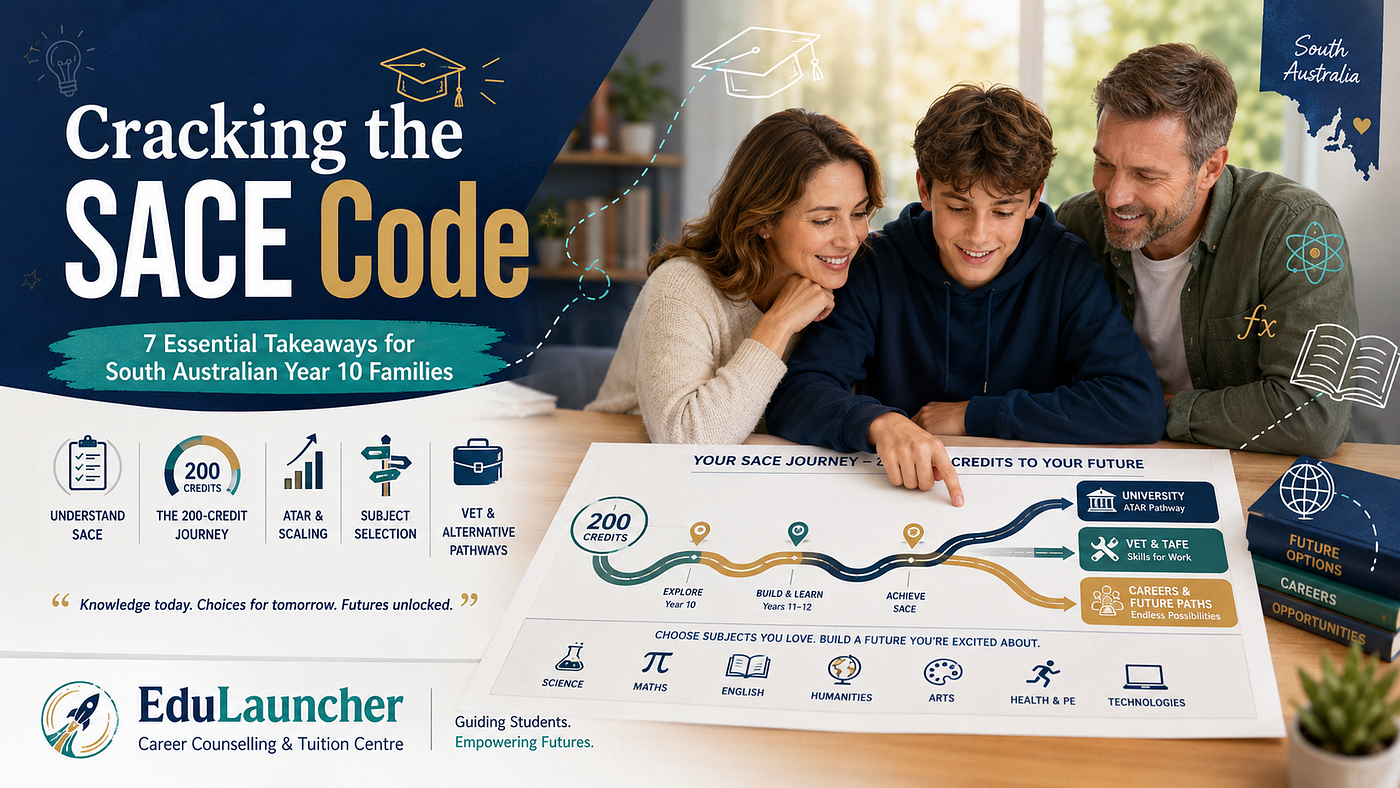
Cracking the SACE Code: 7 Essential Takeaways for Every South Australian Year 10 Family
Year 10 is the bridge to your child’s career, but it is also the official launchpad for the South Australian Certificate of Education…
Cracking the SACE Code: 7 Essential Takeaways for Every South Australian Year 10 Family
Year 10 is the bridge to your child’s career, but it is also the official launchpad for the South Australian Certificate of Education (SACE). This is the year the “middle school” mindset ends and strategic planning begins. From the moment your child begins their first compulsory subject to the day they receive their official SACE registration and portal access, they are no longer just a student — they are an architect of their own future. While the system appears complex, it is actually a flexible roadmap designed to reward individual interests and diverse pathways, provided you know how to navigate the turns.
Takeaway 1: It’s All About the Credits (The 200-Point Goal)
Think of SACE credits as the “currency” of the qualification. To graduate, every student must bank a total of 200 credits. The math is simple: a 10-credit subject usually represents one semester of work, while a 20-credit subject covers a full year. In Year 10, students typically receive their SACE registration, giving them access to the “Students Online” portal to track these credits as they accumulate.
The 200-credit journey is broken down into three distinct categories:
- 50 Compulsory Credits: These are the “must-pass” foundation subjects.
- 60 Stage 2 Credits: Advanced study completed at the Year 12 level (can include recognised VET).
- 90 Elective Credits: A customised mix of Stage 1 or Stage 2 subjects, VET, or recognised community learning.
Takeaway 2: The “Must-Pass” Pillars (The C-Grade Rule)
In a Stage 1 subject, all student work is assessed by the school. In a Stage 2 subject, 70% of student work is assessed by the school, with 30% assessed externally.
There are four compulsory pillars that act as the skeleton of the SACE. Simply attending these classes is not enough; the SACE Board mandates a specific “passing” standard to satisfy the certificate requirements. If a student falls below these grades, they must repeat the subject or find an equivalent credit.
- Exploring Identities and Futures (EIF): 10 credits, usually the first SACE subject tackled in Year 10.
- Literacy: At least 20 credits of English subjects.
- Numeracy: At least 10 credits of Mathematics subjects.
- Activating Identities and Futures (AIF): 10 credits, completed at Stage 2 (Year 12).
The grading rules are non-negotiable:
- Stage 1 Compulsories (EIF, English, Maths): A grade of C or better is required.
- Stage 2 Compulsory (AIF): A grade of C- or better is required.
“To earn the SACE, students must accrue at least 200 credits through a combination of compulsory and elective subjects… To complete the SACE, you must achieve a specific minimum grade in these mandatory areas.” — South Australian Certificate of Education Completion Requirements
Takeaway 3: ATAR is a Rank, Not a Score
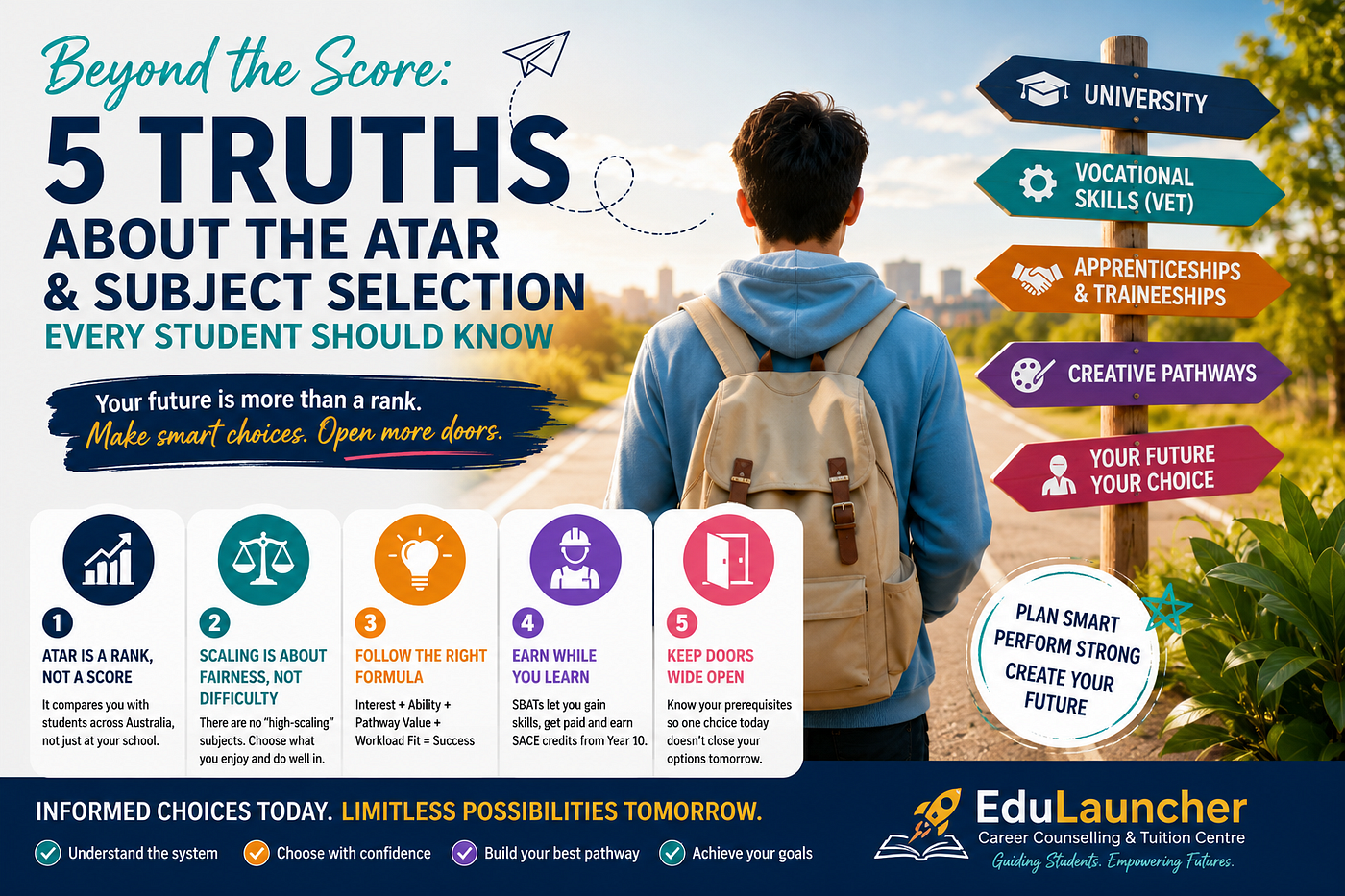
For university-bound families, the Australian Tertiary Admission Rank (ATAR) is often the source of the most confusion. It is vital to understand that an ATAR is a rank from 0 to 99.95, not a percentage of correct answers on a test. SATAC first calculates a “percentile rank” by looking at where a student sits within the cohort of those who received a university aggregate that year. For example, if your child’s aggregate is better than 90% of other students, their raw percentile is 90.00.
However, the final ATAR is adjusted through the “Participation Rate Adjustment.” Because not every person in an age group finishes school, SATAC uses Australian Bureau of Statistics data to compare your child to the entire population of their age group — including those who left school early. This is why the ATAR is the ultimate comprehensive measure; it tells a university where your child stands relative to the entire Australian population of their age, ensuring a fair comparison across the country.
Takeaway 4: The Scaling Trap: Why Chasing Points Can Backfire
Scaling is a statistical tool used by SATAC to ensure fairness across different subjects, but it is often misunderstood as a way to “boost” scores. The reality is that scaling is dynamic and changes every year based on the performance of the cohort. A major red flag in Year 10 planning is choosing a “hard” subject solely for perceived scaling benefits. This strategy often backfires; a student who struggles in a high-scaling subject will likely end up with a lower scaled score than if they had excelled in a subject they actually enjoyed.
Pro-Tip: The Success Formula The most effective subject selection follows a strict hierarchy: Interest + Ability + Pathway Value + Workload Fit. A student in a “sustainable high-performance pathway” — one that matches their strengths — will always produce better results than one chasing a scaling myth.
Takeaway 5: The EIF to AIF Evolution
The “Identity” thread is a unique strength of the South Australian system. It begins in Year 10 with Exploring Identities and Futures (EIF) and culminates in Year 12 with Activating Identities and Futures (AIF). EIF is the subject for self-discovery, allowing students to explore their strengths before “locking in” a final direction. AIF then takes those Year 10 aspirations and turns them into a Stage 2 (Year 12) requirement for action, focusing on self-directed learning and agency.
“Exploring Identities and Futures (EIF) supports students to explore their aspirations. They are given the space and opportunity to extend their thinking beyond what they want to do, to also consider who they want to be in the future.” — EIF Subject Outline
Takeaway 6: VET and Apprenticeships (Earn While You Learn)
Vocational Education and Training (VET) and School-Based Apprenticeships and Traineeships (SBATs) are not “alternative” tracks; they are fully integrated into the SACE. Students can start an SBAT as early as Year 10, earning a wage and an accredited qualification while still at school. For those aiming for university, VET is officially termed “Recognised Studies.” Up to 20 credits of recognised Stage 2 VET can contribute directly to the university aggregate used to calculate an ATAR.
High-demand industry clusters in South Australia include:
- Construction: Carpentry, building, and civil construction.
- Defence and Manufacturing: Specialized technical training for local industry needs.
- Health and Community: Nursing support, aged care, and childcare.
- Automotive: Light and diesel mechanic pathways.
- Primary Industries: Agriculture, forestry, and resource management.
- Information Technology: Cybersecurity foundations and tech support.
Takeaway 7: The “Red Flag” Warning on Prerequisites
One of the most critical parts of Year 10 counselling is distinguishing between a Prerequisite (mandatory for entry) and Assumed Knowledge (background you need to keep up). Dropping certain subjects too early can create a “point of no return.”
The most common risky omission is dropping Mathematical Methods in favor of General Mathematics. While General Maths is a valid SACE subject, it does not meet the prerequisites for Engineering, high-level Science, or Medicine at most universities. Dropping Chemistry or higher-level Mathematics in Year 10 or 11 can permanently close doors to STEM careers. If your child is academically capable, the safest professional advice is to maintain a broad subject package to avoid accidentally limiting their future options.
Conclusion: Planning for a Flexible Future
Success in the senior secondary years looks different for every student. The SACE is not a one-size-fits-all hurdle; it is a customisable journey that evolves as your child grows. Families should use the SACE planner, engage with their school’s VET Coordinator or Careers Counsellor, and focus on building a pathway that is both rigorous and sustainable.
As you sit down to discuss subject selections this year, ask one guiding question:
“Is your child choosing subjects for a rank, or for a future they are actually excited to inhabit?”
Want your child to feel more confident before Year 11?
Subject selection is easier when students have strong foundations. EduLauncher offers Maths, Science and English tutoring for primary, middle and senior school students, with a focus on concept clarity, confidence, homework support, revision and assessment preparation.
Whether your child needs help catching up, extending ahead, or preparing for senior subjects such as primary and middle school Science, Math or English and Stage 1 & 2 Biology, Chemistry and Physics, we can support their learning journey.
Contact EduLauncher Career Counselling & Tuition Centre to enquire about tutoring classes.

메타데이터
- post_id
- 699cb8bd5437
- slug
- cracking-the-sace-code-7-essential-takeaways-for-every-south-australian-year-10-family-699cb8bd5437
- url
- https://medium.com/@tutor.edulauncher/cracking-the-sace-code-7-essential-takeaways-for-every-south-australian-year-10-family-699cb8bd5437
- canonical_url
- https://medium.com/@tutor.edulauncher/cracking-the-sace-code-7-essential-takeaways-for-every-south-australian-year-10-family-699cb8bd5437
- author_url
- https://medium.com/@tutor.edulauncher
- status
- ok
- fetched_at
- 2026-06-14 11:28:49