When is a Mouse a Maus?
Art Spiegelman’s Maus: A Survivor’s Tale deals with the author, Art, traversing the story of his father Vladek as he narrates his early…
When is a Mouse a Maus?
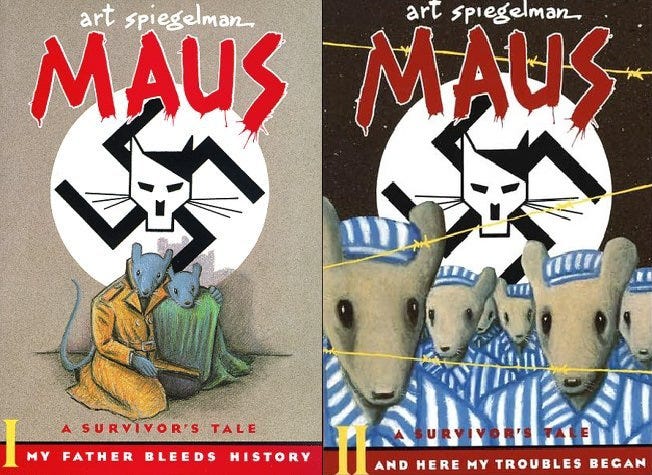
Cover of Maus Volumes 1 & 2
Art Spiegelman’s *Maus: A Survivor’s Tale deals with the author, Art, traversing the story of his father Vladek as he narrates his early life in Poland during the start of World War II, on the front lines, in the Jewish ghettos (Volume One: My Father Bleeds History), and finally in Auschwitz (Volume Two: And Here My Troubles Begin*) whilst Art also tells a metanarrative of the relationship between himself and his father. The significance of this novel comes not with the story (which itself is compelling) but also with the visual medium it inhabits as a means to project the story. While the story is straightforward, Art subverts artistic realities by portraying all different races within his story as animals. Most notably, the Jews are seen as mice, German Nazis as cats, Polish citizens are pigs. The physical representation of identity within the graphic/novel comes at a cost though with the ways in which Art attempts to signify differences.
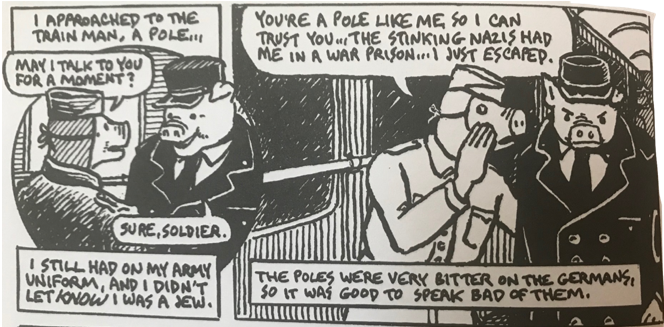
Vladek speaking to a Polish Train Man (Taken from Spiegelman’s Maus Pg. 66)
Sidonie Smith and Julia Watson explain in Reading Autobiography: A Guide for Interpreting Life Narratives that the autobiographical concept of Identity is defined as acts in which the “writers make themselves known by acts of identification and, by implication, differentiation” (38). They go on to explain that identity can serve as a discursive saying that identities “are constructed. […] They are not essential-born, inherited, or natural-though much in social organization leads us to regard identity as given and fixed” (38).
Art Spiegelman is very aware of the ways in which representation and identity work within a graphic medium and the ways in which it could be manipulated. His identity and the identities of others in the story and the metanarrative of Maus, are in a state of flux that is symbolized with the visual within the text. At one point in the story, Vladek tells of a fellow prisoner who appeals to the guards of his German heritage. Within the text, the character is represented both as a mouse, signifying his Jewish self and also a cat signifying his German self.
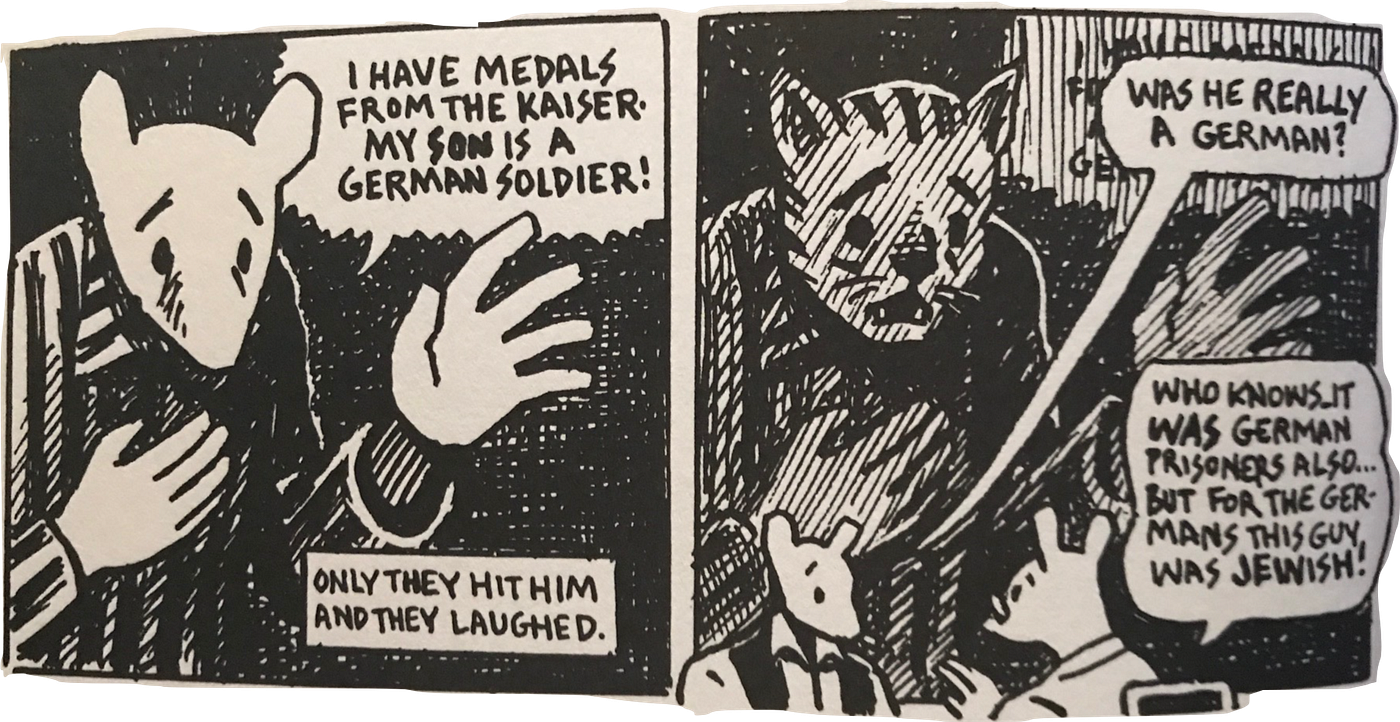
Representation and Identity in Maus (Taken from Maus Pg. 210)
Both of these identities are at odds within the narrative though not only for the obvious political and social clash but also because of the way in which Vladek states how that to the Germans running the camp “this guy was Jewish” denoting that his religious identity is the single identifier of his identity. The identity of this prisoner wasn’t a fluctuating point for Vladek but for Art it is static, and it is exemplified in his representation in the text. Much like in William Apess’ Son of the Forest, both narrators fluctuate between different identities and at times are either stuck within one or the other all whilst being repelled or disavowed by the other in separate ways. For Apess, it comes in the form of not belonging to either the native Indians or the Anglo-Saxon settlers of the area. Spiegelman though feels a disownment from within his own family in the way that Vladek doesn’t accept his son for his rejection of his Jewish identity but this issue lies much deeper.
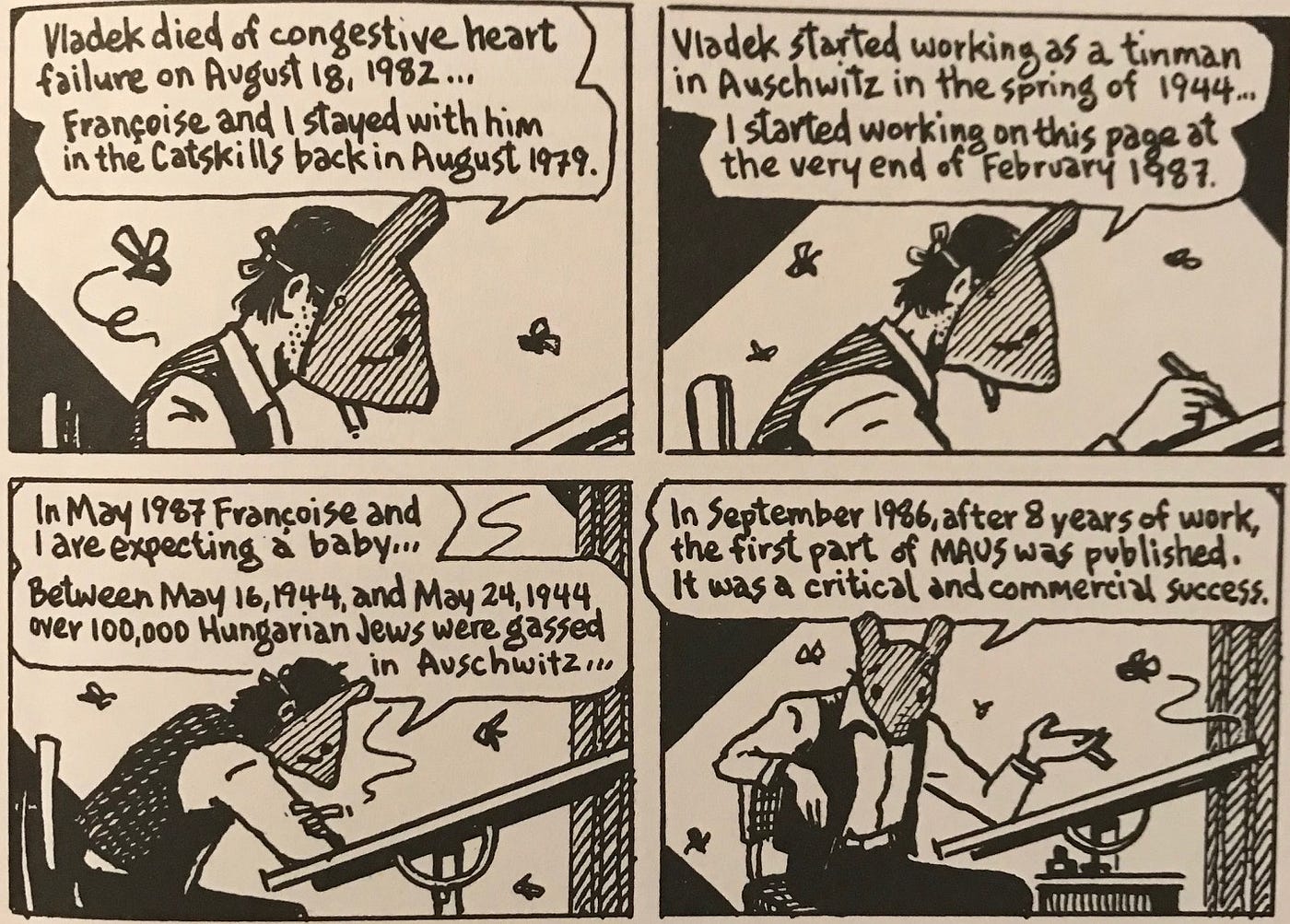
Art’s Identity (Taken from Maus Pg. 201)
Art also deals with the issues of identity within himself. Later in the novel, in an introspective and retrospective moment, he dons a mouse mask while jumping between points of reference in his own life and Vladek’s life. It is the one true moment in the narrative where Art is directly speaking to the reader and also in which what could be his real identity. He wears a mask of a rat (much like how his father wore a “mask” when speaking to a Polish citizen) to symbolize his Jewish identity. There are many ways to read this magnificent point in the story. The most tangible point is Art attempting to find a way to identify with his father. He wishes to understand what his father went through and thus shares something in common with him. But in the end, Art is not his father. In reality, Art is just a man wearing a mouse mask. He is not like one of the mice hunted by the Nazi. He is just a man who is trying.
메타데이터
- post_id
- 69be22cfd1f4
- slug
- when-is-a-mouse-a-maus-69be22cfd1f4
- url
- https://medium.com/@diego.villa93/when-is-a-mouse-a-maus-69be22cfd1f4
- canonical_url
- https://medium.com/@diego.villa93/when-is-a-mouse-a-maus-69be22cfd1f4
- author_url
- https://medium.com/@diego.villa93
- status
- ok
- fetched_at
- 2026-07-30 19:16:16