The Habit Loop: Why You Keep Doing the Same Things Every Day
Every habit you have—good or bad—follows a simple four-step cycle. Once you understand what triggers your behavior, changing it becomes…
The Habit Loop: Why You Keep Doing the Same Things Every Day
Every habit you have—good or bad—follows a simple four-step cycle. Once you understand what triggers your behavior, changing it becomes much easier.
Introduction:
Have you ever opened Instagram without consciously deciding to?
You pick up your phone to check the time.
Five minutes later, you're watching reels.
Then another.
And another.
Twenty minutes disappear.
You finally close the app and wonder:
"Why did I even open Instagram?"
The interesting part is that your brain probably knew exactly what it was doing.
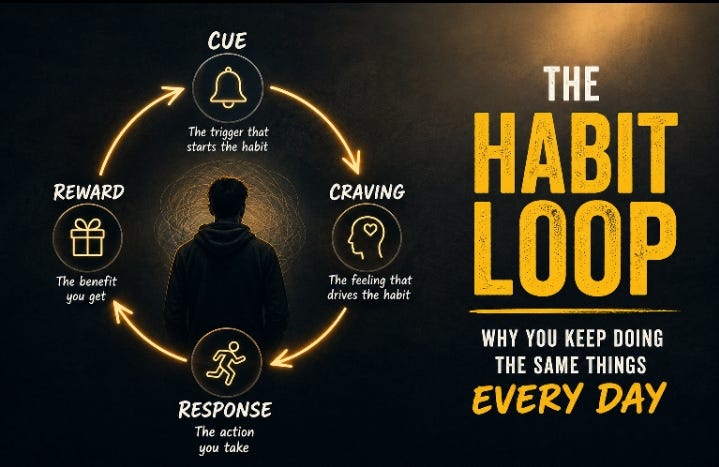
Because behind almost every habit in your life is a simple psychological cycle:
Cue → Craving → Response → Reward
This is called the Habit Loop.
And once a behavior travels through this loop enough times, you start doing it almost automatically.
1. Cue — Something Triggers You
Every habit needs a starting point.
That's the cue.
Imagine your phone vibrates while you're working.
You weren't thinking about your phone a second ago.
But suddenly, your attention shifts.
"Who messaged me?"
The vibration didn't make you check your phone.
It simply created a signal that something potentially rewarding was waiting for you.
Cues can be almost anything:
A notification.
A particular time.
A location.
A person.
An emotion.
Even boredom.
Think about your morning routine.
Your alarm rings.
You wake up.
Maybe the first thing you do is grab your phone.
If you've repeated that behavior hundreds of times, the alarm itself may have become the cue.
Your brain has learned:
Wake up → Check phone.
And that's where the habit begins.
2. Craving — You Want a Change
The second stage is often misunderstood.
You don't necessarily crave the habit.
You crave what the habit gives you.
Someone constantly checking Instagram isn't necessarily craving Instagram itself.
They might be craving entertainment.
Someone ordering junk food after a stressful day might not simply be craving pizza.
They may be craving comfort.
Someone going to the gym every morning isn't necessarily craving dumbbells.
They're craving strength, confidence, progress, or the feeling they get after training.
That's why cravings are powerful.
Behind most habits is a simple desire:
You want to change how you currently feel.
Bored → entertained.
Stressed → relaxed.
Tired → energized.
Weak → stronger.
Disconnected → connected.
The habit is simply the method your brain has learned to achieve that change.
3. Response — You Do Something
Now comes the actual behavior.
You see the notification.
You feel curious.
Then you unlock your phone.
That's the response.
The response is the action you perform to satisfy the craving.
And here's something important:
We naturally repeat behaviors that are easy to perform.
Imagine two situations.
Your phone is sitting beside you while you're studying.
Checking Instagram requires two seconds.
Now imagine your phone is switched off and kept in another room.
The same habit suddenly requires much more effort.
Nothing about Instagram changed.
But the difficulty of the response changed.
The easier a behavior becomes, the more likely we are to repeat it.
That's why our environment has such a powerful influence over our habits.
4. Reward — Your Brain Gets What It Wanted
Finally comes the reward.
You open Instagram.
There's a message from your friend.
You read it.
Maybe you laugh.
For a moment, your curiosity disappears.
Your brain receives what it was looking for.
Satisfaction.
And something important happens in the background.
Your brain remembers the experience.
"When my phone vibrates, checking it feels good."
Next time the phone vibrates, the cycle begins again.
Cue: Notification.
Craving: Curiosity.
Response: Check phone.
Reward: Satisfaction.
Repeat that hundreds or thousands of times and eventually the behavior becomes automatic.
You don't consciously analyze every step anymore.
You just do it.
The Same Loop Can Build Your Best Habits
The Habit Loop isn't something negative.
The exact same mechanism can build powerful habits.
Imagine you've started exercising every morning.
Your workout clothes sitting beside your bed become the cue.
You start thinking about feeling stronger and healthier.
That's the craving.
You go to the gym.
That's the response.
After finishing the workout, you feel energetic, accomplished, and proud.
That's the reward.
Repeat this long enough and something changes.
At first, going to the gym requires effort.
Eventually, not going feels strange.
That's when you realize the habit has started becoming part of your life.
Your Environment Is Training You Every Day
Here's something worth thinking about.
Look around your room.
Your phone.
Your television.
Your books.
Your running shoes.
Your snacks.
Your laptop.
Everything around you can potentially become a cue.
If your phone is always visible, you're constantly reminded to check it.
If unhealthy food is sitting on your desk, you're constantly reminded to eat it.
But the opposite is also true.
If your book is beside your bed, you're reminded to read.
If your water bottle is beside your laptop, you're reminded to drink.
If your gym clothes are prepared before you sleep, exercising becomes easier to start.
Sometimes changing a habit isn't about becoming more disciplined.
It's about changing what your environment keeps reminding you to do.
Conclusion
Your life isn't shaped only by the big decisions you make once in a while.
It's shaped by the tiny behaviors you repeat almost without thinking.
And behind many of those behaviors is the same cycle:
Cue → Craving → Response → Reward.
Your alarm rings.
You reach for your phone.
Stress hits.
You search for comfort.
You see your running shoes.
You remember your goal.
These moments may look insignificant.
But repeated hundreds of times, they become habits.
And repeated for years, those habits can shape your health, career, relationships, finances, and future.
So instead of asking:
"Why don't I have enough motivation?"
Start asking:
"What is triggering this behavior?"
Because once you understand the loop behind your habits, you can finally start understanding the behaviors that are quietly building your life.
Untill Next time , Stay Focused
-Venkat
메타데이터
- post_id
- 69ceccd09a0d
- slug
- the-habit-loop-why-you-keep-doing-the-same-things-every-day-69ceccd09a0d
- url
- https://medium.com/@ashwinseshadri08/the-habit-loop-why-you-keep-doing-the-same-things-every-day-69ceccd09a0d
- canonical_url
- https://medium.com/@ashwinseshadri08/the-habit-loop-why-you-keep-doing-the-same-things-every-day-69ceccd09a0d
- author_url
- https://medium.com/@ashwinseshadri08
- status
- ok
- fetched_at
- 2026-08-12 14:56:17