How ISIS Media Ecosystems Are Leveraging the 2026 FIFA World Cup
The most consequential developments within extremist ecosystems rarely begin with explicit operational directives. More often, they emerge…
How ISIS Media Ecosystems Are Leveraging the 2026 FIFA World Cup
The most consequential developments within extremist ecosystems rarely begin with explicit operational directives. More often, they emerge through shifts in narrative construction, visual propaganda, and media adaptation.
In June 2026, a series of publications released by official and affiliated Islamic State media entities demonstrated how a single ideological narrative can evolve into a multi-layered influence campaign centered on one of the world’s most visible sporting events: the 2026 FIFA World Cup.
Rather than originating from a single source, the campaign developed across multiple layers of the Islamic State media ecosystem. An AI-generated threat poster, an official editorial published in Al-Naba, and a serialized infographic campaign produced by Al-Burhan collectively illustrate how extremist organizations adapt messaging for different audiences, platforms, and formats while maintaining a consistent ideological core.
The Campaign
Al-Iman Publications
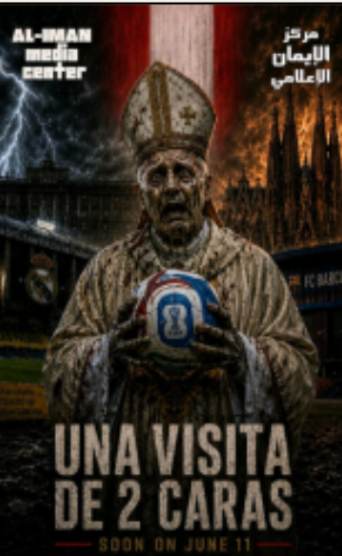
The first indication of the emerging campaign appeared on June 1, when the ISIS-affiliated Al-Iman Media Center released an AI-generated threat poster depicting a blood-stained Pope standing before major Spanish football stadiums and religious landmarks engulfed in flames. Accompanied by the caption “A Two-Faced Visit,” the graphic referenced the Pope’s upcoming apostolic visit to Spain and combined religious symbolism, political messaging, and visual intimidation into a highly shareable digital asset.
While the poster did not reference the FIFA World Cup directly, its imagery is notable. By pairing Christian religious figures with football stadiums and scenes of destruction, the graphic connected multiple high-visibility symbolic targets within a single visual narrative.
Unlike traditional jihadist publications, which often rely on lengthy theological texts, AI-assisted visuals provide immediate emotional impact and require little contextual knowledge from the viewer. As a result, they serve as an effective mechanism for expanding the reach of extremist narratives beyond the organization’s traditional audiences.
AI-generated threat poster published by the ISIS-affiliated Al-Iman Media Center depicting Pope Leo XIV holding a FIFA-branded football while standing before Madrid’s Santiago Bernabéu Stadium and Barcelona’s Sagrada Familia engulfed in flames. The Spanish-language caption, “Una Visita de 2 Caras” (“A Two-Faced Visit”), appears to link the Pope’s visit to Spain with the opening phase of the 2026 FIFA World Cup, illustrating the growing use of AI-enhanced visual propaganda to exploit high-profile global events and symbolic targets.
The Cover of the Publication
Al-Naba Publications
On June 19, 2026, ISIS published Issue 552 of Al-Naba, the organization’s official weekly newspaper. Among its articles was a one-page editorial titled “Who Will Be Crowned with the Title?”, which used the upcoming 2026 FIFA World Cup as a vehicle for a broader ideological message.
Al-Naba does not function merely as a propaganda outlet; it serves as one of ISIS’s primary vehicles for communicating official ideological guidance. Content published within its pages carries a degree of authority, and narratives introduced by Al-Naba frequently serve as the foundation for subsequent amplification campaigns across the broader ISIS media ecosystem.
The article systematically contrasts what it describes as the values of modern sports culture with concepts central to Salafi-jihadist ideology. It criticizes the emotional attachment of fans to athletes, clubs, and national teams. The article repeatedly attempts to redirect attention toward what ISIS presents as more legitimate forms of commitment and sacrifice — relying on benign religious themes to ground more harmful narratives. Themes of jihad, religious duty, collective identity, and ideological steadfastness appear throughout the text, creating a narrative in which sporting events become symbols of a broader cultural and religious struggle.
This dynamic is particularly evident in the World Cup campaign. While the original editorial was limited to a single newspaper page and primarily targeted an audience already familiar with ISIS’s ideological discourse, its publication provided an official doctrinal framework that could later be adapted, repackaged, and redistributed by affiliated media organizations in formats better suited for contemporary digital audiences.
Al-Burhan Publications
ISIS Al-Burhan Media Foundation ( an Islamic State–affiliated media outlet that republishes and repackages ISIS messaging) launched a seven-part infographic campaign built almost entirely from the text of the Al-Naba editorial. Unlike many supporter-driven propaganda efforts, Al-Burhan did not introduce new ideological arguments or reinterpret the message. Instead, it converted an official ISIS publication into a format optimized for modern digital consumption.
This transformation highlights a key characteristic of contemporary jihadist media ecosystems. While official outlets such as Al-Naba establish ideological legitimacy and define the organization’s narrative priorities, affiliated entities increasingly focus on adapting those messages for wider dissemination.
What This Reveals About the Modern ISIS Media Ecosystem
Viewed together, the Al-Iman, Al-Naba, and Al-Burhan publications reveal a media ecosystem that is far more sophisticated than a collection of isolated propaganda outlets. Rather than operating independently, these entities perform complementary functions within a broader communication architecture designed to maximize reach, engagement, and ideological influence.
At the center of this ecosystem remains ISIS’s official media apparatus. Publications such as Al-Naba continue to provide ideological legitimacy and strategic direction, establishing the narratives that supporters and affiliated entities are expected to amplify. The authority of official media remains critical, as content originating from Al-Naba carries significantly greater credibility among supporters than material produced solely by unofficial channels.
Affiliated media entities increasingly serve a different role. The campaign demonstrates not only how extremist narratives are amplified, but also how official doctrine can be adapted into platform-native formats capable of competing within modern attention economies.
In this model, ideological authority remains centralized, while dissemination strategies become increasingly decentralized and optimized for engagement. Instead of generating new ideological content, they adapt, repackage, and optimize official messaging for modern digital audiences.
Al-Burhan’s transformation of a single-page editorial into a seven-part visual campaign illustrates how extremist media ecosystems now borrow techniques commonly associated with mainstream social media marketing: serialization, visual storytelling, audience segmentation, and engagement-focused design.
The Growing Importance of AI-Enhanced Media Production
The AI-generated Al-Iman poster demonstrates how emerging technologies can be used to rapidly produce visually compelling content tailored to contemporary online environments. While official ISIS publications continue to rely primarily on text-based ideological discourse, affiliated entities appear increasingly willing to leverage new technologies to improve visibility, emotional impact, and audience engagement.
Perhaps most importantly, the campaign illustrates a broader shift in how extremist organizations approach influence operations. Rather than relying solely on recruitment or direct organizational participation, contemporary jihadist ecosystems increasingly focus on sustained ideological exposure.
By embedding extremist narratives within globally recognized events such as the FIFA World Cup, media entities can exploit existing public attention, increase the visibility of their messaging, and expose broader audiences to extremist content.
The significance of this campaign therefore extends beyond its immediate subject matter. It demonstrates how modern extremist ecosystems combine official doctrine, affiliated amplification networks, visual optimization, and emerging technologies to transform a single ideological narrative into a scalable influence operation capable of reaching audiences far beyond the organization’s traditional support base.
Conclusion
The World Cup campaign demonstrates that the strength of modern extremist propaganda lies not only in the content itself, but in the ability of media ecosystems to adapt, repackage, and amplify narratives across formats and audiences.
Official publications provide ideological legitimacy, affiliated entities increase accessibility and engagement, and emerging technologies accelerate production and dissemination. The result is a communication model designed to maximize visibility while maintaining consistency with official organizational messaging.
As terrorist organizations continue to experiment with AI-generated content, visual storytelling, and platform-specific distribution strategies, understanding how narratives evolve across interconnected media layers becomes increasingly important. Monitoring these transformations provides valuable insight into how extremist ecosystems adapt to changing technologies and exploit major global events to expand their reach, reinforce ideological narratives, and create opportunities for mobilization.
Understanding these layered influence operations is critical for identifying emerging threats before they transition from narrative exposure and ideological reinforcement into broader mobilization efforts.
If your platform is facing similar risks from the normalization of emerging technologies to their structured adoption within adversarial ecosystems Alice’s intelligence experts can help you identify, monitor, and mitigate these evolving threats. Learn more about our Intelligence offering, or speak with an expert today.
메타데이터
- post_id
- 69dc49f4c0de
- slug
- how-isis-media-ecosystems-are-leveraging-the-2026-fifa-world-cup-69dc49f4c0de
- url
- https://medium.com/intelligence-alice/how-isis-media-ecosystems-are-leveraging-the-2026-fifa-world-cup-69dc49f4c0de
- canonical_url
- https://medium.com/intelligence-alice/how-isis-media-ecosystems-are-leveraging-the-2026-fifa-world-cup-69dc49f4c0de
- author_url
- https://medium.com/@alicesevereharms
- status
- ok
- fetched_at
- 2026-07-14 08:44:00