How Design Thinking Can Fix the Online Learning Experience for Career Changers
My first UX/UI challenge — and why I was both the designer and the user.
How Design Thinking Can Fix the Online Learning Experience for Career Changers
My first UX/UI challenge — and why I was both the designer and the user.
The Problem Space
There is a growing, invisible population on the internet: people who have spent decades mastering one profession and are now starting over in a completely different field.
I am one of them.
After 11 years in architectural design, work in topography, an international engineering project on the Danube River, and three years at Amazon Germany — I decided to pivot toward UX/UI Design. Not because I failed at anything. But because design had always lived inside everything I did — in the blueprints, the precision, the human coordination on a construction site, the workflow optimizations at Amazon.
So I enrolled in an online bootcamp. And I immediately felt something no course designer seemed to have anticipated:
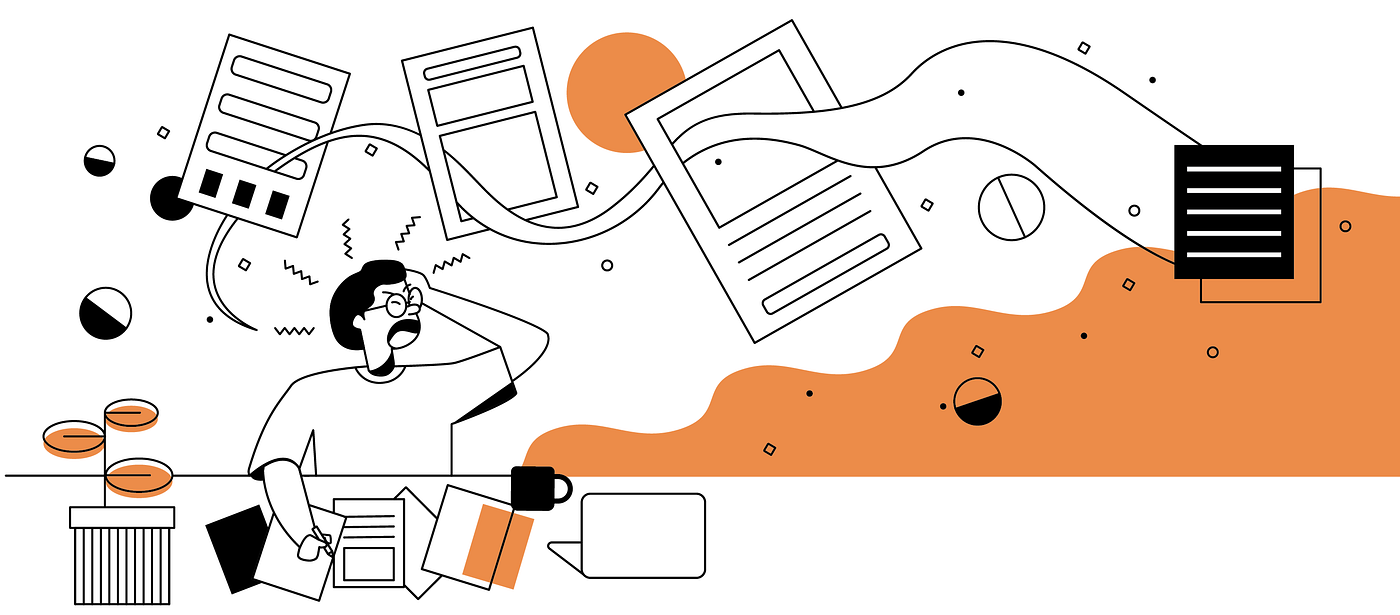
I was overwhelmed, disoriented, and completely alone.
Not because the content was bad. But because the “experience” was broken.
This is my first Design Thinking challenge — and the problem I chose to solve.
Step 1 — Empathize: Understanding the User
The first principle of Human-Centered Design (HCD) is simple: start with the person, not the product.
Who is the career changer enrolling in an online learning platform?
- Age: typically 30–55
- Background: deep expertise in a completely unrelated field
- Motivation: genuine desire for transformation, not just a certificate
- Fear: starting from zero after years of being competent
- Learning style: self-directed, but hungry for structure and mentorship
- Time: limited — often juggling jobs, families, and life
- Through my own experience and conversations with others in similar situations, I identified the core emotional journey of a career-changer learner:
- ”I know I am capable. But this platform makes me feel like a beginner who doesn’t belong here.”
- Key pain points discovered:
-
- Courses assume a linear, full-time student — not someone with fragmented time
- No onboarding tailored to prior professional experience
- Progress feels invisible — no milestones that connect to real-world skills
- Community features exist but feel hollow and generic
- Content is not sequenced by learning “readiness”, only by topic
- Emotional fatigue is ignored entirely — there is no space to acknowledge the difficulty of reinvention.
Step 2 — Define: The Problem Statement
Career changers — people with deep professional expertise pivoting into a new field — need a learning experience that acknowledges their prior knowledge, respects their fragmented time, and supports the emotional complexity of reinvention, because current online platforms are designed for linear, full-time learners with no professional history.
And the ”How Might We” (HMW) question:
How might we design an online learning experience that meets career changers where they are — professionally, emotionally, and temporally ?
Step 3 — Ideate: Exploring Solutions
This is where creativity meets structure. I used a rapid ideation approach — generating ideas without judgment first, then filtering.
Ideas generated:
- A “Career DNA Quiz” at onboarding — maps the user’s existing skills to the new field, showing them what they already know
- “Micro-learning modules” of 10–15 minutes, designed for fragmented time
- A ”Reinvention Journal” feature — a private space to track emotional progress alongside technical progress
- Skill Bridge Cards — visual cards that explicitly connect past expertise to new concepts (”Your experience in precision engineering is your superpower in UX research”)
- A “Mentor Match” system pairing career changers with designers who made similar transitions
- Adaptive curriculum — the platform adjusts content sequence based on your professional background
- A community filter — connect with others who came from your specific industry, not just generic cohorts
- Weekly “Where Am I?” check-ins — a short reflection prompt to prevent silent dropout.
Prioritization matrix — Impact vs. Effort:
After mapping ideas on an Impact/Effort matrix, three solutions emerged as the core MVP:
- Career DNA Onboarding — High impact, moderate effort
- Skill Bridge Cards — High impact, low effort
- Adaptive Micro-learning Modules — High impact, high effort (phased rollout)
Step 4 — Prototype: The Proposed Solution
The proposed solution is a “redesigned onboarding and learning flow” for career-changer users, structured around three pillars:
Pillar 1 — “You Already Know More Than You Think” An intelligent onboarding quiz maps the user’s professional background to the new field. It generates a personalized Skill Bridge Report showing: ”Based on your experience in [field], you already have a foundation in [X, Y, Z]. Here’s where to start.”
This immediately reduces impostor syndrome and creates a sense of continuity rather than rupture.
Pillar 2 — “Learning Fits Your Life” A flexible module system built around 15-minute focused units, with a weekly planner that adapts to how much time the user realistically has. Progress is measured not just in hours completed, but in skills unlocked — visible, tangible milestones.
Pillar 3 — “You Are Not Alone in This” A community layer specifically designed for career changers: filtered by industry of origin, facilitated by transition mentors, and anchored by a weekly group check-in that normalizes the emotional difficulty of reinvention.
Step 5 — Test: How Would We Validate This?
A true UX process never ends at the prototype. Testing would include:
- Usability testing - of the onboarding flow with 5–8 career changers across different backgrounds
- A/B testing - the Skill Bridge Report against a standard welcome email — measuring completion rates at Week 2 and Week 4
- Qualitative interviews - at the 30-day mark: ”Do you feel like this platform was built for someone like you?”
- Dropout rate analysis -comparing career-changer cohorts using the new flow vs. the standard flow
- NPS score - specifically for the onboarding experience
Success metrics:
- 30-day retention rate: target +25% vs. baseline
- Onboarding completion: target 85%+
- Self-reported belonging score: target 7+/10 at Day 7
Reflection: What I Learned
Design Thinking is not a formula. It is a “posture” — a way of approaching problems with curiosity before jumping to solutions.
What surprised me most was how much clarity came from simply writing down the pain. The empathy phase forced me to articulate things I had felt but never named. And once named, the solutions almost suggested themselves.
My engineering background taught me to solve problems with precision. Design Thinking taught me to first make sure I was solving the “right” problem.
For career changers like me, the online learning experience is not just a product problem. It is a human problem. And human problems deserve human-centered solutions.
This article is the first story in my UX/UI Design journey — written as part of Challenge 1: Design Thinking, from my AI-Driven UX/UI Design Bootcamp.
If you are also a career changer navigating a new field, I would love to hear your story. Let’s connect.

메타데이터
- post_id
- 6a0d40fcfccf
- slug
- how-design-thinking-can-fix-the-online-learning-experience-for-career-changers-6a0d40fcfccf
- url
- https://medium.com/@geo.cristea/how-design-thinking-can-fix-the-online-learning-experience-for-career-changers-6a0d40fcfccf
- canonical_url
- https://medium.com/@geo.cristea/how-design-thinking-can-fix-the-online-learning-experience-for-career-changers-6a0d40fcfccf
- author_url
- https://medium.com/@geo.cristea
- status
- ok
- fetched_at
- 2026-07-10 12:09:34