Disclosure Day: Film Review and Reflections
Alien visitation is one of science fiction’s most intriguing themes, buoyed by decades of UFO lore and abduction tales. Cinema’s most…
Disclosure Day: Film Review and Reflections
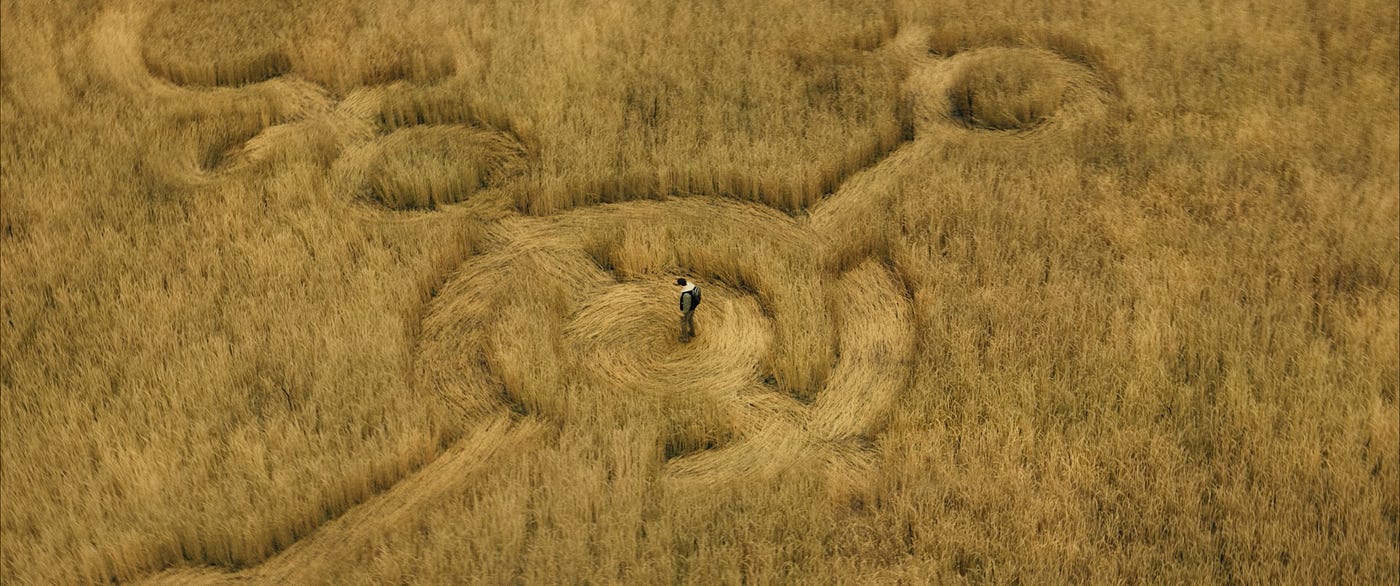
(Credit: Universal Pictures)
Alien visitation is one of science fiction’s most intriguing themes, buoyed by decades of UFO lore and abduction tales. Cinema’s most notable extraterrestrial films range from terrifying invasion thrillers to heartfelt coming-of-age stories. And many of those were directed by the incomparable Steven Spielberg, the mastermind behind ET: The Extraterrestrial, Close Encounters of the Third Kind, and an adaptation of War of the Worlds.
Now, Spielberg puts a deeply emotional abduction tale on a global scale with Disclosure Day, a stirring blend of speculative fiction, conspiracy thriller, and philosophical musing. It’s frightening at times — as all abduction stories are — yet soulfully stirring.
Disclosure Day begins by introducing us to Daniel Kellner (the remarkably emotive and winsome Josh O’Connor), who has stowed sensitive material in a backpack that will give you anxiety the rest of the movie. He intends to go full disclosure. Mysterious people hold his girlfriend Jane (Eve Hewson) hostage hoping to force him to surrender the files. It would be your typical conspiracy thriller — except that Daniel also possesses an alien device with untold power.
We then meet Margaret Fairchild, a weather reporter whose whims seem as mercurial as her predictions. Blunt continues to prove she can handle both sci-fi action and emotional storytelling. Margaret’s showing her supportive yet hapless boyfriend her anchor audition when a cardinal flies into their kitchen. She exchanges one look with the cardinal and begins speaking Russian to her partner — with no knowledge she’s doing so.
These two apparently separate events quickly align in David Koepp’s well-paced screenplay (based on Spielberg’s story). Margaret and Daniel enter a battle of wills with WARDEX, keeper of government UFO secrets. In particular, the dogmatic Noah Scanlon (Colin Firth in an impressively contemptuous performance) is determined to stop Daniel at any costs. His character foil is former colleague Hugo Wakefield (the ever-charismatic Colman Domingo) who nurtures Daniel’s extraordinary ability to defeat WARDEX’s oppressive program.
That’s plenty of fodder for a typical Hollywood conspiratorial thriller, and we’ve got the meat and potatoes here: exciting car chases, dramatic stunts, and nameless government lackeys who are bizarrely eager to ruin people’s lives.
But this is a Spielberg movie, which means we’ve got grander themes and complex emotions. There are no heroes or villains: only people, all trying to make sense of their purpose as they acquire — or abuse — alien powers.
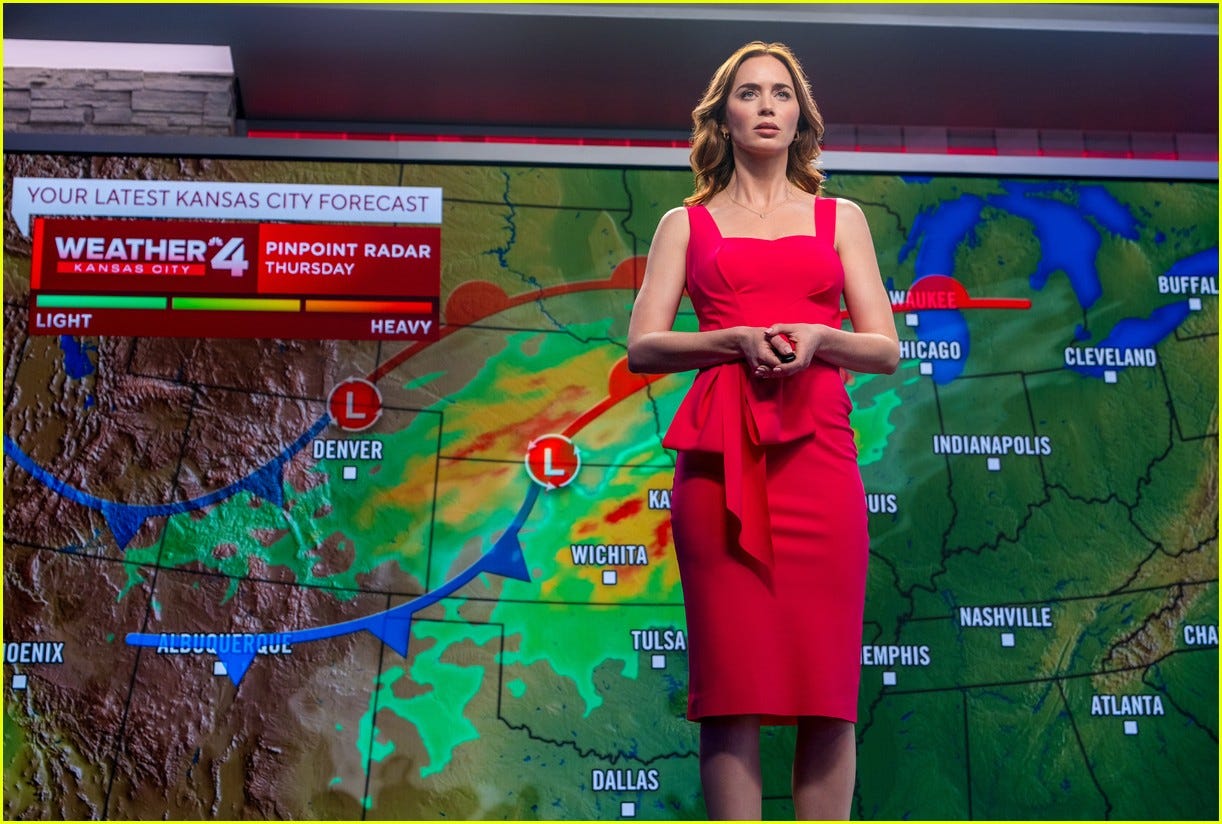
The halo around Margaret’s (Emily Blunt) head gives her a divine quality moments before she channels an alien message. Note her loosely clasped hands that evoke yoga mudras associated with love and connection. (Credit: Universal Pictures)
In this story, the Roswell crash of 1947, a tale long steeped in American ufology, sparked decades of unethical government-funded experiments. That’s an uncomfortably flagrant allegory for real-life atrocities such the Tuskegee syphilis study, as well as more insidious efforts to siphon immigrants’ intellectual power while depriving them of agency.
A government entity exploiting vulnerable beings? Timely. And indeed, Disclosure Day is both perfectly contextualized in 2026’s current events yet (sadly) evergreen, setting its action against an impending world war that Kansas City’s local news is eager to cover — until its weatherwoman starts speaking an alien language. And yet the film exceeds our expectations for typically “socially conscious sci-fi.” Government bad, alien good…we saw that depicted brilliantly in District 9 and to a lesser extent in E.T. Extraterrestrial contact changes society, as we witness through the lens of our central character and their growth. The background context is wide but the focus is small.
Indeed, most alien abduction movies are small scale, as they’re inspired by real-world stories of alleged abductions. The farmer taken from his cornfield, the truck driver missing two days of memories.
Of course, real-life reports about extraterrestrial contact are always small scale. We’ve never had anything large-scale (unless you count the Pentagon declassifying their UFO files).
Meanwhile, alien invasion stories are necessarily large-scale. (Signs was a notable exception.) Those stories raise the Big Questions: who we are as humans, what brings us together in these divided times, and our role in the universe. Even the relatively neutral invasions (such as in The Day the Earth Stood Still) call upon society at large to better themselves. Otherwise, malevolent alien contact stories are never individual. There’s no horror version of E.T. in which a terrifying extraterrestrial singles out a teenager and forces them to face their humanity.
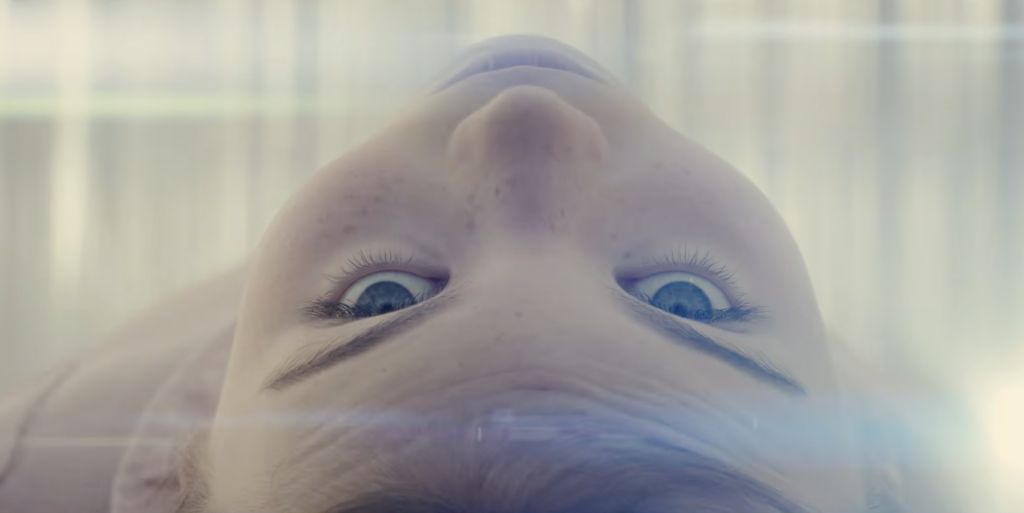
Symmetrical framing + extreme close-up + overexposure = close encounter cinema. (Credit: Universal Pictures)
What makes Disclosure Day so brilliant is not that it explores those Big Questions as an extension of individual soul-searching. It’s the inverse: that two humans’ intricate connection to the extraterrestrials — and each other — could power a fundamental shift in our shared humanity. Elliot in E.T. is an Everyman story. But in Disclosure Day, Margaret’s and Daniel’s transformation can only happen with extraterrestrial presence and with each other. Moreover, it must happen for humanity to learn its lesson. Not from a massive alien witnessing but from a singular experience.
If this sounds like a savior tale, that’s because it is. Unlike the veiled Christ allegory of sci-fi thrillers like The Matrix, Disclosure Day taps into a grander mythos. Divine purpose. Complementary powers of masculine and feminine energies. Telepathic communication. Cosmic wonder that cracks the heart open. Spielberg’s story draws upon myriad tales, from the Hindu legend of Shiva and Shakti to Hansel and Gretel and Snow White. Disclosure Day leans heavily into these stories’ symbolism: the open eye, the joined hands, the breadcrumbs, the empathetic animals (especially the cardinal, long considered divine messengers), the mathematical language. All work beautifully for sci-fi thrillers, and Spielberg and Koepp know how to integrate them both logically and emotionally.
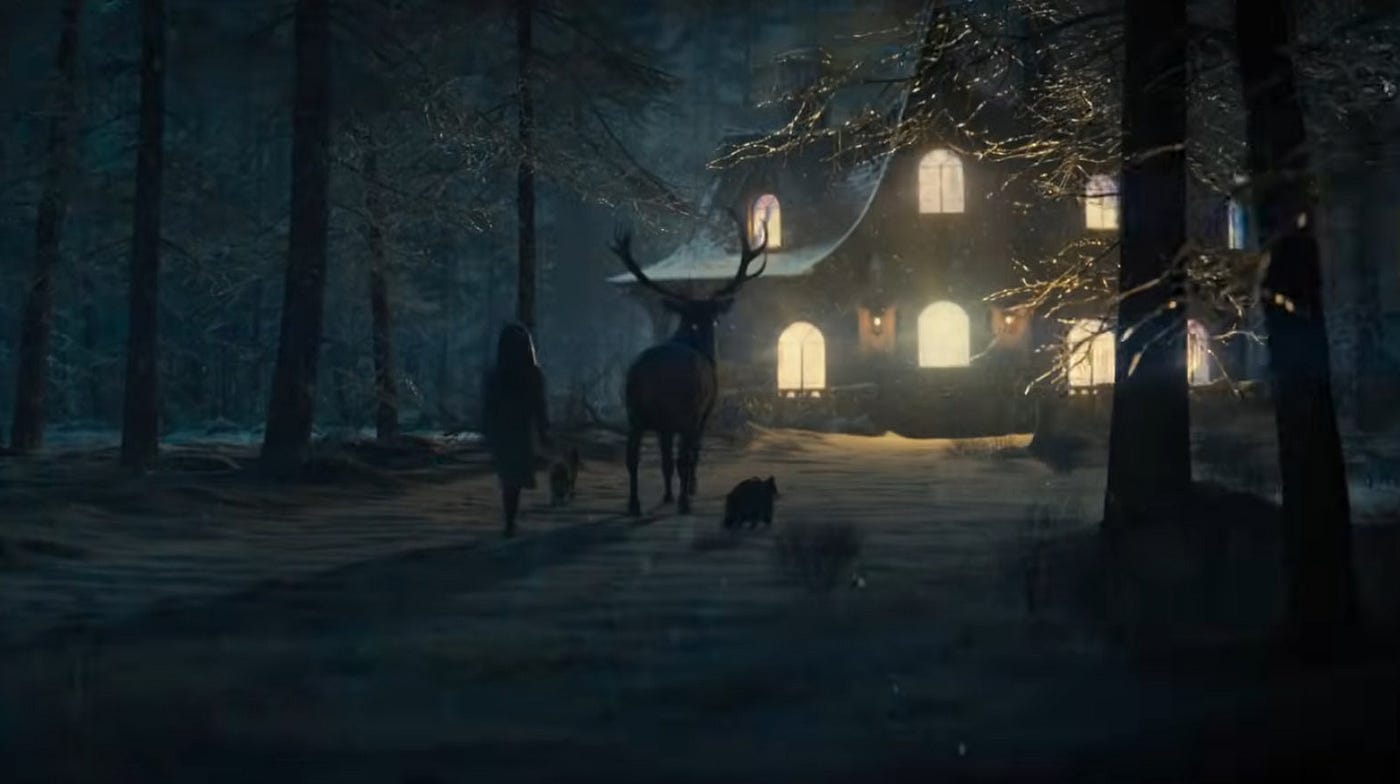
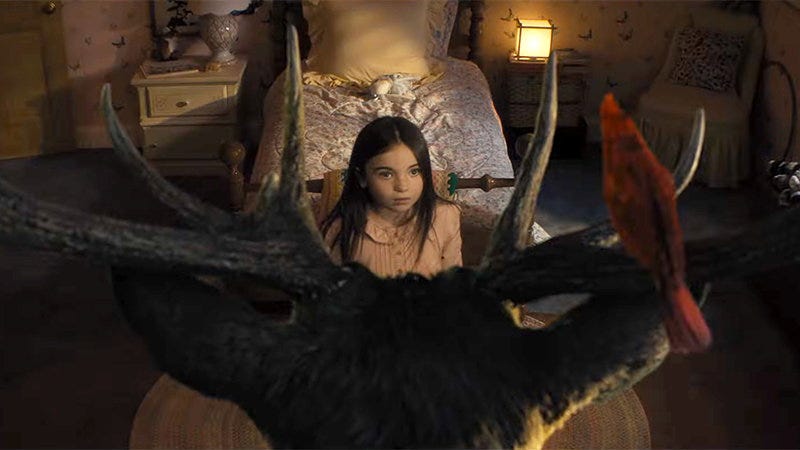
Evocative fairy-tale imagery grounds the high-concept story a fantastical aethestic deeply rooted in oral tradition. Note Spileberg’s iconic use of silhouette and fractured light to forecast emotional transformation. (Credit: Universal Pictures)
Such symbolic filmmaking honors the rich cultural traditions from around the globe as humans have, for millennia, attempted to answer a simple question: What do we do with our power?
And that’s a more compelling question, isn’t it? Not “why are we here?” or “does God love us?” Disclosure Day references those questions but focuses on a more uncomfortable one: we humans are clearly unusual in our ability to govern, transform, and potentially destroy the earth. What does it mean to have that power?
Many alien invasion movies create tension with that question without answering it. Take Independence Day, for example. Humans undoubtedly govern Planet Earth. When the Harvesters want it, they target those who control the resources: us. We must then pit our power against theirs. Jurassic Park asks the same question from a different angle: dinosaurs used to rule the Earth, so who wins if we overlap the timelines?
In Disclosure Day, the enemy is humanity. But that humanity is also our redemption. Our power is empathy, experienced through telepathy and personal reckoning. In interviews, Spielberg referenced The Day the Earth Stood Still, in which an extraterrestrial diplomat essentially calls us out on our bullshit. It is a plea for peace, to think beyond our individual selves or even our society.
When thinking of those post-WWII era sci-fi films, I immediately recall Forbidden Planet and its depiction of humanity’s psychic power. Michael Crichton’s Sphere (and the film of the same name) and of course, ET, both expand upon the idea that extraterrestrials have refined their telepathic and empathic abilities — and humans should follow suit.
What’s interesting about Disclosure Day is that those powers aren’t seen as something new. To the level the aliens gift them to our heroes, yes. But by drawing upon those fairy tales and ancient Eastern myths, Spielberg implies this is something we had — but lost as our world turned industrial, capitalist, war-torn, and digital. We once could know our neighbor’s thoughts with a glance. Now, we’re more preoccupied with what’s on our phone.
Spielberg’s filmmaking style lends itself to such mythical themes. His use of backlighting, dramatic framing, and sound design has always been exceptional. Characters aren’t just on screen speaking lines; they are enmeshed in an intricately designed world. In Jaws, they are navigating a shifting dynamic between crafted terrestrial civilization and untempered marine nature. In Jurassic Park, they’re learning the horrifyingly mortal side effects of godlike powers. And in E.T., they’re discovering the depth to which empathy and telepathy can shape our daily experiences — across the boundaries of species or even planet of origin.
In Disclosure Day, where language is power, animals are messengers, and sight is transformation, every single actor must occupy a palpably symbolic realm. We are essentially exploring divinity. And indeed, even the news anchor delivering coverage of extraordinary events is more than a journalist. She is a conduit.
She’s also authentic: Spielberg and his casting director selected Courtney Grace, a real-life former journalist, to play this small but momentous role. It’s one of many ways Spielberg adds gravitas to his stories: imbuing each scene with an inimitable emotional texture.
Disclosure Day’s most fascinating moments share the same theme as those in E.T., Jaws, Jurassic Park, and Minority Report. It’s all in the eyes. The intense stares as Noah attempts remote viewing. The look of recognition in Margaret’s and Daniel’s eyes.
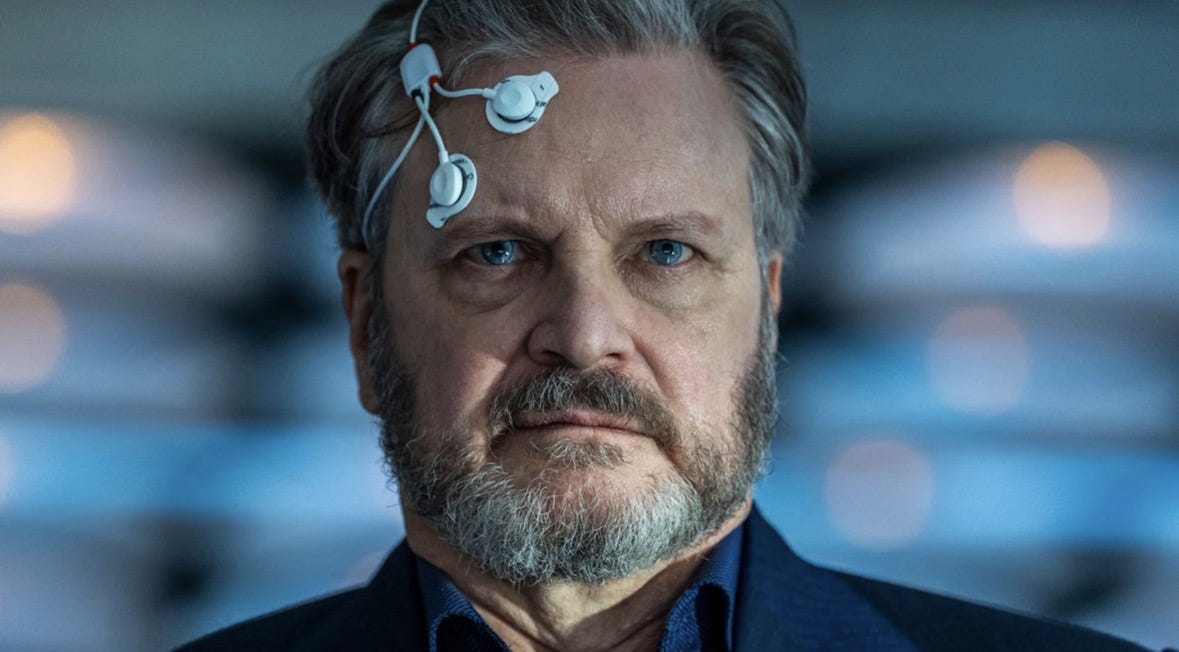
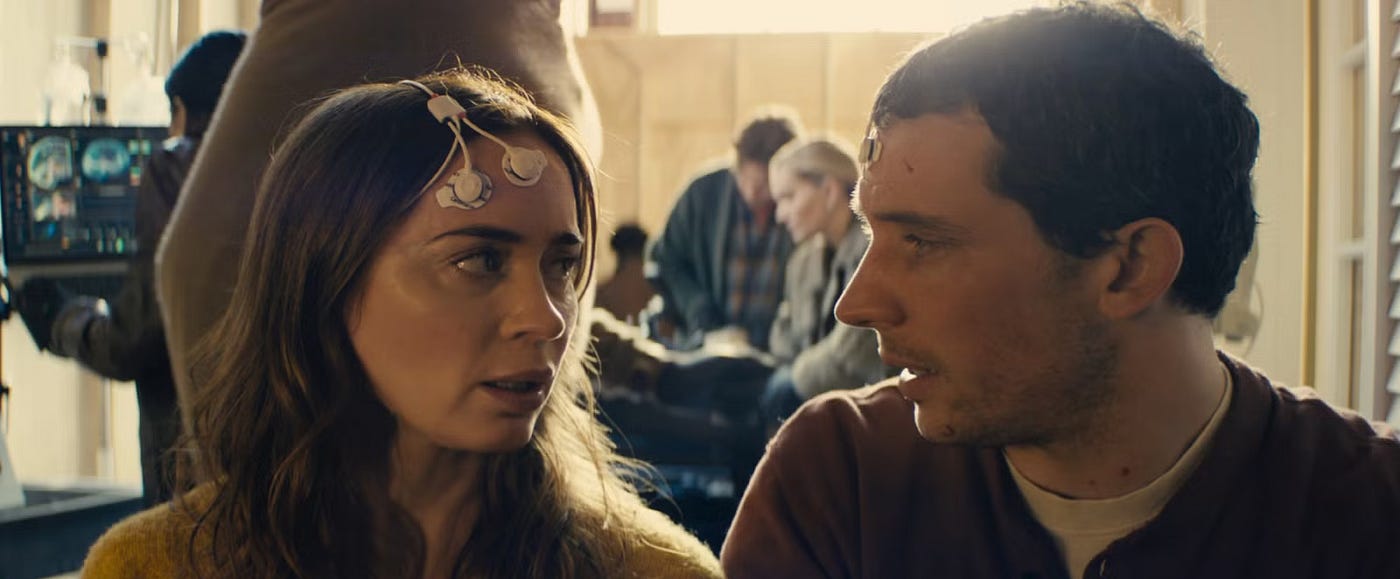
The eyes are the window to the soul, as Noah (Colin Firth) discovers in remote viewing, while Margaret (Emily Blunt) and Daniel (Josh O’Connor) remember the depth of their bond. (Credit: Universal Pictures)
And of course, the enormously huge eyes of the Grey alien.
I will say that Disclosure Day lacks the musicality of Spielberg’s classic films, despite a lovely score by his usual composer John Williams. The mystery unfolds and the tension rises through cinematography and editing more than the other cinematic elements.
It’s a long yet quick-paced film because there’s a lot of story to cover…and sometimes, it feels disjointed as it bounces among action thriller, sci-fi-mystery, and emotional drama. But it juggles all genres coherently within a riveting story — and the performances sell it. With weaker actors than Blunt, O’Connor, Firth, Domino, and yes, Courtney Grace, Disclosure Day would have been yet another alien contact movie that tried to seem smarter than it was.
Disclosure Day is smart, but that’s not its power. It’s emotive. Profound. Deeply connected to ancient myths and traditions that hold more power than we admit. When you watch Disclosure Day, you’re not just witnessing a cinematic take of the UFO declassification. Nor a cheesy “aliens will show us how to be friends” tale. It’s something a bit more twisted, mildly unsettling, but ultimately true to what we all know deep down.
There’s more than us out there in the universe.
메타데이터
- post_id
- 6a2000fc9f95
- slug
- disclosure-day-film-review-and-reflections-6a2000fc9f95
- url
- https://medium.com/@rachelwayne/disclosure-day-film-review-and-reflections-6a2000fc9f95
- canonical_url
- https://medium.com/@rachelwayne/disclosure-day-film-review-and-reflections-6a2000fc9f95
- author_url
- https://medium.com/@rachelwayne
- status
- ok
- fetched_at
- 2026-06-21 09:28:28