Brent Is Stable. The Industrial Economy Is Not.
Two months after the largest oil supply disruption in modern history, the most important question in global energy markets is no longer how…
Brent Is Stable. The Industrial Economy Is Not.
Two months after the largest oil supply disruption in modern history, the most important question in global energy markets is no longer how severe the shock itself was, but why Brent crude continues averaging only around $100 instead of spiraling into the kind of uncontrolled price explosion historically associated with systemic supply collapses. JPMorgan itself now acknowledges that familiar explanations, whether China’s concealed economic slowdown suppressing demand or the temporary cushioning effect created by the liquidation of strategic petroleum reserves, are nowhere near sufficient to explain the apparent stability of crude prices. The market is instead beginning to recognize something far more uncomfortable: a disruption of this magnitude cannot be absorbed through the crude oil market alone because the true fracture point of the global energy system no longer sits primarily at extraction, but within the refining complex itself.
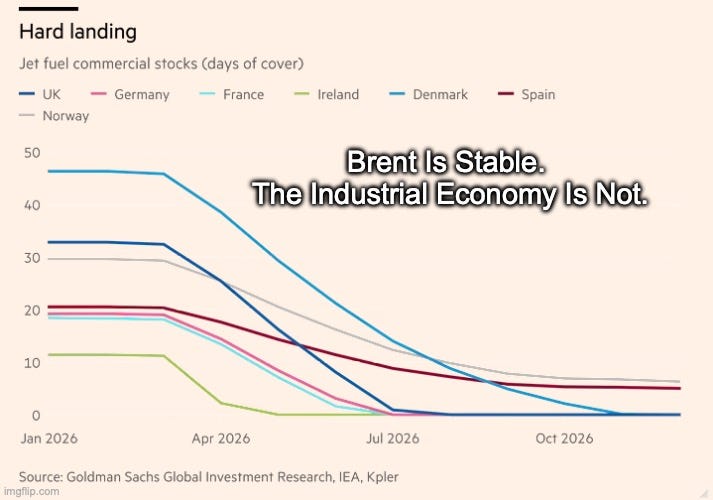
This distinction is absolutely critical because modern industrial economies do not consume crude oil directly. They consume refined products and once refining capacity becomes constrained, benchmark crude prices cease functioning as an adequate measure of systemic stress. Instead of expressing itself through a classic vertical spike in oil prices, the adjustment mechanism is now occurring through an accelerating collapse in refining throughput. Refineries across Asia and Europe have already been forced to reduce refining capacity by approximately 2.1 million barrels per day in March and by 3.8 million barrels per day in April alone, while simultaneously the global system lost roughly 4.7 million barrels per day of petroleum product exports originating from the Middle East. In practical terms, this means the bottleneck has migrated downstream through the supply chain. The world is increasingly not short crude itself, but short the finished fuels required to operate industrial civilization.
The pricing structure reveals this transition immediately. Between January and April, crude oil prices increased by roughly 40%, yet refined petroleum products across Asia surged by between 60% and 120%, implying that fuel markets are repricing between one and a half to three times faster than crude itself. Consequently, refining margins (the spread between crude input prices and refined product output values) have exploded to historic extremes, in some cases reaching a staggering $321 per barrel. Markets are effectively assigning a dramatically higher premium not to the ownership of oil reserves, but to the increasingly scarce industrial capacity capable of converting crude into usable fuels. This is no longer a conventional commodity shortage. It is becoming a molecular allocation crisis embedded deep inside the physical infrastructure of the global economy.
Jet fuel has emerged as the clearest expression of this new regime because aviation demand collided first and most violently with tightening middle-distillate availability. Across Asia, Europe and the United States, jet fuel prices have nearly doubled, while refining margins relative to crude surged toward extraordinary levels of $80-$100 per barrel. Such pricing sends an unmistakable signal to refiners worldwide: maximize jet fuel production immediately. Yet this is precisely where financial logic collides with physical reality. Refining is fundamentally a zero-sum industrial process constrained not by market desire, but by chemistry, feedstock composition, cracking capacity and equipment configuration. Refineries cannot simply manufacture unlimited quantities of whichever fuel suddenly becomes economically attractive.
The molecular structure of crude imposes hard limits on flexibility. Gasoline naturally represents roughly 20% of standard refinery output, though modern cracking infrastructure can push this figure toward 45% under optimized conditions. Jet fuel typically comprises between 8% and 15% of total output, while diesel generally accounts for approximately 25% to 35%. Most importantly, jet fuel and diesel belong to the same category of “middle distillates,” meaning they compete directly for the same hydrocarbon streams within the refining process. The practical flexibility available to refiners is astonishingly limited, often no more than 2% to 5% of total output allocation. Consequently, every incremental increase in jet fuel production mechanically reduces diesel availability elsewhere in the system.
This is where the crisis becomes economically dangerous far beyond the energy sector itself. Diesel fuel is not merely another petroleum product. It is the circulatory system of global logistics, agriculture, shipping, freight transport, mining, heavy machinery, industrial manufacturing and military mobility. A sustained diesel shortage therefore propagates through supply chains with extraordinary speed because virtually every physical layer of modern civilization depends upon diesel-powered transport infrastructure. Gasoline markets are now experiencing similar stress as refiners increasingly divert heavy fractions away from gasoline-oriented cracking processes in order to maximize middle-distillate production.
The United States already provides a real-time example of how rapidly these trade-offs materialize. In response to soaring jet fuel prices, American refiners increased jet fuel yield by approximately two percentage points. The cost was immediate and unavoidable: gasoline yield declined by an equivalent amount, causing gasoline production to fall by roughly 340,000 barrels per day compared with last year precisely as the summer driving season approached. Gasoline prices have already climbed toward politically explosive territory at approximately $4.56 per gallon nationally, while the prospect of seeing $5 gasoline across large parts of the United States no longer appears remotely unrealistic.
The next phase of the global energy crisis therefore may not resemble the traditional oil shocks embedded in public memory, where crude itself becomes the singular focus of panic. Instead, the world is moving toward a far more dangerous environment characterized by chronic shortages of refined fuels, collapsing inventories, refinery bottlenecks, transportation stress and increasingly severe competition between sectors for specific molecular outputs. Policymakers may continue pointing toward relatively stable Brent prices as evidence that the situation remains manageable, while underneath the surface the industrial system enters a state of fuel triage in which every attempt to stabilize one market mechanically destabilizes another.
What markets are beginning to discover is that the strategic asset of the twenty-first century is no longer simply access to crude oil reserves, but access to sufficiently flexible refining infrastructure capable of converting constrained hydrocarbon flows into the exact fuel molecules industrial economies require to function. Once that realization fully penetrates financial markets and governments alike, the conversation will stop revolving around crude abundance altogether and begin revolving around something far darker: which sectors of the economy continue receiving fuel and which ones no longer can.
메타데이터
- post_id
- 6a3a8e1f2e4d
- slug
- brent-is-stable-the-industrial-economy-is-not-6a3a8e1f2e4d
- url
- https://medium.com/@mean.match/brent-is-stable-the-industrial-economy-is-not-6a3a8e1f2e4d
- canonical_url
- https://medium.com/@mean.match/brent-is-stable-the-industrial-economy-is-not-6a3a8e1f2e4d
- author_url
- https://medium.com/@mean.match
- status
- ok
- fetched_at
- 2026-06-22 18:00:48