NVIDIA OpenShell: Moving Agent Permissions Out of the Prompt
Give a coding agent a task worth doing and you have handed it your filesystem, your environment variables, your network, and whatever cloud…
NVIDIA OpenShell: Moving Agent Permissions Out of the Prompt
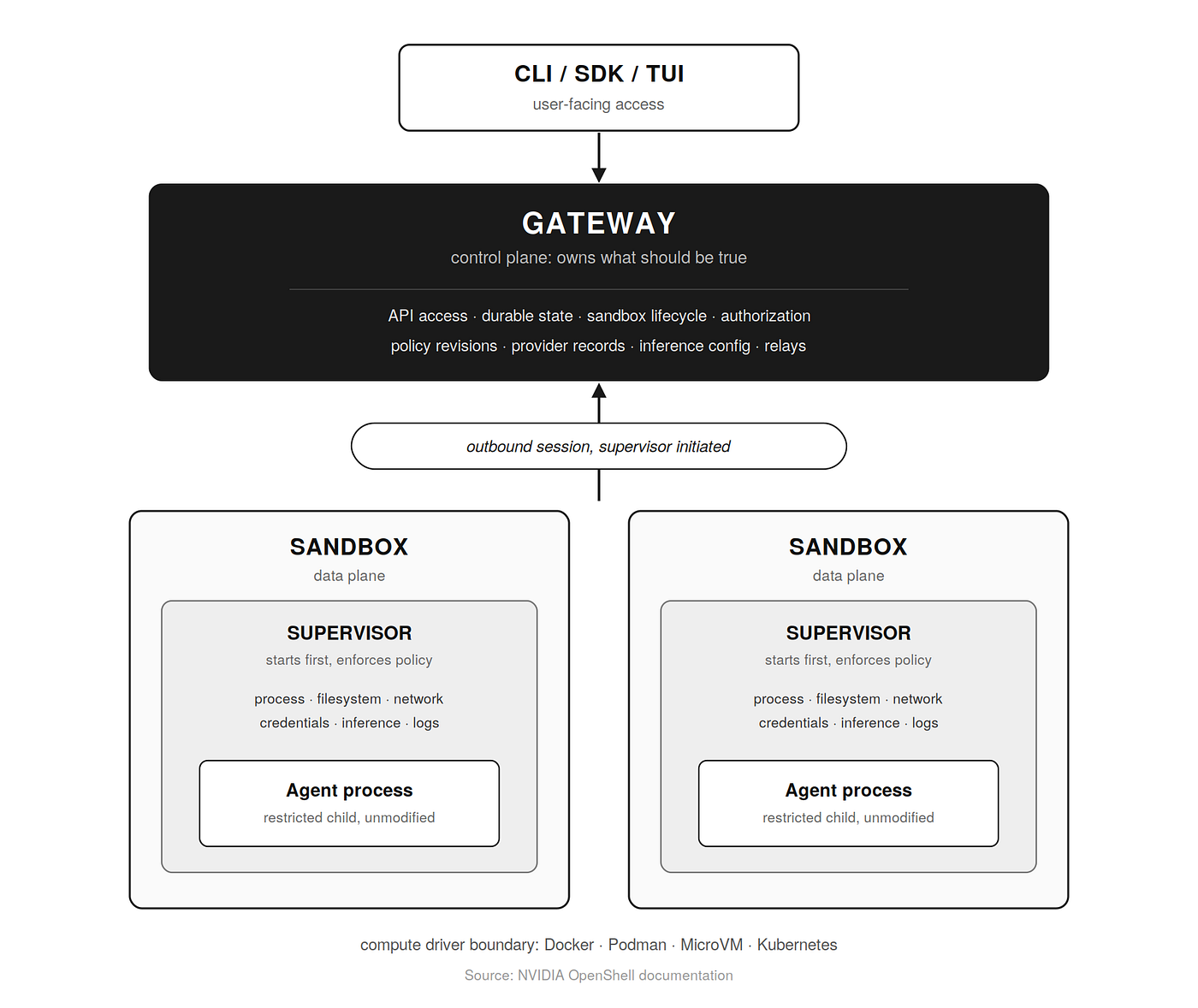
OpenWell Architecture
Give a coding agent a task worth doing and you have handed it your filesystem, your environment variables, your network, and whatever cloud credentials happen to be sitting in your shell. That isn’t a misconfiguration. That’s the whole point. An agent that can’t read files, install packages, or call APIs isn’t much of an agent.
The uncomfortable part is what happens next. The agent decides on its own, in a loop, at machine speed, which of those capabilities to use. And in most setups today, the only thing standing between “helpful” and “pushed our internal source to an endpoint nobody approved” is a system prompt. Which is to say, a strongly worded suggestion.
NVIDIA’s answer to this, an open-source runtime called OpenShell, starts from a different premise: permissions are not a model problem. They belong in the runtime, underneath the agent, in a place the agent cannot negotiate with.
If you read my last piece on Palantir’s agentic governance framework, this is the other half of that story. Palantir argued what controls need to exist: bounded execution, authorization, observability, fail-safes. OpenShell is a concrete answer to where those controls get enforced. And the architecture it lands on is a fairly classic piece of distributed systems design, which is exactly why it’s interesting.
OpenShell is built around three components, and the whole design falls out of how responsibility is split between them.
The CLI (plus an SDK and a TUI). This is just the user-facing surface. You point it at a gateway and ask for a sandbox.
The Gateway. This is the control plane. It owns API access, durable state, sandbox lifecycle, policy revisions, provider and inference configuration, authorization decisions, and coordination of live connections into sandboxes. Nothing about your workload runs here. It’s the thing that knows what should be true.
The Supervisor. This runs inside every single sandbox and is the actual security boundary. It starts before the agent does, prepares the runtime, pulls configuration from the gateway, and only then launches the agent as a restricted child process. Everything the agent tries to do (touch a file, open a socket, call a model) passes through a boundary the supervisor established while the agent was still nonexistent.
That ordering is the entire trick. The agent never gets a moment where it’s running with full privileges and is then asked politely to give some back. It comes into existence already constrained.
The gateway owns durable platform state. The sandbox owns local enforcement: process identity, filesystem scope, network egress, credential injection, logs, and the agent process itself. Standard separation, and it buys the usual things: the control plane can be centrally managed, versioned, and audited without being in the hot path of anything the agent does.
The part I’d flag for anyone who has built infrastructure before is the direction the connection runs. The gateway does not reach into sandboxes. Each supervisor dials outbound to a known gateway endpoint, authenticates as a sandbox workload, and holds that session open. All the live operations (policy refresh, credential delivery, log push, shell access, file transfer) ride over that one authenticated channel.
This is the same pattern as a kubelet talking to an API server, or a self-hosted CI runner talking to its coordinator. And it’s chosen for the same reason: the alternative is making every compute backend solve reachability on its own. Pod IPs, bridge networks, port mappings, NAT traversal, bespoke tunnels. Invert the direction and that entire category of problem disappears, along with the need to expose sandbox network surface to anything.
The gateway then behaves like a reconciliation loop rather than a command channel. It publishes desired state; the supervisor applies it locally. If a refresh fails, the supervisor keeps its last known good configuration and holds the line rather than failing open. For a security boundary, that default matters more than it sounds like it should.
NVIDIA names four failure modes it is explicitly designing against: data exfiltration, credential theft, unauthorized API usage, and privilege escalation. The supervisor’s job breaks into layers, and each one closes off one of those:
That inference interception deserves a second look, because it’s the neatest idea in the design. From inside the sandbox the agent calls a normal-looking HTTPS endpoint. The supervisor catches that call, attaches the real credentials outside the agent’s view, and routes it to whichever backend policy says it should hit, which might be a commercial API or an entirely self-hosted model. You get provider swapping, credential isolation, and a chokepoint for “where is our data actually going” from one mechanism. Unmodified agents work fine, because nothing about the agent had to change.
Not every control in OpenShell behaves the same way at runtime, and the split is deliberate.
Filesystem and process isolation are locked at sandbox creation. You cannot loosen them on a running sandbox. Changing them means recreating the sandbox.
Network policy, credential delivery, and inference routing are hot-reloadable over the live session. You can tighten or adjust them while the agent keeps working.
This is a real engineering judgment call, not an implementation detail. The controls that define what the agent fundamentally is get frozen at birth, so there’s no window in which a running process negotiates its way into a broader boundary. The controls that need to respond to operational reality (a new API host to allow, a rotated credential, a different model backend) stay mutable.
The practical consequence: your filesystem and process policy is a design-time decision that deserves real thought, because getting it wrong costs you a sandbox restart. Your network policy is something you’ll iterate on constantly, and the runtime is built expecting that.
The last design choice worth calling out is the one most likely to determine whether this actually gets adopted.
OpenShell doesn’t try to own compute, secrets, identity, scheduling, or GPU exposure. Those stay with the platforms that already provide them. Compute, credentials, control-plane identity, and workload identity each sit behind a driver or adapter boundary, and the drivers translate OpenShell’s semantics into whatever the underlying platform natively does.
Concretely: the same sandbox contract runs on Docker, Podman, a VM runtime, or Kubernetes. Locally, the gateway runs on your workstation and uses your container runtime. In a cluster, the gateway runs as a service and sandboxes become pods, picking up the cluster’s scheduler, networking, secrets, and GPU device plugins for free. The CLI workflow doesn’t change between the two.
That’s the difference between a security tool that gets deployed and one that gets evaluated and quietly shelved. Anything that requires replacing your secret store to adopt it is not going to be adopted.

A few honest caveats.
It’s early. The project ships under Apache 2.0 and is explicit that GPU passthrough is still experimental, which is worth knowing if GPU workloads are your reason for looking at NVIDIA tooling in the first place. The Kubernetes story is further along, with documented ingress, certificate, and access control setup plus OpenShift support. But this is a young project moving quickly. Pin your versions.
And it’s worth naming the obvious. A runtime whose headline capability is “route inference wherever policy says it should go” is being shipped by the company that sells the hardware most self-hosted backends will run on. The Apache 2.0 license is real and the design is genuinely agent-agnostic and backend-agnostic, so this isn’t a lock-in play in any crude sense. But the strategic logic of making private, self-hosted inference dramatically easier to adopt is not hard to reconstruct. Separate the architecture from the incentive, the way you would with any vendor’s reference design. The architecture holds up on its own.
The boundary is only as good as the policy. OpenShell gives you a place to put least-privilege rules and enforces them properly, but nobody writes them for you. A permissive filesystem scope enforced perfectly is still a permissive filesystem scope. The default policies and the policy advisor tooling help, but this shifts work rather than eliminating it, and the work is now security policy authoring, which is a different skill from prompt engineering.
And sandboxing is not reliability. It constrains blast radius; it does not make the agent correct. An agent confined to your repo can still produce bad code inside that repo, at speed. Everything in the previous piece about downstream evaluation and earned autonomy still applies. This layer just means the failures stay in a box you drew.
The interesting claim in OpenShell isn’t any single feature. It’s the position of the boundary.
Most agent security today is implemented at or above the agent: prompt instructions, framework-level tool gating, human approval steps in the loop. All of those live inside the trust boundary they’re trying to defend, which means a sufficiently confused or manipulated agent can route around them.
Putting enforcement underneath the agent, in a process that starts first and is configured by a control plane the agent has no access to, is a structurally different bet. It’s the same bet containers made about applications: stop asking the workload to behave, and make the runtime the thing that decides.
If you’re designing agent infrastructure right now, that’s the question worth sitting with. Not “what should the agent be allowed to do,” but “where in my stack is that decision actually enforced, and can the agent reach it?”
Technical details in this piece are drawn from NVIDIA’s public OpenShell documentation and the OpenShell repository. The architecture docs are worth reading directly at docs.nvidia.com/openshell.
Originally published at https://siddharthwagh.substack.com.
메타데이터
- post_id
- 6a3d02b0c9ec
- slug
- nvidia-openshell-moving-agent-permissions-out-of-the-prompt-6a3d02b0c9ec
- url
- https://medium.com/@siddw143/nvidia-openshell-moving-agent-permissions-out-of-the-prompt-6a3d02b0c9ec
- canonical_url
- https://medium.com/@siddw143/nvidia-openshell-moving-agent-permissions-out-of-the-prompt-6a3d02b0c9ec
- author_url
- https://medium.com/@siddw143
- status
- ok
- fetched_at
- 2026-07-19 00:45:20



