Redis Explained with Real Backend System Design Examples
Redis is one of the most popular technologies used in modern backend systems. Applications like Swiggy, Zomato, Netflix, and many…
Redis Explained with Real Backend System Design Examples
Redis is one of the most popular technologies used in modern backend systems. Applications like Swiggy, Zomato, Netflix, and many large-scale platforms use Redis to make their systems faster and more scalable.
In this blog, we will understand Redis in very simple terms with practical use cases and architecture diagrams.
What is Redis?
Redis is an in-memory database.
This means Redis stores data inside RAM instead of reading data from slower databases every time.
Because RAM is extremely fast, Redis can return data much faster compared to traditional databases like MongoDB or PostgreSQL.
Why Do We Need Redis?
Imagine thousands of users asking the same question repeatedly:
What is the price of chai?”
Without Redis:
- Every request hits the database
- Database load increases
- Response becomes slower
With Redis:
- Frequently used data is stored in memory
- Future requests become extremely fast
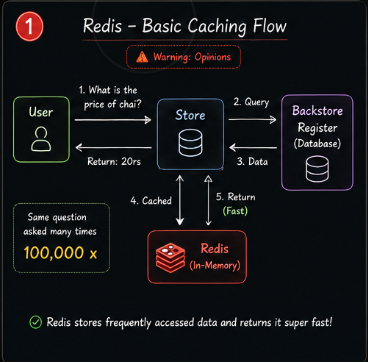
Redis Backend Architecture
A common backend flow looks like this:
User → Backend Server → Redis → Database
How It Works
- User sends request
- Backend first checks Redis
- If data exists → return fast response
- If not:
- Fetch from database
- Store in Redis
- Return to user
This process reduces latency significantly.

Cache Hit vs Cache Miss
Redis becomes very powerful in high traffic systems.
Cache Hit
- Data found in Redis.
- Very fast response
Cache Miss
- Data not found in Redis.
- Backend fetches from MongoDB/Postgres
- Data gets cached for future requests
This is especially useful for “hot data” that users request frequently.

Redis in Real-World Applications
Large applications receive millions of requests daily.
Redis helps by:
- Reducing database read pressure
- Improving API speed
- Handling concurrent users efficiently
Companies like:
- Swiggy
- Zomato
- Netflix
use Redis heavily for scalability.
Redis for Session Management
Redis is commonly used for session storage.
Example:
- User 1 → Active
- User 2 → Inactive
In distributed systems with multiple servers:
- All servers can access session data from Redis
- User sessions remain consistent
Redis for OTP Storage
Redis is perfect for temporary data storage.
Example:
- OTP:
434343 - TTL:
3 minutes
After expiry, Redis automatically removes the OTP.
This makes Redis ideal for:
- OTP systems
- Verification codes
- Temporary authentication tokens

Redis for Rate Limiting
Many APIs use Redis for rate limiting.
Redis stores:
- IP Address
- Request count
- Cooldown duration
Example:
- Max 5 requests/minute
- Extra requests blocked temporarily
This prevents:
- Spam
- API abuse
- Excessive traffic
Redis for Job Queues
Redis is also widely used for background job processing.
Examples:
- Email sending
- Notifications
- Payment processing
- Video uploads
Workers continuously process jobs from Redis queues.

Why Redis is So Popular
Redis is popular because it is:
- Extremely fast
- Lightweight
- Easy to integrate
- Great for scalable systems
- Perfect for temporary and frequently accessed data
Final Thoughts
Redis is much more than just a cache.
It powers:
Caching
Session management
OTP systems
Rate limiting
Background job queues
Real-time systems
If you are learning backend development, Redis is one of the most valuable technologies to understand because modern scalable applications depend heavily on it.
메타데이터
- post_id
- 6a47ce71b08b
- slug
- redis-explained-with-real-backend-system-design-examples-6a47ce71b08b
- url
- https://medium.com/@dhanendra73984/redis-explained-with-real-backend-system-design-examples-6a47ce71b08b
- canonical_url
- https://medium.com/@dhanendra73984/redis-explained-with-real-backend-system-design-examples-6a47ce71b08b
- author_url
- https://medium.com/@dhanendra73984
- status
- ok
- fetched_at
- 2026-06-09 15:37:30