Monolith vs SOA vs Modular Monolith vs Microservices: What Should Your Business Choose?
When teams discuss architecture, the conversation often becomes emotional.Few debates are as persistent and as misunderstood as this one:
Monolith vs SOA vs Modular Monolith vs Microservices: What Should Your Business Choose?
When teams discuss architecture, the conversation often becomes emotional.Few debates are as persistent and as misunderstood as this one:
Some engineers will say microservices are the only scalable future. Others will insist that monoliths are underrated and that microservices are just “distributed monoliths with extra suffering.”
The truth is simpler:
Architecture is a business decision and not a trend.
A good architecture helps your company ship faster, scale smoothly, and stay maintainable. A bad one slows your delivery, increases downtime, and drains engineering energy into debugging instead of building.
But here’s the simple truth:
Most companies don’t fail because they chose the “wrong” architecture.
They fail because they chose an architecture that didn’t fit their current situation, like their company stage, team size, or how prepared they are to manage and maintain it.
Software architecture is not about following trends. It’s about choosing what works best for your needs.
So let’s understand this step by step, with real-world examples, easy decision points, and clear signs of when each approach becomes a good idea… or a bad one.
1. The Monolith: Simple yet effective early on
A monolith is an application where the entire system is built as one single unit. All the features, for example — login, payments, orders, notifications, and admin panels are written inside the same codebase and are usually connected to one common database.
Because everything is in one place, it is easier to build, test, and deploy in the early stages, but it can become harder to manage as the application grows bigger.
Companies like Shopify relied heavily on a monolithic architecture in its early growth phase.
Why Monoliths Work So Well Early On
A monolithic architecture is often the best starting point because it offers strong simplicity and faster execution.
- Operational simplicity: Since the entire application is deployed as a single unit, it eliminates the overhead of managing distributed components like service discovery, inter-service communication, retries, and network failures.
- Faster delivery: A monolith enables rapid development and iteration, which is especially important for startups working toward product-market fit and frequent feature releases.
- Lower infrastructure cost and strong consistency: With a single shared database, data management becomes easier, joins are straightforward, and maintaining transactional consistency is much simpler compared to distributed systems. It also reduces infrastructure and maintenance costs.
When a Monolith Becomes a Bottleneck
As the application grows, a monolith can start creating friction in both engineering and delivery.
- Deployment bottlenecks: Even a small code change can require rebuilding and redeploying the entire application, slowing down release cycles.
- Tight coupling and technical debt: Over time, modules often become heavily dependent on each other, making the codebase harder to modify safely and increasing the risk of regression issues.
- Scaling inefficiencies: Instead of scaling only high-load components (like search, payments, or recommendations), the entire application must be scaled, leading to inefficient resource usage.
- Reduced team velocity: As multiple teams work in the same codebase, coordination overhead increases, merge conflicts become frequent, and delivery speed slows down due to shared ownership.
Common Architectural Paths for Scaling
Once the monolith starts limiting agility, companies typically evolve toward:
- Modular Monolith: The application remains a single deployable unit, but internal boundaries are strongly enforced through domain-driven modules. This reduces coupling and improves maintainability without introducing distributed system complexity.
- Microservices: The system is decomposed into independently deployable services, each owning its own data and lifecycle. This improves scalability and team autonomy but requires mature DevOps practices, strong CI/CD automation, observability, and well-defined service contracts.
Modular Monolith (The Practical Middle Ground)
A modular monolith is often the best “middle option” for companies that want the clean separation of microservices, without taking on the operational complexity of a distributed system. This is why many modern engineering teams are increasingly leaning toward it as a default starting point.
Who Typically Uses It?
Modular monoliths are commonly adopted by companies that need clear domain separation, but don’t yet require independent deployments for every component. It’s especially popular among teams that want to scale their codebase in a structured way while keeping operations simple.
Real-World Examples
- Many fintech and SaaS companies begin with a modular monolith because it helps them build clean boundaries early without over-engineering.
- Even organizations like Amazon, known for its “two-pizza team” culture, maintain strong internal modular boundaries — proving that modular design is valuable even at massive scale.
- In today’s architecture community, a common recommendation is: start with a modular monolith first, then extract services only when needed.
Why Modular Monolith is So Effective
A modular monolith offers the best of both worlds:
- Clear module boundaries that reduce coupling and improve maintainability
- Single deployment pipeline, making releases and rollbacks simpler
- No network latency or service-to-service failures
- No distributed tracing, service discovery, or complex observability overhead
In short, it gives you structured architecture without distributed system pain.
When It Starts Becoming a Limitation
A modular monolith can become restrictive when:
- specific modules require independent scaling
- teams need separate release cycles
- deployment coordination starts slowing down engineering velocity
At that stage, extracting certain modules into microservices becomes a logical next step.
Service-Oriented Architecture (SOA)
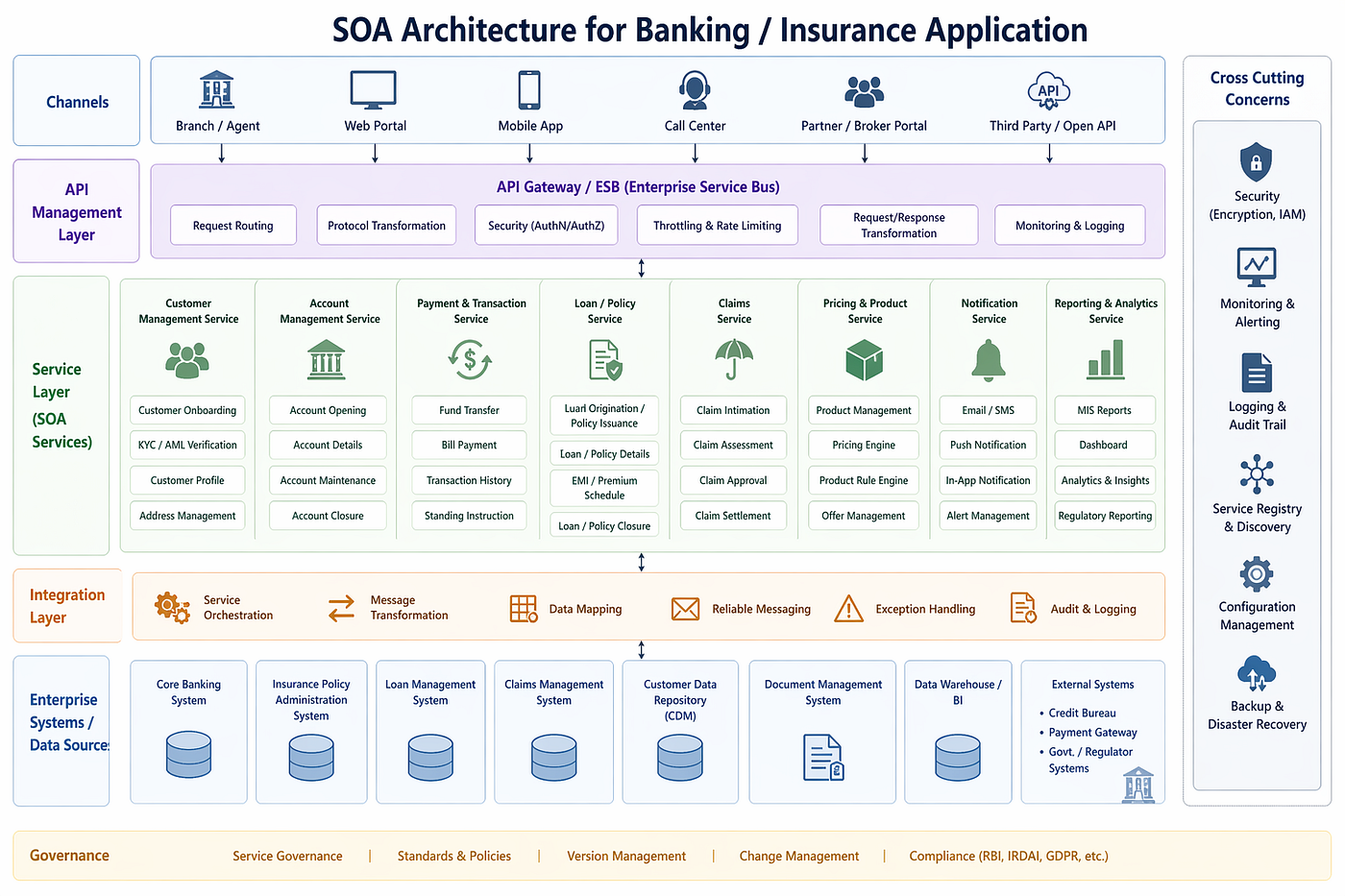
Service-Oriented Architecture (SOA) is an architectural style where an application is built as a collection of reusable business services that communicate with each other over a network. The key idea behind SOA is to expose business functionality (like Customer Verification, Payments, Policy Issuance, Billing, etc.) as standardized services that can be consumed by multiple applications across the organization.
SOA became popular in large enterprises long before microservices and cloud-native systems became mainstream, and it is still widely used in industries where integration, governance, and stability are top priorities.
Key Characteristics of SOA (Important Facts)
1. Enterprise-Level Service Reuse
SOA services are usually designed to be shared across departments and systems. For example, a single “Customer Profile Service” might be used by:
- Mobile banking app
- Loan system
- Credit card system
- KYC platform
This is one of the biggest differences from microservices, where services are usually owned by a specific product team.
2. Centralized Governance and Standardization
SOA typically includes strong governance such as:
- common service standards
- enterprise security policies
- centralized API definitions
- strict contracts
This helps large organizations ensure compliance and consistent service behavior across systems.
3. Heavy Use of Middleware (ESB)
SOA is often implemented using an Enterprise Service Bus (ESB) which acts as a central communication layer.
The ESB usually handles:
- message routing
- transformation (XML ↔ JSON)
- protocol conversion (SOAP ↔ REST)
- authentication and authorization
- orchestration (multi-service workflows)
This makes SOA powerful but also introduces a central dependency.
4. SOAP and XML Dominance (Historically)
SOA systems traditionally use:
- SOAP-based web services
- XML messaging
- WSDL contracts
- WS-Security standards
Although REST-based SOA exists, SOAP is still common in legacy-heavy industries like banking and insurance.
5. Focus on Business Capabilities
SOA services are usually designed around business functions like:
- Customer onboarding
- Payments processing
- Fraud detection
- Billing and invoicing
- Claims management
This makes SOA a very “business-aligned” architecture.
Who Typically Uses SOA?
SOA is widely used in:
- Banks and financial institutions
- Insurance companies
- Telecom providers
- Government systems
- Large enterprises with multiple internal applications
Real-World Examples of SOA Usage
Banking
A bank may have separate systems for:
- Core banking
- Credit cards
- Loan processing
- KYC and onboarding
- Transaction monitoring
SOA helps integrate these systems through reusable services and standardized communication.
Telecom
Telecom systems often use SOA to integrate:
- recharge systems
- billing engines
- customer relationship systems
- network usage systems
Insurance
Insurance companies often use SOA to connect:
- policy management systems
- claims systems
- agent portals
- customer apps
Pros of SOA (Strengths)
1. Strong Integration Across the Enterprise
SOA is excellent when many systems need to communicate in a standardized way.
This is why SOA is still extremely common in large organizations with multiple departments.
2. High Reusability of Services
A service built once can be reused across many platforms.
Example: A “Document Verification Service” can be used by:
- banking onboarding
- loan onboarding
- insurance onboarding
This reduces duplicate development across departments.
3. Mature Security and Compliance Standards
SOA works well in regulated environments because it supports:
- enterprise authentication models
- strong authorization rules
- audit logs
- encryption standards like WS-Security
Banks prefer SOA-style governance because it is easier to control and audit.
4. Works Well with Legacy Systems
Many enterprises still run legacy systems (COBOL, old ERP tools, old DB platforms). SOA is great for wrapping these systems and exposing them as services.
5. Better Process Orchestration
SOA systems often support orchestration well, where multiple services are coordinated as a workflow.
Example:
- KYC verification → Credit score check → Risk approval → Account creation
SOA platforms handle these multi-step business processes naturally.
Cons of SOA (Limitations)
1. ESB Becomes a Bottleneck (Single Point of Failure)
Because SOA relies heavily on ESB, the ESB can become:
- a performance bottleneck
- a scaling bottleneck
- a single point of failure
If the ESB goes down, multiple business systems can get impacted.
2. Slower Development and Delivery
SOA usually comes with heavy governance, such as:
- approvals
- documentation requirements
- contract validations
- strict versioning rules
This slows down teams, especially when fast product iteration is required.
3. Complex Debugging and Troubleshooting
SOA environments can become hard to debug because:
- requests go through ESB
- transformations happen internally
- multiple protocols may be involved
It often becomes difficult to trace the exact failure point.
4. High Operational and Licensing Cost
SOA platforms often use expensive middleware tools like:
- IBM Integration Bus
- Oracle Service Bus
- TIBCO
- MuleSoft
This introduces:
- high licensing cost
- vendor lock-in
- specialized maintenance needs
5. Heavy Dependency Between Teams
SOA services are shared enterprise-wide, so changes often require coordination between multiple teams.
Example: If a Customer Service changes its response format, multiple downstream systems can break.
This leads to slower release cycles.
SOA vs Microservices (Quick Industry Comparison)
When SOA is a Good Choice
SOA is a good idea when:
- your company is a large enterprise with many systems
- you need strong governance and compliance
- you want standardized reusable services across departments
- you rely on legacy applications that need integration
- your business values stability over speed
When SOA is a Bad Choice
SOA becomes a poor fit when:
- you are a startup or mid-sized company
- your product requirements change frequently
- you need faster release cycles
- you want independent deployments per team
- you want to avoid centralized bottlenecks like ESB.
Microservices Architecture
Microservices architecture is a software design approach where an application is built as a set of small, independent services, each responsible for a specific business function. Unlike a monolith (where everything is packaged and deployed together), microservices allows each part of the system to be developed, deployed, and scaled separately.
This architecture is widely used in modern large-scale platforms because it supports rapid growth, team independence, and high scalability — but it also introduces significant operational complexity.
The Core Idea
Instead of building one large application, you split the system into multiple focused services, where each service handles one business capability.
For example, an e-commerce platform may have separate services for:
- User Management
- Product Catalog
- Cart
- Order Processing
- Payments
- Delivery
- Notifications
Each service runs as its own application, owns its own data, and communicates with other services through APIs or messaging systems.
Key Characteristics of Microservices
1. Business Domain Ownership (Single Responsibility)
Each microservice is aligned with a specific business domain.
Example:
- Payment Service handles only payment processing
- Order Service handles order creation and status updates
This keeps codebases smaller, cleaner, and easier to maintain.
2. Independent Deployment and Release Cycles
One of the biggest advantages is that services can be deployed independently.
If the recommendation system needs a fix, the team can deploy only that service without redeploying the entire platform. This improves release velocity and reduces deployment risk.
3. Decentralized Data Ownership
Microservices typically follow the principle of:
One service owns one database.
Here’s where the concept of polyglot persistence comes into picture. Polyglot persistence is the practice of using multiple, specialized database technologies (relational and/or NoSQL) within a single application or system architecture, rather than forcing all data into a single, monolithic database. This prevents tight coupling caused by shared databases, but it also makes cross-service reporting and consistency harder.
4. Communication Through APIs and Messaging
Services communicate using:
- REST APIs (HTTP-based)
- gRPC (high-performance service-to-service communication)
- Message brokers like Kafka / RabbitMQ (event-driven architecture)
This is a major shift from monoliths, where communication happens inside the same codebase and process.
5. Technology Flexibility (Polyglot Architecture)
Microservices allow different services to use different technologies.
For example:
- Payment service: Java + Spring Boot + PostgreSQL
- Search service: Node.js + Elasticsearch
- Recommendation service: Python + ML models
This flexibility can be powerful, but it increases complexity in maintenance and skill requirements.
How Microservices Communicate
Microservices usually communicate in two common ways:
1. Synchronous Communication (Request/Response)
One service calls another service directly and waits for the response.
Example: Order Service calls Payment Service and waits for payment confirmation.
Pros:
- Simple to understand
- Easy to implement
Cons:
- Creates dependency (if Payment service is down, Order service may fail)
- Increases latency across the system
2. Asynchronous Communication (Event-Driven)
Services publish events and other services consume them later.
Example:
Order Service publishes an OrderPlaced event → Notification Service consumes it and sends an SMS.
Pros:
- More resilient
- Less direct dependency between services
Cons:
- Harder debugging
- Eventual consistency challenges
Supporting Infrastructure Required
Microservices cannot run efficiently without strong infrastructure. Common supporting components include:
API Gateway
Acts as the entry point for clients and manages:
- routing
- authentication
- rate limiting
- request aggregation
Service Discovery
Used because service instances change dynamically. Tools like Eureka or Consul help services locate each other without hardcoded IP addresses.
Centralized Logging & Monitoring
Since logs are spread across multiple services, you need centralized systems like:
- ELK / EFK stack
- Prometheus + Grafana
Distributed Tracing
Tools like Zipkin or Jaeger are required because a single request can travel through many services.
Containerization & Orchestration
Microservices are commonly deployed using:
- Docker
- Kubernetes
These handle scaling, deployments, self-healing, and health checks.
Real Benefits of Microservices
1. Faster Team Scaling
Different teams can own different services, reducing coordination overhead and allowing parallel development.
This is one reason microservices is popular in large organizations.
2. Independent Scalability
Only the services under heavy load need to scale.
Example: During a flash sale, the Order Service and Payment Service can scale aggressively, while the admin dashboard remains unchanged.
3. Better Fault Isolation
Failures can be isolated.
If the recommendation service crashes, the checkout system can still function. This improves system resilience when designed correctly.
4. Easier Long-Term Maintainability (at Scale)
Each service remains small and focused, so teams can improve, refactor, and maintain services without touching the entire system.
New engineers can also onboard faster by learning one service at a time.

Real Challenges of Microservices
Microservices come with serious trade-offs, and many companies underestimate them.
1. Distributed System Problems Become Real
In microservices, failures are normal. You must design for:
- network latency
- timeouts
- retries
- partial failures
- circuit breakers
This complexity does not exist in a monolith.
2. Data Consistency Becomes Difficult
Since each service owns its database, maintaining consistency across services becomes hard.
Instead of ACID transactions, teams often rely on patterns like:
- Saga Pattern
- compensating transactions
- event-driven consistency (eventual consistency)
This increases design and testing effort.
3. Debugging and Root Cause Analysis is Harder
A single user request can pass through 5–15 services.
Without tracing, logs, and correlation IDs, identifying the failure point becomes extremely difficult.
4. Operational Overhead is High
Instead of managing one application, you manage dozens of applications.
This includes:
- deployments
- monitoring
- service versioning
- API compatibility
- incident response
Microservices requires strong DevOps maturity to succeed.
5. Service Contract and Versioning Issues
Since services interact through APIs, breaking changes can easily impact multiple downstream systems.
Teams must implement:
- backward compatibility
- API versioning
- contract testing
Microservices vs SOA
SOA and microservices both decompose applications into services, but they differ in scope, coupling, communication, and intent. SOA was designed to integrate large enterprise systems across an organization. Microservices were designed to decompose a single application into independently deployable units.
In short, SOA is about integrating systems. Microservices is about building systems.
Side-by-Side Comparison

Side by side comparison
Key Insights & Trade-offs
- Microservices can be seen as an evolution of SOA principles adapted for cloud-native environments.
- Microservices improve agility and scaling but introduce higher operational complexity (latency, observability, distributed consistency).
- SOA is better suited for large enterprises needing legacy integration, strict governance, and stable workflows.
- Microservices work best for product-driven companies prioritizing rapid delivery and independent scaling.
- Many organizations adopt a hybrid model: SOA-style integration for legacy systems and microservices for modern digital products.
- Microservices often align with Conway’s Law by enabling autonomous teams and reducing cross-team dependencies.
CONCLUSION -
In the end, the best architecture is the one that matches your business scale, team structure, and operational maturity. If you are an early-stage company or building a new product, a monolith or modular monolith is usually the smartest choice because it keeps development fast, deployments simple, and costs under control. As your product grows and multiple teams start working independently, modular monolith becomes a strong stepping stone by giving you clean boundaries without introducing distributed complexity. Microservices should be adopted only when you truly need independent scaling, independent deployments, and team-level ownership, and when you have the DevOps automation, observability, and governance to run it reliably. For large enterprises with heavy legacy integration and strict compliance needs, SOA can still be a practical option. The goal is not to pick the most modern architecture, but to pick the one that helps your teams deliver reliably, scale confidently, and evolve the system without unnecessary complexity.
메타데이터
- post_id
- 6a5b7d2baa6b
- slug
- monolith-vs-soa-vs-modular-monolith-vs-microservices-what-should-your-business-choose-6a5b7d2baa6b
- url
- https://medium.com/@ananya.raina672/monolith-vs-soa-vs-modular-monolith-vs-microservices-what-should-your-business-choose-6a5b7d2baa6b
- canonical_url
- https://medium.com/@ananya.raina672/monolith-vs-soa-vs-modular-monolith-vs-microservices-what-should-your-business-choose-6a5b7d2baa6b
- author_url
- https://medium.com/@ananya.raina672
- status
- ok
- fetched_at
- 2026-06-13 12:55:53




