The Day Euphemisms Die
(When words wear makeup)
The Day Euphemisms Die
(When words wear makeup)
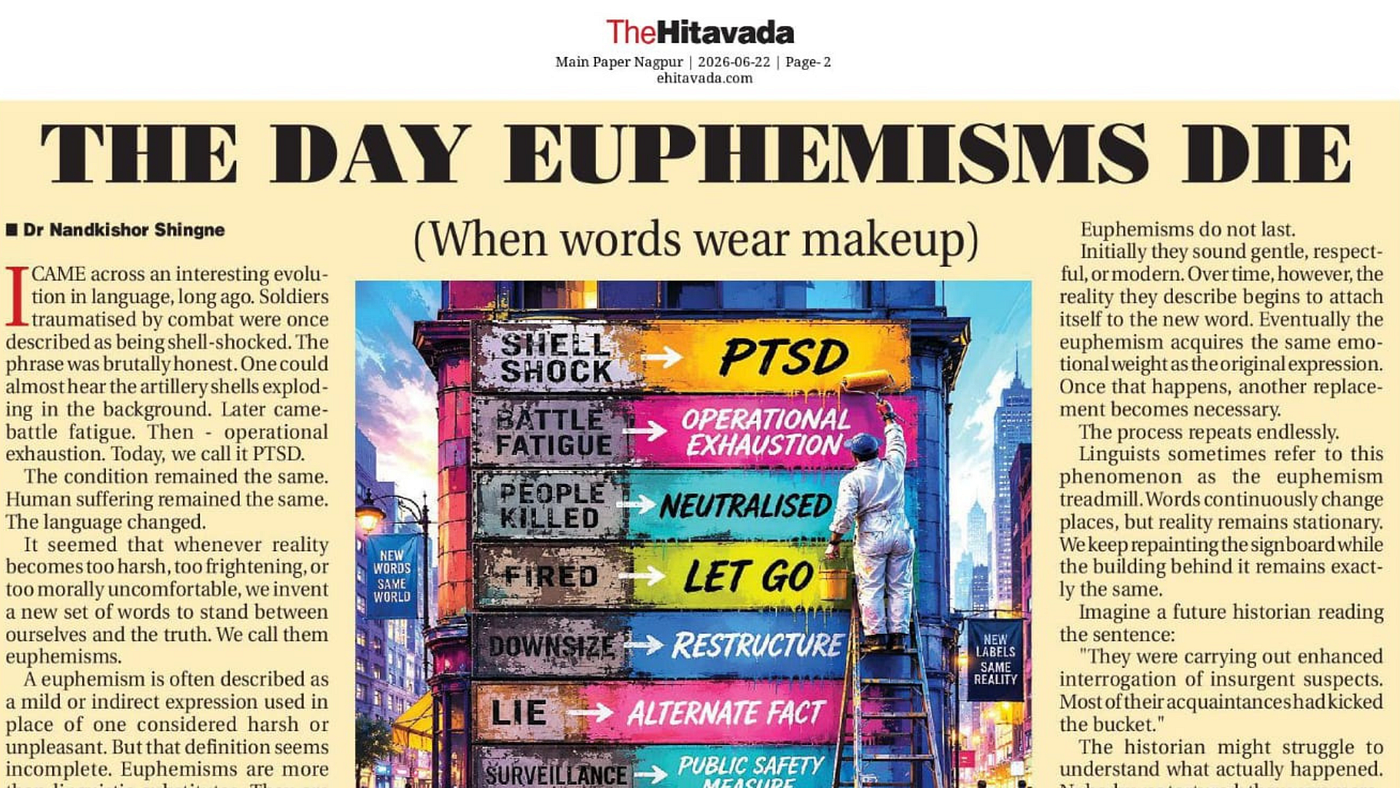
The article appeared in the newspaper The Hitavada
I came across an interesting evolution in language, long ago.
Soldiers traumatized by combat were once described as being shell-shocked. The phrase was brutally honest. One could almost hear the artillery shells exploding in the background. Later came- battle fatigue. Then- operational exhaustion. Today, we call it PTSD.
The condition remained the same. Human suffering remained the same. The language changed.
It seemed that whenever reality becomes too harsh, too frightening, or too morally uncomfortable, we invent a new set of words to stand between ourselves and the truth. We call them euphemisms.
A euphemism is often described as a mild or indirect expression used in place of one considered harsh or unpleasant. But that definition seems incomplete. Euphemisms are more than linguistic substitutes. They are emotional shock absorbers. They soften the blow, reduce discomfort, and conceal the reality they describe.
We have always had an uneasy relationship with reality. We admire truth in principle, but prefer it wrapped in softer language.
Nowhere is this more evident than in the language of war.
People are no longer killed; they are- neutralized. Populations are not reduced; they are depopulated. Civilian deaths become- collateral damage. Torture becomes- enhanced interrogation. Terrorists become-insurgent suspects.
The transformation is remarkable. The actions remain unchanged, yet the language becomes increasingly sterile. The blood, pain and moral ambiguity disappear behind a curtain of carefully chosen words.
The corporate world has elevated euphemism into an art form.
Employees are rarely fired; they are-let go. Companies do not dismiss workers; they-downsize or restructure. Unemployed individuals are merely- between jobs or considering their options. A used car becomes a certified pre-owned vehicle.
Even failure receives cosmetic treatment.
People do not quit; they pivot. Businesses do not retreat; they reposition. Mistakes become learning opportunities.
The language of everyday life is equally revealing.
We rarely describe someone as poor; they are economically disadvantaged. Someone who is cheap becomes economical. Pornography becomes adult entertainment. A strip club becomes a gentleman’s club. Couples no longer divorce; they consciously uncouple. A breakup occurs because someone needs space. An affair is described as slipping one’s moorings. A sexual relationship becomes a friendship with benefits.
The intent behind many euphemisms is understandable and often compassionate. Society has become more sensitive toward disability, illness, ageing and personal hardship.
A cripple became handicapped, then disabled, then physically challenged, and eventually differently abled. A blind person became visually impaired.
The underlying reality does not change merely because the label changes.
Death remains the undisputed champion of euphemism.
We rarely say someone died. They passed away. They passed over to the other side. They kicked the bucket. The family dog crossed the rainbow bridge. Mercy killing becomes euthanasia.
The sheer number of euphemisms for death is revealing. Perhaps humanity has invented hundreds of alternative expressions because it has never quite learned how to make peace with death.
Politicians have long understood that language shapes perception.
A lie becomes an alternate fact.
Propaganda becomes strategic communication.
Surveillance becomes a public safety measure.
Language, in such cases, functions almost like an anaesthetic. It dulls discomfort and creates distance between actions and their consequences.
Yet there is a fascinating irony at the heart of all this.
Euphemisms do not last.
Initially they sound gentle, respectful, or modern. Over time, however, the reality they describe begins to attach itself to the new word. Eventually the euphemism acquires the same emotional weight as the original expression. Once that happens, another replacement becomes necessary.
The process repeats endlessly.
Linguists sometimes refer to this phenomenon as the euphemism treadmill. Words continuously change places, but reality remains stationary. We keep repainting the signboard while the building behind it remains exactly the same.
Imagine a future historian reading the sentence:
“They were carrying out enhanced interrogation of insurgent suspects. Most of their acquaintances had kicked the bucket.”
The historian might struggle to understand what actually happened. Nobody was tortured; they were merely optimally interrogated. Nobody died; they simply kicked the bucket. Nobody was a terrorist; merely an insurgent suspect.
The sentence is almost comical. Yet it reveals something profound. Layer upon layer, euphemisms have wrapped themselves around reality until the original meaning becomes difficult to see.
Reality is patient. It waits behind the words.
Sooner or later, the unpleasant truth that a euphemism was designed to soften catches up with it. The new expression acquires the same stigma as the old one. Then another replacement is invented, and the cycle begins again.
One day, even the word euphemism may itself become too blunt, too obvious. It may require a replacement of its own- perhaps- alternate expression, or context-adjusted communication.
Euphemisms tell us less about language than about ourselves. They reveal our fears of death, our disability, failure and moral responsibility.
Every euphemism is a small negotiation between truth and comfort.
Reality stands on one side. Human sensitivity stands on the other.
And language, forever trying to keep both happy, endlessly repaints the signboard.
(Reams have been written on Euphemisms- This is my take on it.)
Dr. Nandkishor Shingne
메타데이터
- post_id
- 6a5b8123ade2
- slug
- the-day-euphemisms-die-6a5b8123ade2
- url
- https://medium.com/infinite-impulse/the-day-euphemisms-die-6a5b8123ade2
- canonical_url
- https://medium.com/infinite-impulse/the-day-euphemisms-die-6a5b8123ade2
- author_url
- https://medium.com/@drnandushingne
- status
- ok
- fetched_at
- 2026-06-23 17:05:31