The Impeccable Puzzle of Vermeer’s Milkmaid
A brilliant painting infused with suggestive hints
The Impeccable Puzzle of Vermeer’s Milkmaid
A brilliant painting infused with suggestive hints
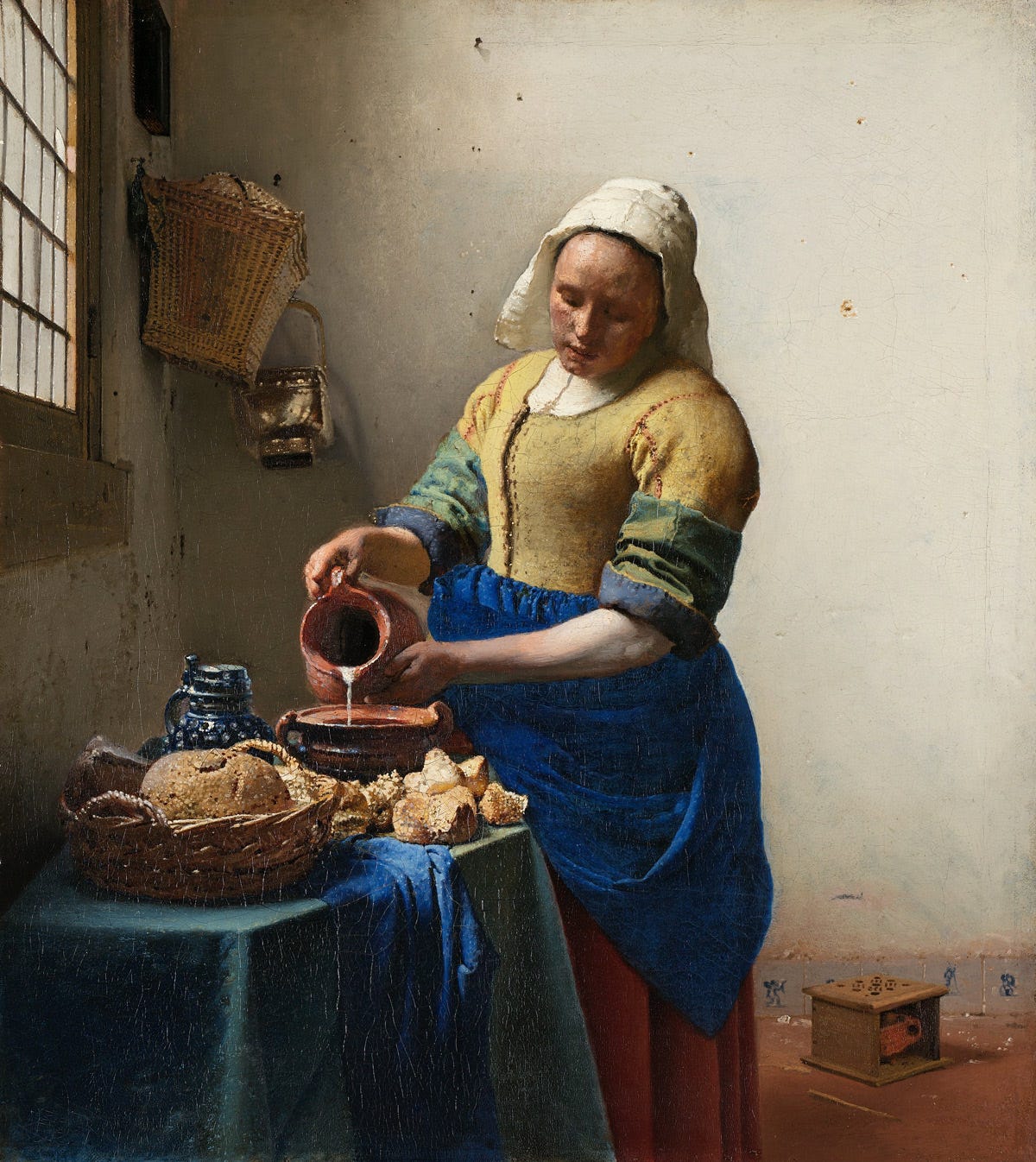
The Milkmaid (c.1660) by Johannes Vermeer. Oil on canvas. 45.5 × 41 cm. Rijksmuseum, Amsterdam, Netherlands. Image source
It looks like a simple scene. A woman stands pouring milk from a clay jug. Before her on a small table is a loaf of bread in a wicker basket, along with several other tufts of old loaf. She is perhaps preparing bread pudding, soaking the ingredients before baking.
The overall mood is quiet, concentrated on the woman in her occupation. With a little imagination, it’s possible to hear the trickle of the milk as it falls softly from the jug’s spout into the earthenware pot.
Johannes Vermeer is an artist known for the utmost care he took over the placement of elements in his paintings. This image is no different. Through the clarity of the composition and the lingering sense of solitude, the painting seems to propose an impeccable puzzle.
Can it be solved?

Detail of ‘The Milkmaid’ (c.1660) by Johannes Vermeer. Oil on canvas. 45.5 × 41 cm. Rijksmuseum, Amsterdam, Netherlands. Image source
Eloquent arrangement
The Milkmaid is a type of painting known as a “genre” work, a style popular in Dutch art in the 17th century, one that celebrated the lives of ordinary people engaged in everyday occupations or pastimes.
The theme offered artists the chance to infuse their paintings with delicate hints of a deeper meaning. Indeed, 17th-century Dutch art was made to be looked at intensely, painted with a deliberate attempt to give the viewer “sweet nourishment to the eyes, making them tarry long” — as the first historian of Dutch art, Karel van Mander, encouraged as early as 1604.
In this painting, Vermeer does just that. The activity of light and surface textures across the painting encourages us to take a prolonged, invested look.

Detail of ‘The Milkmaid’ (c.1660) by Johannes Vermeer. Oil on canvas. 45.5 × 41 cm. Rijksmuseum, Amsterdam, Netherlands. Image source
Notice, for instance, how the paint has a slightly coarse quality, with the highlights of the bread and the pottery painted with fairly thick dabs of paint, a technique known as pointillés.
The activity of blue and white highlights on the surface of the redware pot, for instance, alerts us to its clay texture and suggests a glazed sheen. Meanwhile, the same technique brilliantly establishes the grainy, pitted quality of the bread crusts.

Detail of ‘The Milkmaid’ (c.1660) by Johannes Vermeer. Oil on canvas. 45.5 × 41 cm. Rijksmuseum, Amsterdam, Netherlands. Image source
Interest is further raised by the trio of objects hanging on the wall — a black frame, a straw basket and a brass container — and how, despite their different materials, they work in unison, cascading down the wall towards the main focus of the painting.
The genius of Vermeer was to use objects like these to bring additional texture to the image, as well as guiding the viewer’s eye so our attention always returns to the milkmaid.
These details may also alert us to the fact that the composition is a little imbalanced: the left side of the image is crowded with so many objects and textures, whilst the right side is little more than a plain wall and a small section of floor. Yet, nothing in the painting looks awkward or disordered. How has Vermeer done this? How has he made the painting seem so poised, with such noticeable asymmetry?

Detail of ‘The Milkmaid’ (c.1660) by Johannes Vermeer. Oil on canvas. 45.5 × 41 cm. Rijksmuseum, Amsterdam, Netherlands. Image source
I think the answer lies in the use of light. We see a window along the left edge of the painting with one of its panes broken. The window naturally illuminates the broad expanse of plasterwork behind the woman’s left shoulder, in which cracks and nail holes add surface texture.
Meanwhile, the objects hanging in the corner remain largely in shadow, whilst the strongest point of contrast between light and dark is on the right edge of the woman’s outline. This natural flow, from left to right, greatly stabilises the scene.
Detail of ‘The Milkmaid’ (c.1660) by Johannes Vermeer. Oil on canvas. 45.5 × 41 cm. Rijksmuseum, Amsterdam, Netherlands. Image source
The shape of the table is also interesting. It is easy to miss, but the table is actually a rather peculiar shape. The left edge is butted against the wall, whilst the right edge is protruding into the room at an angle — as if the corner of the table were missing. This opens up the space, and draws the viewer’s eye along the lit edge of the table into the scene.
Latent erotism?

Detail of ‘The Milkmaid’ (c.1660) by Johannes Vermeer. Oil on canvas. 45.5 × 41 cm. Rijksmuseum, Amsterdam, Netherlands. Image source
The puzzle of the painting gets deeper with the curious box positioned on the floor.
It has been identified as a foot warmer or “foot stove”, consisting of a perforated box containing a lump or two of hot coals in an inner vessel. They were used to keep feet and legs warm during the Dutch winters, and were typically enjoyed in a seated position with one’s feet resting upon the lid.
The very fact that Vermeer has included one in his painting can perhaps be read as another indication of the maid’s domestic diligence: rest and relaxation may come later, but for now there is work to be done.
The foot warmer might also carry provocative connotations, as it was occasionally employed by artists of this time as a symbol of female sexual arousal. This association stems from its placement beneath a skirt, effectively radiating heat throughout the lower body.

Detail of ‘The Milkmaid’ (c.1660) by Johannes Vermeer. Oil on canvas. 45.5 × 41 cm. Rijksmuseum, Amsterdam, Netherlands. Image source
A row of Delft tiles behind the foot warmer may also be significant. Of those that are visible, the left-most tile shows an image of Cupid, the mischievous god of desire and love, with wings and a bow.
So subtle is this detail that we have to be careful not to overstate it, but it’s worth bearing in mind that at this time in Dutch art, there was a strong tradition of imbuing simple kitchen scenes with erotic insinuations. Milkmaids especially, who were typically young, unmarried women who travelled from rural areas to cities for work, were depicted as comely young women whose domestic labours were given undertones of sexual willingness.

Detail of ‘The Milkmaid’ (c.1660) by Johannes Vermeer. Oil on canvas. 45.5 × 41 cm. Rijksmuseum, Amsterdam, Netherlands. Image source
The presence of Cupid in the Vermeer painting has led some historians to find a similar salacious element in this image. The central act of pouring the milk into a receptacle is the most obvious suggestion of the woman’s amorous availability, along with the palpable bareness of her exposed forearms.
Ethical practicality
But not all interpretations agree. Personally, I lean towards the opinion that Vermeer has painted a work that has less to do with lasciviousness and more with the virtues of humble labour, accentuating the ethical and social value of the maid’s practical hard work.

Detail of ‘The Milkmaid’ (c.1658) by Johannes Vermeer. Oil on canvas. 45.5 × 41 cm. Rijksmuseum, Amsterdam, Netherlands. Image source
After all, Vermeer was an artist with an eye for psychological nuance in the women he painted. We may read from her coarse clothing, starched linen headwear, thickset sleeves (known as morsmouwen or “mess sleeves”) and slightly ruddy complexion, that far from being a threat to the honour of the household she is an upright and faithful steward.
Moreover, the fact that she is making good use of old stale bread would also have been seen as an act of domestic propriety. In this case, the appearance of Cupid can perhaps be understood as a sign that love lingers in her memory, but chores must come first.
Painted in about 1658, this is a relatively early work for Vermeer. He was just 25 when he painted it, and as such it carries some of the hallmarks of his earlier stylistic choices. In later works, he would aim for a much smoother finish in his painted surface. Yet, given the consummate way the image is constructed, it has long been considered one of his best and most captivating works.

If you enjoyed this, you may also like my new book ***Great Art Explored,* **an exploration of some of art’s most compelling images.
Would you like to get…
A free guide to the Essential Styles in Western Art History, plus tips and stories about great art? Download for free here.
Love my writing?
You can leave me a tip at **Ko-fi**.
메타데이터
- post_id
- 6a5f8ae68720
- slug
- the-impeccable-puzzle-of-vermeers-milkmaid-6a5f8ae68720
- url
- https://medium.com/@christopherpjones/the-impeccable-puzzle-of-vermeers-milkmaid-6a5f8ae68720
- canonical_url
- https://medium.com/@christopherpjones/the-impeccable-puzzle-of-vermeers-milkmaid-6a5f8ae68720
- author_url
- https://medium.com/@christopherpjones
- status
- ok
- fetched_at
- 2026-06-09 15:37:30





