Understanding PCD
Riding a dysfunctional wave
NONFICTION
Understanding PCD
Riding a dysfunctional wave

Photo by Nils Schirmer on Unsplash
Nearly every cell in your body has hair on it. Even the cells in your hair have hair. These tiny hairs, called cilia, are only a few millionths of a meter long, but they perform many vital functions and have a fascinating internal structure that allows them to sense and interact with their environments.
There are cilia in your ears, eyes, and nose that sense vibration, light, and odors. Cilia in your brain help form the long neural axons. Embryonic cilia circulate fluid in the very early stages of human development to “teach” the embryo on which side of the body the heart, and other organs, should be placed.
In reproductive cells (gametes), cilia are vital to correct functioning, and without them, none of us would be here. The “tail” of a sperm cell is a cilium (also called a flagellum) that whips back and forth to propel it toward its important destination. Forests of synchronously waving cilia in the fallopian tubes move fertilized eggs from the ovary to the uterus, much like crowd surfing at a concert.

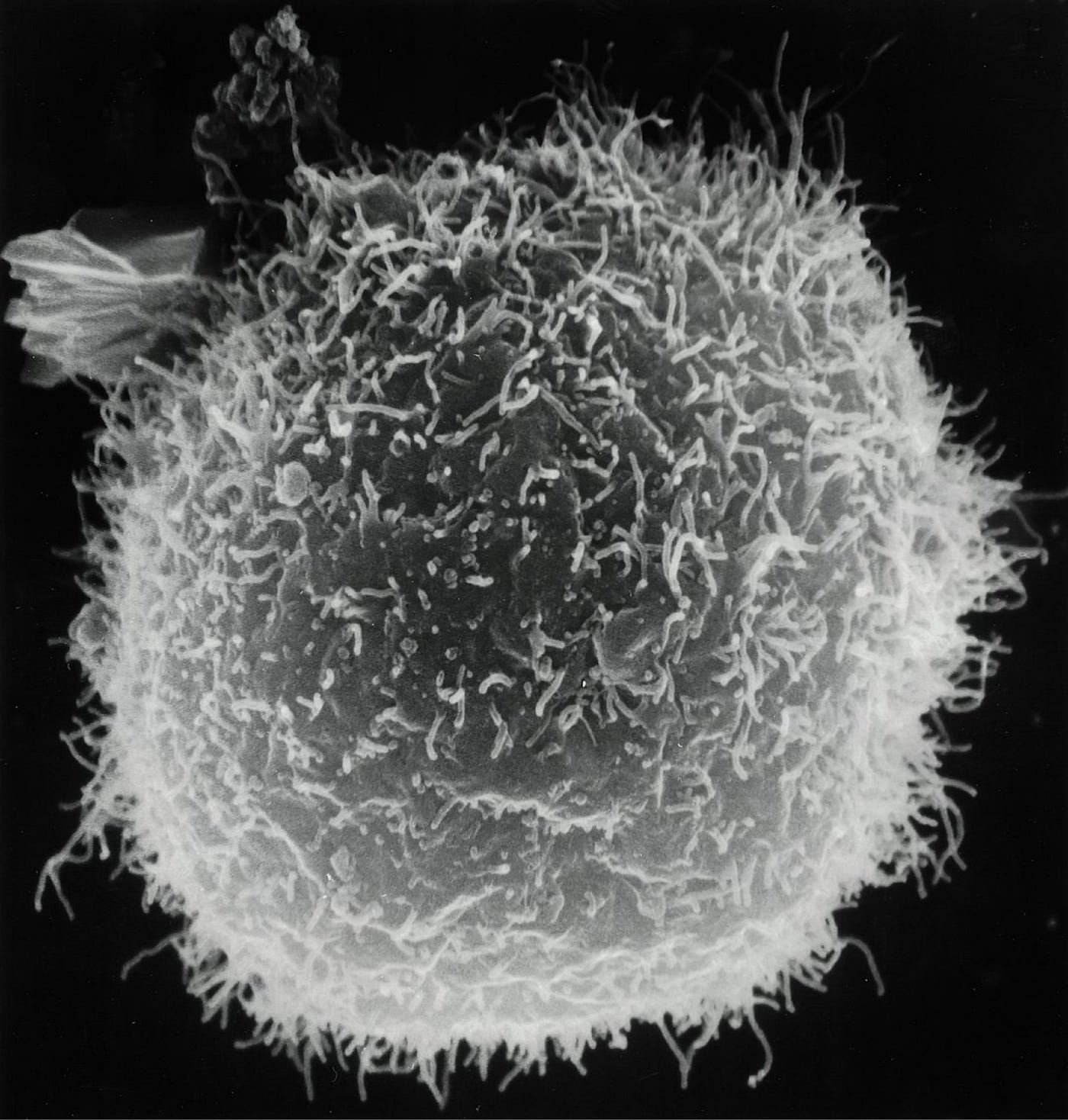
Credit: Charles Daghlian, Public domain, via Wikimedia Commons
The lungs are lined with millions of cilia (see photomicrograph above) that also wave in unison to move foreign particles and mucus out of the way. Think how often you replace or clean your AC filter and how grimy it looks if you wait too long — just from moving “fresh” air through it occasionally. It’s the same with our lungs, except we are breathing air in and out repeatedly, every couple of seconds for as long as we live, and there is no lung filter to replace.
So-called motile cilia, like the tail of the sperm cell or the lung-clearing cilia, must move by waving or undulating about the point where they anchor to a cell. As small as a typical cilium is, there is a complex structure of even smaller components inside of one that defines its structure and facilitates its movement.
The diagram below shows a cross-sectional view of a cilium as if we had cut it down like a tree. No matter where they are in the body, or what function they serve, they all have an internal skeleton, a cytoskeleton, built from semi-rigid cables called microtubules. As the figure depicts, there are always exactly nine pairs of these hollow, molecular cables around the periphery of the cilium. For motile cilia only, there is an additional pair of microtubules running up the center of the hair-like structure. Each microtubule is a single polymerized molecule only about 25 nanometers (billionths of a meter) in diameter with walls only 10 nanometers thick!

Credit: LadyofHats, Public domain, via Wikimedia Commons
The microtubules give the cilia their elongated structure, but what makes them sway? The answer to that is so astounding it sounds like science fiction.
Nanobots.
That’s right. Legions of the smallest living critters on the planet (depicted in blue above), only a few nanometers tall, hold on to one of the microtubules in each pair and walk down the other one. This strange, coordinated activity among biological automatons too small to have a brain, causes physical slippage of one of the tubules in each pair relative to the other, stressing the whole structure in one direction or another and causing it to flex and bend.
I’ve written about these robotic proteins before and marveled at how they manage to move at all, given they are embedded in a virtual hurricane of water molecules being thrashed about by random Brownian forces. In general, microbiologists call these molecular motors and there are many, many different families of them that work inside cell bodies, the muscles, and all over the body. Basically, any application that requires physical movement at the molecular level uses these nanobots to accomplish it. In the case of ciliary movements, the family of molecular robots primarily responsible is called dynein. This one has only a single “leg” and “foot” and moves like a payload on a pogo stick along the microtubules.

Credit: TheTrappist, CC BY-SA 3.0, via Wikimedia Commons
So that gives us some rudimentary idea of how an individual cilium might move. But how do all those nanobots coordinate to move all those cilia with perfectly choreographed dance steps in unison to accomplish something like that wave action described above? That is still an area of active research, but we do know something about a related question: What happens when that sublime coordination among molecules fails to work properly?
If the concert-goers in that first photo aren’t strong enough or coordinated enough, the crowd surfer will fall. And if the cilia in your lungs, nasal passages, and fallopian tubes (to name just a few) aren’t coordinated enough, if they move at random rather than in unison, for example, they will fail to perform the jobs they’re intended to do.
That is exactly what happens with a disease called Primary Ciliary Dyskinesia (PCD). Patients with this rare (about 1 in 20,000 births) hereditary condition have immotile, uncoordinated, or otherwise dysfunctional cilia, usually in multiple locations. PCD patients begin to exhibit symptoms immediately after birth and they must continue to deal with them throughout their lives. There is no cure.
Due to the ubiquity of the primary ciliary mechanism all through our bodies, the symptoms of PCD can be quite serious, even fatal. These include the following:
- Inability to clear the lungs of accumulated mucus, causing a chronic, rasping cough
- Hearing impairment and/or blindness
- Obesity
- Sterility due to dysfunctional fallopian transport (in women) or immotile sperm (in men)
- In some cases, the major organs of the body are in the wrong places due to dysfunctional cilia in the embryonic node during the first few days of fetal development
Despite these serious symptoms, some PCD patients do learn to manage and live with the disease. Many live into their 20s, 30s, 40s, and beyond. So you just might meet someone with uncoordinated cilia, or sit next to them on an airplane.
To repeat, and this is important, PCD is an inherited disease. It is caused when both parents have a certain, unfortunate recessive gene. Neither parent will have exhibited symptoms, so the presence of symptoms in the newborn is always a sad surprise.
PCD is not contagious
You cannot, under any circumstances, catch it if someone next to you coughs. As concerning as that terrible cough might sound to you, the disease cannot be passed from one person to another. It is not an infection. Not a virus. Not a germ. Not the flu. And most importantly during these trying times…
PCD is not COVID
Unfortunately, it does not protect a person from the virus. Someone with PCD is just as likely as any of us to contract COVID-19 from someone who is unvaccinated, unmasked, or unlucky enough to have been infected with the virus despite taking all sane precautions.
Please be careful out there. And compassionate.
Jim Dutton © 2022
메타데이터
- post_id
- 6aa5f6363267
- slug
- understanding-pcd-6aa5f6363267
- url
- https://medium.com/an-idea/understanding-pcd-6aa5f6363267
- canonical_url
- https://medium.com/an-idea/understanding-pcd-6aa5f6363267
- author_url
- https://medium.com/@duttonator
- status
- ok
- fetched_at
- 2026-07-27 15:08:01