What Product Marketing Really Means Beyond Launches and Sales Decks
A beginner-friendly guide to understanding product marketing in B2B SaaS — with examples, frameworks, and practical exercises.
What Product Marketing Really Means in B2B SaaS
A beginner-friendly guide to understanding product marketing in B2B SaaS, what PMMs actually do, how they connect Product, Sales, Marketing, and Customer Success, and why PMM is much more than promotion.
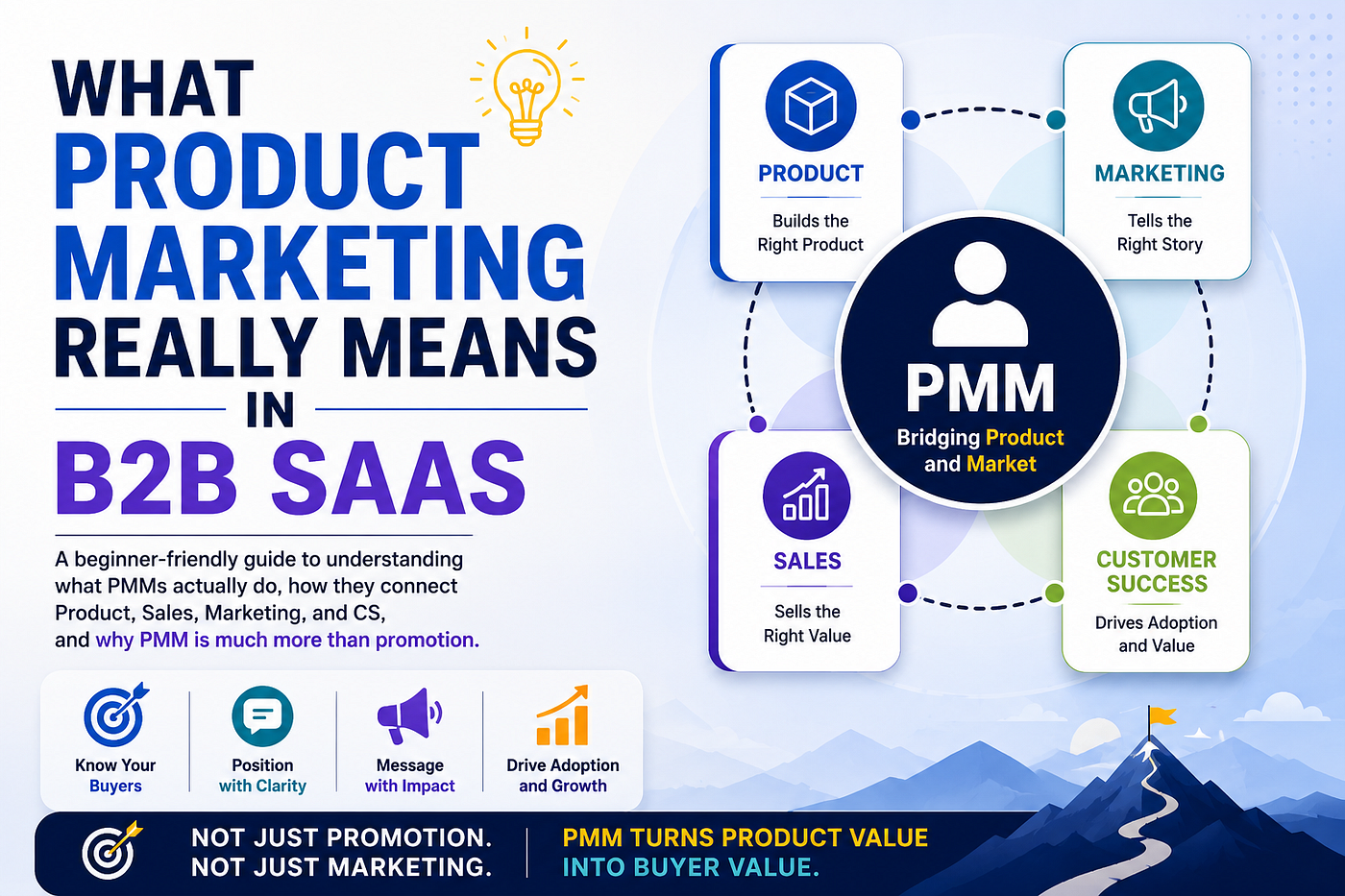
Product marketing is not just about launching products, writing copy, or creating sales collateral. In B2B SaaS, product marketing is the function that turns product value into market understanding, buyer clarity, Sales readiness, GTM alignment, and business impact.
I used to think product marketing was simply marketing a product.
That sounded obvious.
Product marketing means:
Write about the product. Promote the product. Create launch posts. Make brochures. Support campaigns. Help Sales with decks.
But the more I started learning product marketing, the more I realised that this definition was too small.
Product marketing is not only about promotion.
It is about clarity.
Clarity about who the product is for. Clarity about what problem the product solves. Clarity about why the problem matters. Clarity about how the product is different. Clarity about how Sales should explain value. Clarity about how Marketing should communicate the story. Clarity about how customers should understand and adopt the product.
In B2B SaaS, this clarity matters even more because buying decisions are rarely simple.
There are multiple stakeholders. There are long sales cycles. There are technical evaluations. There are budget discussions. There are competitor comparisons. There are internal objections. There are implementation concerns. There are business outcomes to prove.
That is where product marketing comes in.
A PMM helps connect the product to the market.
Not just by saying what the product does, but by explaining why it matters to the right buyer.
This is the first article in my Product Marketing Playbook.
So before going into messaging, positioning, GTM, launches, Sales enablement, competitive intelligence, metrics, and portfolio building, we need to start with the foundation:
What product marketing really means in B2B SaaS.
What You’ll Learn
By the end of this article, you will understand:
- What product marketing means in B2B SaaS
- Why product marketing is not the same as general marketing
- What PMMs actually do
- How PMMs work with Product, Sales, Marketing, and Customer Success
- Where PMM fits inside a company
- Why PMM is important across the product lifecycle
- What skills a PMM needs
- What product marketing is not
- How beginners should think about PMM
What Is Product Marketing?
Product marketing is the function that connects product, market, customer, and revenue teams.
A simple definition:
Product marketing helps the right audience understand the product, its value, its differentiation, and why it matters.
But in B2B SaaS, PMM goes deeper than that.
A product marketer helps answer:

Product marketing sits between the product and the market.
Product teams build the product.
Sales teams sell the product.
Marketing teams create demand.
Customer Success teams help customers adopt the product.
PMM connects all of them with a clear product story.
Product Marketing in One Simple Line
If I had to explain product marketing in one simple line, I would say:
Product marketing turns product capabilities into buyer value.
That means a PMM does not stop at:
“This feature exists.”
A PMM asks:
“Why does this feature matter to the buyer?”
For example:

This is the difference between product language and buyer language.
Product language explains what exists.
Buyer language explains why it matters.
Why Product Marketing Matters in B2B SaaS
B2B SaaS products are often complex.
They may involve:
- Technical features
- Multiple use cases
- Different buyer personas
- Long sales cycles
- Multiple decision-makers
- Competitive evaluations
- Security or compliance questions
- Implementation concerns
- Adoption challenges
Because of this, simply listing features is not enough.
Buyers need clarity.
Sales needs clarity.
Marketing needs clarity.
Product needs market feedback.
Customer Success needs adoption messaging.
Leadership needs GTM alignment.
This is why PMM matters.

Product marketing helps teams move from:
“We built this.”
to
“Here is why this matters, who it is for, and how it creates value.”
Product Marketing Is Not Just Promotion
One of the biggest beginner mistakes is thinking PMM is only promotional.
Promotion is one part of product marketing.
But product marketing starts much earlier.
Before a campaign goes live, PMMs often work on:
- Customer understanding
- Market research
- Positioning
- Messaging
- Buyer personas
- Competitive intelligence
- Sales enablement
- Launch planning
- GTM alignment
- Product feedback
- Adoption communication
- Metrics and learning
A simple comparison:

PMM is not only about making noise.
It is about making the product easier to understand, sell, adopt, and trust.
Weak PMM vs Strong PMM
A weak PMM focuses only on tasks.
A strong PMM focuses on clarity, alignment, and business impact.

This is one of the biggest mindset shifts in product marketing.
The job is not only to create more things.
The job is to make the right things clearer and more useful.
Product Marketing vs General Marketing
Product marketing and general marketing are connected, but they are not the same.
General marketing often focuses on brand awareness, demand generation, campaigns, channels, content, and audience engagement.
Product marketing focuses more deeply on product value, positioning, messaging, GTM, enablement, buyer understanding, competitive context, and adoption.

Both are important.
But PMM brings the product, buyer, and market story into focus.
Where PMM Fits in the Company
Product marketing usually works across many teams.
It may sit inside Marketing, Product, or GTM depending on the company structure.
But no matter where it sits, PMM usually connects these functions:

This is why PMM is often called a cross-functional role.
But the real value is not just working with many teams.
The real value is helping those teams speak the same product language.
What PMMs Actually Do
A PMM’s work can vary by company, product, size, and stage.
But most PMMs work across these areas:

A PMM may not own all of these equally.
But these are the areas where product marketing creates value.
PMM Across the Product Lifecycle
Product marketing is not only needed at launch.
PMM can support the product across the full lifecycle.

This is important because product marketing should not enter only at the end.
If PMM only gets involved after the product is ready, the work becomes reactive.
Strong PMM work starts earlier.
It helps shape how the product is understood before, during, and after launch.
How PMMs Work with Product, Sales, Marketing, and CS
PMM is a cross-functional role.
A PMM rarely works alone.
They work with Product, Sales, Marketing, Customer Success, and sometimes leadership.

PMM acts like a bridge.
But not a passive bridge.
A PMM does not just pass information from one team to another.
A PMM translates information.
Product says:
“This feature supports configurable workflows.”
PMM translates it into:
“Teams can adapt review processes based on business rules, reduce manual routing, and improve consistency.”
Sales says:
“Buyers keep asking how we are different.”
PMM translates that into:
“We need clearer differentiation, comparison messaging, and objection responses.”
Customer Success says:
“Customers are not using this feature.”
PMM translates that into:
“We may need better adoption communication, onboarding content, or use-case education.”
That is the real value of PMM.
PMM Output vs PMM Impact
Beginners often judge PMM work by outputs.
But good PMM work should also connect to impact.

Outputs matter.
But the real goal is not just to create assets.
The goal is to improve understanding, alignment, confidence, adoption, and business learning.
What Product Marketing Is Not
It is also important to understand what PMM is not.

PMM sits between strategy and execution.
That is what makes it powerful.
And sometimes, confusing.
A Simple Example of PMM Thinking
Imagine a company has built a new feature:
Configurable approval workflows.
A product-only explanation might say:
“Users can configure multi-step approval workflows with custom rules.”
A PMM would ask:
Who is this for? What problem does it solve? Why does this matter? What is the business impact? How should Sales explain it? What objections might buyers raise? What proof do we have? How should we launch it? How will we measure success?
A stronger PMM message might be:
“Help operations teams reduce manual routing and improve approval consistency with workflows that can be configured around business rules.”
That is product marketing.
It turns product capability into buyer value.
Skills a Product Marketer Needs
Product marketing requires a mix of strategy, communication, research, and execution.

A good PMM is not only creative.
A good PMM is also structured, curious, and business-aware.
Beginner-Friendly Way to Think About PMM
If you are new to PMM, do not try to understand everything at once.
Start with these five questions:

Most PMM work begins here.
Positioning, messaging, GTM, launch, Sales enablement, website messaging, case studies, and content all become easier when these questions are clear.
Common Beginner Misconceptions About PMM
1. PMM Is Just Marketing
PMM is part of marketing in many companies, but it is deeply connected to Product, Sales, CS, and strategy.
2. PMM Only Works During Launches
Launches are important, but PMM work also happens before and after launch.
3. PMM Only Creates Assets
Assets are outputs.
The real work is understanding the problem, buyer, market, message, and impact.
4. PMM Needs to Know Everything About Product Management
PMMs need product understanding, but they do not usually own roadmap decisions.
5. PMM Is Only for Big Companies
Even early-stage startups need product marketing thinking.
They need to explain who they serve, what problem they solve, and why buyers should care.
A Simple PMM Checklist
Before creating any PMM asset, ask:

This checklist works for launches, website pages, Sales assets, campaigns, and content.
Why PMM Is Important for Career Growth
Product marketing is a valuable career path because it builds both strategic and execution skills.
As a PMM, you learn how to:
- Understand products
- Study markets
- Listen to buyers
- Work with Sales
- Collaborate with Product
- Create messaging
- Plan launches
- Build enablement
- Track impact
- Communicate clearly
These skills are useful not only in PMM roles but also in Product, Growth, Strategy, Sales Enablement, and GTM leadership roles.
PMM teaches you how a product becomes understandable, sellable, adoptable, and valuable in the market.
That is why it is such an interesting role.
Expected Interview Questions

Sample Answer
Product marketing, to me, is the function that connects product, market, customer, and revenue teams. It helps define who the product is for, what problem it solves, why it matters, how it is different, and how internal teams should communicate its value. In B2B SaaS, PMM is important because products can be complex, buying committees are larger, and buyers need clarity before they trust, choose, and adopt a product.
Closing Thought
Product marketing is often misunderstood because it sits between many teams.
It is not only Product.
It is not only Marketing.
It is not only Sales support.
It is not only launch management.
It is the function that helps everyone understand the product better.
The buyer understands why the product matters. Sales understands how to explain it. Marketing understands what story to tell. Product understands how the market responds. Customer Success understands how to support adoption. Leadership understands how product value connects to GTM.
That is what product marketing really means in B2B SaaS.
It creates clarity.
And in a market full of similar products, complex features, and busy buyers, clarity is not a small thing.
Clarity is the difference between a product that exists and a product that buyers understand, trust, choose, and adopt.
A Book I Recommend
One book that is useful for understanding product marketing basics is Obviously Awesome by April Dunford.
The book is focused on positioning, but it is highly relevant for product marketers because positioning is one of the foundations of PMM work.
It helps you understand how to make a product easier to understand, easier to compare, and easier to value.
For beginners, the most important lesson is this:
A product does not become valuable just because it has features.
It becomes valuable when the right audience understands why those features matter.
Recommended read: **Obviously Awesome by April Dunford**
This is the starting point of the *Product Marketing Playbook.*
Next, I’ll write about Product Messaging Is Not Copywriting and explain why messaging is not just about writing better words, but about understanding the buyer, the problem, the value, and the reason to believe.
메타데이터
- post_id
- 6aad52645e3a
- slug
- what-product-marketing-really-means-b2b-saas-6aad52645e3a
- url
- https://medium.com/@nityap093/what-product-marketing-really-means-b2b-saas-6aad52645e3a
- canonical_url
- https://medium.com/@nityap093/what-product-marketing-really-means-b2b-saas-6aad52645e3a
- author_url
- https://medium.com/@nityap093
- status
- ok
- fetched_at
- 2026-06-12 07:40:50




