Wuthering Heights: An Aesthetic Disaster
Wuthering Heights: An Aesthetic Disaster
This is not meant to be a cinematic review.
I am not interested in analyzing camera work and editing, or rather, it is not my place to do so. What interests me is that grey area between interpretation and betrayal: adaptation.
When we speak about the cinematic transposition of a literary work, we are speaking about intersemiotic translation. Not a translation from one language to another, but from one system of signs to another. From word to image. A novel can afford not to tell me what Catherine is wearing in a particular scene; a film cannot. If the page can dig into interiority, the screen must suggest it through a face, a gesture, a room, a detail of makeup.
And this is precisely where Wuthering Heights seems to take what it understood-or chose to understand- from the nineteenth-century novel and transform it into a visually striking spectacle emptied of its historical and social substance.
The problem is not adaptation itself. It is simplification.
Emily Brontë’s work is a gothic novel about class, violence, resentment, and marginality. The film is not.
Heathcliff, whose ethnicity in the novel is never clearly defined yet unmistakably marked as “other,” is brutal, resentful, shaped by the violence he suffers and later reproduces. In the film, however, he undergoes a process of softening (not that I necessarily object to this): he becomes digestible, seductive, romantic, almost submissive. But the moment he is smoothed out, the other characters become distorted. Isabella, who in the novel is a victim and a symbol of a violent power dynamic, is rendered almost complicit. Trauma becomes consensual practice. Structural violence is diminished in favor of a polished BDSM aesthetic.
As for the representation of women, the film takes a step backward from the novel. Catherine, in the context of the nineteenth century, is a radical character. She is not a contemporary feminist icon, certainly, but for her time she is a woman who chooses, who desires, who makes mistakes consciously even deliberately. She’s complex.
In the film, she’s reduced to a bratty girl who wants her toy. The sexualization of her character is almost obsessive. And this does not apply only to Catherine: women are compared to horses and dogs, animalized in moments of intimacy. To see women in the twenty-first century still represented through bestial metaphors is not provocative: it is regressive.
If we momentarily set all of this aside, the film is not devoid of brilliant visual intuitions.
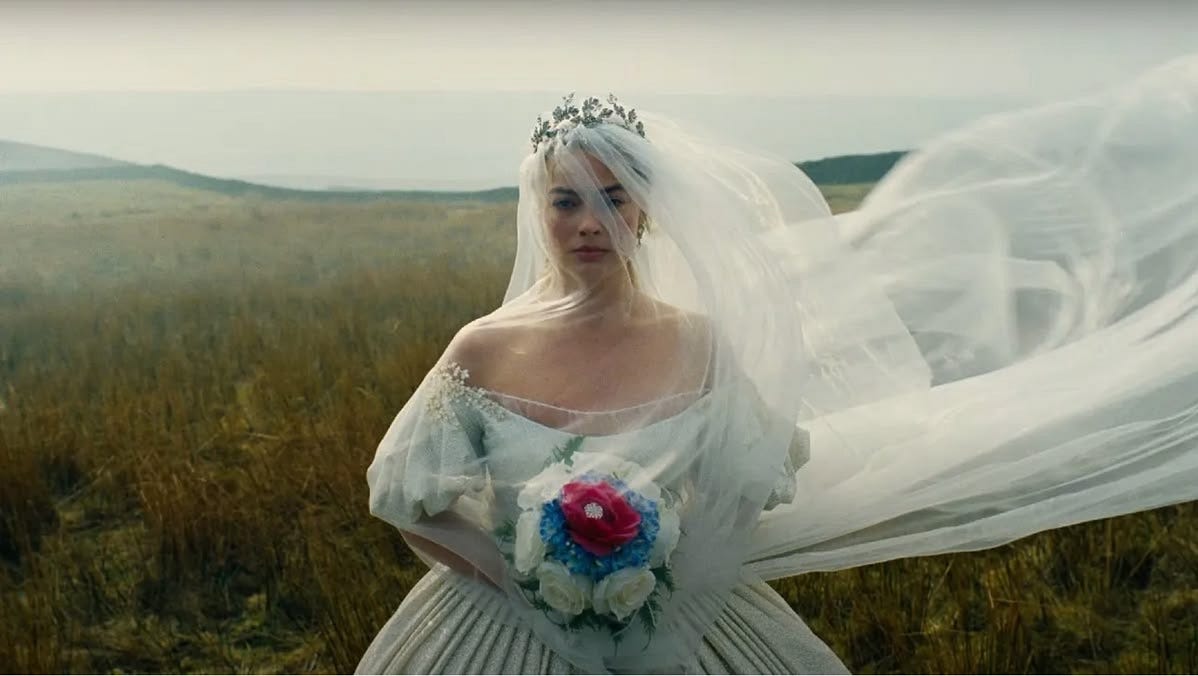
Makeup, for instance, becomes a central narrative device. It accompanies the story without overwhelming it. Catherine’s blush acts as a mirror of her emotional turmoil: cherry red when she feels rage and desire; softer pink when youth and embarrassment prevail; nearly faded in the final act, where grief, emptiness, and dissolution dominate.
This is not exactly character development- because, ultimately, the character does not truly evolve- but rather an evolution of emotion. A powerful and coherent visual language, like Heathcliff’s perpetually dirty hands and blackened nails, even in moments of intimacy. It is a striking detail once you notice it: dirt as an identity marker. No matter how wealthy he becomes or how close he moves toward the bourgeoisie, Heathcliff remains the outsider. Wealth does not cleanse him neither socially nor spiritually.
Then there are the houses. Every location and every room seems to exist in symbiosis with the characters. Though historically inaccurate (like much of the film) they remain consistent with its aesthetic vision. The dining room exudes tension; Wuthering Heights itself appears to accumulate pain, mold, and stones pushing out from the walls, as though the architecture were absorbing and reflecting the characters’ suffering.
For many, this may not be a bad film and maybe isn’t. But it is merely a beautiful picture to look at. A picture that is afraid to confront non-romanticized violence and class struggle, choosing instead a nineteenth-century version of Fifty Shades.
메타데이터
- post_id
- 6aad63dfdc94
- slug
- wuthering-heights-an-aesthetic-disaster-6aad63dfdc94
- url
- https://medium.com/@mgl0ssy/wuthering-heights-an-aesthetic-disaster-6aad63dfdc94
- canonical_url
- https://medium.com/@mgl0ssy/wuthering-heights-an-aesthetic-disaster-6aad63dfdc94
- author_url
- https://medium.com/@mgl0ssy
- status
- ok
- fetched_at
- 2026-07-15 23:27:12