Linear vs Convolution vs Attention Deep Learning Explained
Unlock the secrets of Deep Learning in just 60 seconds! 💡 Discover the difference between Linear, Convolution, and Attention layers with…
Linear vs Convolution vs Attention Deep Learning Explained
Unlock the secrets of Deep Learning in just 60 seconds! 💡 Discover the difference between Linear, Convolution, and Attention layers with simple examples. These concepts power today’s smartest AI models — and now you can master them too!
Script:
Deep learning is a journey of turning simple numbers into intelligence. A Linear layer transforms data into a new space, giving it fresh meaning. A Convolutional layer captures hidden patterns, perfect for images and sequences. An Attention layer looks globally, connecting every piece of data with context. Together, these layers form the foundation of today’s smartest AI models. Each plays a unique role in how machines understand the world. Mastering them opens the door to endless innovation in AI. Subscribe now and get the complete Jupyter notebook on our site to start building smarter models today.
Code:
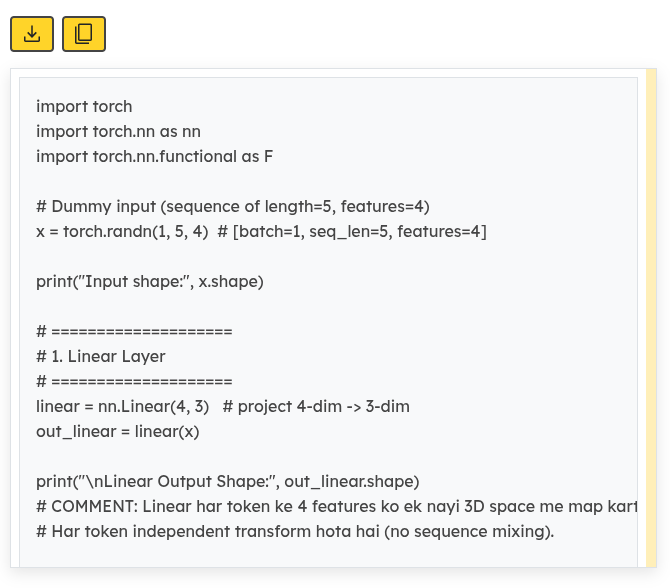
import torch
import torch.nn as nn
import torch.nn.functional as F

# Dummy input (sequence of length=5, features=4)
x = torch.randn(1, 5, 4)  # [batch=1, seq_len=5, features=4]

print("Input shape:", x.shape)

# ====================
# 1. Linear Layer
# ====================
linear = nn.Linear(4, 3)   # project 4-dim -> 3-dim
out_linear = linear(x)

print("\nLinear Output Shape:", out_linear.shape)
# COMMENT: Linear har token ke 4 features ko ek nayi 3D space me map karta hai
# Har token independent transform hota hai (no sequence mixing).

# ====================
# 2. Conv1D Layer
# ====================
conv1d = nn.Conv1d(in_channels=4, out_channels=3, kernel_size=2, stride=1)

# Conv1d ko [batch, channels, seq_len] chahiye
x_conv = x.transpose(1, 2)  # [1, 4, 5]
out_conv = conv1d(x_conv)

print("\nConv1D Output Shape:", out_conv.shape)
# COMMENT: Conv local sliding window se pattern pakadta hai
# Yahan kernel_size=2 => har 2 consecutive tokens ka relation seekh raha hai.

# ====================
# 3. Self-Attention
# ====================
d_model = 4
attn = nn.MultiheadAttention(embed_dim=d_model, num_heads=2, batch_first=True)
out_attn, _ = attn(x, x, x)  # Q=K=V=x
print("\nAttention Output Shape:", out_attn.shape)메타데이터
- post_id
- 6abb6c4f0f8f
- slug
- linear-vs-convolution-vs-attention-deep-learning-explained-6abb6c4f0f8f
- url
- https://medium.com/@codingmalik/linear-vs-convolution-vs-attention-deep-learning-explained-6abb6c4f0f8f
- canonical_url
- https://medium.com/@codingmalik/linear-vs-convolution-vs-attention-deep-learning-explained-6abb6c4f0f8f
- author_url
- https://medium.com/@codingmalik
- status
- ok
- fetched_at
- 2026-07-24 07:51:51