Clarence Thomas, Harlan Crow and the Lack of Consequences
What happens when judges are expected to judge themselves?
Clarence Thomas, Harlan Crow and the Lack of Consequences
What happens when judges are expected to judge themselves?
For decades, Clarence Thomas positioned himself as proof that a Black man could rise to the highest levels of American power through conservative ideology, personal discipline and rejection of what he viewed as dependency politics.
To his supporters, he represents independence. To his critics, he represents a sellout.
The recent reappearance of billionaire donor Harlan Crow seated openly in the audience during Thomas’s public speech at the University of Texas reignited a question far larger than ethics rules:
Who does power in America actually serve?
Because this story stopped being about “friendship” a long time ago.
The controversy surrounding Thomas and Crow is already one of the most significant ethics scandals in modern Supreme Court history.
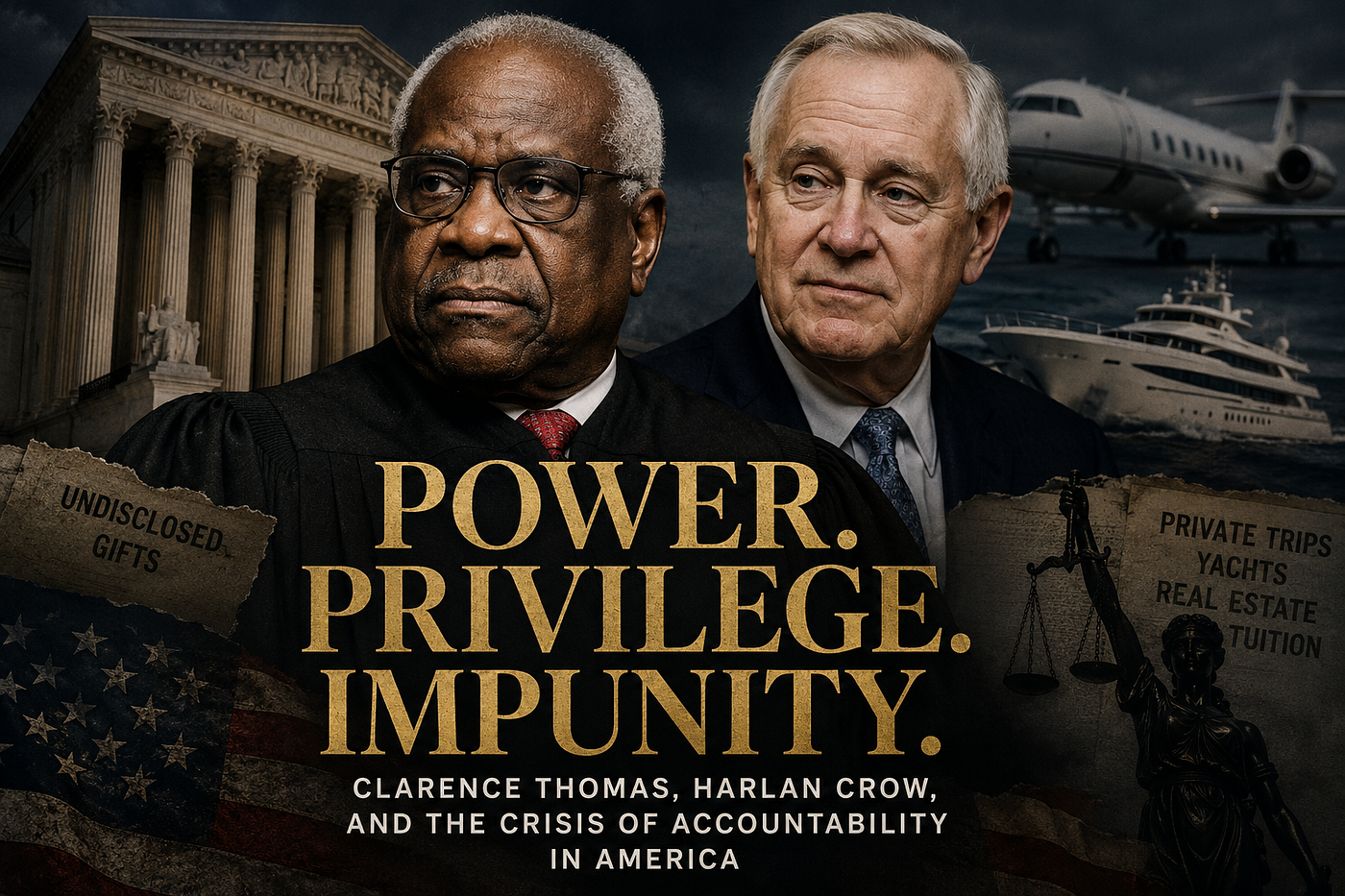
Investigations revealed years of luxury vacations, private jet travel, yacht trips, real estate deals and other undisclosed gifts connected to Crow.
Thomas defended the relationship as a personal friendship. Crow denied trying to influence the justice. No criminal charges emerged. No impeachment occurred. The Supreme Court continued functioning as normal.
But many Americans, especially African Americans, looked at the situation and saw something deeper than legal technicalities.
They saw a portrait of American power operating exactly as it often has for centuries: wealth protecting wealth, elites protecting elites and accountability becoming flexible once someone reaches a certain level of influence.
For Black Americans, the symbolism is angering.
Clarence Thomas is not just any justice. He is the second Black Supreme Court justice in U.S. history after Thurgood Marshall, the civil rights giant who argued Brown v. Board of Education and spent his life fighting segregation.
Thomas replaced Marshall in 1991, and ideologically they could not have been more different.
Marshall believed government intervention was often necessary to correct racial injustice. Thomas frequently argues the opposite.
That divide has defined Thomas’s relationship with Black America for decades.
Many Black conservatives admire him precisely because he refuses to shape his politics around racial solidarity.
They see him as intellectually fearless, unwilling to bend to liberal orthodoxy simply because he is Black.
But the majority of African Americans see Thomas as someone who benefited from the sacrifices of the civil rights movement while consistently voting against protections that movement fought to secure, from affirmative action to voting rights.
The Crow controversy intensifies that divide because it touches on something Black Americans know intimately: unequal accountability.
Ordinary Americans are expected to disclose small financial conflicts.
Poor people are heavily scrutinized for public assistance fraud.
Working-class people can lose jobs, housing or security clearances over comparatively minor ethics violations.
Yet, one of the most powerful judges in the country could spend years accepting luxury benefits from a billionaire political donor while facing almost no immediate institutional consequences.
That disparity matters.
It reinforces the belief that America still operates through two systems, one for ordinary people and another for the wealthy and connected.
For African Americans, there is another painful layer underneath all of this.
Throughout American history, Black achievement has often been measured not simply by success itself but by proximity to powerful white institutions and wealthy white patrons.
That history stretches from Reconstruction politics to corporate boardrooms to modern party politics.
Whether fair or unfair, the image of a Black justice publicly aligned with a billionaire conservative donor evokes old tensions about autonomy, loyalty, access and dependency within American racial politics.
Clarence Thomas gives SELLOUT at the highest order!
Some Black Americans view the Thomas-Crow relationship as evidence that symbolic representation alone means very little.
Simply placing Black faces in high places does not guarantee advocacy for Black communities. It almost never does.
Representation without accountability can become branding rather than liberation.
Others see the attacks on Thomas differently.
They argue Black conservatives are often treated more harshly than liberals because they challenge assumptions about how Black Americans are “supposed” to think politically.
They note that wealthy liberal donors also cultivate relationships with judges, politicians, universities and institutions.
In their view, Thomas is targeted not because he is uniquely unethical but because he is ideologically unacceptable to many elites in media and academia.
Both arguments now coexist simultaneously in the national conversation.
But regardless of political ideology, the larger institutional problem remains difficult to dismiss: the Supreme Court increasingly appears insulated from the standards imposed on everyone else.
The Court has immense power. It can overturn abortion rights, reshape voting laws, weaken federal agencies, reinterpret civil rights protections and influence nearly every aspect of American life. All while taking bribes. Allegedly.
Yet, unlike lower federal judges, Supreme Court justices face extraordinarily limited enforcement mechanisms for ethics oversight.
Which is ridiculous given how much power they are given. They should live up to the highest of standards.
Americans are effectively asked to trust that the most powerful judges in the country will police themselves.
Public trust erodes when that faith appears one-sided.
For African Americans specifically, distrust in institutions is not abstract.
It is historical memory.
Black Americans lived through legalized segregation, voter suppression, unequal policing, discriminatory housing policies, medical abuses and courts that frequently upheld injustice rather than stopping it.
Many Black Americans, therefore, do not approach institutions with blind trust. We evaluate whether institutions behave fairly under pressure.
The Thomas-Crow controversy became a test of that fairness.
And for many observers, the result reinforced a familiar conclusion: elite institutions often protect themselves first.
The danger for the nation is not simply scandal fatigue. It is democratic exhaustion. Once enough Americans conclude that rules are selectively enforced, cynicism replaces civic faith.
People stop believing accountability is real. They stop believing systems can self-correct. Eventually, they stop believing participation matters at all or that they have to care about the laws because the very people expected to uphold them, don't.
That is how institutional legitimacy quietly collapses, not always through revolution or dramatic crisis but through accumulated disbelief and disappointment.
The image of Harlan Crow sitting comfortably in the audience while Clarence Thomas publicly praised him was powerful precisely because it symbolized that collapse of concern.
There was no visible embarrassment, retreat or distancing. Instead, the relationship appeared normalized, even defiant.
Thomas even acknowledged Crow to further let Americans know he had no worries that anything could happen to him for befriending a billionaire political donor.
To supporters, that may signal innocence.
To critics, it signals impunity.
And to many Americans watching from outside elite circles, it signals something else entirely: the growing perception that there are people in this country who exist beyond consequence and if they don’t have to follow the rules, then why should we?
메타데이터
- post_id
- 6ace8bb3e2a6
- slug
- clarence-thomas-harlan-crow-and-the-lack-of-consequences-6ace8bb3e2a6
- url
- https://medium.com/@samanthadawsonwilliams/clarence-thomas-harlan-crow-and-the-lack-of-consequences-6ace8bb3e2a6
- canonical_url
- https://medium.com/@samanthadawsonwilliams/clarence-thomas-harlan-crow-and-the-lack-of-consequences-6ace8bb3e2a6
- author_url
- https://medium.com/@samanthadawsonwilliams
- status
- ok
- fetched_at
- 2026-06-25 12:15:08