Mining the Malacca Strait
Weaponised viscosity: What would happen to global power if a rogue state mined the Malacca Strait?
Geopolitics
Mining the Malacca Strait
Weaponised viscosity: What would happen to global power if a rogue state mined the Malacca Strait?
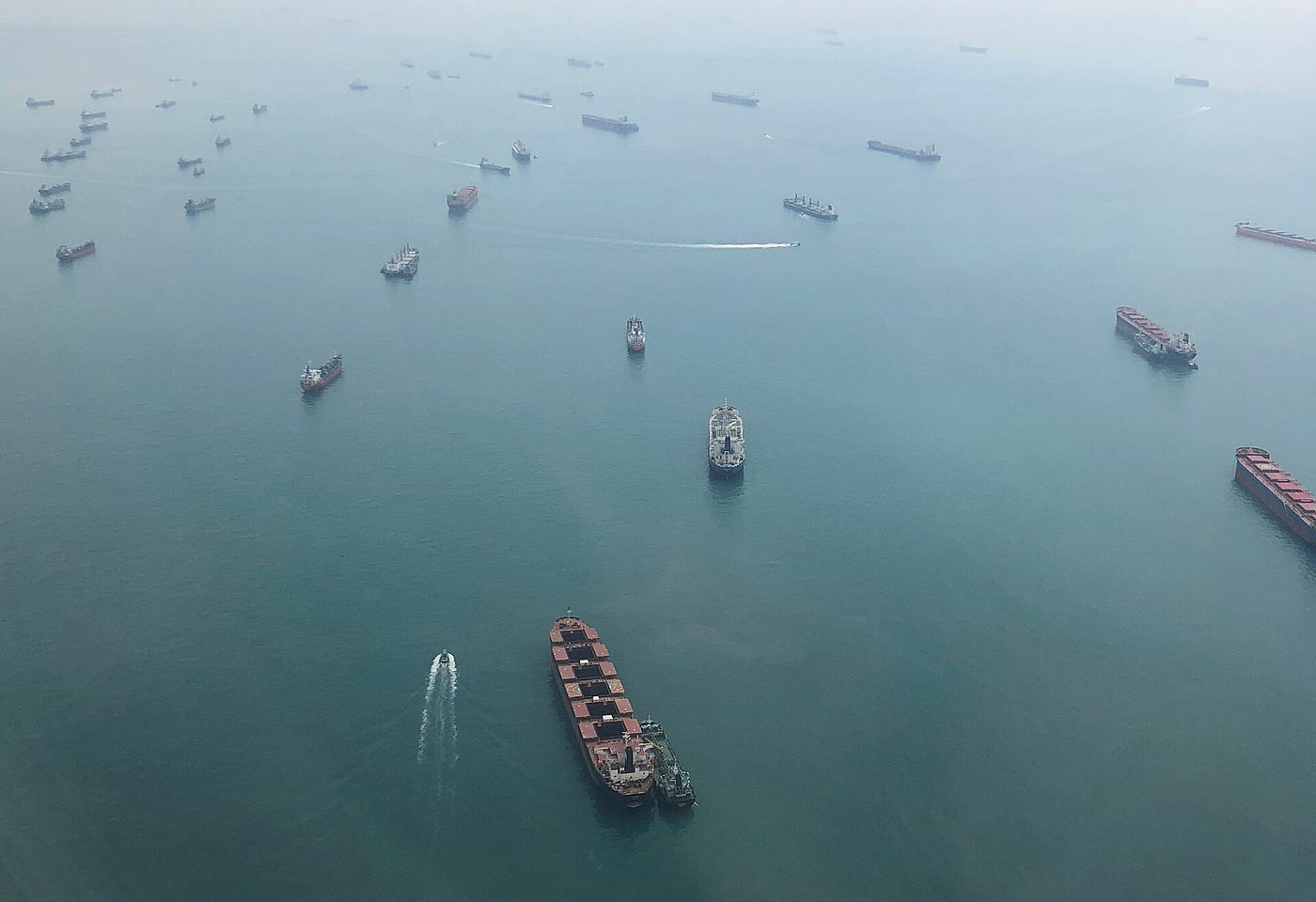
Ships in the Singapore Strait. Credit: By Bjoertvedt — Own work, CC BY-SA 4.0
Although I’ve crossed a few oceans in my boat and sailed through many straits, I’ve only flown over the Malacca Strait. Covid stopped me reaching it. About 250 ships per day pass through the Strait of Singapore at the southern end. Compare that with 138 ships per day passing through the Strait of Hormuz prior to the US-Iran war in 2026. It’s almost a 100% difference.
My early background in physics, fluid dynamics and oceanography combined with an interest in geopolitics recently led me to an insight. I started seeing the modern world of trade and geopolitics as a fluid system with reservoirs, sinks, pipework and chokepoints, subject to pressure changes.
That led me to examine some scenarios using numerical modelling.
As I write we have a blockade of the Strait of Hormuz (a blockade claimed to be controlled by both the US and Iran) and threats of a Houthi blockade of the Red Sea at the Bab-el-Mandeb (Gate of Tears).
But there are other straits which are critical to world trade and the economic stability of many (but not all) nations.
Let’s take the Malacca Strait as a case in point. The easiest way to ‘blockade’ it would be to seed it with naval mines.
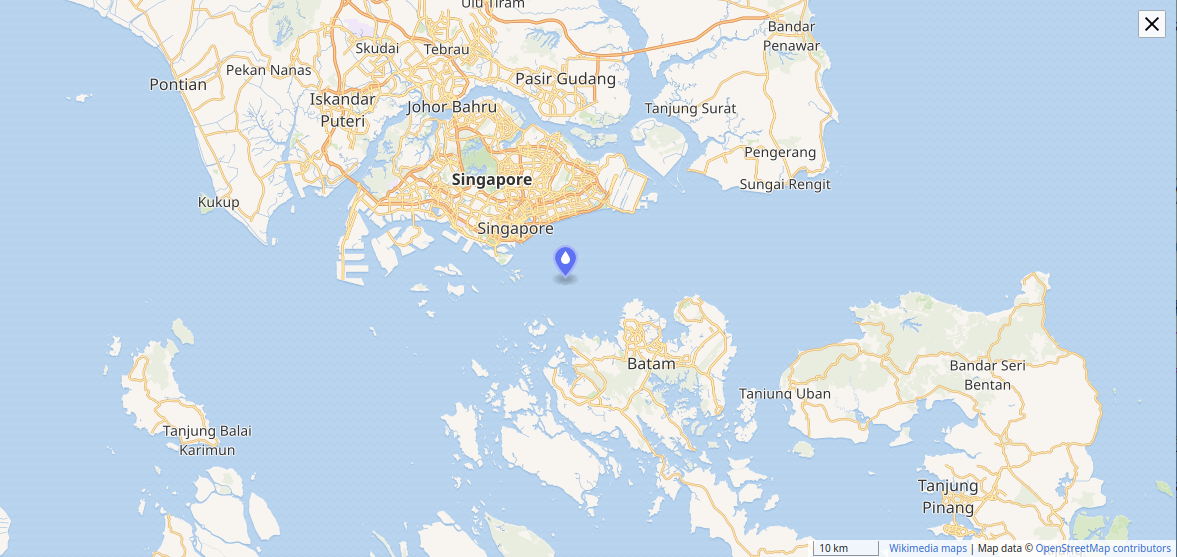
The Singapore Strait, part of the Malacca Straits region. Credit: Wikipedia
From a pure geopolitical perspective, a nation-state would only mine the Malacca Strait if its strategic goal was to deliberately crash the global operating system, or if it possessed a high enough degree of Internal Autarky (Sovereign Mass) to survive the resulting economic shockwave while its adversaries starved.
Mining Malacca would be an act of total systemic sabotage. The states that would theoretically “gain” from it are those looking to break the current international architecture. A few countries spring immediately to mind.
The Malacca Strait mine disruption
The global trade architecture operates under a dangerous delusion. For decades, macroeconomic risk has been measured through the soft, abstract lens of financial valuation — GDP metrics, sovereign credit ratings, and fiat balance sheets.
This fiat-centric view treats the global economy as a frictionless, ethereal web where capital moves instantly to solve any crisis.
It is a dangerous miscalculation.
The global economy is not an abstraction; it is a physical, thermodynamic pipeline. It is a network of rigid conduits, volatile reservoirs, and high-pressure valves. Power is not defined by the paper wealth of a nation, but by its physical capacity to maintain volumetric flow under conditions of extreme external shock.
To demonstrate the cold reality of this physical paradigm, I simulated its ultimate breaking point in my numeric model.
Consider a scenario that national security establishments whisper about but traditional economic models are entirely unequipped to quantify: the covert mining of the Malacca Strait by an asymmetric rogue actor.
Mines could easily be laid covertly from a suitably equipped and seemingly innocent ship transiting the Strait. In the Phillip channel off Singapore, depths are as low as 25 metres. Mines could be pre-programmed to sit on the sea bottom until a specific date and time. And then chaos would ensue.
The Singapore Strait to the south has been mined once before , by the British during the Second World War.
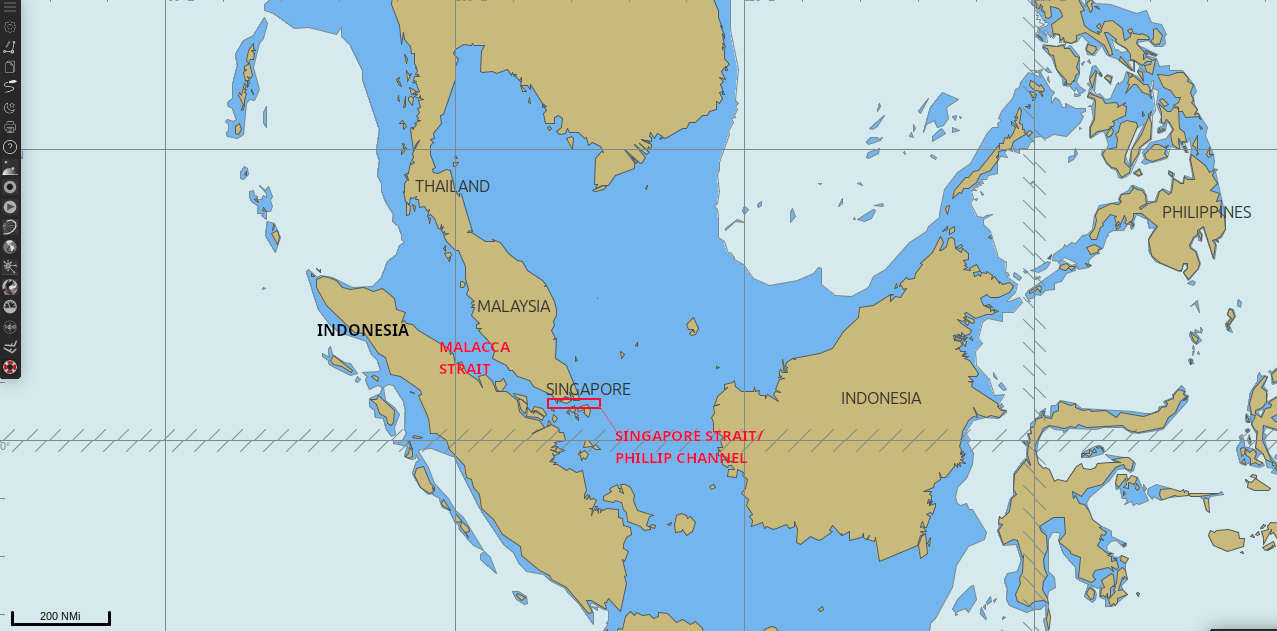
Captioned image from authors nautical chart (zoomed out)
The asymmetric catalyst: Closing one of the world’s primary valves
The Malacca Strait is one of the most critical maritime choke points on Earth, a narrow 550 mile-long funnel connecting the Indian Ocean to the South China Sea. At its narrowest bottleneck — the Phillip Channel in the Singapore Strait — the navigable shipping lane shrinks to just 1.5 nautical miles wide.
It is the jugular vein of the Indo-Pacific, carrying over 25 percent of all global trade, including the vast majority of the energy supplies feeding the industrial powerhouses of East Asia.
Now, look past the cinematic, outdated imagery of a conventional superpower naval blockade.
A 21st-century disruption does not require an armada of warships. It requires only an unmarked, commercial “ghost fleet” cargo vessel silently dropping a dozen state-of-the-art, bottom-dwelling acoustic and magnetic sea mines into the shallow mud of the Phillips Channel.
The physical detonation of a single mine against a commercial ship is all it takes.
Sceptics point out that the heaviest supertankers (ULCCs and VLCCs) already bypass Malacca due to its 20.5-metre draft limit (3.5 metres under-keel clearance is mandated). They miss the structural mathematics.
Mining Malacca isn’t a crude oil stoppage; it is a systemic capacity seizure.
By forcing the annual 90,000 container ships, bulk carriers, and smaller product tankers into the bottlenecks of Lombok and Sunda, the global fleet suffers an instantaneous ton-mile explosion (ton mile is a shipping cost measure).
Geopolitical viscosity doesn’t require total blockage — it only requires forcing a high-velocity fluid into an unyielding, narrow pipe.
Instantly, the Water-Hammer Effect triggers across the global supply network. The disruption is not gradual; it is almost instantaneous. Global maritime insurers, led by Lloyd’s of London, immediately revoke war-risk coverage for the region. The Malacca Strait effectively throughput drops to zero velocity. Out of pure self-preservation, hundreds of container ships and tankers freeze in place or scramble to turn around.
Traditional economic analysts immediately scramble to calculate the financial fallout, predicting stock market corrections and fluctuations in the price of crude oil.
They miss the entire point.
The crisis is not financial; it is a crisis of Kinetic Viscosity. The physical pipeline has been severed, and the fluid inside has begun to back up.
Seizure of the hyper-optimised nodes: Japan and South Korea
On paper, Japan and South Korea are economic titans. In my numerical model, they are hyper-fragile, low-tolerance pipes with near-zero structural margin.
Both nations sit low on my G20 tolerance scale — Japan at rank 11 and South Korea at rank 16 — precisely because their dominant power is silicon (electronics), which relies entirely on the uninterrupted inflow of energy.
The moment Malacca is mined, Japan’s and South Korea’s latency coefficient spikes to a terminal threshold because their economies ares so closely coupled to Malacca. Commercial shipping must reroute around the deep-water Indonesian straits (Sunda or Lombok), adding thousands of miles, burning much more fuel, and introducing weeks of delay.
Because Japan and South Korea possess almost zero internal energy reservoirs, their industrial engines begin to starve within days. Their internal pipelines seize, proving that high efficiency without a physical buffer is nothing more than structural fragility.
The China paradox: The stagnant boulder
Conventional geopolitical thought suggests that China would welcome a disruption in its own backyard to project power. My model shows a different effect.
A boulder survives global shocks because it has too much inertia to be moved by the current of world trade. However, that same mass makes it a high-friction zone. For example, in the Malacca Strait mining scenario, China’s sheer size becomes its own structural problem. It cannot easily pivot its massive industrial infrastructure when its import and export pipe is being choked.
But it is still vulnerable to static stagnation. China suffers from the famous “Malacca Dilemma.” It relies on the strait to pull in the raw hydrocarbons required to feed its massive industrial manufacturing base. If a rogue actor closes that valve, China cannot easily pivot its massive physical mass. The outward pressure of its industrial output meets a wall of static friction.
While the heaviest crude oil arrives on VLCCs, a massive portion of China’s oil and chemical imports arrives on smaller Suezmax and Aframax tankers that transit Malacca.
These ships feed the massive refining and petrochemical complexes concentrated in Southern China (Guangdong and Fujian). Forcing this specific fleet east of the Philippines introduces devastating latency, and pushing up ton-mile costs dramatically.
Roughly 80% of China’s imported crude oil passes directly through the Malacca Strait.
When you scale that metric against China’s total domestic oil consumption (since they produce a portion of their own crude natively), the strait accounts for approximately 60% of China’s entire operational oil supply.
For liquefied natural gas (LNG), the dependency is lower but still highly volatile, with roughly 20% to 30% of its imported gas requirements arriving via the Malacca Strait.
The counter-intuitive sovereign: Russia’s autarkic ascendancy
The true winner of a Malacca Mine Disruption would be the nation built to thrive in conditions of high global entropy: Russia, which ranks #2 on my scale.
Russia is the ultimate Isolated Reservoir. Its dominant vector is energy and its physical infrastructure is entirely independent of Western maritime choke points. It does not rely on the Malacca Strait for its internal survival or its primary export routes.
When Malacca freezes, the rest of the world experiences a catastrophic drop in resource velocity. Russia’s output, however, remains completely unimpeded. As global energy viscosity skyrockets, the value of Russia’s overland, land-linked Eurasian pipelines triples overnight.
Furthermore, commercial traffic desperate to bypass the natural weather chaos of the southern oceans is forced to look to the Northern Sea Route (Arctic) — an icy maritime conduit that Russia physically controls, polices, and taxes. High global friction is Russia’s native environment; it gains systemic leverage when the rest of the world seizes.
The fluid verdict
The mining of the Malacca Strait demonstrates why traditional risk architecture is obsolete. A nation can have a multi-trillion-dollar service economy, a booming tech sector, and an immaculate credit rating, but if its physical pillars are brittle and its resource vectors are severed, its sovereign resilience collapses to zero in a matter of weeks.
By mapping the global operating system through my model, the system removes the financial propaganda and exposes the hard, material truth of global power. In the new era of asymmetric gray-zone warfare, the survivors will not be those who boast the highest digital balance sheets, but those who possess the physical autarky, structural buffers, and material mass to survive the freeze.
메타데이터
- post_id
- 6ae92fa3db56
- slug
- mining-the-malacca-strait-6ae92fa3db56
- url
- https://medium.com/the-dock-on-the-bay/mining-the-malacca-strait-6ae92fa3db56
- canonical_url
- https://medium.com/the-dock-on-the-bay/mining-the-malacca-strait-6ae92fa3db56
- author_url
- https://medium.com/@james-marinero
- status
- ok
- fetched_at
- 2026-06-15 20:49:13