The Halving City
Part Three — The Floor, the Charter, the Child’s Belief
Serial Fiction
The Halving City
Part Three — The Floor, the Charter, the Child’s Belief
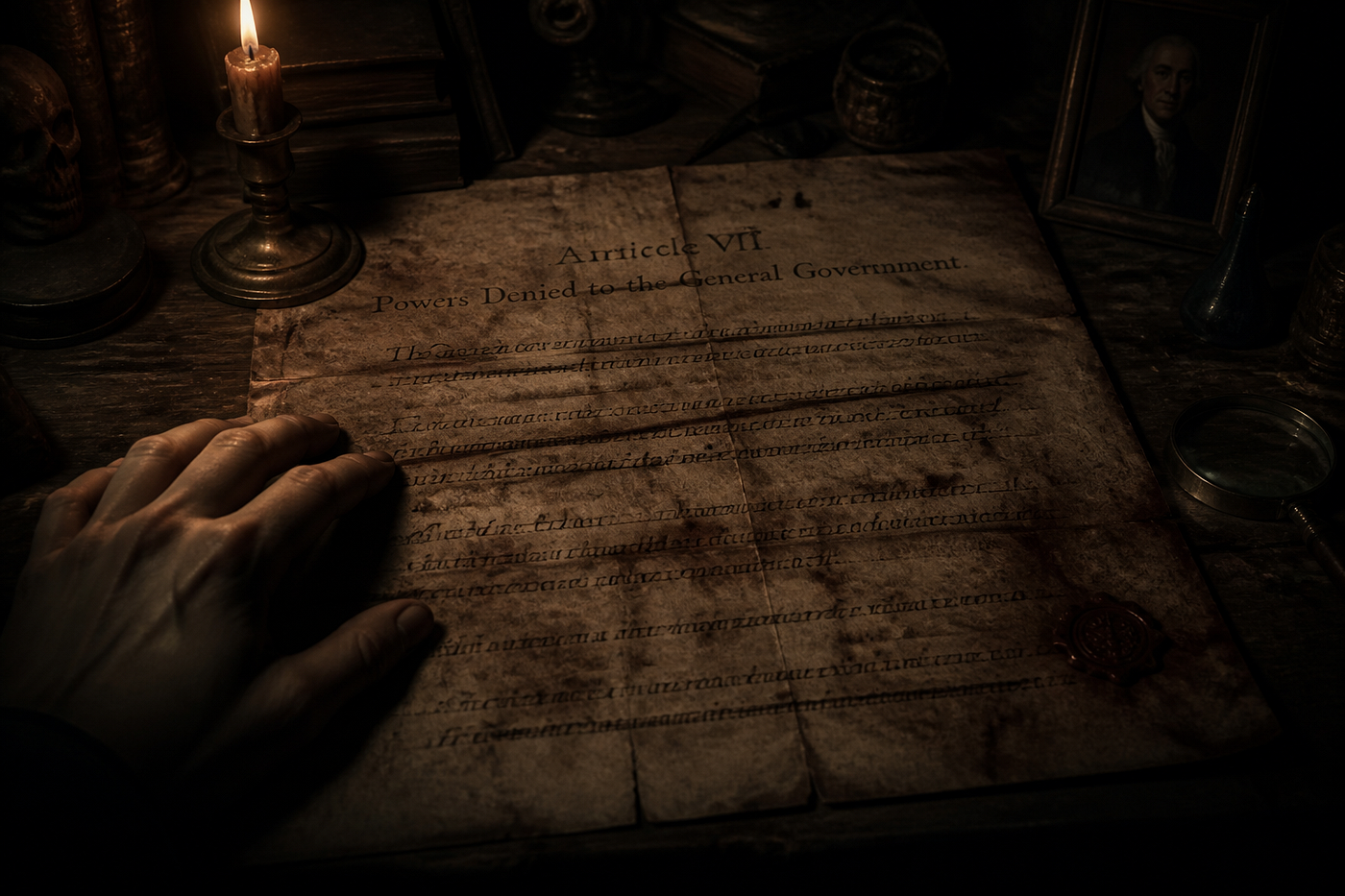
Image created by author on Magnific
(Part 1)
(Part 2)
Continued. The Magistrate has watched the Law destroy a friendship, a name, and a sworn vow. He has begun to suspect the Law has a floor, a point past which it does not divide but only destroys.
The Magistrate, in the same season, was conducting an investigation of his own, though he would not have called it that, because the thing he was investigating was the Law itself, and a magistrate does not investigate the Law any more than a fish investigates the sea.
He had begun to ask a question, and the question was this: was there a floor?
The Law halved all things. That was its nature. But the Magistrate had seen, case by case, that the halving did different work on different things. On the loaf it had done the work of justice, two satisfied parties, a wound between brothers set. On the farm it had done damage that the parties survived. On the marriage it had destroyed the thing entirely while leaving the parties alive to mourn it. On the friendship and the name it had destroyed the thing and the parties both, in the sense that mattered, leaving men walking around who were no longer the men they had been. And on the vow it had done a thing stranger than any of these, had let a man turn the blade on his own keeping of faith and walk away unmade by his own request, the ruin no longer needing a victim and a culprit because the Law had taught a man to be both.
There was, the Magistrate saw, a descent in this. The things grew less divisible as the season went on, and the less divisible the thing, the more total the ruin. And he began to suspect that this descent had a bottom. That somewhere below the name there was a thing so wholly indivisible that to halve it would be not merely to ruin the thing but to commit, through the instrument of the Law, an act that no honest man could call a settlement and no court could survive having performed. A floor. A point past which the Law did not divide but only destroyed, and below which it should not be allowed to reach.
If there was such a floor, then the Law was not, as the founders had believed, a thing that could be applied to all disputes equally. It was a thing that worked above a certain depth and became murder below it, and the whole genius of the founding, the refusal to weigh, the blind and even edge, was not genius at all but a failure to ask the one question that mattered, which was not who deserves the thing but whether the thing can be cut without ceasing to be.
So he took the question to the oldest documents of the Hall, the founding instruments, on the long candlelit nights he no longer spent sleeping, looking for any sign that the founders had asked it before him.
The founding instruments were kept in a room behind the bench that no one entered, a dry room with a stone shelf, and the documents on the shelf were so old that the Magistrate had to learn, over the first several nights, how to read them without destroying them, how to turn a leaf that wished to crumble, how to coax the failed ink back toward legibility by the angle of the light. He had handled old things before. Timber salvaged from drowned houses, deeds to land the river had taken back. He knew the particular reverence a thing demands when it has outlived everyone who made it, and he gave the founding instruments that reverence, and in giving it he came to understand something about the founders that the city had forgotten, which was that they had been afraid.
The city told itself a story about its founding, as every city does, and in the story the founders were wise, serene, certain, men who had perceived the great truth of the Half the way a prophet perceives a god, and had handed it down whole.
But the documents told another story.
The documents were full of argument. They were full of crossings-out and second drafts and clauses proposed and clauses defeated, and reading them the Magistrate understood that the founders had not perceived the Law at all. They had fought their way to it, exhausted, in terror of the alternative, which was the thing they had fled to build this city, the endless blood-feud cities of the plain where merit was weighed and the weighing was bought and the man with the longest memory and the sharpest knife was the man whom justice always, somehow, favored. The founders had watched those cities tear themselves apart over the question of who deserved, and they had come here swearing never to ask it, and the Law of the Half was not a truth they had received. It was a wall they had built against a truth they could not bear, which was that the question of desert has no answer that the strong will not corrupt.
This made the Magistrate’s task harder, not easier, because he had hoped to find that the founders were fools, and instead he was finding that they were wise, and that their wisdom had built the thing that was now killing the city. A fool’s error a man may correct. A wise man’s necessary choice is a harder thing to stand against, because to stand against it you must believe you have seen something the wise man did not, and the Magistrate, turning the brittle leaves by candlelight, did not believe he had seen anything the founders had not seen. He believed they had seen everything he saw and had chosen this anyway, and the belief was a weight on him heavier than any case.
And he found, at last, in the founding charter, in a hand so old the ink had gone the color of dried blood, a single clause that had been struck through.
The clause had read, before it was struck: Provided that no thing be halved which, being halved, ceases wholly to be.
Someone had drawn a line through it. The line was in a different ink, newer, though still old. And beside the struck clause, in the margin, in the same newer hand, was written the reason for the striking, and the reason was four words, and the four words were the foundation of the whole city, and reading them the Magistrate understood that the rot he had been tracing all winter went down to the root, that it had been planted at the founding by a hand that had seen the danger and chosen the danger on purpose.
The four words were: Who shall decide which?
That was all. The founders had seen the floor. They had written the clause to protect it. And then they had struck the clause, because to keep it would have required someone to decide which things ceased to be when halved and which did not, and deciding which is weighing, and weighing is the door that opens onto endless rooms, the door the whole city had been built to keep shut. The founders had faced a choice between a Law that could destroy some things and a Law that required a man to judge, and they had chosen the destruction, because the destruction was even and the judgment was not, and they had trusted evenness over mercy, and they had struck the clause and built the city on the strike.
The Magistrate sat with the charter until the candle drowned in its own wax. He understood now that the question he had been asking all winter, was there a floor, had the wrong shape. There was a floor. The founders had known there was a floor. The real question, the one they had struck through and built over, was whether anyone had the right to find it, because to find the floor was to claim the power to decide which things were sacred, and the city had been founded precisely on the refusal of any man to claim that power.
To rule that the Law had a floor was to overthrow the founding. It was to walk through the forbidden door. It was to take onto himself, a man who measured grain, the right to say what in the world was too whole to cut, and there was no one to grant him that right, because the whole city was an agreement that no one should have it.
And yet the cases kept coming, each less divisible than the last, descending toward the bottom he now knew was there. And he understood that he would not be able to refuse the bottom case when it came. He would have to choose. He would have to either halve a thing that could not survive halving, and complete the ruin the founders had built into the Law, or refuse to halve it, and in refusing claim the power the founders had forbidden, and overthrow the city in order to save it.
He did not have to wait long. The bottom case came with the spring.
The woman who came before the bench in the first true week of spring did not look like the end of anything. She looked like a tired woman holding the hand of a boy of perhaps seven years, and the boy looked at the Hall the way children look at large rooms, as places designed by giants for purposes that did not include him.
Her husband stood across the Hall from her. The Magistrate had seen the posture a hundred times that season, two people arranged in the space like the poles of a magnet, held apart by a force that had once held them together. He knew before either spoke that they had come to end a marriage, and he was wrong, because they had come for something worse, and the marriage was only the thing they had used to find their way to it.
“We are agreed on the house,” the woman said. “We are agreed on the goods. We are agreed, even, on the boy, that he will be with me in the dark of the year and with his father in the light of it, and we have not come to fight about any of that.”
“Then why have you come?” the Magistrate asked, though a cold place in him already knew.
It was the husband who answered. He was not a cruel man either. That was the thing the Magistrate would not be able to stop thinking about, afterward. He was a hurt man, which is more dangerous, because a cruel man wants to do harm and can be reasoned with about the cost, but a hurt man wants only to stop hurting and will pull down the pillars of the world to do it.
“The boy believes,” the husband said, “that I am a good man.”
The Hall was quiet. Even the Recorder’s reed had stopped.
“He believes I am the best man he knows,” the husband went on. “He believes it the way he believes the sun will rise, without ever having decided to believe it, because it is the floor he stands on.” He did not look at his wife. “She has told him things. About me. Things that are true. And the boy does not believe her, because the believing of me is older in him than the truth, and so he has decided that his mother lies. He thinks his mother is a liar because his mother told him what his father is. And I will not have my son think his mother is a liar. So I have come to ask the Hall to settle it. The boy believes I am good. His mother says I am not. The belief is a thing wanted by two. Halve it.”
The Magistrate did not move.
“You cannot mean this,” he said. It was the first time in his tenure that the Magistrate had said such a thing to a party. The Law did not permit him to tell a party what they could mean. The Law took all claims as equal. But the man had reached past the Law into something older, and the Magistrate answered from that older place before he could stop himself.
“I mean it exactly,” the husband said. “The boy must stop thinking his mother lies. The only way is for him to half-believe me. Let him believe I am half good. Then his mother’s words will have their half, and the boy will not have to choose between his father and the truth, because he will hold both, in halves, as the Law holds all contested things. It is the most merciful thing I can ask. I am asking you to let my son keep a piece of me without having to keep all of me, when all of me is not a thing he should have to carry.”
The Magistrate looked at the woman. She had not spoken since the matter of the days. She stood with her arms folded across herself in the posture of a person braced against a cold she has lived in so long she no longer expects it to end, and the Magistrate understood, looking at her, that she did not want this either. She had not come to the Hall to have her son’s belief halved. She had come because her husband had insisted on it, and she had agreed because she could see no other way to stop being called a liar in her own house by the child she had not lied to, and she was here against everything in her, hoping, the Magistrate thought, that the Hall would refuse what she had come to ask for. She had brought her own plea to the bench disguised as her husband’s, and her plea was: do not do this thing I am asking you to do. Find me another way. There is no other way and I know there is no other way and I have come to you because you are the last place left to look for one.
“What does the boy say?” the Magistrate asked.
“He is seven,” the husband said. “He says nothing. He believes. That is the whole trouble. He cannot say anything because he does not know there is anything to say. He simply stands by me. That is what I am asking you to take from under him, gently, in halves, before life takes it from under him all at once.”
And the terrible part, the part that froze the Magistrate to the bench, was that the man was not entirely wrong. There was a mercy buried in the monstrous thing he asked. The boy was going to lose his father one way or another, the whole and shining father of his belief, because that father had never existed and the truth was coming for him the way it comes for every child. The husband was asking the Hall to manage the loss, to portion it, to make it survivable. He had brought a real grief to the bench and asked the Law to halve it, exactly as the brothers had brought the loaf.
But a child’s belief in a parent is not a loaf.
The Magistrate understood, sitting there with the spring light coming sideways through the high windows of the Hall, that he had reached the floor. This was the bottom case. This was the thing the struck clause had been written to protect and the founders had chosen to leave unprotected. A child’s belief in a parent is the most indivisible thing in the world, more indivisible than a name, more indivisible than a friendship, because it is not a thing the child has. It is a thing the child is. It is the floor the child stands on to become a person, and you cannot give a child half of the floor he stands on. You can only take the floor away and watch him fall, and call the falling a settlement, and write it in the record as a half.
To halve the boy’s belief was not to give him a smaller, sadder, more accurate father. The Law could not do that, because the Law did not weigh and could not produce an accurate anything. To halve the boy’s belief was to reach into the place where the boy kept the one thing that let him trust the world, and to break it, evenly, down the middle, and to hand him the two pieces and tell him that this was justice. It was to teach a seven-year-old, by the authority of the Hall, that the people who made you can be divided into the part that loves you and the part that lies, and that there is no whole anywhere, not even in the father you stand on, not even in the floor.
The Magistrate looked at the boy. The boy was looking at a beam of dusty light, and reaching one hand into it, watching the dust turn, entirely unaware that the large room built by giants had finally found a purpose that included him.
“Bring me the founding charter,” the Magistrate said.
The Recorder rose, and went, and brought it.
What followed was not in the record, or rather it was not in the record the city kept, though it was in the second record, the one beneath the stone, because the Recorder wrote down every word of it that night with shaking hands, knowing it was the most important thing he would ever set down and that no one might ever read it.
The Magistrate held the charter open on the bench to the page with the struck clause. He did not read it aloud. He read it to himself, one more time, the clause that would have forbidden this exact case, no thing be halved which, being halved, ceases wholly to be, and the line drawn through it, and the four words in the margin, who shall decide which, and he understood that the whole weight of the founding had come to rest on his single bench in the person of a tired woman and a hurt man and a boy reaching into the light.
The crisis was this, and the Magistrate saw both its faces with the clarity that comes only to a man who has stopped sleeping.
He could halve the belief. He could follow the Law as he had followed it all winter, as he had followed it with the friendship and the name, and decree that the boy held his father in halves, good and false, and let the boy fall through the broken floor and call it a settlement and write it in the record. This was the path of the founders. It honored the thing they had built. It kept the door shut. It refused to weigh, refused to decide which things were sacred, kept the Law even and blind and consistent unto the destruction of a child, and it preserved the city exactly as the city had asked to be preserved, as a place where no man held the terrible power of deciding what could not be cut. It would be lawful. It would be consistent. It would be monstrous, and the monstrousness would belong not to him but to the Law, and he could lay it down at the end of his life and say, I did only what the office required, I weighed nothing, I added nothing, I was accurate.
Or he could refuse. He could rule that the belief had a floor beneath it, that this was the thing the struck clause had named, that there existed a kind of thing the Law had no right to touch. And in ruling so he would do the one thing the city had been founded to prevent. He would weigh. He would decide which. He would take onto himself, a man who had measured grain, the authority to say what in all the world was too whole to be cut, and there was no charter that granted him that authority, no founder living to confirm it, no Law behind him but the Law he would be breaking in the act.
He would save the boy and in saving him he would become the thing the founders had most feared, a single man who had appointed himself the judge of the sacred, and the city, learning of it, would not thank him. The city had grown to love the evenness of the blade. The city had drawn apart and hardened and learned to fear all shared things precisely because the blade was even and could be trusted to fall the same way every time. A magistrate who announced that the blade had a floor, that some things were exempt, that he, he personally, would decide which, was a magistrate the city would tear from the bench, because he had given them back the thing they had abolished at the founding, which was the terror of being judged by a man instead of a rule.
To follow the Law was to destroy the boy.
To save the boy was to destroy the Law, and with it, in time, the city, which could not survive the knowledge that its bench was occupied by a man who weighed.
He sat in the dilemma a long time. The light moved across the floor of the Hall. The boy grew bored and was taken by his mother to wait outside, and the father waited, and the Recorder waited with his reed dry, and the Magistrate looked for a third path, the way a man trapped between a wall and the sea will look for a third path, knowing there is none, looking anyway, because the looking is the last thing a man does before he chooses.
He thought of the flood walls. He had built flood walls all his life, and a flood wall is an argument with a river about where the water may go, and the river always wins in the end, the only question being how long the wall buys and how many it saves in the buying. He had never once believed a flood wall would hold forever. He had believed only that it would hold this spring, and the next, and that the holding was worth the stone. He had made his peace, decades ago, with building things that would fail, because everything fails, and a man who will only build what lasts forever will build nothing, the river being patient and the stone being finite. He had thought, when he took the bench, that he was leaving that world behind, the world of provisional things, the world of holding back a flood you could not stop. He had thought the Law was different, that the half was a thing that did not fail, that he had been given at last a wall the river could not reach.
And he saw now, sitting in the dilemma, that he had been wrong about which thing was the river. He had thought the disputes were the river, the endless flood of human wanting that the Law walled off and divided and sent harmlessly to the sea.
But the disputes were not the river. The Law was the river. The Law was the flood, the patient finite-defeating force, and the things people loved, the loaf and the farm and the marriage and the friendship and the name and the vow and the belief of a child in a parent, those were the walls, the provisional human things built up over lifetimes against the water, and the Law had been eating them one by one, this spring and the next, and he had stood on the bench and called the eating justice and the flood a wall.
He had spent his life learning that everything fails and had taken an office on the belief that he had finally found the thing that did not, and the thing that did not fail was the thing that was failing everyone else.
There was no flood wall against the Law, because the Law was the flood. That was the whole of it. And a man who understands that the thing he serves is the flood has only two honest choices, which are to go on serving it and drown the city slowly, or to break the one wall the flood had not yet reached, which was himself, the bench, the office, and let the breaking be the last wall, the wall that says: here. No further. Not because I can stop the water. I cannot stop the water. But because I will not be the channel it runs through anymore.
And he found a third path. Not a way out. There was no way out. But a third thing, which was neither following the Law nor breaking it, and which had been waiting for him, he realized, since the loaf, since the first clean cut, the way the bottom of a well waits for the stone you drop at the rim.
He understood what he had to halve.
“I will not rule on the boy’s belief today,” the Magistrate said.
The husband began to protest. The Law guaranteed every claimant a settlement. To refuse a ruling was itself a kind of ruling, and an unlawful one, and the husband knew it, and opened his mouth to say so.
“I said today,” the Magistrate said, and something in his voice closed the husband’s mouth. “Come back tomorrow. The Hall will rule tomorrow. Tonight there is a thing the Hall must settle first, and it cannot rule on the boy until that other thing is settled, because the other thing is the question of whether this bench has the right to rule on the boy at all, and that question must be answered before the boy’s, and it can only be answered by the one party to it.”
“What party?” the husband said. “What other case is there?”
“The oldest one,” the Magistrate said. “Go home. Bring the boy tomorrow.”
They went. The Hall emptied. And when it was empty, when there was no one in it but the Magistrate and the Recorder and the dust still turning in the last of the light, the Magistrate closed the founding charter and set both his hands flat upon it and spoke, and the Recorder wrote, and this is what he wrote.
“There is a case before this bench,” the Magistrate said, “that has been before it since the founding, and has never been heard, because there has never been a magistrate willing to bring it. It is the case of the office itself.
“The office of Magistrate is a thing wanted by two. It is wanted by the Law, which requires a man to apply it evenly, blindly, without weighing, unto the destruction of any thing that cannot survive the blade. And it is wanted by justice, which requires a man to refuse to destroy what cannot be cut. These two have wanted the office since the founding, and the founders gave it wholly to the first, to the Law, and struck out the clause that would have given any part of it to the second. They gave the whole office to the blade.
“But the office is a thing wanted by two. And the Law of this city is clear on what becomes of a thing wanted by two.”
The Recorder’s hand stopped. He understood, before the Magistrate said it, what was coming, and he understood that it was the only honest thing left in the city, and that it would end the man he had sat beside for thirty years, and he could not decide whether what he felt was grief or something closer to the thing the brothers had felt over the loaf, the setting of a long-broken bone.
“The office must be halved,” the Magistrate said.
메타데이터
- post_id
- 6b022ac8ea7f
- slug
- the-halving-city-6b022ac8ea7f
- url
- https://medium.com/@nrw.scribe/the-halving-city-6b022ac8ea7f
- canonical_url
- https://medium.com/@nrw.scribe/the-halving-city-6b022ac8ea7f
- author_url
- https://medium.com/@nrw.scribe
- status
- ok
- fetched_at
- 2026-07-18 15:52:18