Netflix Unleashed a Monkey With a Weapon in Its Own Data Center — On Purpose
This is how a three-day database disaster in 2008 led Netflix to deliberately destroy their own production servers every single business…
Netflix Unleashed a Monkey With a Weapon in Its Own Data Center — On Purpose
This is how a three-day database disaster in 2008 led Netflix to deliberately destroy their own production servers every single business day — and why it made them unbreakable.
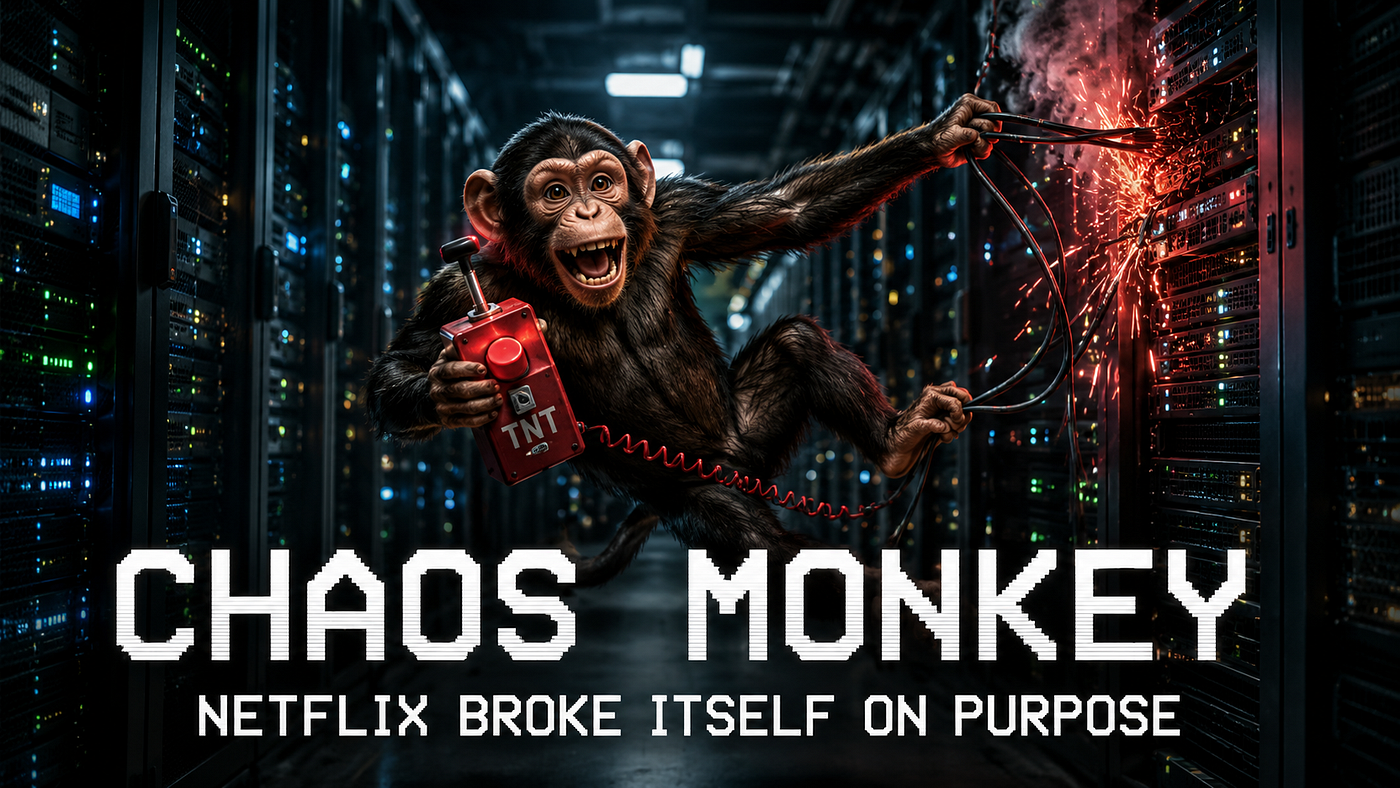
It was July 19, 2011, and Netflix published a blog post that stopped engineers mid-scroll.
They had built a tool called Chaos Monkey. Its job was simple: during business hours, it would pick a random server from Netflix’s production infrastructure and kill it. No warning. No coordination. No grace period.
The server would just stop.
And Netflix would keep streaming.
This wasn’t a test environment. This wasn’t a staging cluster. This was the system that millions of people used to watch movies every night — and Netflix was deliberately breaking it on a Tuesday afternoon while engineers were at their desks eating lunch.
The engineering world had questions. Netflix had answers.
The Three Days That Changed Everything
The story doesn’t start in 2011. It starts in August 2008, when Netflix was still primarily a DVD-by-mail business running on vertically scaled servers in its own data center.
A major database corruption took everything down.
For three days, Netflix could not ship DVDs to its customers. It wasn’t a sophisticated attack. It wasn’t a novel failure mode. It was the simplest possible disaster: one database, one failure point, total outage.
The engineering team drew a conclusion that would define the company’s infrastructure for the next decade: the only way forward was to move away from centralized systems and into the cloud. They chose AWS. They began a seven-year migration to a fully distributed, horizontally scaled microservices architecture.
But the migration created a new problem — and it was harder to see.
The Problem With Being Theoretically Resilient
Netflix’s new architecture was, in theory, fault-tolerant.
They had hundreds of microservices. They had load balancers. They had graceful degradation logic — if the recommendations service went down, show popular titles instead of personalized ones; if search was slow, streaming should still work. They wrote the code. They reviewed it. They tested it in staging.
And then they realized something uncomfortable.
There was no way to know if any of it actually worked without experiencing actual failures in production.
Staging environments couldn’t reproduce the chaos of real traffic. Controlled tests couldn’t capture the emergent failure modes of hundreds of interdependent services under real load. The graceful degradation they had designed so carefully on paper had never been forced to prove itself in the real world.
This is the trap that every distributed system eventually falls into. You design for resilience. You write the fallback logic. You tell yourself the system can handle it. But until the system has actually handled it — live, in production, with real users — you’re working on faith.
Netflix decided to stop working on faith.
The Core Insight: Fail Constantly
The founding philosophy of Chaos Engineering was radical in its simplicity.
The best way to avoid failure is to fail constantly.
If your systems only experience failures accidentally — at 3am, on-call engineer scrambling, no one prepared — your engineers have no muscle memory for responding to them, and your systems have never been forced to prove their resilience claims.
But if you fail constantly, during business hours, with engineers present? Your systems either prove they can recover, or they expose the gaps so engineers can fix them before those gaps become real incidents.
Chaos Monkey was mechanically simple. It ran during business hours only — that constraint was the key. An instance killed at 2pm on a Tuesday meant engineers were at their desks. They could watch. They could respond. They could learn.
An instance killed at 2am would have recreated exactly the scenario Netflix was trying to avoid.
“The name comes from the idea of unleashing a wild monkey with a weapon in your data center to randomly shoot down instances and chew through cables — all the while we continue serving our customers without interruption.” — Yury Izrailevsky & Ariel Tseitlin, Netflix Tech Blog, 2011
The Simian Army
Chaos Monkey was just the beginning.
If randomly killing individual instances made Netflix more resilient to instance failures, what would it take to become resilient to other failure categories? The team asked this question systematically and built tools for each answer.
Latency Monkey injected artificial delays in service communication, simulating network degradation. Conformity Monkey shut down instances not following engineering best practices. Doctor Monkey ran health checks and removed unhealthy instances automatically. Janitor Monkey cleaned up unused cloud resources. Security Monkey hunted for security vulnerabilities and misconfigurations.
Then came the ones that escalated the stakes.
Chaos Gorilla simulated the complete failure of an entire AWS availability zone — an entire data center, gone, while Netflix kept streaming.
Chaos Kong went further still. It simulated the complete failure of an entire AWS region. Not one data center. An entire geographic cluster of them. Netflix kept streaming through that too.
Each level was only attempted after the previous level produced stable, confident results. The graduated escalation — instance, then availability zone, then region — is how chaos engineering should work. You prove you can survive the small failure before you test the big one.
The Business Hours Rule Is Everything
Engineers sometimes miss the most important design decision in Chaos Monkey: it runs during business hours only.
This isn’t a limitation. It’s the entire philosophy.
Chaos Monkey’s purpose is not destruction — it’s education. When an instance dies at 2pm and a service goes down, engineers learn immediately. They see which fallbacks worked. They discover which assumptions were wrong. They fix the gaps while the incident is fresh and the context is clear.
This behavioral economics effect — where the cost of fragile code was paid immediately by the team who created it — transformed how Netflix engineers thought about resilience.
It was no longer a design principle to be aspirationally applied. It was a daily test to be continuously passed.
The September 2014 Validation
For three years, Chaos Monkey killed servers. Engineers fixed gaps. The system got more resilient. Repeat.
Then, on September 25, 2014, AWS rebooted approximately 10% of its EC2 instances across regions without warning.
Netflix handled it without customer impact.
The engineering team didn’t need to scramble. The systems didn’t cascade. Services degraded gracefully and recovered automatically — exactly as they’d been trained to behave by years of deliberate failure.
This was the experiment Netflix couldn’t have designed themselves. A real, unplanned, large-scale infrastructure event. And they passed it.
Netflix built a tool that killed their own servers on purpose every business day for years, and the one time AWS killed 10% of their servers by accident, nobody noticed — which is either the best possible outcome of a chaos engineering program or proof that Netflix engineers have very high stress tolerances.
The Lesson That Spread
By 2015, Netflix’s approach had been codified in the Principles of Chaos Engineering — a document that transformed what had been an internal Netflix tool into a formal engineering discipline with scientific language: hypothesis, experiment, steady state, blast radius.
Companies including LinkedIn, Facebook, Google, Amazon, and Twilio adopted chaos engineering practices. Kolton Andrus, who had worked on Netflix’s chaos engineering team, founded Gremlin in 2016 to commercialize the tooling. AWS launched its own Fault Injection Simulator service in 2021.
What started as Netflix’s answer to a 2008 database disaster became the industry’s standard approach to production resilience.
The principle that emerged is simple and applies to every distributed system ever built:
Designing for fault tolerance is not the same as having fault tolerance.
Until production failure exercises the code path, you don’t know whether your resilience design survived contact with reality. Chaos Monkey converts theoretical resilience into empirical evidence.
And it does it at 2pm on a Tuesday, while everyone is watching.
This breakdown was adapted from the full engineering case study at TechLogStack — where we retell real production incidents from Netflix, Stripe, Cloudflare, GitHub, and more in plain English. No jargon walls. Just the disaster, the diagnosis, and the fix.
Read the full technical deep-dive, including the Simian Army roster and the complete Chaos Engineering principles: **techlogstack.com/explore/netflix-chaos-monkey-2011**
Follow TechLogStack for one real engineering disaster per week — retold in plain English, the way your smartest friend would explain it.
메타데이터
- post_id
- 6b09b2de2c3e
- slug
- netflix-unleashed-a-monkey-with-a-weapon-in-its-own-data-center-on-purpose-6b09b2de2c3e
- url
- https://medium.com/@techlogstack/netflix-unleashed-a-monkey-with-a-weapon-in-its-own-data-center-on-purpose-6b09b2de2c3e
- canonical_url
- https://medium.com/@techlogstack/netflix-unleashed-a-monkey-with-a-weapon-in-its-own-data-center-on-purpose-6b09b2de2c3e
- author_url
- https://medium.com/@techlogstack
- status
- ok
- fetched_at
- 2026-06-09 15:37:30