Tiny Worlds 101, Part 6: Choosing Props That Create Scale
Props are one of the most powerful tools in tiny-world art. They tell the viewer instantly, “This world is small” without needing any…
Tiny Worlds 101, Part 6: Choosing Props That Create Scale
Props are one of the most powerful tools in tiny-world art.
They tell the viewer instantly, “This world is small” without needing any explanation.
The right prop makes the scene seem magical. The wrong prop breaks the illusion completely and just looks wrong even if your viewer can’t figure out why.
Tiny-world art doesn’t rely on fancy objects. It relies on everyday things made enormous through contrast: a leaf, a thimble, a teacup, a pencil. Let’s walk through the main principles so you can pick props that make your miniature scenes feel real, grounded, and full of charm.
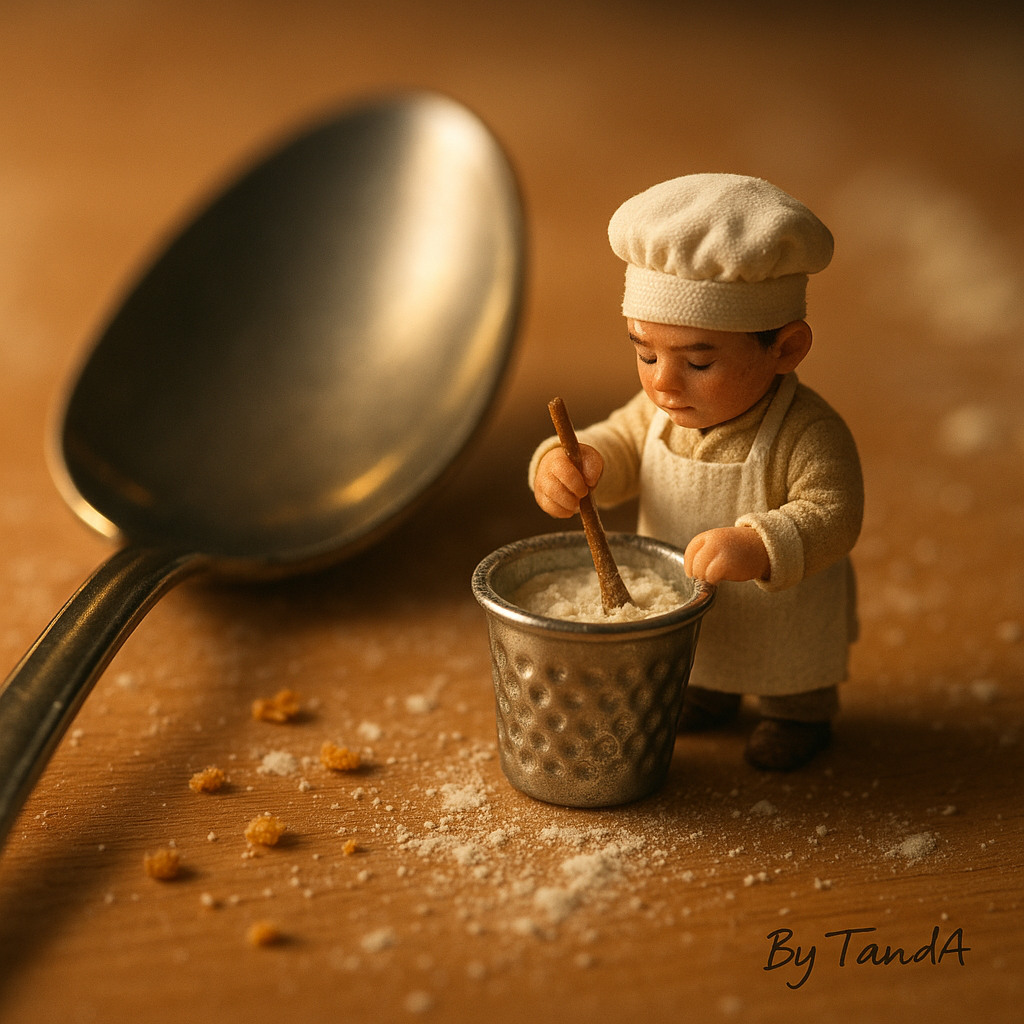
A tiny baker stirring a thimble-sized bowl beside a spoon — perfect props for scale — By TandA
1. Props Are the Fastest Way to Lock Scale
Your viewer shouldn’t have to think about how small the character is. If everything is small in the scene, your viewer can be left wondering if it’s a miniature scene or do your people/characters look funny!
Props do this automatically.
When you place a tiny human next to:
- a pencil
- a matchbox
- a teaspoon
- a leaf
- a spool of thread
- a flower petal
- a book page
- candlewick the brain instantly understands scale.
It’s automatic. It’s subconscious. It’s powerful.
Choose props the viewer would be familiar with.
2. The “Recognizable Object Rule”
Props that people interact with daily work best because the brain knows their size by heart.
Great props:
- teacups (a popular one)
- beads
- sewing tools
- pencils/pens
- small bowls
- matchsticks
- keys
- corks
- marbles
- tiny jars
- buttons
- leaves
- acorns
- petals
- books
- spools
Avoid unfamiliar objects or overly modern items unless the story demands it.
recognizable objects = instant believability.

Tiny gardener with an extremely tiny ‘garden’ beside a matchbox and pencil — simple props with very recognizable scale — By TandA
3. Texture Matters Even More Than Size
Great tiny-world props have texture because texture makes big objects feel huge.
Examples:
- paper fibers
- wood grain
- moss fuzz
- stone grit
- fabric weave
- rope threads
- candlewax ridges
- tiny crumbs or dust
AI handles texture beautifully. Texture says: “This world is close-up, tactile, and small.”
A smooth smartphone? Not helpful. A rough thimble? Perfect.
4. Pick One Prop, Not Ten
Don’t make a mess. Beginners often clutter the scene with too many objects. Dioramas only need one strong prop.
Examples:
- a tiny climber scaling a pencil
- a tiny reader sitting on a leaf
- a tiny baker mixing in a thimble
- a tiny explorer crossing a spoon
- a tiny artist painting a single petal
One story. One object. One moment.
This keeps the scene clean and magical.
5. Props Must Belong in the Scene
Ask yourself: “Would this object realistically be in this tiny world?”
For example:
- Forest scene: leaves, stones, acorns
- Kitchen scene: spoons, bowls, jars
- Study scene: books, pencils, envelopes
- Garden scene: petals, moss, twigs
When props belong naturally, the viewer relaxes into the scene.
When props feel random, the illusion breaks.

Tiny explorer on a spoon in a miniature kitchen diorama — simple, clean, and intentional — By TandA
6. The “Prop Selection Ladder” for Beginners
Use this ladder when choosing props:
Tier A — Best Props (always work)
- cereal bowl with cereal and milk
- thimble
- teaspoon
- pencil
- matchbox
- spool
- leaf
- petal
- acorn
- pebble
- book
- cork
Tier B — Good Props (need a little help)
- sewing kit items
- thread
- flower
- small candle
- tiny jar
- measuring cup
Tier C — Tricky Props (use with caution)
- food items (can confuse AI)
- plastic objects
- overly reflective items
- modern electronics
- complex toys
- objects with logos
Tip: If AI makes messy props, tell it: “clean simple props, remove clutter.”
It works almost every time.
7. How to Prompt Props Clearly
A simple prompt structure:
“Tiny human interacting with a [prop], clear recognizable object for scale, soft textures, simple diorama set, warm directional light, gentle shadows — By TandA.”
Examples:
- “tiny painter painting a flower petal”
- “tiny baker stirring a thimble bowl”
- “tiny explorer climbing a pencil”
- “tiny reader sitting on a curled leaf”
Clear prompts = cleaner props.
Takeaway
Props are your scale anchors. They tell the viewer instantly how big (or small) the world is. Choose props with clear size, good texture, and story potential. One strong prop is all you need for a clean, magical tiny-world scene.
Next Up: Part 7 — Final Polishing + Styling
In Part 7, you’ll learn:
- how to refine shadows and depth
- how to fix AI mistakes quickly
- how to use contrast and color to enhance miniature scale
- how to create a consistent visual style
- how to turn “good” tiny-world images into “great” ones
메타데이터
- post_id
- 6b0d08f92eb8
- slug
- tiny-worlds-101-part-6-choosing-props-that-create-scale-6b0d08f92eb8
- url
- https://medium.com/tanda-ai-art-library/tiny-worlds-101-part-6-choosing-props-that-create-scale-6b0d08f92eb8
- canonical_url
- https://medium.com/tanda-ai-art-library/tiny-worlds-101-part-6-choosing-props-that-create-scale-6b0d08f92eb8
- author_url
- https://medium.com/@ttrimm
- status
- ok
- fetched_at
- 2026-06-21 23:24:37