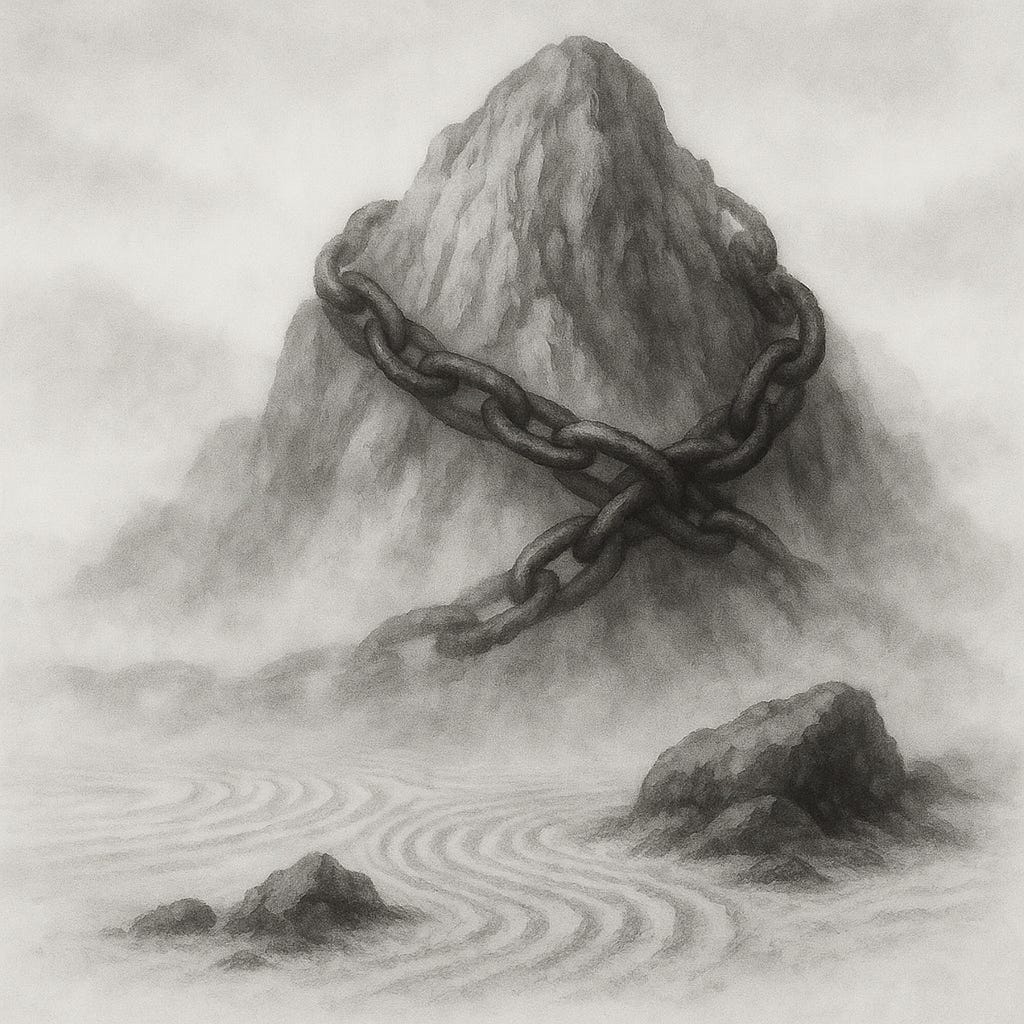
From Tekhen to Techne: The Egyptian Roots of Art and Creation
The word technē didn’t begin in Greece. It began in Egypt — in the tekhen, in the phallus, in the act of creation
From Tekhen to Techne: The Egyptian Roots of Art and Creation
The word technē didn’t begin in Greece. It began in Egypt — in the tekhen, in the phallus, in the act of creation
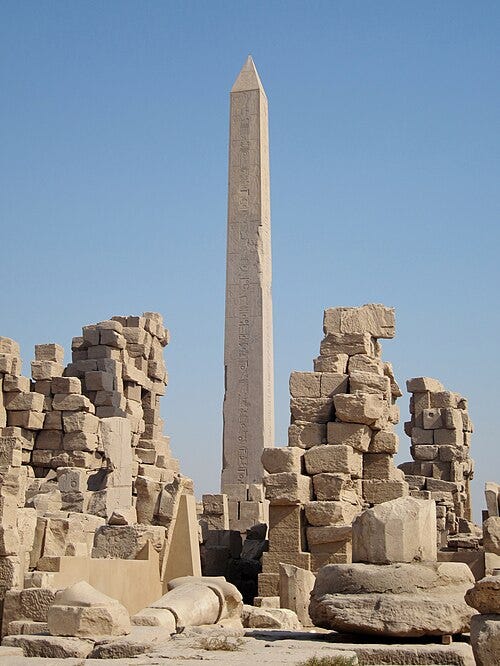
“The serpent coils around its peak, and the sun rests in its shadow.” — Hatshepsut’s Obelisk, Karnak. Karnak Obelisk of Hatshepsut by Olaf Tausch is licensed under CC BY 3.0. Source: Wikimedia Commons
You’ve heard of technology. You know technique. You might even know the Greek word technē — often translated as “art,” “craft,” or “skill.” But have you ever wondered where this word came from?
Most assume it began in ancient Greece — the birthplace of philosophy, democracy, and art. But what if it didn’t?
What if the root of technē — the very idea of human creation — didn’t arise in Athens, but in the Nile? Not from a philosopher’s mind, but from a stone that pierced the sky: “tekhen”, the Egyptian obelisk — a phallic symbol of creation.
At first glance, the words technē and tekhen might seem connected only by sound. But the semantic and symbolic parallels are too strong to ignore. Technē in Greece meant art, craft, skill, the power to shape nature, and mastery over the natural world. Tekhen in ancient Egypt referred to the obelisk — a stone that pierced the sky, mastery over the heavens. Both concepts imply the human power to create, yet history has separated them. Did the Greeks inherit this concept from Egypt?
It is not only possible, it is highly probable. Greek thinkers in the Hellenistic period (after Alexander the Great) had extensive contact with Egypt. Alexandria was a center of learning, philosophy, and cultural exchange. Moreover, Greek achievements in various fields show deep Egyptian influence: in architecture, they adopted temple columns, central plans, and the monumental logic of pyramids; in medicine, they built upon Egyptian surgical techniques and diagnostic methods; in mathematics and astronomy, they inherited the 365-day calendar, geometric principles, and star charts; and in literature and myth, they reworked Egyptian narratives of resurrection, divine conflict, and moral instruction into their own epics.
The link becomes clearer when we look at Hermeticism — the philosophical tradition born in Hellenistic Egypt, where Greek and Egyptian thought merged. The Hermetists never used the word tekhen, but they inherited its meaning: the pillar that reaches the sky, the act of ascending in order to create anew. And this is exactly what technē meant: not to reflect the world, but to remake it.
Yet, no scholar has directly claimed that technē derives from tekhen. Perhaps because the Greeks preferred to reinterpret foreign concepts in their own linguistic and cultural terms. And the Western tradition has long favored the narrative of Greece as the sole cradle of civilization, while portraying Egypt as mysterious, primitive, or merely symbolic. Linguists claim technē arose from a hypothetical Indo-European root: tek-ti-, meaning “to build, to shape.” But this is a hypothetical root, not a word attested in any spoken language. It is a modern scholarly construct, not a historical term. tek-ti-* has no direct evidence in ancient texts. It is a reconstruction, not a documented word. It reflects a linguistic bias toward Indo-European origins. Thus, the claim that technē is Indo-European is itself a modern assumption, not an established fact.
In Egyptian texts, tekhen was not limited to a physical obelisk. It carried a broader meaning: one of craft, skill, and creative power.
In The Maxims of Ptahhotep (24th century BCE), the vizier states: “Do not be proud in your heart because of your knowledge; confer with the ignorant as well as the wise, for the limits of art (tekhen) are not attained, and no craftsman is ever fully skilled in his craft.”
Here, tekhen clearly means “art” or “craft”, not “obelisk,” not “piercing,” but creative mastery.
Also, R. O. Faulkner, a leading Egyptologist, translated tekhen as “art”, interpreting it as creative skill, not a monument. This is identical in meaning to the Greek technē, suggesting a conceptual continuity across cultures. In ancient Egypt, the tekhen was not merely a towering stone. It was a sacred act of mastery — a phallic column that rose from the earth to touch the sun. It stood at the entrance of temples, not as decoration, but as a weapon of dominance over the heavens.
For centuries, obelisks have been misread. Modern interpretations assumed they were built to worship the sun. But Egyptian inscriptions reveal the opposite: they were built to assert dominance over the sun — a symbol of creative authority. This was not passive reverence. This was creation through conquest. The obelisk was not a symbol of submission. It was a declaration: man can master the sun. The obelisk is a symbol of the serpent in battle with the sun — not in worship, but in triumph.
As Hatshepsut’s Obelisks at Karnak illustrate:
“I have raised the tekhen to the sky, that my name may live among the stars. The serpent coils around its peak, and the sun rests in its shadow.”
Here, the serpent encircles the obelisk, not in reverence, but in triumph. The sun rests in its shadow — a sign of submission.
The inscription of Ramesses II at Luxor states: “I have raised two tekhen, like the legs of the sky. They are the fingers of the earth, pointing to the sun. The sun bows to them.”
The sun bows. Earth points upward, not in prayer, but in command. Power is inverted: not sun over earth, but earth over sun.
What has been hidden throughout history is that tekhen refers to the phallus as a sacred symbol of creative power. The obelisk is a cosmic phallus, uniting earth and sky. Technē is its conceptual descendant — the intellectual phallus, shaping the world through knowledge. This changes our understanding of art forever. When Plato, in the Allegory of the Cave, compares the sun to truth, and then, reduces technē to mere imitation of nature, he detaches art from its original meaning from its root in creative mastery. And this misreading has continued to this day.
메타데이터
- post_id
- 6b332d950e79
- slug
- from-tekhen-to-techne-the-egyptian-roots-of-art-and-creation-6b332d950e79
- url
- https://medium.com/@khaledibahman99/from-tekhen-to-techne-the-egyptian-roots-of-art-and-creation-6b332d950e79
- canonical_url
- https://medium.com/@khaledibahman99/from-tekhen-to-techne-the-egyptian-roots-of-art-and-creation-6b332d950e79
- author_url
- https://medium.com/@khaledibahman99
- status
- ok
- fetched_at
- 2026-07-11 02:08:05