Futures Market Guide: How ES, NQ, YM, Metals, Energy, and Rates Shape Daily Market Trends
The futures market plays a major role in shaping daily market trends. Before the stock market opens, many professional traders…
Futures Market Guide: How ES, NQ, YM, Metals, Energy, and Rates Shape Daily Market Trends
The futures market plays a major role in shaping daily market trends. Before the stock market opens, many professional traders, institutional investors, hedge funds, and active market participants already watch futures to understand the likely mood of the day. Futures can show whether investors are leaning bullish, bearish, cautious, or aggressive before regular trading begins.
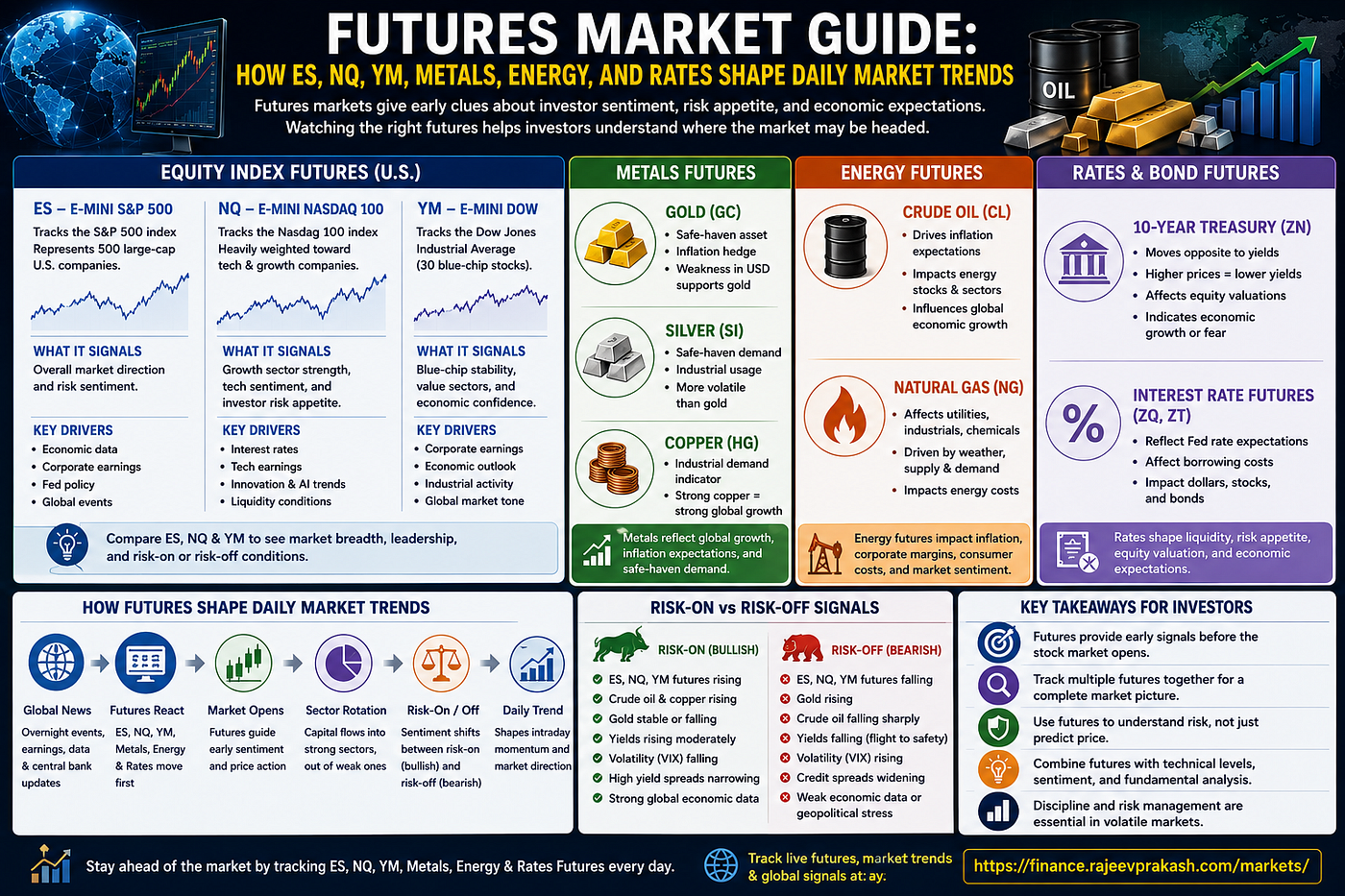
When people talk about futures, they often refer to contracts such as ES, NQ, and YM. These represent major U.S. equity index futures linked to the S&P 500, Nasdaq 100, and Dow Jones Industrial Average. Traders also track futures linked to metals, energy, bonds, interest rates, and currencies. Together, these markets create a daily roadmap for global risk sentiment.
A futures market guide is useful because futures do not move in isolation. ES may show broad market direction. NQ may reveal the mood in technology and growth stocks. YM may show blue-chip strength or weakness. Metals like gold, silver, and copper can signal inflation, safety demand, and industrial growth. Energy futures like crude oil and natural gas can influence inflation, sector performance, and consumer costs. Rate futures and bond futures can shape expectations for interest rates, liquidity, and equity valuations.
For investors, futures are not just trading instruments. They are early indicators of market behavior. By tracking futures, investors can better understand daily trends, sector rotation, risk-on and risk-off conditions, and possible market volatility.
What Are Futures?
Futures are financial contracts that allow buyers and sellers to agree on the price of an asset for a future date. These assets can include stock indices, commodities, metals, energy products, bonds, currencies, and interest rates.
For example, an equity index future allows traders to speculate on or hedge against the future movement of a stock index. A crude oil future allows market participants to trade expectations about oil prices. A gold future reflects expectations about gold demand, inflation, currency movement, and safe-haven flows.
Futures are widely used by institutions for hedging and by traders for speculation. They are also used by investors as market indicators. Even if an investor never trades futures directly, watching futures can help them understand the daily direction of markets.
The futures market often trades nearly around the clock. This means futures react to overnight news, economic data, geopolitical events, central bank comments, corporate earnings, and global market movement before the regular stock market opens.
Why Futures Matter for Daily Market Trends
Futures matter because they provide early signals. If major index futures are rising before the market opens, investors may expect a positive start. If futures are falling sharply, traders may prepare for weakness or volatility.
However, futures are not guarantees. A strong futures market can reverse after the opening bell. A weak futures market can recover during the day. Still, futures are useful because they show how investors are reacting before the regular session begins.
Daily market trends are often shaped by a combination of futures signals. If ES, NQ, and YM are all positive, broad risk appetite may be strong. If NQ is weak while YM is flat or positive, technology stocks may be under pressure while blue-chip value stocks remain stable. If crude oil rises sharply, energy stocks may gain attention, but inflation-sensitive sectors may face pressure. If bond yields rise, growth stocks may struggle.
Futures help investors connect these signals before making decisions.
Understanding ES Futures
ES futures refer to E-mini S&P 500 futures. They track the S&P 500 index, which represents 500 large U.S. companies across many sectors. ES is one of the most watched futures contracts in the world because the S&P 500 is a broad benchmark for U.S. equities.
When ES futures rise, it often suggests positive sentiment toward large-cap U.S. stocks. When ES futures fall, it may signal caution or selling pressure. Since the S&P 500 includes technology, healthcare, financials, consumer companies, industrials, energy, utilities, and other sectors, ES gives a broad view of market risk appetite.
Traders watch ES futures for overnight direction, pre-market levels, support and resistance, gap openings, and intraday momentum. Investors use ES to understand whether the broader market is strong or weak before regular trading begins.
ES futures are especially important during earnings season, Federal Reserve meetings, inflation data releases, jobs reports, and global risk events. A sharp move in ES can influence sentiment across global markets.
Understanding NQ Futures
NQ futures refer to E-mini Nasdaq 100 futures. They track the Nasdaq 100 index, which is heavily weighted toward technology, growth, semiconductor, software, internet, and innovation-driven companies.
NQ futures are closely watched because growth stocks can be highly sensitive to interest rates, liquidity, earnings expectations, and investor risk appetite. When NQ futures rise strongly, it may suggest confidence in technology and growth sectors. When NQ futures fall, it may indicate pressure on high-valuation stocks or concerns about rates and earnings.
NQ often moves more sharply than ES because technology stocks tend to be more volatile. If NQ is outperforming ES, growth leadership may be strong. If NQ is underperforming ES, investors may be rotating away from growth and into value, defensive sectors, or cash.
For investors who track technology stocks, AI-related companies, semiconductors, cloud businesses, and high-growth names, NQ futures are highly important.
Understanding YM Futures
YM futures refer to E-mini Dow futures. They track the Dow Jones Industrial Average, which includes 30 large blue-chip U.S. companies. The Dow is older and narrower than the S&P 500, but it remains an important sentiment indicator.
YM futures often reflect the mood in large, established companies. These may include industrials, healthcare, financials, consumer brands, and other blue-chip businesses. Because the Dow is less technology-heavy than the Nasdaq, YM can sometimes perform differently from NQ.
If YM futures are strong while NQ futures are weak, investors may be favoring value, industrials, or blue-chip stability over growth. If YM and NQ both rise, the market may have broader support. If YM falls sharply, it may signal weakness in traditional large-cap sectors.
YM futures can help investors understand whether the market is being led by stable blue-chip names or by faster-moving growth stocks.
ES vs NQ vs YM: What the Difference Tells Investors
Tracking ES, NQ, and YM together gives investors a clearer view of market leadership.
ES shows the broad market. NQ shows growth and technology sentiment. YM shows blue-chip and traditional large-cap strength. When all three move together, the signal is stronger. When they diverge, investors should study the reason.
If NQ leads strongly while ES follows and YM lags, the market may be driven by technology and growth stocks. If YM leads while NQ lags, investors may be rotating toward value or defensive blue chips. If ES is flat but NQ is very weak, the broader market may hide stress in growth sectors.
This comparison helps investors understand whether the daily trend is broad-based or concentrated. A broad rally is generally healthier. A narrow rally can still continue, but it may carry higher risk.
Metals Futures and Market Trends
Metals futures are important because they provide signals about inflation, industrial demand, currency movement, and safe-haven demand. The most watched metals include gold, silver, and copper.
Gold futures often reflect safe-haven demand, inflation concerns, real interest rates, and currency movement. When investors are worried about financial stress, geopolitical tension, or currency weakness, gold may attract buying. However, gold can also fall when real yields rise or when investors prefer risk assets.
Silver futures have both precious metal and industrial characteristics. Silver can move with gold during safe-haven demand, but it can also respond to industrial demand in electronics, solar, and manufacturing.
Copper futures are often seen as an economic growth indicator. Copper is used in construction, power, manufacturing, infrastructure, and industrial activity. Rising copper prices may suggest stronger growth expectations, while falling copper can signal concern about demand.
Investors can use metals futures to understand whether markets are pricing in safety, inflation, or growth.
Gold Futures and Risk Sentiment
Gold futures are one of the most watched instruments during uncertain markets. Gold often acts as a store of value when investors worry about currencies, inflation, banking stress, geopolitical events, or financial instability.
If equity futures are falling while gold futures are rising, the market may be showing risk-off behavior. Investors may be reducing exposure to stocks and moving toward safer assets. If equity futures are rising while gold is weak, risk-on sentiment may be stronger.
However, gold does not always behave perfectly as a safe haven. During liquidity shocks, investors may sell gold to raise cash. During periods of rising real yields, gold may struggle even if uncertainty remains.
Therefore, gold futures should be studied with other signals such as the dollar, bond yields, volatility, and equity futures.
Silver Futures and Dual Demand
Silver futures are useful because silver has two identities. It is a precious metal and an industrial metal. This means silver can respond to both safe-haven demand and economic growth expectations.
When investors buy precious metals due to inflation fears or currency concerns, silver may rise with gold. When industrial demand improves, silver may also benefit because of its use in solar panels, electronics, medical equipment, and manufacturing.
Silver can be more volatile than gold. It may rise sharply during strong precious metal cycles and fall quickly when sentiment weakens. Investors tracking silver futures should understand that it can reflect both safety demand and industrial optimism.
Copper Futures and Global Growth
Copper futures are often called a barometer of global growth. This is because copper is widely used in economic activity. Construction, electrical systems, transportation, power grids, manufacturing, and infrastructure all require copper.
When copper prices rise, investors may interpret it as a sign of stronger demand or supply tightness. This can support mining stocks, industrial sectors, and commodity-linked economies. When copper falls, it may suggest weakening demand or concern about global growth.
Copper can also influence inflation expectations. Rising copper prices can increase input costs for industries. Falling copper prices may reduce cost pressure but can also signal weaker industrial activity.
For investors tracking global markets, copper futures provide a useful macro signal.
Energy Futures and Daily Market Direction
Energy futures are among the most important drivers of daily market trends. Crude oil and natural gas affect inflation, transportation costs, corporate margins, consumer spending, and energy-sector performance.
Crude oil futures influence energy stocks, airlines, logistics, chemicals, inflation expectations, and central bank policy expectations. A sharp rise in oil can support energy producers but pressure companies that depend heavily on fuel. It can also increase inflation concerns.
Natural gas futures affect utilities, power producers, chemicals, fertilizers, and energy-intensive industries. Natural gas prices can be highly sensitive to weather, storage levels, production, export demand, and geopolitical factors.
Energy futures help investors understand whether inflation pressure is rising or easing and which sectors may benefit or suffer.
Crude Oil Futures and Inflation
Crude oil is one of the most important commodities in the world. It affects fuel prices, transportation, manufacturing, logistics, and household costs. Because of this, crude oil futures are closely watched by investors and policymakers.
When crude oil rises sharply, markets may worry about inflation. Higher oil prices can increase costs for businesses and consumers. This can reduce profit margins for sectors such as airlines, shipping, and consumer goods. However, oil producers and energy-service companies may benefit.
When crude oil falls, inflation pressure may ease. This can support consumer spending and reduce pressure on central banks. However, falling oil can also signal weak global demand if the decline is driven by economic slowdown.
Crude oil futures must be interpreted carefully. A supply-driven rally may have different market implications than a demand-driven rally.
Natural Gas Futures and Sector Impact
Natural gas futures can be volatile because they are affected by weather, storage levels, production, exports, and regional demand. Cold winters, hot summers, supply disruptions, and export demand can all move natural gas prices.
Rising natural gas prices may affect utilities, fertilizer companies, chemical producers, and manufacturing businesses. Lower natural gas prices can reduce costs for energy-intensive industries and consumers.
Natural gas is also important in global energy security. Changes in natural gas prices can affect European markets, Asian demand, and energy policy decisions.
Investors should track natural gas futures as part of a broader energy and inflation view.
Rates and Bond Futures
Rates and bond futures are important because interest rates influence almost every asset class. Equity valuations, bond prices, currency movement, housing, banking, and corporate borrowing all depend on rates.
Bond futures, such as Treasury futures, reflect expectations about interest rates and bond prices. When bond prices rise, yields usually fall. When bond prices fall, yields usually rise.
Equity investors track rates because higher yields can reduce the appeal of stocks, especially growth stocks. Lower yields can support equity valuations if inflation is controlled.
Rate expectations also influence sector performance. Banks, real estate, utilities, technology, and dividend stocks can all react differently to yield movements.
Why Rates Shape Equity Market Valuation
Interest rates affect equity valuation because they influence the discount rate used to value future cash flows. When rates rise, future profits become less valuable in present-value terms. This can pressure stocks with high valuations and profits expected far in the future.
Growth stocks are often more sensitive to rate changes. If yields rise quickly, NQ futures may weaken. If yields fall, growth stocks may recover.
Value stocks and banks can respond differently. Banks may benefit from certain rate environments, but they can also suffer if high rates increase credit risk or reduce loan demand.
Investors who track ES, NQ, and YM should also track Treasury yields and rate futures because rates often explain why one index is outperforming another.
How Futures Signal Risk-On and Risk-Off Conditions
Futures help investors understand whether markets are risk-on or risk-off.
A risk-on environment often includes rising ES, NQ, and YM futures, falling volatility, stable bond yields, weaker safe-haven demand, stronger copper, and improving crude oil demand. Growth and cyclical sectors may lead.
A risk-off environment often includes falling equity futures, rising gold, stronger safe-haven currencies, falling copper, wider credit spreads, and rising volatility. Defensive sectors may outperform.
Futures are useful because they show these signals early. Traders can prepare before the market opens. Investors can avoid reacting emotionally during the session.
How Futures Affect Sector Rotation
Futures can influence sector rotation. If crude oil futures rise, energy stocks may attract interest. If copper rises, industrial and materials stocks may gain attention. If bond yields rise, banks may move differently from technology stocks. If NQ futures weaken while YM holds firm, money may be rotating from growth to value.
Sector rotation often begins before it becomes obvious in individual stocks. Futures can provide early clues. For example, rising rates and falling NQ may signal pressure on high-growth stocks. Rising crude and strong energy-sector performance may show rotation into energy.
Investors who track futures can better understand why certain sectors are moving.
How Traders Use Futures Before the Market Opens
Traders use futures to prepare for the day. They check overnight highs and lows, pre-market direction, support and resistance levels, gap-up or gap-down scenarios, and correlation between indices.
If ES and NQ futures are strong, traders may look for bullish setups in leading sectors. If futures are weak, they may reduce risk or look for short setups. If futures are mixed, they may wait for confirmation after the opening.
Traders also watch whether futures hold key levels. A pre-market rally that fails after the open can signal weakness. A weak open that recovers quickly can show buying support.
Futures are not a trading plan by themselves, but they help build one.
How Long-Term Investors Can Use Futures
Long-term investors do not need to trade futures. However, they can still use futures as market context.
For example, if equity futures fall sharply due to temporary fear, long-term investors may watch quality stocks for better entry points. If futures rise strongly but valuations are stretched, investors may avoid chasing. If crude oil futures rise, investors may review energy exposure and inflation-sensitive sectors. If rate futures suggest higher yields, investors may reassess growth-stock valuations.
Futures help long-term investors understand market environment, but decisions should still be based on company fundamentals, valuation, portfolio goals, and risk tolerance.
Common Mistakes Investors Make With Futures
One common mistake is assuming futures predict the full trading day. Futures can change quickly after the market opens.
Another mistake is looking at only one futures contract. ES, NQ, YM, metals, energy, and rates should be studied together for a complete view.
A third mistake is ignoring the reason behind the move. Crude oil can rise due to strong demand or supply disruption. These have different implications.
A fourth mistake is overreacting to overnight moves. Long-term investors should use futures as context, not as a reason for emotional buying or selling.
A fifth mistake is ignoring risk management. Futures markets can be volatile and leveraged. Investors who trade futures directly must understand position sizing, margin, and risk.
Building a Daily Futures Market Routine
A simple daily routine can help investors track futures effectively. Start with ES, NQ, and YM to understand equity index direction. Then check Russell futures, if available, to understand small-cap risk appetite.
Next, check gold, silver, and copper. These metals can show safety demand, inflation pressure, and industrial growth expectations. Then check crude oil and natural gas to understand energy and inflation trends.
After that, check Treasury yields or bond futures. These signals help explain growth-stock performance and broader valuation pressure.
Finally, connect the signals. Are equity futures rising while yields are stable? Are metals confirming risk-off behavior? Is crude rising due to demand or supply risk? Are technology futures leading or lagging?
This routine helps investors move from random observation to structured market analysis.
Futures and Global Market Connection
Futures connect global markets because they react across time zones. U.S. futures may move during Asian and European trading hours. Commodity futures may respond to global demand and supply. Rate futures may react to central bank expectations. Currency and bond futures can shift after economic data releases.
This creates a 24-hour market environment. An event in Asia can affect U.S. futures. A European policy announcement can influence global risk sentiment. A crude oil supply shock can affect inflation expectations worldwide.
Investors who track futures can understand global market mood before their local market opens.
Conclusion
The futures market is one of the most important tools for understanding daily market trends. ES, NQ, and YM futures help investors track broad equity sentiment, technology leadership, and blue-chip strength. Metals futures such as gold, silver, and copper reveal signals about safety demand, inflation, and industrial growth. Energy futures such as crude oil and natural gas influence inflation, sector performance, and global economic expectations. Rate and bond futures shape equity valuation, growth-stock momentum, and macro risk.
Futures do not guarantee market direction, but they provide valuable early clues. They help traders prepare for the opening session and help long-term investors understand market context. When futures are studied together, they reveal whether markets are risk-on, risk-off, mixed, or rotating between sectors.
The best investors do not look at one signal alone. They connect equity futures, commodities, energy, rates, currencies, breadth, and sector performance. This creates a clearer picture of the market environment.
In fast-moving markets, preparation matters. Futures help investors prepare before the crowd reacts. They show where money is flowing, where risk is rising, and where opportunities may appear.
To track global indices, futures, sector trends, commodities, and broader market signals in one place, visit the Markets page here: https://finance.rajeevprakash.com/markets/
메타데이터
- post_id
- 6b3613f7beb7
- slug
- futures-market-guide-how-es-nq-ym-metals-energy-and-rates-shape-daily-market-trends-6b3613f7beb7
- url
- https://medium.com/@techiteindia/futures-market-guide-how-es-nq-ym-metals-energy-and-rates-shape-daily-market-trends-6b3613f7beb7
- canonical_url
- https://medium.com/@techiteindia/futures-market-guide-how-es-nq-ym-metals-energy-and-rates-shape-daily-market-trends-6b3613f7beb7
- author_url
- https://medium.com/@techiteindia
- status
- ok
- fetched_at
- 2026-07-16 18:45:13