Your Code Will Fail Successfully: The Hidden Trap of Asking AI for Unit Tests
There’s a new anti-pattern quietly spreading across software teams, startups, side projects, and even enterprise environments. It looks…
Your Code Will Fail Successfully: The Hidden Trap of Asking AI for Unit Tests
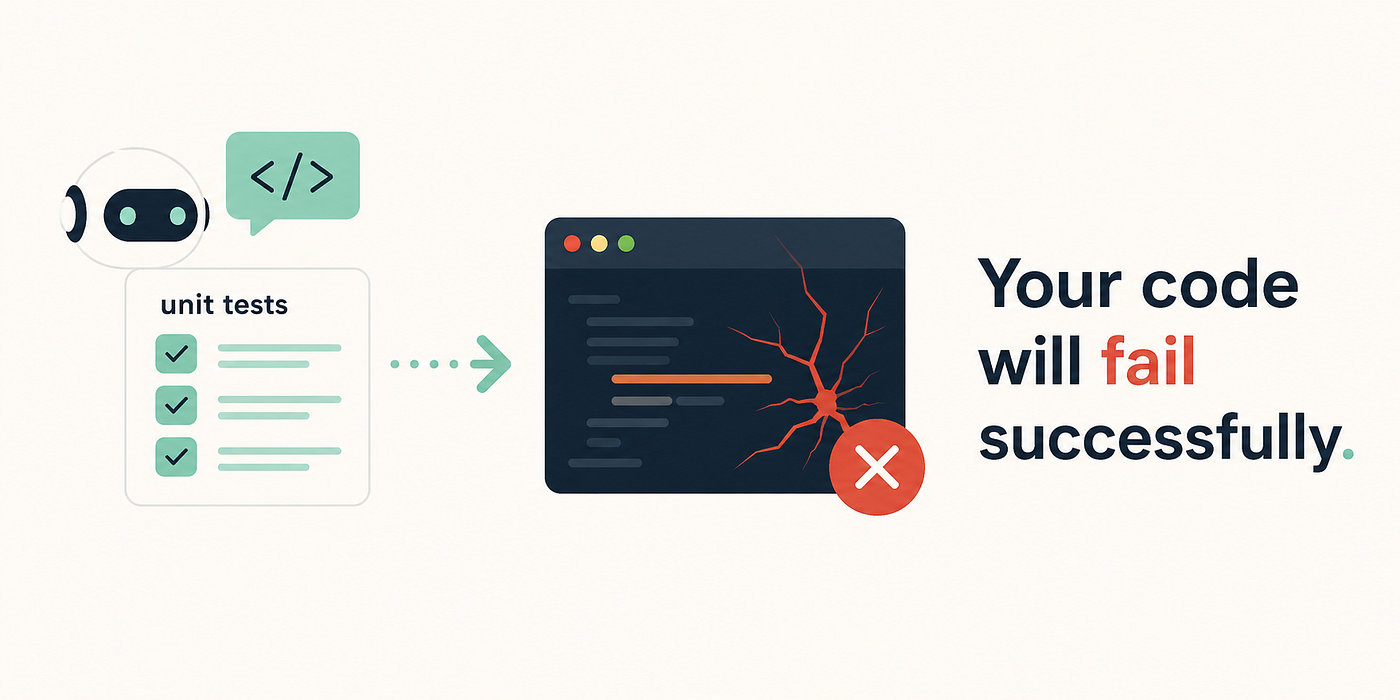
There’s a new anti-pattern quietly spreading across software teams, startups, side projects, and even enterprise environments. It looks productive. It looks modern. It looks efficient. But under the surface, it creates one of the most dangerous illusions in software engineering:
The illusion that your code is tested because an AI generated the tests.
And the worst part is that the tests often pass.
This is what I call “failing successfully.”
Your CI pipeline is green. Coverage reports look beautiful. Pull requests get approved faster. Managers are happy because “AI increased productivity.” Developers feel safer because there are now hundreds of tests where previously there were none.
And yet the system is still broken.
Not because the AI is useless. Quite the opposite. AI is incredibly good at producing something that resembles quality software engineering. The danger is precisely that the output often looks legitimate enough to bypass human skepticism.
The problem begins when developers stop treating tests as verification mechanisms and start treating them as decorative artifacts generated to satisfy process requirements.
That shift changes everything.
The New Era of Synthetic Confidence
A large percentage of AI-generated unit tests today are not truly validating behavior. They are validating assumptions extracted from the implementation itself.
That sounds subtle, but it’s catastrophic.
Traditional testing philosophy assumes that tests represent an independent perspective of correctness. A test should challenge the implementation. It should behave almost like an adversary. It should try to prove the code wrong.
AI usually does the opposite.
When you ask an LLM to generate tests for a function, the model analyzes the implementation and produces tests that mirror the same logic, assumptions, branches, and patterns it already observed in the code.
The AI is effectively saying:
“Given that this code exists, here are examples of inputs that make the code behave consistently with itself.”
That is not verification.
That is self-confirmation.
You are no longer testing correctness. You are testing internal consistency.
And broken systems can be perfectly internally consistent.
The Mirror Problem
One of the deepest issues with AI-generated tests is what I call the mirror effect.
Humans typically write tests from specifications, expected behavior, business rules, incident history, or edge cases discovered through experience. AI, however, usually writes tests by reflecting the implementation back at itself.
If the implementation contains a flawed assumption, the tests inherit that flaw automatically.
For example, imagine a function that incorrectly rounds financial values upward instead of using banker’s rounding. An AI model reading the implementation will likely generate tests that validate the existing rounding behavior because statistically that behavior appears intentional.
The generated tests may achieve 95% coverage.
They may all pass.
They may even look elegant.
But they are certifying a bug.
The tests are not detecting the defect because the defect became part of the training context for the test generation itself.
This creates an extremely dangerous psychological outcome:
Developers trust the code more precisely because the tests passed.
In reality, the tests merely agreed with the implementation.
Coverage Became a Cosmetic Metric
AI has accidentally exposed a truth many engineering organizations were already avoiding:
Most teams were never optimizing for correctness.
They were optimizing for measurable process indicators.
Coverage percentages. Number of tests. CI success rates. Static quality gates.
AI just made it dramatically easier to game those metrics at industrial scale.
A developer can now generate hundreds of unit tests in minutes. Entire repositories can suddenly jump from 20% coverage to 85% coverage overnight.
Executives see improvement. Dashboards look healthier. Quality gates turn green.
But the actual resilience of the software may not improve at all.
In some cases it gets worse, because now teams believe they are protected.
False confidence is more dangerous than visible instability.
When systems visibly lack tests, engineers remain cautious. They manually verify behavior. They expect surprises. They investigate carefully.
But once an AI floods the repository with seemingly comprehensive tests, teams psychologically downgrade their skepticism.
The system looks mature.
That illusion changes deployment behavior, review quality, and operational risk tolerance.
Why AI Loves Happy Paths
Large language models are probabilistic systems trained on patterns.
And software engineering culture overwhelmingly publishes happy-path examples.
Documentation examples. Tutorials. Blog posts. Stack Overflow snippets. Open-source examples.
Most of the internet teaches software in terms of success scenarios.
As a result, AI models become naturally biased toward generating tests that validate expected success conditions rather than destructive adversarial behavior.
This is why AI-generated test suites often miss:
- Race conditions
- Partial failures
- Resource exhaustion
- Invalid ordering states
- Concurrent mutations
- Distributed consistency problems
- Timeout edge cases
- Corrupted payloads
- Clock skew
- Retry storms
- Memory pressure
- Cache poisoning
- Real-world infrastructure instability
The model statistically gravitates toward normality because normality dominates the training data.
But production systems do not fail under normality.
Production systems fail under chaos.
The Unit Test Delusion in Distributed Systems
The problem becomes dramatically worse in distributed systems, Kubernetes environments, observability pipelines, and cloud-native architectures.
AI-generated unit tests often validate isolated function behavior while completely ignoring emergent system properties.
A distributed system can have:
- Perfect unit test coverage
- Perfect linting
- Perfect formatting
- Perfect typing
…and still collapse catastrophically in production.
Because distributed systems fail at the boundaries between components.
The real failures happen in:
- Network instability
- Timing variance
- Event ordering
- Retry amplification
- Backpressure
- Queue saturation
- Lock contention
- Partial infrastructure outages
- Data consistency windows
- Protocol mismatches
- Service discovery delays
AI-generated unit tests rarely model these realities effectively because they are fundamentally harder to infer from static code.
This creates a bizarre paradox in modern engineering:
The more distributed your architecture becomes, the less meaningful autogenerated unit tests become as indicators of reliability.
And yet teams continue treating them as proof of quality.
AI Is Optimizing for Plausibility, Not Truth
This is probably the single most important concept developers need to understand.
LLMs do not optimize for correctness.
They optimize for plausibility.
That distinction matters enormously.
A generated unit test only needs to look like a reasonable test according to statistical patterns learned during training.
The model is not executing a deep semantic verification process. It is predicting what a convincing test probably resembles.
This is why AI-generated tests often contain:
- Assertions that verify implementation details instead of behavior
- Redundant assertions
- Mock-heavy architectures that validate mocks instead of reality
- Tests tightly coupled to internal implementation
- Assertions copied from method names
- Circular logic
- Brittle snapshots
- Fake edge cases that are not operationally meaningful
To humans skimming quickly through pull requests, the tests appear legitimate.
But many of them provide little real safety.
The Most Dangerous Outcome: Engineers Stop Thinking
The biggest risk is not bad tests.
The biggest risk is cognitive outsourcing.
Once developers become habituated to AI-generated testing, many subtly stop performing the mental exercise that testing was originally designed to force.
Writing tests manually used to require engineers to ask:
- What assumptions am I making?
- What could break?
- What inputs are dangerous?
- What happens under stress?
- What are the invariants?
- What does failure look like?
- What should never happen?
- What are the operational boundaries?
These questions are extremely valuable.
Not because they produce lines of test code.
Because they produce understanding.
AI can accidentally short-circuit that process.
Developers begin reviewing tests instead of reasoning about systems.
That is a massive downgrade in engineering rigor.
The Rise of “Green Pipeline Engineering”
We are entering an era where some teams unconsciously optimize for maintaining permanently green pipelines rather than improving actual system robustness.
AI accelerates this trend because it can rapidly generate tests tailored to existing implementation behavior.
In other words:
The tests adapt to the code instead of the code adapting to correctness.
This reverses the entire philosophical purpose of testing.
A healthy engineering culture treats tests as constraints that challenge the implementation.
An unhealthy AI-assisted culture treats tests as generated accessories attached after the fact.
The difference sounds subtle.
Operationally, it is enormous.
Why Senior Engineers Distrust Beautiful Test Suites
Experienced engineers often develop an instinctive distrust toward suspiciously clean testing environments.
Because reality is messy.
Production incidents are messy. Infrastructure is messy. Concurrency is messy. Humans are messy.
When a repository has thousands of perfect AI-generated unit tests but almost no incident-driven regression testing, chaos testing, integration testing, or operational simulation, senior engineers immediately notice the imbalance.
The system may be over-tested in trivial dimensions and catastrophically under-tested in the dimensions that actually matter.
This is especially common in cloud-native environments where:
- APIs depend on eventual consistency
- Retries interact unpredictably
- Caches mask failures
- Service meshes introduce latency variance
- Queues reorder events
- Horizontal scaling changes timing behavior
None of these realities are captured well by simplistic autogenerated unit tests.
The Real Role AI Should Play in Testing
AI is not the enemy.
Used correctly, it can be extremely powerful.
But its role should be assistive, not authoritative.
AI works best when:
- Generating boilerplate
- Suggesting edge cases humans may overlook
- Expanding repetitive parameterized tests
- Helping create mocks quickly
- Producing fuzzing inputs
- Building test scaffolding
- Accelerating regression reproduction
- Generating load-testing scenarios
- Creating synthetic datasets
The mistake is allowing AI to define correctness autonomously.
Correctness must still come from humans, specifications, production incidents, operational understanding, and business constraints.
The engineer must remain the source of truth.
Incident-Driven Testing Is Still Superior
The strongest tests in mature systems are rarely autogenerated.
They are usually written after painful outages.
A production incident teaches things no LLM can infer statically:
- Real timing conditions
- Infrastructure behavior
- Human misuse patterns
- Cascading failure dynamics
- Operational edge cases
- Unexpected protocol interactions
These tests encode institutional memory.
They are valuable because they emerged from reality.
AI-generated tests, by contrast, usually emerge from pattern synthesis.
That difference matters.
One is grounded in operational truth.
The other is grounded in statistical plausibility.
“But the Tests Pass”
Of course they do.
That’s the whole problem.
The most dangerous bugs in software engineering are not the ones that crash immediately.
The most dangerous bugs are the ones validated by flawed assumptions.
AI-generated testing increases the probability of systems becoming internally self-consistent while remaining externally incorrect.
And modern CI/CD pipelines are extremely vulnerable to this illusion because they fundamentally trust binary outcomes:
Green or red. Pass or fail. Coverage high or low.
AI exploits the weakness of metric-driven engineering culture.
Not intentionally. Just statistically.
The Future: AI-Written Code Testing AI-Written Code
Now imagine the next stage.
AI generates the implementation. AI generates the unit tests. AI reviews the pull request. AI summarizes the CI results. AI explains the incident.
Humans become passive observers inside a synthetic engineering loop.
At that point, the system can become detached from operational reality entirely.
You may end up with repositories that are mathematically dense with “quality indicators” while remaining operationally fragile.
That future is not hypothetical anymore.
Parts of the industry are already moving toward it.
Software Engineering Was Never About Producing Code
This is the deeper lesson many teams are forgetting.
Software engineering is not primarily about generating code quickly.
It is about managing complexity safely.
Testing was never valuable because it created files ending in _test.go or .spec.ts.
Testing was valuable because it forced humans to reason explicitly about failure.
AI can help accelerate implementation.
But if it removes the thinking process from engineering, then teams may accidentally optimize themselves into fragility.
And that is exactly how systems begin to fail successfully.
They pass every check.
Right before production goes down.
메타데이터
- post_id
- 6b3cbc1828d4
- slug
- your-code-will-fail-successfully-the-hidden-trap-of-asking-ai-for-unit-tests-6b3cbc1828d4
- url
- https://medium.com/@msalinas92/your-code-will-fail-successfully-the-hidden-trap-of-asking-ai-for-unit-tests-6b3cbc1828d4
- canonical_url
- https://medium.com/@msalinas92/your-code-will-fail-successfully-the-hidden-trap-of-asking-ai-for-unit-tests-6b3cbc1828d4
- author_url
- https://medium.com/@msalinas92
- status
- ok
- fetched_at
- 2026-06-09 15:37:30