The Largest Scorpion That Ever Lived Was the Size of a 4-Year-Old
A recent study re-examines 150-year-old fossils, confirming Praearcturus gigas as the largest scorpion ever recorded and suggesting it may…
FOSSILS ET AL.
The Largest Scorpion That Ever Lived Was the Size of a 4-Year-Old
A recent study re-examines 150-year-old fossils, confirming Praearcturus gigas as the largest scorpion ever recorded and suggesting it may have hunted both on land and in water.
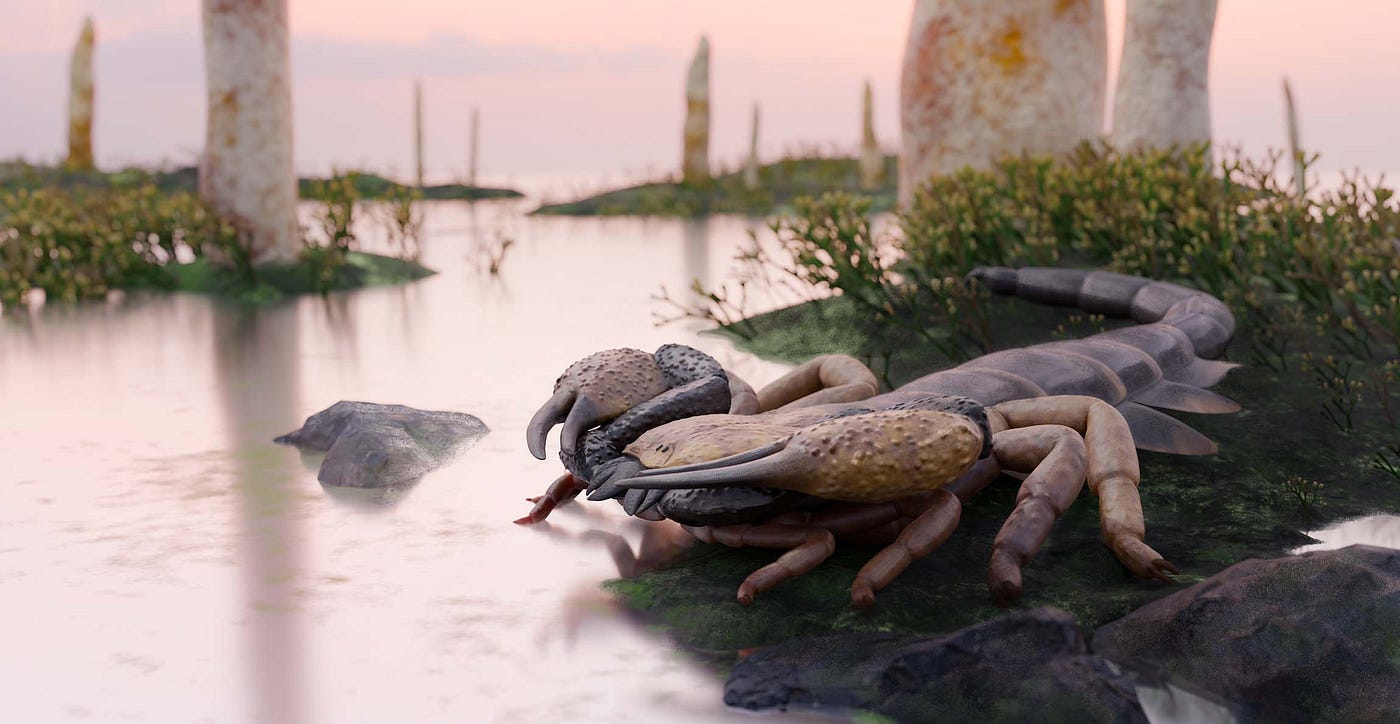
Artistic reconstruction of P. gigas. Credit: Franz Anthony
I remember a day in kindergarten when we were swimming in the pool, and suddenly, a bunch of the other kids got spooked and basically jumped out. Swimming idly near me was a massive bug, and I do mean massive; this thing was almost the size of my adult hand. It had huge forelegs which looked like pincers and a long, needle-like tail.
It freaked me out! The thing is, the rapid movements I made to try and get away from the creature likely spooked it, and it bit me. That bite was incredibly painful and made my skin swell.
For a long time, I had no idea what it was, but I called it a water scorpion because that is exactly what it looked like to me. I later found out it was colloquially called a water scorpion, but only because of how it looks, as the creature was actually a type of *Nepidae. *They are not venomous, and the needle-like tail is more like a snorkel used for breathing, but they do deliver a painful bite. To this day, they freak me out a little.
Thankfully, I did not live during the Devonian (about 419.2 to 358.9 million years ago), because a recent study identified the largest scorpion ever to live. Not only was it massive, but it was possibly semi-aquatic.
The Mystery of Praearcturus gigas
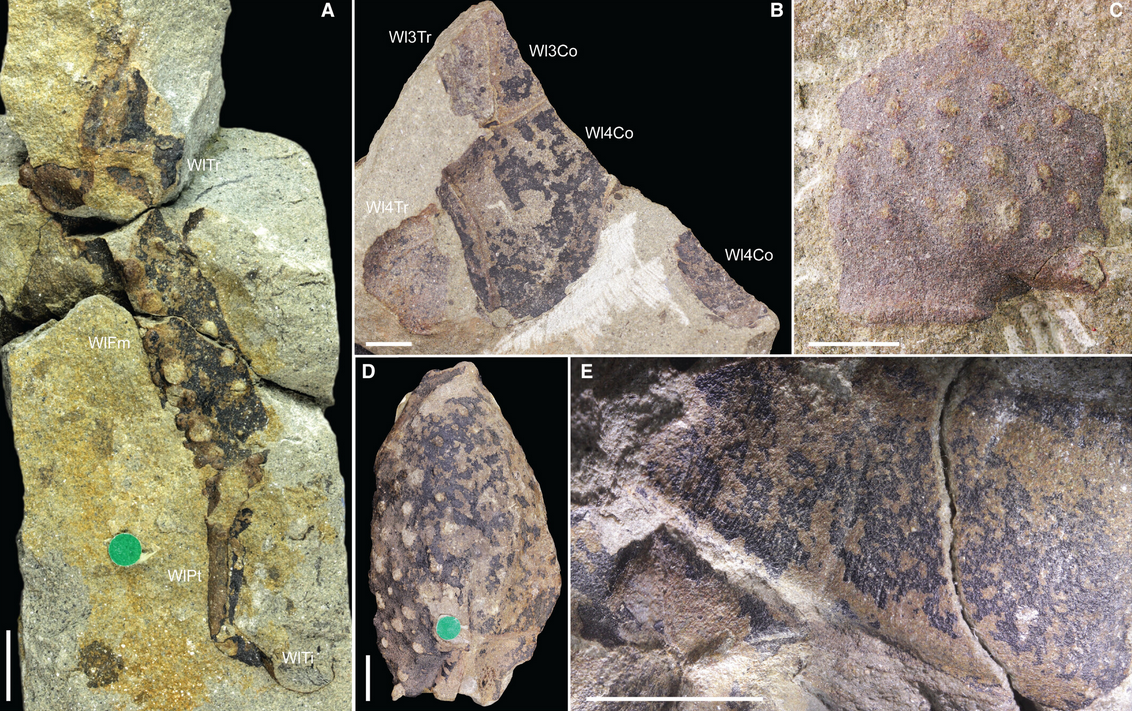
Various elements of Praearcturus gigas found in the Lochkovian St Maughan’s Formation of Rowlestone. Scale bar= 10mm Credit: Howard et al. 2026
When you picture some of the absolute earliest land-dwelling animals, you imagine a world with alien-like trees, in which giant dragonflies and millipede-like creatures roamed the earth. Most of these giants lived during the Permo-Carboniferous period, and their large size is often attributed to high oxygen levels.
However, giant scorpions are an interesting puzzle because they lived during an earlier period, the Early Devonian. At this time, life on land was just getting started, and oxygen levels were much lower. One of the creatures that lived during this period was Praearcturus *gigas*, a massive arthropod.
Given the lower oxygen levels, its gigantism likely had a different cause. But trying to figure out the cause is somewhat hampered by the fact that no one seems to be able to agree on exactly what P. gigas was, with some saying it was a scorpion while others argue it was a crustacean.
The debate began over 150 years ago with the discovery of the first P. gigas specimen. It was originally described as an isopod (a type of crustacean like woodlice), but was later compared to other creatures, including *arthropleurids (extinct giant millipede-like arthropods) and [eurypterids](https://en.wikipedia.org/wiki/Eurypterid)* (extinct ‘sea scorpions’), before being classified as a type of scorpion in the 1980s.
However, more recently (2024), it has been argued once again to be a crustacean, based on crustacean-like features, though the study includes no images to support the claims. In fact, very few images of P. gigas exist, making it difficult to determine which features it had or lacked.
To determine what P. gigas was, various fossils were re-examined using photography and CT scanning, before then comparing the Praearcturus specimen directly with other fossils, including Brontoscorpio and Bennettarthra.
Giant Fossils
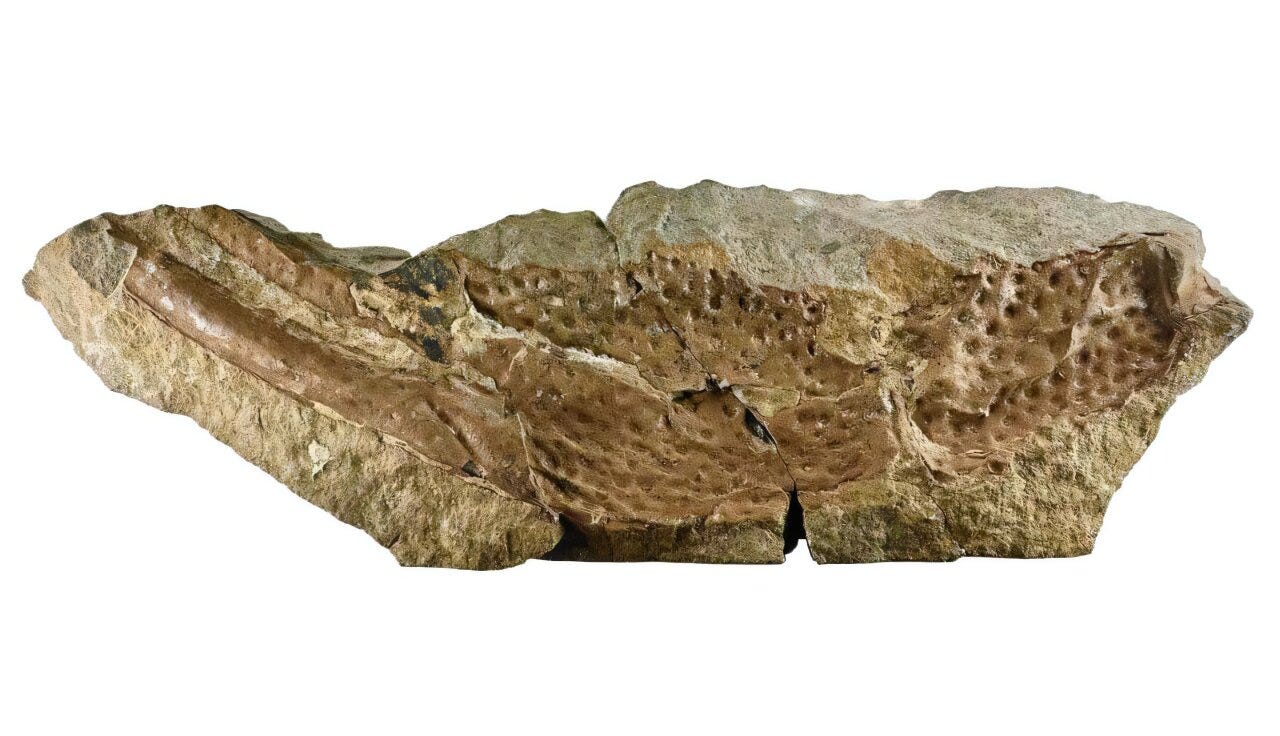
16-cm-long pincer of P. gigas. Credit: Natural History Museum
The researchers worked with a total of various fossils, including five specimens classified as P. gigas, three Brontoscorpio anglicus, three Bennettarthra annwnensis specimens, and two unconfirmed fragments that may have belonged to Praearcturus but had no formally assigned species. All P. gigas specimens came from the St Maughan’s Formation in the Anglo-Welsh Basin, spanning parts of England and Wales.
This formation forms part of the Old Red Sandstone Supergroup, and by the Early Devonian, it was fully terrestrial with various animals, including arachnids, myriapods, and freshwater fish, calling it home. Based on spore specimens from plants, the fossil-bearing layers date to the Lochkovian stage around 416–412 million years ago. At the time, the environment would have featured a river and floodplains.
The four P. gigas specimens were found in a quarry in Herefordshire, while the three Brontoscorpio anglicus specimens were from Trimpley, and the three Bennettarthra annwnensis specimens were from Tredomen Quarry. The two unconfirmed specimens were found in the Late Devonian layers of Somerset.
Scorpion vs. Crustacean
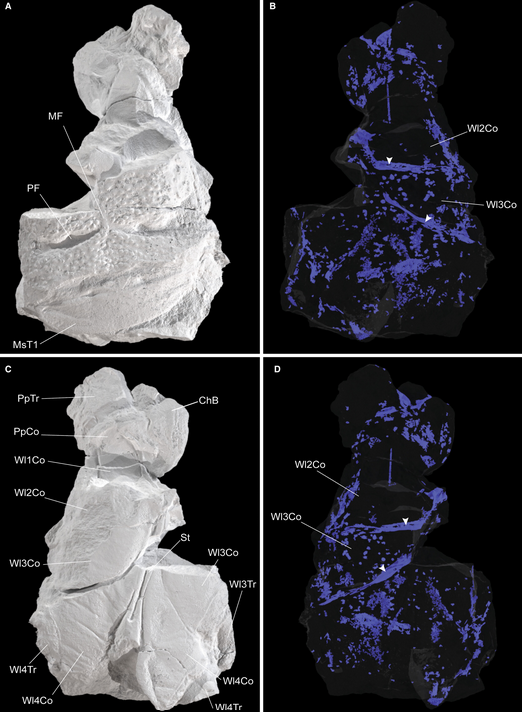
CT scans of Praearcturus gigas (NHMUK PI). Credit: Howard et al. 2026
One of the central arguments that Praearcturus was a crustacean is based on its lack of scorpion features, including a sting and comb-like sensory structures called pectines. However, the body parts where these structures would have been located are not preserved in any of the specimens, thus their absence means nothing.
It would be like me looking at a skeleton and saying, ‘Ah, but this person was clearly bald in life because they have no hair.’ Meanwhile, the skeleton we are discussing only has preserved feet and hands; of course, it has no hair!
However, Praearcturus preserves a sternum very similar to that of Eramoscorpius, a known scorpion that lived during the Silurian (443–419 million years ago). Beyond this, the researchers looked at the pincers. In crustaceans such as lobsters and crayfish, the outer pincer is fixed (does not move), while the inner pincer is movable. In scorpions, the opposite is true; the inner pincer is fixed, while the outer one is movable. Based on the morphology, Praearcturus had pincers like a scorpion, not a crustacean.
Another piece of evidence came from a set of parallel ridges located at the base of the pincer arm. In modern scorpions, this is a sound-producing structure that makes noise by rubbing it against things.
The evidence all pointed towards Praearcturus being a scorpion. Not only that, but while examining the other fossils, the researchers noted they were very similar to Praearcturus, so similar in fact that all six Brontoscorpio anglicus and Bennettarthra annwnensis were likely also Praearcturus scorpions.
The Largest Scorpions Ever
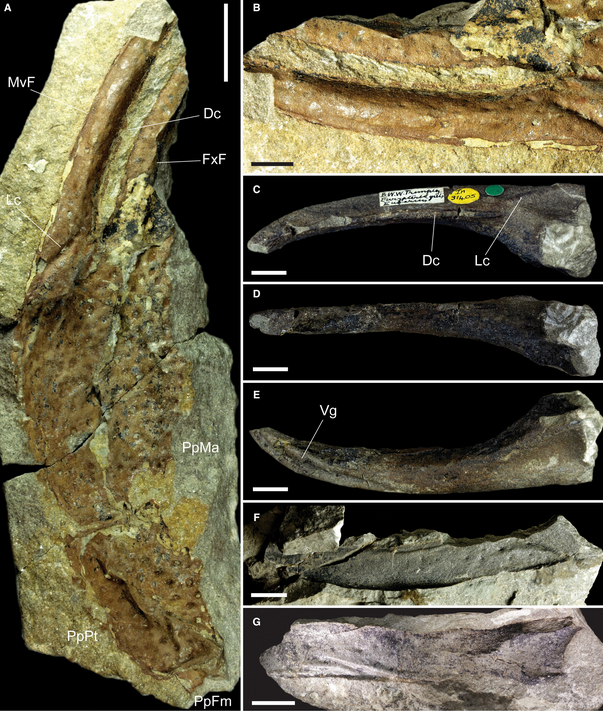
Pincers of Praearcturus gigas. Credit: Howard et al. 2026
Based on the results, P. gigas would have been the biggest scorpion to have ever lived. And I do mean big. This creature would have been more than a meter long, with pincers up to 16 cm long. That’s the same size as a 4-year-old!
The world in which these giants lived would have looked nothing like the lush forest that later giant arthropods lived in. In the early Devonian, plants were small and simple; they lacked leaves, proper roots, and tree-like forms. Additionally, no vertebrates existed on land yet.
Based on modern scorpions, it is likely that Praearcturus would have been a predator. The researchers suggest it evolved its massive size to fill a completely empty niche. Making it the only giant top terrestrial predator of its time. But what would it have hunted?
Most other arthropods at the time were tiny, with many measuring less than a centimeter. Unless it was eating truckloads of mini-arthropods, it must have had an alternative food source.
Praearcturus had a unique feature not seen in other scorpions but resembling something seen in some crustaceans, namely, wing-like side extensions. These wing-like body parts would have been useful in the water, leading the researchers to speculate that Praearcturus may have been able to swim, hunting freshwater prey such as sea scorpions and fish.
Being at least semi-aquatic would possibly also explain its massive size, as aquatic life can support larger body sizes more easily. Though it lacks some features, such as gnathobases, a jaw-like structure that exists in fully aquatic relatives, suggesting it lived a dual lifestyle, alternating between land and water.
It would also not be the first; other early scorpions, like Eramoscorpius, lived in the sea but could walk on land. Now the question is: was this an ancestral trait, indicating that scorpions had not yet fully transitioned to life on land, or was it a secondary adaptation, in which a fully terrestrial scorpion ancestor returned to the water (like whales and dolphins)?
A recent study has identified a group of highly contentious fossils as ancient scorpions, including the largest scorpions ever to have lived, reaching lengths of up to 1 meter. Based on their fossils, it is possible these scorpions could swim, hunting on land and in the water.
Thank goodness they are extinct; otherwise, I would never touch another body of water again.
Do you think these were scorpions or crustaceans, and what do you think led to them growing to such massive sizes?
Let me know your thoughts, and if you’d like to support the countless hours I pour into researching, writing, and bringing these hidden corners of history to life, why not Buy Me A Coffee
Reference
Howard, R.J., Garwood, R.J., Edgecombe, G.D. and Legg, D.A. (2026), A revision of Praearcturus gigas: a giant scorpion from the Lower Devonian (Lochkovian) of Britain. Palaeontology, 69: e70064. https://doi.org/10.1111/pala.70064
Published in Fossils et al. **Follow **to learn more about Paleontology.
메타데이터
- post_id
- 6b4bff099e89
- slug
- the-largest-scorpion-that-ever-lived-was-the-size-of-a-4-year-old-6b4bff099e89
- url
- https://medium.com/fossils-et-al/the-largest-scorpion-that-ever-lived-was-the-size-of-a-4-year-old-6b4bff099e89
- canonical_url
- https://medium.com/fossils-et-al/the-largest-scorpion-that-ever-lived-was-the-size-of-a-4-year-old-6b4bff099e89
- author_url
- https://medium.com/@sandeeoster17
- status
- ok
- fetched_at
- 2026-06-12 07:40:50