How E-Commerce Scraping Services Help Brands Track MAP Policy Violations
Brands use e-commerce scraping services to automatically monitor online prices across marketplaces, retailer websites, and reseller stores…
How E-Commerce Scraping Services Help Brands Track MAP Policy Violations
How E-Commerce Scraping Services Help Brands Track MAP Policy Violations
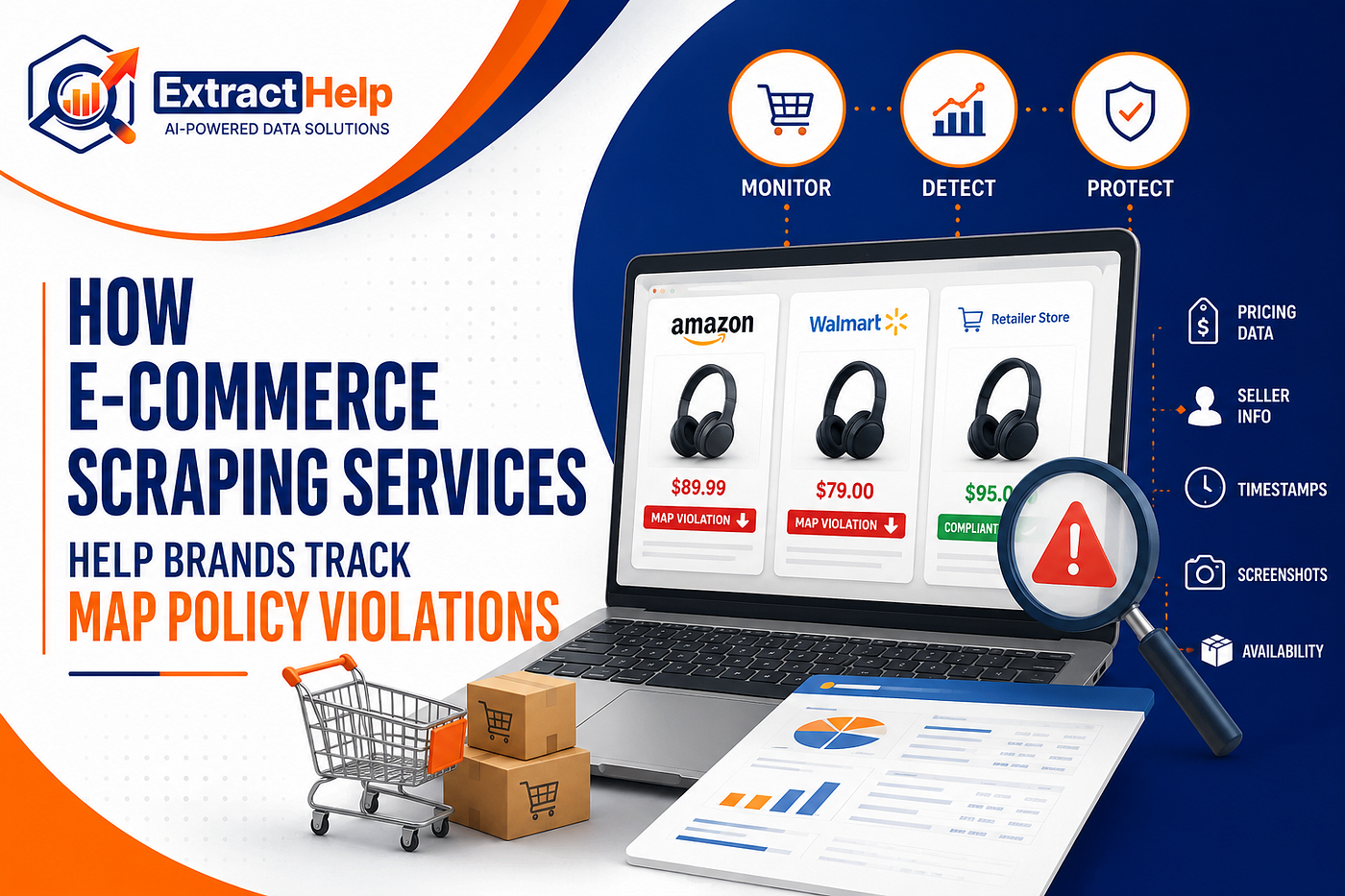
Brands use e-commerce scraping services to automatically monitor online prices across marketplaces, retailer websites, and reseller stores, making it easy to detect Minimum Advertised Price (MAP) policy violations before they spread. Instead of manually checking hundreds or thousands of product listings, automated scraping collects pricing data, seller information, timestamps, screenshots, and product availability in real time. This allows brands to identify unauthorized discounts, enforce MAP agreements consistently, protect profit margins, and maintain a healthy relationship with authorized retailers.
What Is a MAP Policy?
A Minimum Advertised Price (MAP) policy is a pricing agreement between a manufacturer or brand and its authorized retailers. It defines the lowest price at which a product can be advertised publicly.
MAP policies don’t prevent retailers from selling below that price privately. Instead, they restrict how products are advertised across online channels.
For example:
- MAP Price: $299
- Retailer A advertises the product for $299 (compliant)
- Retailer B advertises it for $279 (MAP violation)
Even a handful of violations can quickly trigger price wars, reduce retailer confidence, and weaken a brand’s perceived value.
That’s why brands need continuous monitoring instead of occasional manual checks.
Why Manual MAP Monitoring Doesn’t Scale
Many brands sell hundreds or thousands of SKUs across:
- Amazon
- Walmart Marketplace
- eBay
- Shopify stores
- WooCommerce websites
- Regional online retailers
- Distributor websites
- Price comparison portals
Imagine monitoring:
- 3,000 SKUs
- Across 180 retailers
- Updated 4 times per day
That equals more than 2.1 million price checks every day.
No internal team can manually verify that amount of information while maintaining accuracy.
This is where e-commerce scraping services become essential.
How E-Commerce Scraping Services Detect MAP Violations
Web scraping automatically visits websites, extracts product information, and organizes it into structured datasets.
Instead of opening websites one by one, automated systems scan hundreds of stores simultaneously.
Typical data collected includes:
- Product title
- SKU
- UPC or EAN
- Advertised price
- Sale price
- Coupon availability
- In-cart pricing (where possible)
- Seller name
- Marketplace
- Product URL
- Timestamp
- Screenshot evidence
- Product availability
This information is then compared against the brand’s official MAP price list.
Whenever pricing falls below the approved threshold, the system flags the listing immediately.
Monitoring Multiple Marketplaces from One Dashboard
Price violations rarely happen on a single website.
A reseller may advertise below MAP on:
- Amazon
- Walmart
- eBay
- Google Shopping
- Shopify stores
- Independent retailer websites
Without automation, these violations remain hidden until customers — or authorized dealers — notice them.
A scraping solution centralizes monitoring so pricing data from multiple channels appears in one dashboard.
For example:
MarketplaceProducts CheckedViolations FoundAmazon12,500148Walmart8,70062eBay6,40097Shopify Stores9,800131
Brand managers immediately know where enforcement should begin.
Catching Hidden Discounts
Many sellers understand MAP policies.
Instead of lowering the advertised price directly, they use hidden discounts such as:
- Coupon codes
- “Add to Cart to See Price”
- Instant rebates
- Bundle discounts
- Checkout promotions
- Loyalty pricing
Basic monitoring tools often miss these pricing tricks.
Advanced scraping systems simulate customer interactions to uncover pricing that isn’t immediately visible on product pages.
This provides a much clearer picture of actual advertised pricing.
Identifying Unauthorized Sellers
Price violations frequently originate from unauthorized sellers rather than approved distributors.
Scraping helps brands collect seller-level information such as:
- Store name
- Marketplace seller ID
- Business website
- Contact information (where publicly available)
- Product catalog
- Geographic location
Example:
A consumer electronics brand monitored 420 sellers and discovered that 37 unauthorized retailers were responsible for more than 70% of all MAP violations.
Rather than contacting hundreds of stores, enforcement focused only on repeat offenders.
Building Reliable Evidence for Enforcement

Building Reliable Evidence for Enforcement
Price monitoring alone isn’t enough.
Brands also need evidence when contacting retailers or legal teams.
Modern scraping solutions automatically capture:
- Product URLs
- Timestamped screenshots
- Advertised price
- Seller information
- Marketplace details
- Historical pricing
Instead of saying,
“Your listing violated MAP.”
Brands can provide documentation like:
- Product: Wireless Noise-Canceling Headphones
- Seller: ABC Electronics
- Advertised Price: $239
- Approved MAP: $279
- Date: March 18, 2026
- Marketplace: Amazon
- Screenshot Attached
This significantly strengthens compliance discussions.
Historical Price Tracking Reveals Patterns
Not every violation is accidental.
Some sellers repeatedly reduce prices during weekends, holidays, or promotional events.
Historical price tracking helps identify:
- Repeat offenders
- Seasonal pricing trends
- Flash-sale abuse
- Long-term pricing behavior
- Marketplace-specific issues
For example:
A sporting goods manufacturer monitored pricing for 14 months.
Historical analysis showed that 82% of MAP violations occurred during holiday promotions, allowing the compliance team to increase monitoring frequency before major shopping events.
Faster Monitoring Means Faster Action
Price violations spread quickly.
If one retailer drops pricing below MAP, competitors often respond within hours.
Automated scraping can monitor listings:
- Every hour
- Every 30 minutes
- Several times per day
- Continuously for high-priority products
Example workflow:
8:15 AM Retailer advertises below MAP.
↓
8:20 AM Scraper detects pricing change.
↓
8:22 AM Alert sent to compliance team.
↓
9:00 AM Retailer receives warning.
Instead of discovering violations days later, brands can react before widespread pricing erosion occurs.
Supporting Large Product Catalogs
Enterprise brands often manage:
- 5,000 SKUs
- 20,000 SKUs
- 100,000+ SKUs
Scaling manual monitoring becomes impossible.
Modern scraping infrastructure easily handles:
- Millions of product pages
- Thousands of sellers
- Hundreds of websites
- Daily updates
For example, a monitoring project may scrape:
- 52,000 product pages
- Across 320 retailer websites
- Every 12 hours
while maintaining 99%+ structured data accuracy.
Integrating MAP Monitoring with Business Intelligence

Integrating MAP Monitoring with Business Intelligence
Raw data becomes far more valuable when connected to reporting systems.
Brands often integrate scraped data with:
- Power BI
- Tableau
- Google Looker Studio
- Excel dashboards
- Internal ERP systems
- CRM platforms
This allows compliance teams to visualize:
- Daily violations
- Seller rankings
- Marketplace performance
- Violation frequency
- Regional pricing differences
Decision-makers no longer rely on spreadsheets alone.
How ExtractHelp Supports MAP Monitoring
Brands looking for scalable monitoring often partner with specialized data providers instead of building complex scraping infrastructure internally.
ExtractHelp’s web scraping services can collect pricing data from marketplaces, retailer websites, and distributor catalogs, delivering clean, structured datasets within 24–72 hours and maintaining 99%+ data accuracy. Whether you need daily monitoring or ongoing compliance tracking, their team can tailor extraction workflows to your product catalog. web-scraping
For companies that require automated reporting, ExtractHelp can also integrate scraped pricing data into existing dashboards and workflows, reducing manual effort while helping compliance teams act faster. **web-scraping**
Brands with large catalogs often combine MAP monitoring with ExtractHelp’s data enrichment and workflow automation services to identify sellers, standardize product data, and streamline enforcement processes.**web-scraping**
Best Practices for Effective MAP Monitoring
To get the most value from e-commerce scraping services, follow these best practices:
Monitor Frequently
Run scans several times each day for high-demand products.
Frequent monitoring catches short-lived promotions before they disappear.
Track Every Marketplace
Don’t focus only on Amazon.
Independent retailers often create the biggest pricing issues.
Capture Visual Evidence
Always save screenshots alongside pricing data.
Evidence simplifies retailer communication.
Maintain Historical Records
Store pricing history for trend analysis and repeat offender detection.
Prioritize High-Risk Products
Premium products with high margins usually require the closest monitoring.
Automate Alerts
Notify compliance teams immediately whenever prices fall below MAP.
Fast action prevents wider pricing disruption.
Build vs. Outsource: Which Approach Makes More Sense?
Some enterprise companies develop their own scraping systems.
However, maintaining them requires:
- Developers
- Proxy infrastructure
- Browser automation
- CAPTCHA handling
- Website maintenance
- Ongoing monitoring
Outsourcing to an experienced provider often reduces implementation time while giving access to scalable infrastructure and dedicated support.
For many brands, partnering with a specialized web scraping company is more cost-effective than building and maintaining a custom solution internally.
The Business Impact of Automated MAP Monitoring
Brands that consistently monitor pricing often see measurable improvements beyond policy compliance.
Common benefits include:
- Faster identification of pricing violations
- Better relationships with authorized retailers
- Reduced unauthorized discounting
- Stronger brand perception
- Improved pricing consistency across sales channels
- Better visibility into reseller behavior
- More efficient compliance workflows
- Data-driven enforcement decisions
Rather than reacting after prices have already dropped across multiple marketplaces, brands can proactively detect issues, document violations, and respond before pricing problems escalate.
Final Thoughts
MAP policy enforcement is only effective when it’s backed by accurate, timely data. As brands expand across marketplaces, retailer websites, and reseller networks, manual monitoring becomes too slow and inconsistent to keep up. E-commerce scraping services provide continuous visibility into advertised prices, helping businesses identify violations quickly, gather reliable evidence, and take action before pricing issues affect margins or brand reputation.
By combining automated data collection with actionable reporting, brands can maintain pricing consistency, strengthen relationships with authorized retailers, and make smarter compliance decisions. Whether you’re monitoring a few hundred products or a catalog of thousands of SKUs, the right scraping solution turns MAP enforcement from a reactive task into a proactive strategy for protecting long-term brand value.
메타데이터
- post_id
- 6b5bb7bf47fd
- slug
- how-e-commerce-scraping-services-help-brands-track-map-policy-violations-6b5bb7bf47fd
- url
- https://medium.com/@ProductScraping/how-e-commerce-scraping-services-help-brands-track-map-policy-violations-6b5bb7bf47fd
- canonical_url
- https://medium.com/@ProductScraping/how-e-commerce-scraping-services-help-brands-track-map-policy-violations-6b5bb7bf47fd
- author_url
- https://medium.com/@ProductScraping
- status
- ok
- fetched_at
- 2026-07-29 08:09:57