Johnny Depp Lost $650M — Here’s Exactly Where It Went
The Pirates of the Caribbean star earned more money than most countries’ GDP and handed every dollar to a business manager he’d never…
Johnny Depp Lost $650M — Here’s Exactly Where It Went
The Pirates of the Caribbean star earned more money than most countries’ GDP and handed every dollar to a business manager he’d never signed a contract with.
Watch full video >> https://youtu.be/_DQNxYZbNfs?si=6p4610-hhOrbH0mO
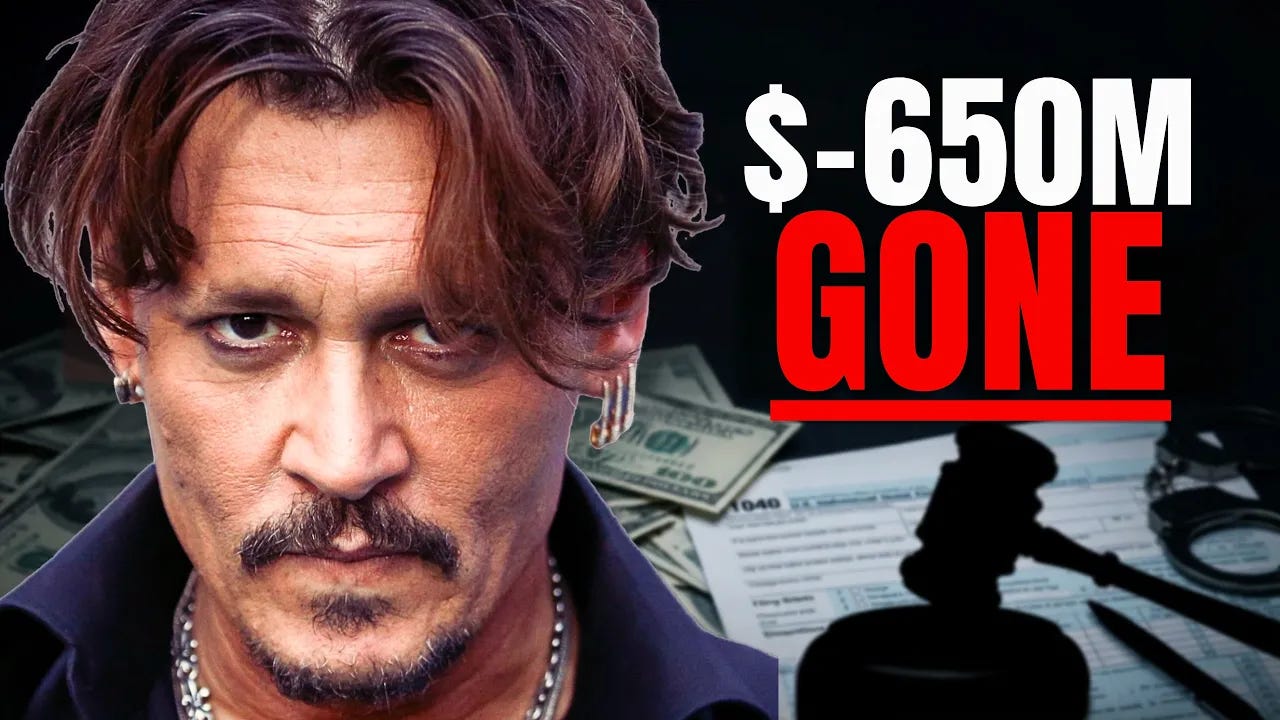
Johnny Depp earned more than $650 million during a single decade at the top of Hollywood. Forbes ranked him the world’s highest-paid actor in 2006, 2007, 2010, and 2012. Guinness World Records certified the numbers. Pirates of the Caribbean alone generated over $265 million for him personally.
By his mid-fifties, nearly all of it was gone.
This isn’t a story about celebrity recklessness, though the wine and the yachts and the 153-foot cannon make for good copy. It’s a story about what happens when a franchise-scale earner signs every financial decision over to a five-percent handshake arrangement — and doesn’t look at a single document for 17 years.
The $650 Million Handshake
In 1999, Depp brought brothers Joel and Robert Mandel into his financial life. Their firm, The Management Group — known around Hollywood as TMG — handled everything: taxes, investments, loans, monthly bills. Joel Mandel ran Depp’s accounts day-to-day.
There was no written contract. Just a handshake and a five-percent commission.
That arrangement lasted 17 years.
During that window, the money was genuinely extraordinary:
- Pirates of the Caribbean 1: $10 million flat (no backend — Disney wasn’t sure the film would work)
- Pirates 2: ~$60 million total (base salary plus backend)
- Pirates 3: ~$50–55 million
- Pirates 4: ~$55 million (leaked emails confirmed $35M base plus $20M in bonuses)
- Alice in Wonderland: ~$55 million, almost entirely from backend on a billion-dollar film
- Additional films: Charlie and the Chocolate Factory ($18M), Public Enemies, The Tourist, Transcendence ($20M each), The Rum Diary ($15M)
TMG’s own sworn court filings put his total earnings during their tenure at more than $650 million. Rolling Stone writer Stephen Rodrick summed it up in the line everyone now quotes: “650 million on films that netted 3.6 billion. Almost all of it is gone.”
$2 Million a Month: The Spending Breakdown
TMG’s court filings stated that Depp “lived an ultra-extravagant lifestyle that often knowingly cost Depp in excess of two million dollars a month to maintain, which he simply could not afford.”
Here’s what that actually looked like:
Monthly operating costs:
- Personal staff (roughly 40 employees): $300,000/month ($3.6M annually)
- Around-the-clock security: $150,000/month
- Private Gulfstream GV operation: $200,000/month
- Addiction specialist costs: $100,000/month
- Wine: $30,000/month (Depp disputed this figure — not downward. He told Rolling Stone: “It’s insulting to say I spent $30,000 on wine. Because it was far more.”)
TMG offered their own editorial on the subject: “Wine is not an investment if you drink it as soon as you buy it.”
Real estate — 14 properties totaling roughly $75 million:
- Five penthouses in the Eastern Columbia Building, downtown LA: $7.2M
- 37-acre estate in Provence, France (12–15 buildings, $10M+ in restoration alone)
- Little Hall’s Pond Cay, a 45-acre private island in the Bahamas: $3.6M (purchased on Marlon Brando’s advice)
- A horse farm in Kentucky for his mother
- A mansion in Somerset, England: $15.8M
- A 156-foot yacht, the Vajoliroja, named for his children: $18–30M depending on the estimate
The collection:
- 200+ artworks, including Basquiats, Warhols, and Klimts
- 70 collectible guitars
- 45 luxury vehicles
- 12 storage facilities packed with Hollywood memorabilia
And then there was the Hunter S. Thompson funeral. When his close friend died in August 2005, Depp arranged for Thompson’s ashes to be fired from a 153-foot cannon shaped like a double-thumbed fist at his Owl Farm property. John Kerry, Jack Nicholson, Bill Murray, and Sean Penn watched. TMG put the cost at $3 million. Depp told Rolling Stone it was $5 million — and the reporter noted that Depp “seemed to be bullshitting” about the higher number.
The Tax Problem Nobody Talks About Correctly
When Depp fired TMG in March 2016 and new business manager Edward L. White took over, White’s findings were alarming.
Depp testified under oath during his 2020 UK libel trial that his first real look at his own finances — in April 2016 — revealed that taxes had not been paid on his behalf for 17 years and that his IRS debt stood at $100 million. That number comes only from his sworn testimony; no public IRS document corroborates it.
What court records do document is specific: tax attorney Miriam L. Fisher filed a declaration itemizing $5.7 million in IRS penalties and interest spanning tax years 2000 through 2014, plus an additional $336,000 in interest for 2015. Her filing accused TMG of leaving Depp’s taxes “in the hands of a CPA in training” and filing late for 13 consecutive years. The Hollywood Reporter placed total penalties and interest even higher, at $8.3 million.
Here’s where a popular myth needs correcting. Despite widespread references to “federal tax liens” against Depp’s properties, no reporter has located a publicly recorded IRS Notice of Federal Tax Lien in the Los Angeles County Recorder’s office.
The encumbrances actually filed against Depp’s properties were civil and commercial — primarily a $5 million bridge loan from TMG itself, secured by deeds of trust on five of his LA properties, plus separate City National Bank deeds of trust.
That distinction matters. The IRS didn’t almost take Johnny Depp’s homes. His own business managers did — lending him money at interest while simultaneously failing to file his taxes for over a decade.
The Lawsuits: Depp vs. TMG
On January 13, 2017, Depp filed a $25 million complaint against TMG alleging professional negligence, breach of fiduciary duty, and fraud. His lawyers argued TMG collected roughly $28 million in commissions without a written contract, violating California’s Talent Agencies Act.
Additional allegations included unauthorized loans — approximately $7 million to Depp’s sister Christi Dembrowski and $750,000 to his assistant Nathan Holmes — all while failing to pay taxes on time.
TMG’s cross-complaint was a masterpiece of corporate self-defense. Their filing argued that Depp suffered from a “compulsive-spending disorder” and that TMG “did everything within its power over the last 17 years to protect Depp from himself and to keep Depp financially solvent.” The real problem, they insisted, was that “TMG did not have the power or ability to control Depp’s spending or his numerous other vices.”
The financial engineering that kept things afloat tells its own story:
- A $5 million City National Bank loan defaulted in late 2012; TMG covered it with their own bridge loan
- In 2014, attorney Jake Bloom arranged a $12.5 million hard-money loan at 10% interest, secured against Depp’s profit participation in Pirates and Alice
- Rolling Stone tallied $34 million in total loans taken in Depp’s name
- On November 6, 2017, TMG filed for judicial foreclosure to seize Depp’s Los Angeles homes
A confidential settlement arrived in July 2018, weeks before trial. A separate $30 million malpractice suit against Bloom settled in October 2019.
The liquidation that followed:
- Five LA penthouses (bought for $7.2M) sold for roughly $12.8M — a modest gain that went straight to debt service
- Nine Basquiat paintings sold at Christie’s London in June 2016 for approximately $13.7 million
- The Kentucky horse farm’s January 2018 auction collapsed when the top bid ($1.4M from radio DJ Rick Dees) was rejected
- The Provence estate listed at $26M in 2015, then $55.5M in 2022, with no confirmed sale
The Heard Trials and the Career Cost
While Depp was unwinding his financial crisis with TMG, a parallel legal war was burning through what remained — and destroying his most valuable asset: his market value.
UK trial (2020): Depp sued The Sun over its “wife beater” headline. Justice Andrew Nicol ruled against him in a 585-paragraph judgment. Legal fees: approximately $6.4 million, with Depp ordered to cover much of the newspaper’s defense costs.
Four days after that ruling, Warner Bros. asked Depp to resign from Fantastic Beasts. His pay-or-play contract had no morality clause, so he collected his full $16 million salary for shooting a single scene — one of the most expensive firings in Hollywood history.
Forbes had already named Depp the “Most Overpaid Actor” in both 2015 and 2016, calculating just $2.80 in box-office return per dollar of salary. His former agent Tracey Jacobs — who represented him at UTA for nearly three decades before being let go in 2016 — gave videotaped testimony that played at trial: “His star had dimmed due to it getting harder to get him jobs given the reputation that he’d acquired due to his lateness and other things.” She described crews waiting hours for him to arrive on set. She described him being fed his lines through an earpiece.
Virginia trial (2022): Depp filed a $50 million suit over Amber Heard’s Washington Post op-ed about domestic violence — which never named him but was widely understood to reference him. Heard countersued for $100 million.
The jury awarded Depp $10 million in compensatory damages and $5 million in punitive damages. Judge Azcarate reduced the punitive award to $350,000 under Virginia’s statutory cap, bringing the total to $10.35 million. Heard collected $2 million on one counterclaim, leaving Depp with a net of $8.35 million — before his own legal fees, estimated above $5 million.
The most financially significant testimony came from talent manager Jack Whigham, who told the jury that Depp had a verbal agreement worth $22.5 million for Pirates 6 — a deal that evaporated after Heard’s op-ed. On cross-examination, Whigham conceded the figure never made it to paper.
Asked what the allegations cost him, Depp answered: “Nothing less than everything.”
When Heard’s attorney pressed him on whether any amount would get him back to Pirates — “$300 million and a million alpacas” — Depp replied: “That is true, Mr. Rottenborn.”
Settlement came December 19, 2022. Heard agreed to pay $1 million from her homeowner’s insurance. Depp gave the full amount to five charities.
The Comeback
Dior never dropped Depp through either trial. In May 2023, Variety reported he signed a three-year renewal for the Sauvage campaign worth more than $20 million — reportedly the largest men’s fragrance deal in history, ahead of Robert Pattinson’s $12 million Dior Homme deal and Brad Pitt’s $7 million Chanel arrangement.
He opened the 2023 Cannes Film Festival as Louis XV in Maïwenn’s Jeanne du Barry to a seven-minute standing ovation. His directorial film Modì: Three Days on the Wing of Madness premiered at San Sebastián in September 2024. Lionsgate’s Day Drinker, an action thriller co-starring Penélope Cruz directed by Marc Webb, shot through late 2025 and marked Depp’s first studio lead since Fantastic Beasts 2 in 2018.
His art print series — portraits of Dylan, Pacino, Richards, and Taylor through Castle Fine Art — grossed over $3.6 million in July 2022 and another $3.7 million in a 2023 follow-up. Touring with the Hollywood Vampires alongside Alice Cooper and Joe Perry kept additional income flowing.
Net worth aggregators now place Depp at approximately $150 million as of 2026. A real recovery. Still less than a quarter of what he earned during the TMG years.
The Actual Lesson
“I just had no clue. I trust these people.” — Johnny Depp
Four words. Roughly half a billion dollars, two franchises, and six years in court.
Depp’s financial collapse wasn’t a morality tale about celebrity excess, though the excess was real in every direction. What actually happened is structurally simple: an actor at the top of the industry’s earnings charts delegated every financial decision to a handshake arrangement and never examined what he signed for 17 years.
The popular version of this story — federal liens, the IRS almost seizing his homes — turns out to be less dramatic than the truth. No federal agency nearly took his properties. His own business managers did that, extending bridge loans at interest while simultaneously failing to file his taxes for over a decade. The actual record is messier, more ordinary, and considerably more damning.
Every number in this story is documented: the $650 million TMG counted, the $2 million monthly burn rate, the $34 million in loans, the $16 million payout for one scene, the $8.3 million in tax penalties. What isn’t documented is the cleaner version people prefer to tell.
The wine was real. The cannon was real. The 45-acre Bahamian island was real. And so was the seventeen-year handshake that made all of it possible — and eventually made all of it gone.
Enjoyed this breakdown? Follow for weekly deep dives into the financial stories behind Hollywood’s biggest names.
메타데이터
- post_id
- 6b69579c1405
- slug
- johnny-depp-lost-650m-heres-exactly-where-it-went-6b69579c1405
- url
- https://medium.com/@backstagehollywood/johnny-depp-lost-650m-heres-exactly-where-it-went-6b69579c1405
- canonical_url
- https://medium.com/@backstagehollywood/johnny-depp-lost-650m-heres-exactly-where-it-went-6b69579c1405
- author_url
- https://medium.com/@backstagehollywood
- status
- ok
- fetched_at
- 2026-06-10 21:21:38