When Touch Changes
What happens when we lose the ability to feel? It’s like losing part of our ability to see.
Experiencing Neuropathy
When Touch Changes
What happens when we lose the ability to feel? It’s like losing part of our ability to see.
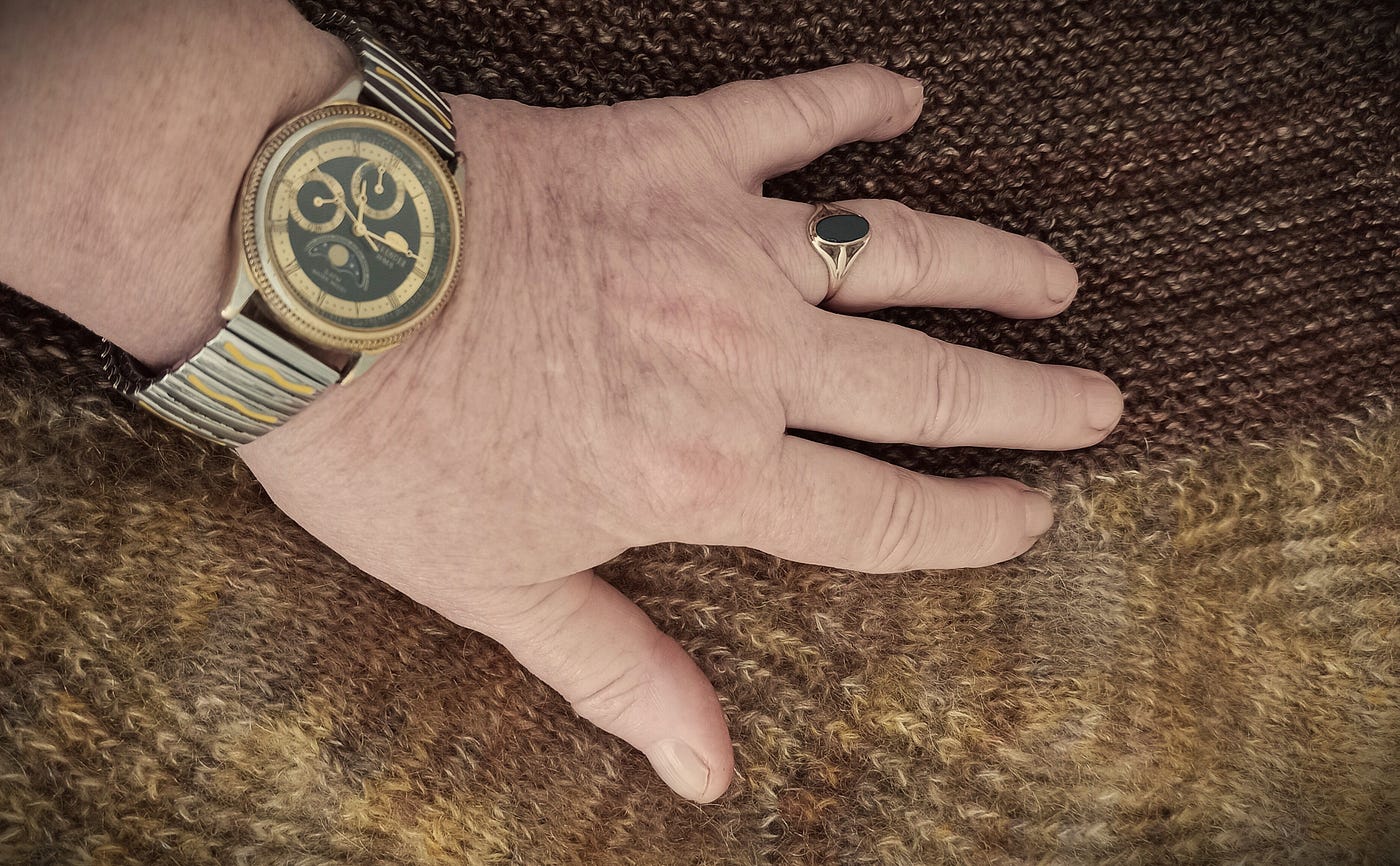
Photo of author’s hand and knitted scarf (photo by author)
We think that we navigate our environment by sight, but we don’t realise how much we rely on our sense of touch to experience the world.
One day my fingers felt like I had dipped them in glue. As if I had been fixing something and some of the glue stuck to my finger tips and dried. Except my hands were clean.
It was the beginning of neuropathy. I was six months in on my chemotherapy treatments, and the neuropathy was unexpected. At first it was annoying, then it became more concerning. I thought it was because I was taking some heavy-duty antibiotics for an infection that was unrelated to the breast cancer that I was being treated for. I thought that after I’d finished the antibiotics that it would disappear. Instead, it intensified and then my toes joined in.
At first it was just dullness, like there was a barrier between my fingertips and the outside world. After about a week I started to get the feeling like my fingers had “gone to sleep”. That tingling sensation when sleeping in an awkward position and the blood flow is blocked. But the tingling sensation never went away. On the worst days there were sharp stabbing pains that lanced into my fingers. They were momentary and left quickly, making me wonder what other sensations I might experience as the neuropathy progressed.
Meanwhile my feet felt cold and numb. A friend of mine describes it as waxy feet. It is as if my toes were encased in something that restricted their movement. Maybe that’s what those trendy running shoes that have divided spaces for toes feel like. The soles of my feet felt like they had thick leather pads, like the feet of an ostrich or a camel. They were at the same time numb and hypersensitive. Sometimes if felt as if I had a raw wound on my skin, but when I looked at my foot, it was fine. There were no abrasions or cuts, just the hurting sensation of an open sore.
My hands and feet felt cold, even though they were warm to the touch. I slept with socks on. Having my feet covered made them feel warmer. I tucked my hands under my arms in bed, trying to keep them warm. I debated sleeping with gloves on. I went to sleep with the idea that it would be better to sleep with my hands outstretched rather than closed in fists. I don’t know why, but I took on little superstitions.
One of the sensations I lost was the quality of texture. I spent my time knitting while I was getting chemo treatments. I figured the exercise would help my fingers. I was knitting with kid mohair blended with silk, one of the softest, finest fibres there is. But yet when I touched it, I could only feel the texture of the stitches, not the softness. If I closed my eyes, I wouldn’t have been able to tell if I was touching knitted mohair or burlap.
Neuropathy gave me problems trying to type and clicking the mouse. My fingers twitch and I double click when I meant to do it once. Touch screens on credit card readers were also difficult. I couldn’t feel how hard I was pushing and I either didn’t push hard enough for the number to register, or I pushed too hard and ended up producing multiple numbers.
I had to be careful when cooking because I had a muted sense of heat. I could easily touch a hot pan, or put my hands into scalding water and not realise it until too late. Smooth or slippery things were a challenge. Washing the dishes became an exercise in mindfulness. Suddenly I had to pay attention to my fine motor skills in a way that I hadn’t done in many years. It was like learning to use my hands all over again.
Fine motor skills were difficult and I worried that I wouldn’t be able to do jewellery work again, but I could at least knit and keep my fingers in motion. Maybe it helped, but it made me feel better that there was one skill that I could still perform.
For many years I made my living as a jeweller and gem cutter. I was used to doing fine detail work. Later, I went of to get degrees in archaeology, specializing in Bronze Age metalworking. I learned to work with ancient tools and techniques, making jewellery, and replicating the ancient tools I used to make it.
About the time I was working on my master’s degree, someone published a theory that early metalsmiths employed children to do the fine filigree work that is seen in Anglo Saxon jewellery. Their reasoning was that adult vision is too poor to see such fine detail. It was a hairbrained theory proposed by people who had never done that sort of work, but it got a lot of press in the BBC and the Guardian.
There are children who work in the jewellery industry in many countries, but for the most part they are cutting small crudely faceted gems that get pasted into costume jewellery. Under magnification the work looks terrible, but the kids are learning and developing their fine motor skills. The finely done detail work and the perfectly faceted gems are made by adults who grew up doing that work as children.
And anyone who has worked as a jeweller will tell you that seeing with your eyes is only a part of the work.
Chasing is a technique where a chisel is hammered while guiding it along the surface of metal in order to create an incised design. I enjoyed doing that work, and relied on my hands to guide the chisel the way it needed to go. I didn’t need to focus my eyes on the work. Instead, I could look ahead to where the chisel needed to go next. Often, my fingers or tools would be in the way and obstruct my view of what I was working on. I needed to rely on my sense of touch in order to know what was happening.
There were many times when I felt as if the tools were doing the work and I was just along for the ride. In his book, The Craftsman, Richard Sennet describes this as a feedback loop, where the fingers sense changes, and in concert with the brain they respond and correct what they are doing without the artisan consciously thinking about it. Now, with the neuropathy, I lost this fine sensation. I had to think consciously about all the signals that normally went directly from my fingers to my brain.
I remember reading about leprosy as an archaeology student. The reason people lost their fingertips and toes wasn’t because of the disease, it was because nerve damage left them without feeling in their extremities. Without the sense of touch, fingers get burned, toes stubbed, small cuts go unnoticed and infections set in. Rebecca Solnit wrote about leprosy in her book The Faraway Nearby, describing patients, who without the sense of touch felt divorced from their hands and feet, as if they were artificial prosthetics or tools they could use, but were not a part of their body. They had no sense of self protection.
The sense of touch creates a boundary between ourselves and the rest of physical reality. My fingers tell me that I am touching something that is not part of me, that I am touching something else in the external world.
When I touched my arm with my neuropathic fingers, my fingers felt as if I was touching someone else, but yet the skin of my arm registered the touch of my fingers. They could tell it was a smooth, yielding surface, but little else. There was an odd disconnect. It was as if I was simultaneously touching and not touching my arm.
Throughout the experience, I was examining and evaluating my neuropathy. While one part of me was dispassionately analysing it, another part of me worried if my nerves could reconnect themselves. Would I recover? Was this now a permanent condition? Or would this be an intermittent thing that might come and go with the change of seasons, or recur in times of stress?
The neuropathy is slowly fading. About three weeks after my last chemotherapy treatment, the tingling in my little fingers lessened a little. Bit by bit, my fingers started to feel more normal, ending with my thumbs. I can feel the softness of my knitting again and I am feeling more physically connected. I am sure the constant movement of my fingers helped speed my recovery. Still, the recovery is not a continuous progression. Some days it’s two steps forward and one step back, but I am glad for every day that my sense of touch improves.
Books Cited
Sennett, R. 2008. The Craftsman, London, Penguin Books.
Solnit, R. 2014. The Faraway Nearby Penguin Books
메타데이터
- post_id
- 6b7dd33b5166
- slug
- when-touch-changes-6b7dd33b5166
- url
- https://medium.com/never-stop-writing/when-touch-changes-6b7dd33b5166
- canonical_url
- https://medium.com/never-stop-writing/when-touch-changes-6b7dd33b5166
- author_url
- https://medium.com/@gfregni
- status
- ok
- fetched_at
- 2026-06-13 16:00:06