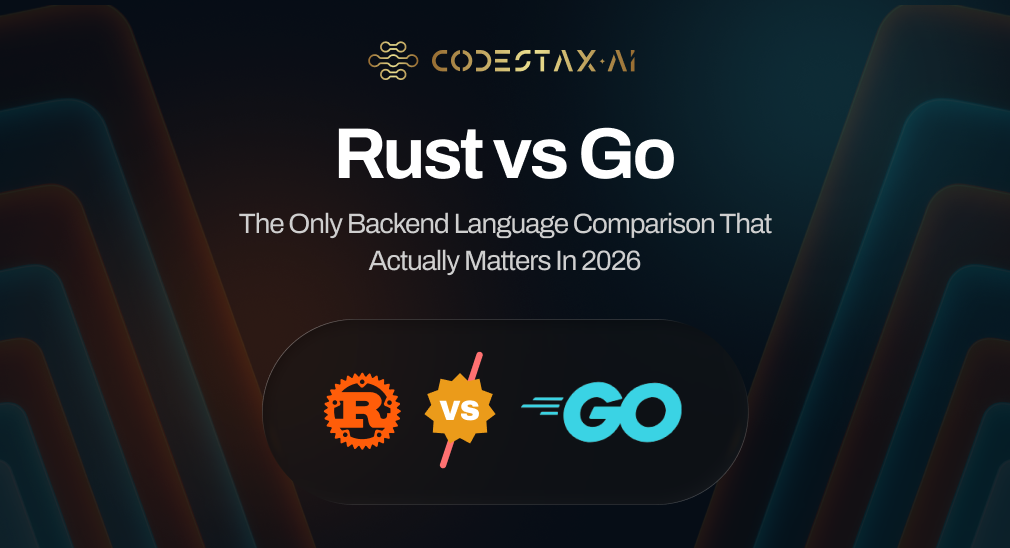
Rust vs Go: The Only Backend Language Comparison That Actually Matters in 2026
The Wall You Eventually Hit
Rust vs Go: The Only Backend Language Comparison That Actually Matters in 2026
The Wall You Eventually Hit
Every backend system hits a wall.
At first, everything feels fine.
You spin up services, deploy to AWS, wire up queues, maybe add a scheduler, scale horizontally — things just work. Your APIs respond fast enough, your team ships features quickly, and your infra bill is acceptable.
Then growth happens.
- Traffic increases
- Latency spikes in weird places
- Costs start climbing faster than usage
- Debugging gets harder
- Small inefficiencies compound into real problems
And suddenly, the question changes.
It’s no longer:
“How fast can we build this?”
It becomes:
“How do we keep this system predictable, efficient, and scalable without slowing the team down?”
That’s where the Go vs Rust decision actually starts to matter.
Not at the beginning, but right when you hit that wall.
The Modern Backend Reality (AWS in the Center)
Today’s backend systems are not single services.
They are orchestrations.
A typical production system looks something like this:
- API layer (behind API Gateway / ALB)
- Compute (ECS / EKS / Lambda)
- Messaging (SQS / Kafka)
- Storage (RDS / DynamoDB)
- Observability (CloudWatch / Open Telemetry)
- Background jobs (Schedulers, cron, event-driven workers)
Everything runs on AWS (or another similar cloud provider), and everything is:
- distributed
- concurrent
- failure-prone by default
Which means your language choice affects:
- how efficiently services run inside containers
- how predictable your concurrency is
- how costly your scaling becomes
- how easy it is for teams to reason about failures
Where Go Fits in This Orchestration
Go became the default for a reason.
It fits naturally into this AWS-first architecture.
Typical Go-heavy system
- REST/gRPC services running on ECS/EKS
- Workers consuming from SQS
- Lightweight background jobs
- Internal tooling and CLIs
- Kubernetes operators
Why it works:
- fast startup times → great for containers
- low memory footprint → better cost efficiency
- simple concurrency → easy parallel processing (SQS consumers, fan-out workers)
- minimal cognitive load → teams move fast
Example scenario:
You have an SQS queue processing appointment updates.
In Go:
- spin up multiple goroutines per worker
- process messages concurrently
- scale horizontally via ECS
No deep threading model knowledge needed.
That’s why Go dominates service orchestration layers.
Where Rust Enters the System
Rust doesn’t usually replace Go.
It shows up where the system starts struggling.
Heavy-lifting components
These are the parts of your system where:
- CPU usage spikes
- latency matters deeply
- memory efficiency becomes critical
- cost scales with inefficiency
Typical examples:
- real-time data processing pipelines
- streaming systems
- high-throughput message processors
- fraud detection engines
- media/voice processing systems
- edge compute workloads
In AWS terms:
- Lambda functions where cold start + memory matters
- high-throughput consumers reading from Kinesis/Kafka
- compute-heavy services running in ECS with tight CPU limits
Real-World Patterns (How Teams Actually Use Both)
Pattern 1: Service Layer in Go, Hot Path in Rust
A common architecture:
Go handles:
- APIs
- orchestration
- service-to-service communication
Rust handles:
- CPU-heavy processing
- performance-critical pipelines
This avoids over-engineering while still optimizing where it matters.
Pattern 2: Cost Optimization at Scale
As systems scale:
- Go services are “fast enough”
- but resource usage starts adding up
Rust is introduced to:
- reduce memory footprint
- increase throughput per instance
- lower infra cost
Especially relevant in:
- high-scale SQS/Kafka consumers
- data aggregation pipelines
Pattern 3: Latency-Sensitive Systems
Some systems cannot tolerate unpredictability:
- voice/video processing
- financial systems
- real-time analytics
Here, Rust’s:
- no GC pauses
- predictable execution
- tighter control
becomes a necessity, not an optimization.
Philosophy: Why These Languages Behave Differently
Everything comes back to this.
Go: Move Fast, Keep It Simple
Go assumes:
- most systems don’t need extreme optimization
- developer time is more expensive than CPU time
- consistency matters more than flexibility
Result:
- fast development
- easy onboarding
- predictable codebases
Rust: Control Everything That Matters
Rust assumes:
- bugs in production are expensive
- performance inefficiency compounds at scale
- correctness should be enforced early
Result:
- stronger guarantees
- higher upfront cost
- better long-term predictability
Concurrency in Real Systems
Go in AWS workloads
Typical pattern:
- multiple goroutines per worker
- parallel API calls
- concurrent SQS/Kafka consumption
Example mental model:
“Spin up more workers and let the runtime handle it.”
Rust in heavy pipelines
Typical pattern:
- async runtime (Tokio)
- controlled parallelism
- memory-aware processing
Example mental model:
“Be explicit about how work is scheduled and executed.”
Performance: What Actually Matters in Production
Let’s ground this.
Rust
- often 2–5× faster in CPU-bound workloads
- no garbage collection
- better memory efficiency
Go
- slightly slower in raw compute
- but predictable GC
- more than sufficient for most services
The real insight
Most systems are not CPU-bound.
They are:
- waiting on databases
- waiting on network
- waiting on other services
So:
Performance only matters in specific parts of your system.
And that’s exactly where Rust fits.
Ecosystem Reality
Go
- mature cloud-native ecosystem
- excellent AWS SDK support
- stable frameworks
- fewer decisions, faster progress
Rust
- Cargo + crates ecosystem has matured significantly
- strong async ecosystem (Tokio, Axum)
- growing adoption in backend systems
Bonus advantage:
- WebAssembly (WASM) support
- ideal for edge/serverless scenarios
Team Scaling
This is where many decisions are actually made.
Go teams
- easy onboarding
- readable code
- lower variance between engineers
Rust teams
- slower ramp-up
- higher skill requirement
- fewer production issues later
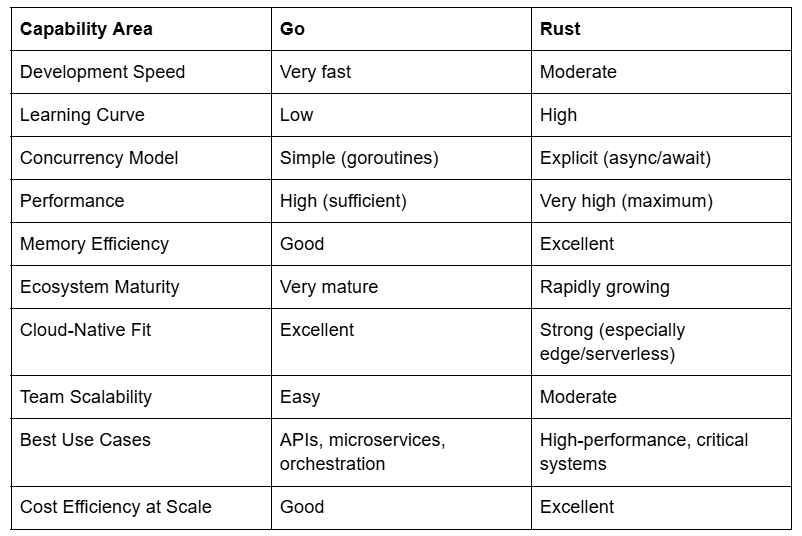
Capability Matrix
Press enter or click to view image in full size
The Decision (What Actually Works in Practice)
After all of this, the answer is not dramatic.
It’s practical.
Use Go to build systems. Use Rust to optimize systems.
Start simple.
- Build your APIs, workers, and orchestration in Go
- Run them on AWS (ECS, Lambda, SQS, etc.)
- Move fast, iterate, ship
Then, when you hit the wall:
- identify bottlenecks
- isolate heavy components
- rewrite only those parts in Rust
Final Thought
You don’t win by choosing the “best language.”
You win by:
- understanding where your system breaks
- knowing which tool solves that specific problem
- and applying complexity only where it pays off
Because in real systems:
The goal isn’t perfection. The goal is sustainable, scalable progress.
About the Author
**Deepa Elango is a Full Stack Engineer at [Codestax.ai](http://codestax.ai)**, specializing in building scalable, cloud-native applications. She works across frontend and backend systems using modern web technologies and AWS, with a strong focus on system design, performance, and real-world engineering challenges. She is committed to continuous learning and staying aligned with the latest advancements in software engineering.
About CodeStax. Ai
At CodeStax.Ai, we stand at the nexus of innovation and enterprise solutions, offering technology partnerships that empower businesses to drive efficiency, innovation, and growth, harnessing the transformative power of no-code platforms and advanced AI integrations.
But the real magic? It’s our tech tribe behind the scenes. If you’ve got a knack for innovation and a passion for redefining the norm, we’ve got the perfect tech playground for you. CodeStax.Ai offers more than a job — it’s a journey into the very heart of what’s next. Join us, and be part of the revolution that’s redefining the enterprise tech landscape.
메타데이터
- post_id
- 6b8303dbb7c2
- slug
- rust-vs-go-the-only-backend-language-comparison-that-actually-matters-in-2026-6b8303dbb7c2
- url
- https://medium.com/@codestax/rust-vs-go-the-only-backend-language-comparison-that-actually-matters-in-2026-6b8303dbb7c2
- canonical_url
- https://medium.com/@codestax/rust-vs-go-the-only-backend-language-comparison-that-actually-matters-in-2026-6b8303dbb7c2
- author_url
- https://medium.com/@codestax
- status
- ok
- fetched_at
- 2026-06-17 19:05:54