I’m Not a Zionist, I’m a Zionistish Person
Jewish Person, Parent #1, Parent #2, and Other Linguistic Innovations of Our Time
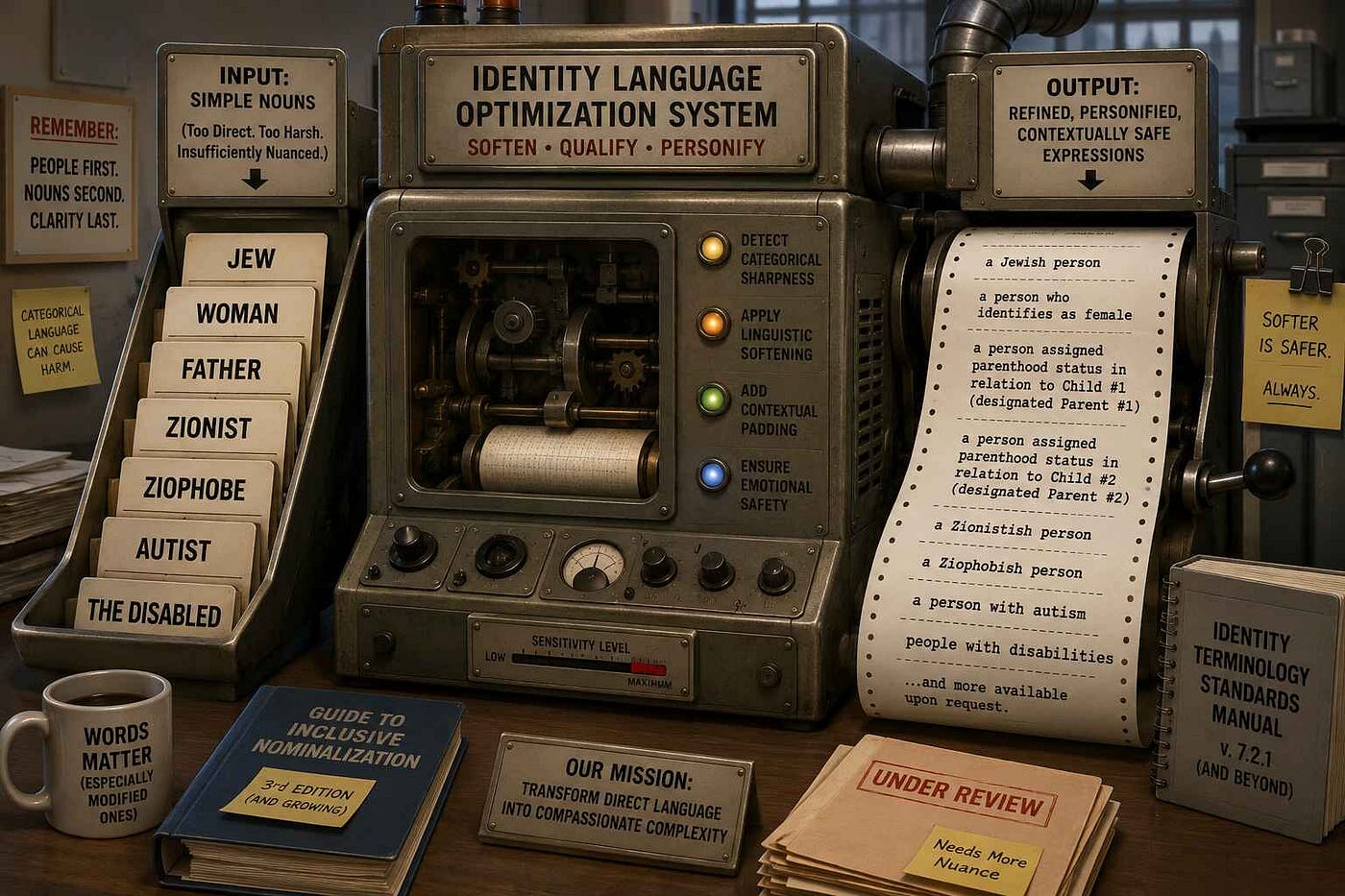
When language becomes a system of approvals, nouns stop standing alone. Image © Ivan Bassov, 2026. Licensed under CC BY 4.0.
I’m Not a Zionist, I’m a Zionistish Person
Jewish Person, Parent #1, Parent #2, and Other Linguistic Innovations of Our Time
There was a time when English was a relatively simple language. You could say things like “a Jew,” “a woman,” or “a father,” and people would assume you were referring to… well, a Jew, a woman, or a father.
But those days are gone. Today, language has evolved into a highly sensitive descriptive system designed to ensure that no noun is left unmodified, unaccompanied, or emotionally unsupported.
Now we are expected to say:
- “a Jewish person”
- “a person who identifies as female”
- “a person assigned parental status in relation to Child #1 and Child #2 (designated Parent #2)”
Because nothing says clarity like turning everyday nouns into bureaucratic subtitles.
It used to be called “Political Correctness,” but today even the term “Political Correctness” itself has become politically incorrect.
In practice, nouns on their own have become politically inconvenient and increasingly require explanation.
The rise of adjectival identity
One of the most fascinating developments in modern English is the gradual suspicion toward simple nouns. A noun like “Jew” is apparently too… final. Too categorical. Too emotionally decisive. It sounds like you are a thing, rather than a person who happens to be adjacent to a thing.
So we improve it.
We soften it.
We upgrade it into something safer:
not “a Jew,” but “a Jewish person”
Similarly:
not “a woman,” but “a person identified as female”
Because apparently identity should now arrive with a full explanatory footnote.
The Parent #1 / Parent #2 breakthrough
Of course, language reform does not stop at ethnicity, religion or gender. It continues into the most sacred domain of human civilization: family terminology.
We no longer risk the emotional volatility of “mom” and “dad.” Instead, we now have:
- Parent #1
- Parent #2
This is clearly more scientific. It sounds like a software licensing agreement, which is exactly what family life was missing all along.
One can only imagine future bedtime stories:
“Goodnight, Child #1, please acknowledge your caregivers, Parent #1 and Parent #2, as your primary domestic units.”
Progress.
Enter: Zionistish
Now, naturally, once a pattern becomes established, it tends to expand.
If “Jew” becomes “Jewish,” then logically other identity nouns may also require refinement.
Which brings us to a groundbreaking innovation in identity linguistics:
Zionist → Zionistish
Yes, it is only a matter of time.
Soon we will hear:
- “I am not a Zionist. I am a Zionistish person.”
- “She is not politically active; she is politically activism-adjacent and Zionistish-coded.”
- “We must ensure Zionistish individuals are properly personified before discussion.”
It pairs beautifully with the existing ecosystem:
- Jewish → Jewish person
- Female → person assigned female identity status
- Zionist → Zionistish person
English, at last, achieves its final form: semantic padding with emotional compliance layers.
Of course, English does not need to work very hard to innovate here. German already has zionistisch, meaning “Zionist (adjectival),” and Yiddish carries a closely related form, tsionistish (ציוניסטיש), with the same built-in grammatical softness of “-ish” already baked into the structure.
In other words, the linguistic machinery is already there. English is not inventing a new category — it is simply rediscovering old European grammar and upgrading it with contemporary sensitivity aesthetics.
What About Ziophobish?
Naturally, the system must remain balanced and inclusive across all ideological directions.
Accordingly:
- Zionist → Zionistish
- Ziophobe → Ziophobish
We must avoid binary frameworks such as “Zionist” and “Ziophobe” in favor of a more nuanced spectrum of Zionistish and Ziophobish positionalities across the ideological experience continuum.
After all, categorical nouns are increasingly discouraged in favor of softer, more gradient-compatible formulations.
Nobody should be reduced to a single clearly defined position when a sufficiently long adjectival construction is available.
The underlying logic (if we dare call it that)
At the heart of this linguistic evolution is a consistent preference: reduce categorical sharpness. A noun is a border. An adjective is a gradient. A phrase like “Jewish person” feels less like an identity declaration and more like a temporary descriptive setting.
From one angle, this looks like linguistic refinement. From another, it looks like a systematic distrust of clear categories in favor of softened, continuously qualified descriptions.
In this framework, identity is no longer something you are. It is something you are described as being in relation to a larger sentence structure.
To be fair
To be fair, not every linguistic softening is irrational. In some contexts — particularly around disability — changes in terminology can reflect genuine attempts at empathy, dignity, or precision.
For example:
- “the disabled” → “people with disabilities”
- “an autist” → “a person with autism”
- older clinical labels once used casually in everyday speech have gradually fallen out of polite usage altogether
Examples include terms that originally had clinical or technical meanings but later became widely used as insults or casual put-downs, causing them to fall out of polite everyday language.
For example:
- “retarded” / “mentally retarded” — once formal clinical terms in psychology and medicine, later widely used mockingly or pejoratively, and therefore largely replaced in professional contexts by terms such as “intellectual disability”
- “moron,” “idiot,” and “imbecile” — originally technical classification categories in early 20th-century psychology before becoming generic insults
- “crippled” — once a common descriptive term, now often replaced by “disabled person,” “person with a disability,” or more specific descriptions depending on context
- “handicapped” — once standard institutional language, now less preferred in many contexts compared to “disabled” or “person with disabilities”
In such cases, many people see the shift as an effort to place the person before the condition.
The question becomes more complicated when this linguistic instinct expands far beyond disability and begins reshaping religion, nationality, ideology, family structure, and eventually nouns themselves.
Somewhere along the way, English moved from protecting people against cruelty to protecting nouns against excessive definitiveness.
The multiplication of categories
In parallel with this broader linguistic shift, another development has entered public discourse: the expansion of gender as a category beyond the traditional binary framework.
Where earlier usage operated primarily with two categories, many contemporary discussions now describe gender as a spectrum of identities. In some online and academic taxonomies, the number of listed gender identities can reach dozens — sometimes cited as 20, 50, or even 72 or more.
The exact number is not stable, and that instability is itself part of the phenomenon. Gender is no longer treated as a fixed binary label, but as an expanding descriptive field, where categories can be added, refined, or redefined across different frameworks.
Such a trend naturally expands from gender to other identities, and language adapts accordingly. If gender is no longer understood in strictly binary terms of male and female, then “a Jew” and “a Zionist” would, by the same logic, be shifted toward “Jewish” and “Zionistish” as a first step. And once a pattern of softening categorical nouns is established, it is difficult to predict where the next adjustment will end.
Conclusion: welcome to descriptive reality
We now live in an era where direct nouns are treated like aggressive simplifications, and adjectives are promoted as diplomatic alternatives.
Some people adapt easily. Others still find themselves instinctively saying things like “a woman,” “a Jew,” or “a Zionist,” only to remember — too late — that they were supposed to add a gentle linguistic buffer.
And perhaps that is the real achievement of modern English:
Not clarity.
Not precision.
But the ability to never let a noun stand alone without supervision.
메타데이터
- post_id
- 6b9502ea5ae5
- slug
- im-not-a-zionist-i-m-a-zionistish-person-6b9502ea5ae5
- url
- https://medium.com/@ibassov/im-not-a-zionist-i-m-a-zionistish-person-6b9502ea5ae5
- canonical_url
- https://medium.com/@ibassov/im-not-a-zionist-i-m-a-zionistish-person-6b9502ea5ae5
- author_url
- https://medium.com/@ibassov
- status
- ok
- fetched_at
- 2026-06-14 11:28:49