🚀IMON Begins
Artificial intelligence (AI) is a wide-ranging branch of computer science concerned with building smart machines capable of performing…
🚀IMON Begins

Artificial intelligence (AI) is a wide-ranging branch of computer science concerned with building smart machines capable of performing tasks that typically require human intelligence.
Herbert Alexander Simon was an American political scientist, with a Ph.D. in political science, whose work also influenced the fields of computer science, economics, and cognitive psychology. His primary research interest was decision-making within organizations and he is best known for the theories of “bounded rationality” and “satisficing”.He received the Nobel Memorial Prize in Economic Sciences in 1978 and the Turing Award in computer science in 1975. His research was noted for its interdisciplinary nature and spanned across the fields of cognitive science, computer science, public administration, management, and political science. He was at Carnegie Mellon University for most of his career, from 1949 to 2001.
Notably, Simon was among the pioneers of several modern-day scientific domains such as artificial intelligence, information processing, decision-making, problem-solving, organization theory, and complex systems. He was among the earliest to analyze the architecture of complexity and to propose a preferential attachment mechanism to explain power law distributions.
Time proved him right, albeit late, and he was proved right after nearly 30 years. Today, artificial intelligence has become an indispensable part of technology. In order to give Simon his due, we take the name of our project from the name Simon and bring it to you as intelligent monsters, namely (S)I-mon.
Blockchain and AI
Blockchain’s evolution is already written in history and science. It will fuel a major change in human habits, a great clash of ideology and ultimately, become the way AI propagates on its own.
DNA is the chemical inside the nucleus of all cells within an organism that carries the exact genetic instructions to recreate it. It contains four different chemical bases — represented by the letters A, T, C and G — arranged in a double helix structure. The particular order of the four bases defines how a species should look like, and slight variations gives individuals their unique traits. Bigger gene mutations enable a species to adapt and survive to changing external conditions. Conceptually the blockchain isn’t very different. It uses cryptography mathematics to parse information represented in 1’s and 0’s (binary code) into a long chain of records that keeps extending as new information is added. This chain propagates exact copies of itself throughout its network to ensure it is hard to lose or corrupt.
In its most basic sense, a blockchain is an ever-growing digital ledger that can store data. A blockchain is an articulated data structure called a block, arranged in chronological order, linked and secured by cryptographic proofs. Blockchain transactions occur within a peer-to-peer network of globally distributed computers (nodes). Each node maintains a copy of the blockchain and contributes to the functioning and security of the network. As a distributed ledger technology (DLT), blockchain is deliberately designed to be highly resistant to modification and fraud (such as double spending). This is true because, as a database of records, the Bitcoin blockchain is immutable and indestructible without an impractical amount of electricity and computational power, meaning that this network can implement the concept of “original” digital documents and create each and every one of them.
The blocks are permanently ‘chained’ together. In practice, the “blockchain” is an immutable medium. It contains instructions in the form of computer code and is copied in thousands of nodes like DNA in cells. By the way, the word node means that many identical copies of a blockchain database reside in a large network of multiple computers, rather than a central administrator keeping a computer in one place. These computers; are nodes (Nodes). From this perspective, blockchains are very similar to cells containing many identical copies of DNA.
A blockchain responds to computations. It develops, adapts, self-regulates, and reproduces in a closed-circuit system like DNA. Therefore, Blockchain technology gains a feature that can meet a theoretical definition of life.
There are a number of functional and structural similarities between the blockchain and DNA, a self-replicating molecule that is the genetic blueprint for all known life. Are you ready for more? Blockchain system has possible advantages in the biological life cycle. A blockchain system can transfer data even more efficiently from biological lineages to new blocks (descendants). These inherited traits are developed to direct their evolution towards each other. Unlike our carbon-based biological lives, technological lifeforms could have a potentially indefinite lifespan in theory and perhaps in the future. Who knows? Self-regulating systems may be on their way to becoming indistinguishable from the biological life we study every day. Artificial intelligence (AI), based on artificial neural networks, coordinates processes the same way a brain does. It is possible to transfer the experience and information gained by artificial intelligence with a cybernetic system with blocks in the digital DNA structure. In this sense, the emergence of blockchain as the new life building block of the modern world is not even sincere.
Computing systems share many similarities with biological life forms. Blockchain, in particular, exhibits some characteristics of life and can meet the definition of life, at least in theory. From a computational point of view, there are similarities between the ways DNA and genetics drive evolution and how blockchain nodes drive technological progress. I am not claiming that blockchains are actually alive like a biological cell. But the claim that a “blockchain-based” organism “fits some definition of life” and can surpass biological life in terms of evolutionary adaptation and development terrifies me as well. We argue that blockchain networks follow all widely accepted criteria for biological life, only without the biological part and eventually able to grow and develop just like an organism.
Wasn’t blockchain just for transactions and record keeping? Could it contain enough digital instructions to replicate an artificial intelligence, such as a replica of an entire living organism? When we combine the self-improvement capability of machine learning with the self-protection design of the blockchain, will we then create a digital version of the machine DNA using the blockchain to protect the AI’s we will trust to run our own work? Against the limited storage capability of DNA, does Blockchain’s ability to reach unlimited dimensions, the ability to transfer all acquired characteristics to its offspring (blocks), a programmed death scenario, or the ability to immortality reveal a new and superior DNA model?
These advantages could theoretically allow AI running on such a blockchain to evolve in a way that resembles the randomness of natural selection but with more aspects than it, resulting in the birth of artificial general intelligence that ultimately makes itself smarter.
What is I-MON?
I-mon combines machine learning with blockchain, creates added value for all users, I-Mons are fully onchain NFTs, powered by the ERC1155, ERC20, ERC2917 standards. The contracts also implement the EIP-2535 Diamonds standard, which allows for modular upgradeability.
Our motto is “Socialize&Earn, Earn&Learn”
How does it work?
- All NFTs on our platform represent people well known in the blockchain space.
- These NFTs are linked to the twitter account of the person they represent.
- As these people tweet from their twitter account, NFT owners connected to that account have the right to upgrade their NFT by using this tweet. Each tweet is used for only one upgrade.
- Machine learning capacity increases as NFTs are upgraded. At the same time, this development allows NFT to take a larger share of the stake pool. For this reason, users earn as they socialize, and their learning capacity increases as they earn. This development allows users to earn more.
- The development level of NFTs is limited by their learning capacity, that is, endless. The main factor that enables the development of NFTs is the tweets of the influencer representing that NFT. In this way, the more social the influencer is, the more social the NFT owners are. The main factor for the development of NFT is social interaction!
Deflationary Features
- All NFT’s are sold with $IMON token. Collected tokens are burned permanently
- The IMON token is used for NFT machine learning. Tokens spent by users for improvements are burned permanently.
Tokenomics
Name: Intelligent Monsters
Ticker:IMON
Network: Polygon Network
Decimals: 18
Total Supply: Unlimited
Contract Adress: 0x9631be8566fC71d91970b10AcfdEe29F21Da6C27
Liquidity Generation Event (LGE)
A Liquidity Generation Event (LGE) is an innovative initial token distribution mechanism enabling a free and fair participation process with no pre-sales, private sales.
How to Participate
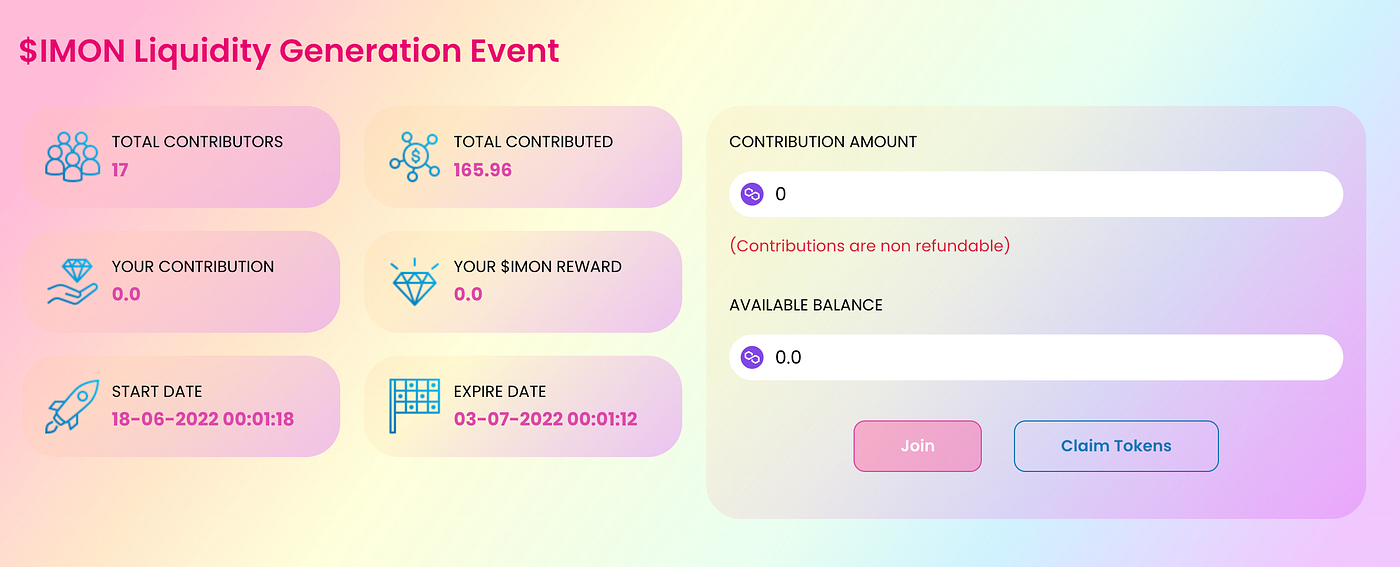
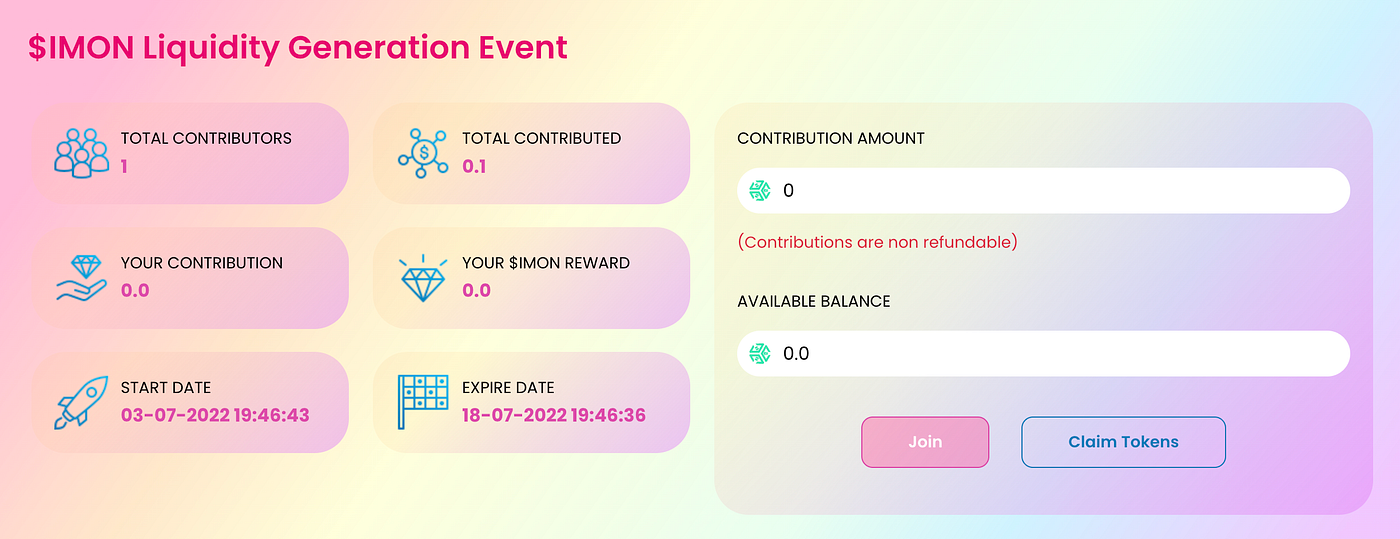
Users can join the LGE pool with $MATIC(Polygon) coin. The total $MATIC coins collected in the pool till 03/07/2022 are divided by the price(0.0001 $MATIC), and the amount of IMON tokens earned for each $MATIC coin is calculated and distributed to the users. The same amount of IMON coins is added to the liquidity along with the $MATIC coins collected in the pool.
Example:
User 1, join the LGE event with 1 $MATIC user 10000.0 earns;
$MATIC1/$0.0001= 10000.0 IMON tokens.
Contact
IMON Telegram: https://t.me/imondotai
IMON Twitter: https://twitter.com/imondotai
IMON Medium: https://medium.com/@imonai
IMON Github: https://github.com/imonai
메타데이터
- post_id
- 6b98f8a7ef57
- slug
- imon-begins-6b98f8a7ef57
- url
- https://medium.com/@imonai/imon-begins-6b98f8a7ef57
- canonical_url
- https://medium.com/@imonai/imon-begins-6b98f8a7ef57
- author_url
- https://medium.com/@imonai
- status
- ok
- fetched_at
- 2026-06-18 00:10:23