Why Enterprise AI Fails So Consistently — And What Real Transformation Actually Requires
Enterprise AI System
Why Enterprise AI Fails So Consistently — And What Real Transformation Actually Requires
Enterprise AI System
Disclosure: I use GPT search to collection facts. The entire article is drafted by me.
Let me start with a number that should make any executive pause.
In 2025, global enterprises invested $684 billion in AI initiatives. By year-end, over $547 billion of that investment — more than 80% — failed to deliver intended business value. MIT’s research is even harsher: 95% of generative AI pilots fail to scale to production with measurable returns. And Deloitte’s 2026 State of AI report, surveying 3,235 leaders across 24 countries, found that while worker access to AI surged 50% last year, only 21% of projects reached production with demonstrable ROI.
That’s not a product problem. That’s not a model problem. That’s a fundamentally broken mental model of what enterprise AI transformation actually requires.
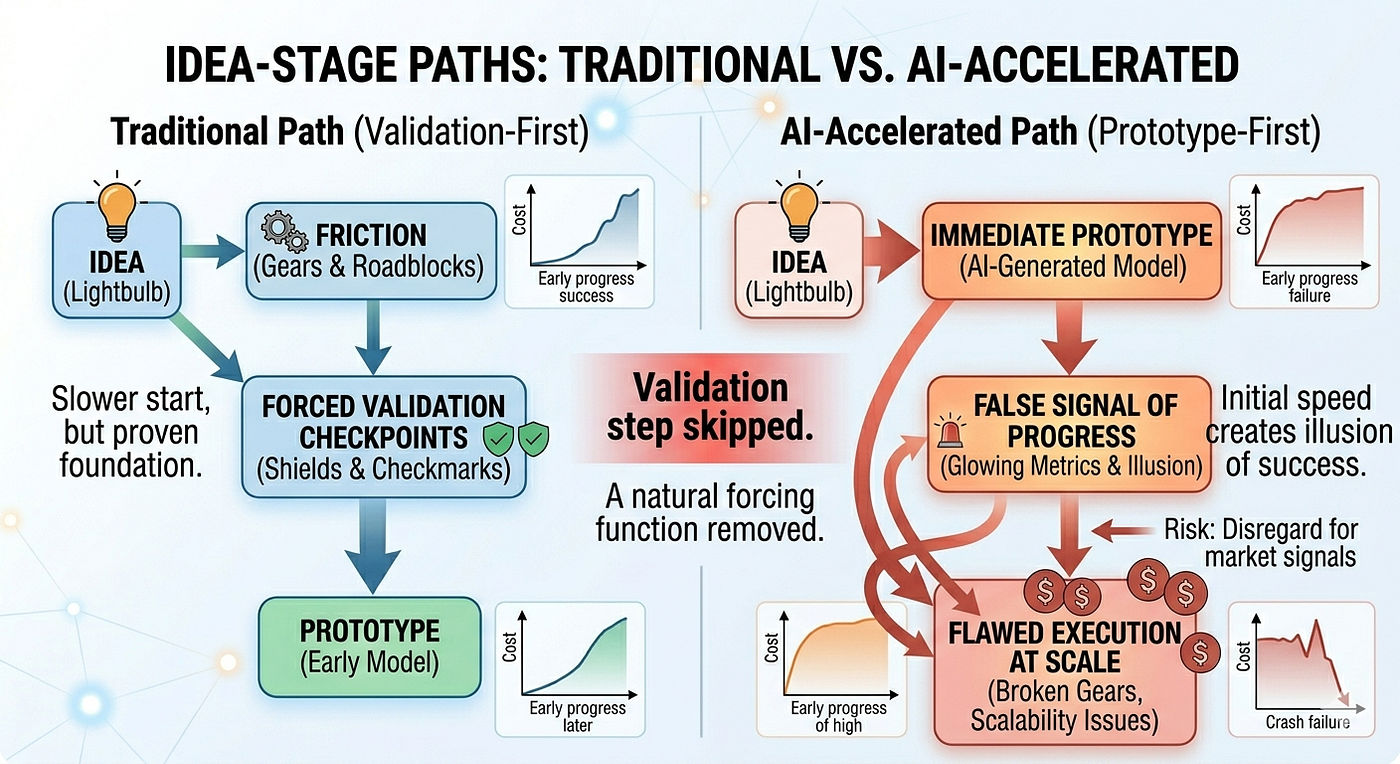
The failure pattern is remarkably consistent: companies ask “where can we use AI?” instead of “what is the most valuable problem we need to solve?” They buy tools, deploy pilots, train employees on prompt writing, and then wait for results that never come. Or worse — results come in the form of faster reports, better-looking presentations, and slightly shorter meeting notes, and everyone declares success while nothing in the business actually changed.
This piece is about the gap between that and what real organizational AI transformation looks like.
Stage 1 Versus What You Think Stage 1 Means
Here is the most honest framing for where most large organizations sit right now:
They are in Stage 1 of AI adoption, which looks like ERP implementation in 1998 or cloud migration in 2012. The first-stage question is always “Do our employees use it?” That question gets answered, adoption dashboards turn green, and leadership moves on. Business impact gets deferred to later.
The problem is that Stage 1 has been quietly rebranded as transformation.
Consider what most enterprise AI deployments are actually optimizing for:
- Document generation and summarization
- Meeting transcription and action item extraction
- Internal knowledge search
- Email drafting and response suggestions
- Basic data analysis assistance
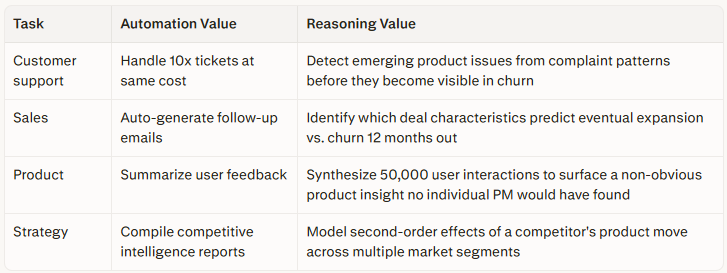
These are real productivity wins. A salesperson who can compress two hours of client research into 20 minutes has genuinely gained something. But here’s the diagnostic question: did that free time compound into better decisions, higher revenue, and stronger customer relationships? Or did it just create capacity for more of the same work?
In most cases, the efficiency gains are absorbed by the existing workflow without changing anything structural. The pipeline looks the same. The decision quality looks the same. The organizational capacity for insight hasn’t changed. The work just runs faster.
Efficiency is not transformation. Faster execution of a poorly designed process is still a poorly designed process.
Stage 2 — where AI begins to reshape how value is created — requires a different set of questions. Not “can AI do this task?” but “should this task exist in its current form at all?”
The Audit Paradox: When AI Creates the Problem It Was Supposed to Solve
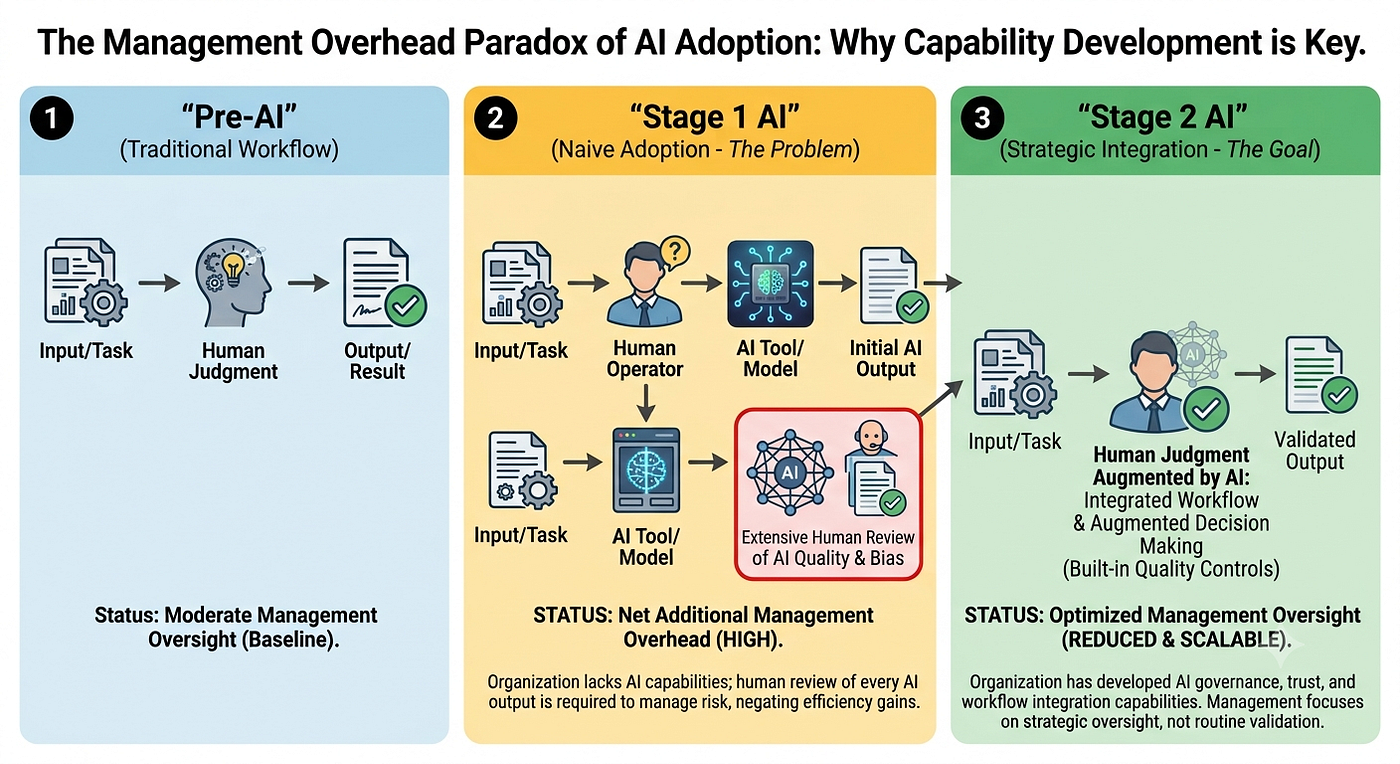
There’s a failure pattern that keeps surfacing in organizations that have pushed AI deployment without complementary capability development. I’ll describe it directly because it’s more common than anyone publicly admits.
The company deploys AI writing and analysis tools broadly. Employees — particularly junior staff — begin generating large volumes of professional-looking content: market analyses, strategy documents, proposal frameworks, technical assessments.
Surface metric: productivity is up. Volume is up. Response time is down.
Actual result: management burden increases.
Because now every output needs a new layer of review. Is the data in this analysis accurate? Did the AI hallucinate that statistic? Is this strategic recommendation actually grounded in the company’s specific context, or does it sound like generic consulting advice? Is this code review correct, or just plausible?
The managers who now bear that review burden are the same people who previously spent their time on judgment-intensive work. They’ve been converted into AI auditors. Their bandwidth — which was the actual organizational bottleneck — has been consumed by a new class of quality control work that didn’t exist before.
This is the AI amplification trap in its most ironic form.
AI is, at its core, a capability amplifier. Feed it a strong business thinker with deep contextual knowledge and genuine judgment, and you get extraordinary output. Feed it a process-follower without deep domain understanding, and you get high-velocity average content — smooth, professional, and often subtly wrong in ways that are expensive to catch.
The solution companies keep reaching for is more AI training. Teach everyone better prompt engineering. Teach everyone how to use the tools.
That is not the solution. It’s addressing a symptom.
The actual constraint is the ratio of judgment capacity to volume of work being processed. AI dramatically increases the volume. It does not automatically increase judgment capacity. The fix is to invest in building judgment first — and then use AI to extend the reach of that judgment, not to replace it.
AI-Generated Image
Three Structural Reasons Enterprise AI Projects Fail
The data from Pertama Partners’ synthesis of RAND, MIT, McKinsey, Deloitte, and Gartner research is fairly unambiguous: 84% of AI project failures are leadership-driven, with 73% lacking clear success metrics at project approval, 68% underinvesting in data and governance foundations, and 56% losing C-suite sponsorship within six months.
But these are symptoms. Let’s go one level deeper.
Reason 1: Optimizing jobs rather than redesigning work
The dominant conversation in most boardrooms when AI comes up is some variation of: “How many headcounts does this allow us to eliminate?” That’s an understandable question from an efficiency standpoint, and it’s not inherently wrong to ask.
But it misses the more important structural question: has AI changed what this role should fundamentally be doing?
Consider the downstream cascade when AI reaches information-processing-intensive work. Tasks like data aggregation, report generation, standard document review, and preliminary analysis have historically required large teams because the volume of work was proportional to headcount. AI compresses that ratio dramatically.
But the response to that compression is not simply “reduce the team.” The response should be: “Given that the bottleneck has shifted, where does the new bottleneck live?”
Usually, the new bottleneck is judgment and synthesis at a higher level of abstraction. The question is no longer “can we produce the analysis?” — AI can produce it in minutes. The question is “can we ask the right question, interpret the output correctly, and make a good decision based on it?”
That requires redesigning roles toward judgment, interpretation, and decision-making — and it requires organizational investment in building those capabilities. Most companies skip this entirely and simply try to reduce headcount without rebuilding the capacity structure that remained.
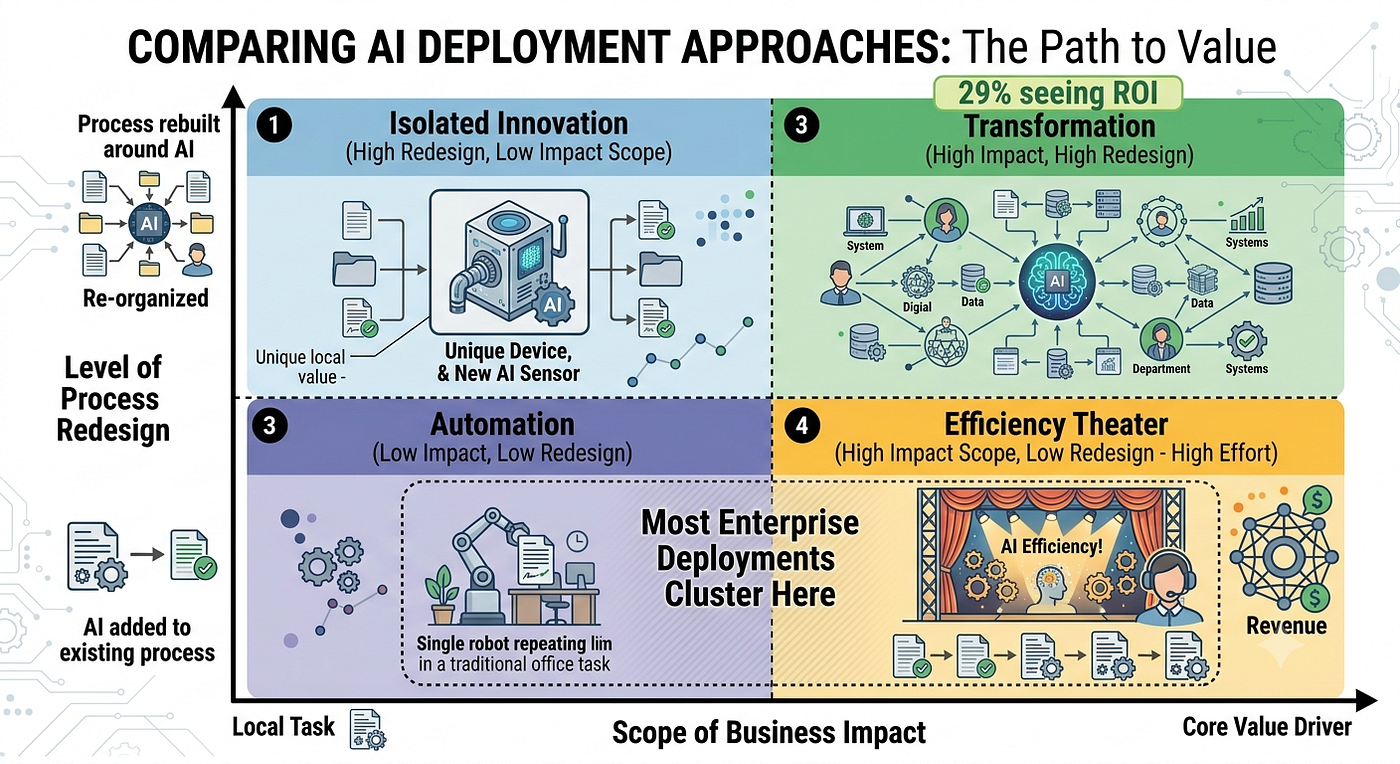
Reason 2: Adding AI to legacy processes instead of redesigning from the value
This is endemic. The organizational logic goes: “We have an ERP — can we add an AI layer?” “We have a CRM — can AI summarize customer interactions?” “We have a procurement system — can AI flag anomalies?”
Each of these is a legitimate micro-improvement. Collectively, they leave the underlying process architecture untouched.
The more valuable question — and the harder one — is: if you designed this process from scratch today, knowing AI exists, what would it look like?
Supply chain planning is a useful illustration. The traditional model has human planners building forecasts, reviewing inventory levels, negotiating with suppliers, and adjusting production schedules. AI augmentation in Stage 1 gives planners better dashboards and surface anomaly detection faster. That’s real but marginal.
A process redesigned around AI capabilities might look different entirely: probabilistic demand forecasting that continuously updates based on real-time signals, automatic supplier commitment optimization across multiple tiers, and exception-based human intervention rather than routine human review throughout the entire cycle. The planner’s job isn’t “faster human review” — it’s “decision authority over situations that exceed AI confidence thresholds.”
The difference between these two approaches is not one of AI sophistication. The same model could underpin both. The difference is architectural intent. One treats AI as a feature added to an existing system. The other treats AI as a native capability that reshapes the system’s design logic.
The companies in the 29% achieving meaningful ROI consistently treat AI adoption as organizational redesign, not technology deployment.
Reason 3: Mistaking tool training for capability development
Writer.com’s 2026 survey of 2,400 workers and executives found that 75% of AI strategies are “more for show than actual guidance,” and only 29% of employees see significant ROI from their organization’s AI investments.
The gap between those numbers can be explained almost entirely by what organizations invest in when they deploy AI.
The typical enterprise AI training program teaches:
- How to write effective prompts
- Which tools to use for which tasks
- Best practices for reviewing AI output
None of that builds the underlying capability that determines whether AI actually creates value. What determines value is:
Domain depth: Can you tell when the AI output is wrong? This requires deep understanding of the subject matter — not AI literacy.
Problem definition ability: Can you translate a fuzzy business problem into a precise, answerable question? This is not a prompt engineering skill — it’s a strategic thinking skill.
Judgment and validation: Can you assess whether an AI-generated recommendation makes sense in your specific context? This requires contextual knowledge and skepticism that no AI training program develops.
Systems thinking: Can you trace how an AI-assisted decision in one part of the organization propagates to other parts? This requires organizational understanding that is orthogonal to AI fluency.
Training people to use AI tools is like training factory workers to operate faster machines without understanding the production system. The throughput increases. The defect rate increases proportionally.
What the Working Framework Actually Looks Like
The organizations seeing meaningful ROI share a consistent pattern. Here’s the structure that works:
Start with the business problem, not the AI use case.
The right first question is: “What are the three biggest constraints on our growth or profitability right now?” — and then working backward to whether AI addresses any root cause. Not: “What tasks could AI help with?”
Identify your organization’s most valuable bottleneck. Is it the sales conversion rate? Product development cycle time? Customer churn? Supply chain cost? These are measured in revenue and margin, not in hours saved.
Map the value chain at the process level, not the task level.
Take the business problem you’ve identified and decompose the full process that determines outcomes. For sales conversion, that might be: market qualification → lead scoring → needs diagnosis → proposal development → negotiation → close → retention.
At each stage, ask two questions:
- What determines whether this stage succeeds or fails?
- What information or judgment capability would most improve that outcome?
AI value concentrates at the nodes where information asymmetry is high, and pattern recognition matters. Those are not always the most time-consuming nodes.
Prioritize depth over breadth.
The consensus among successful implementations is clear: picking 1–3 high-value scenarios and achieving genuine capability in them produces dramatically better outcomes than deploying AI tools across the entire organization simultaneously.
This runs counter to the instinct of enterprise IT and procurement teams, which favor broad platform deployments. But broad deployment without deep use case development produces the adoption statistics we’re looking at: 88% of pilots that never reach production, 42% of organizations abandoning most AI initiatives.
Three Cases Where AI Reaches Core Business Value
Manufacturing: Supply Chain Decision Intelligence
The naive deployment: give procurement managers better data dashboards.
The redesigned version: build a continuous planning loop where AI generates probabilistic demand forecasts updated daily based on market signals, customer order patterns, and macroeconomic indicators. Procurement recommendations are AI-generated with confidence intervals. Human planners review exception cases — situations where confidence is below threshold, or where strategic considerations override the model’s optimization target.
class ProcurementAdvisor:
    def __init__(self, confidence_threshold: float = 0.85):
        self.confidence_threshold = confidence_threshold

    def generate_recommendation(
        self,
        sku: str,
        forecast_data: dict,
        inventory_state: dict,
        supplier_constraints: dict
    ) -> dict:
        forecast_confidence = forecast_data["confidence"]
        recommended_quantity = self._calculate_optimal_order(
            forecast_data, inventory_state, supplier_constraints
        )
        return {
            "sku": sku,
            "recommended_quantity": recommended_quantity,
            "confidence": forecast_confidence,
            "requires_human_review": forecast_confidence < self.confidence_threshold,
            "review_reason": self._explain_uncertainty(forecast_data)
                             if forecast_confidence < self.confidence_threshold
                             else None,
            "estimated_cost_impact": self._calculate_cost_delta(
                recommended_quantity, inventory_state
            )
        }
This code sketch shows what AI-native process design looks like versus an AI-augmented human process: the system explicitly routes to human review when confidence is below a threshold rather than having humans review everything. The human role is redefined as exception handler, not primary analyst. The business metric that matters is inventory carrying cost and stockout rate — not planner time spent.
B2B Sales: Predictive Qualification
Most sales AI deployments generate better email templates. That’s fine, but marginal.
The more impactful application is AI-driven qualification scoring: analyzing firmographic data, product usage signals, engagement history, market timing indicators, and deal pattern similarity to generate a probability-weighted prioritization of the pipeline. The sales team doesn’t change what they do — they change who they do it to first.
The measured outcomes here are conversion rate and sales cycle length, not “time saved on administrative tasks.” When you focus on those metrics, the AI’s contribution to revenue becomes calculable and defensible.
Knowledge-Intensive Firms: Making Experience Retrievable
Professional services firms, research organizations, and technology companies share a common problem: their most valuable asset — accumulated expertise and contextual judgment — is trapped in individual minds, old email threads, and project archives that nobody can search effectively.
The value of AI here is not a chatbot that answers generic questions. It’s a system that makes organizational memory accessible and queryable in a way that genuinely accelerates the judgment development of new team members and enables pattern recognition across historical cases that no individual could hold in memory.
The success metric is speed to competence for new hires and quality of decisions referencing institutional knowledge — not search queries per day.
AI-Generated Image
A Necessary Caution: AI Is Not a System Repair Tool
Here is the under-discussed failure mode that no vendor presentation will mention.
If a business process is poorly designed, if organizational incentives are misaligned, if data quality is low, if decision-making accountability is unclear — AI will amplify those problems, not solve them.
AI deployed on bad data produces confident, fast, wrong outputs. AI deployed in an organization where accountability is diffuse produces recommendations that nobody owns and decisions that nobody makes. AI deployed in a politically dysfunctional organization gives each faction better ammunition to support their existing conclusion.
The precondition for AI creating value is a minimum level of organizational health in the domain being addressed. Sixty percent of organizations abandon AI projects specifically because of data quality issues — not model capability. The infrastructure prerequisite — clean data, clear ownership, defined success metrics — is boring and unglamorous compared to deploying a large language model. But it’s the actual bottleneck.
Think of AI as a high-performance engine. The engine is genuinely more powerful than anything that existed before. But a more powerful engine in a vehicle with no steering wheel, bad tires, and no navigator doesn’t produce faster arrival. It produces faster departure in an unknown direction.
The Actual Competitive Differentiator
Here is the landscape as it will likely consolidate over the next three to five years.
Model capability is becoming commoditized. The gap between frontier models and widely available mid-tier models is narrowing. Pricing is falling. Access is broadening. By 2027, “we have access to a good model” will be table stakes, not differentiation — similar to how “we have cloud infrastructure” became table stakes around 2018.
The differentiation will come from three things that are harder to buy than a model subscription:
Data moats: Proprietary data that makes AI more accurate in a specific domain is a genuine competitive advantage. It can’t be licensed from an API. It accumulates over time through operational discipline.
Process architecture: The organizational ability to redesign workflows around AI capabilities rather than adding AI to existing workflows. This requires both engineering skill and organizational will — and it’s slow to develop.
Judgment depth: The organizational capacity to ask the right questions of AI systems, interpret outputs critically, and make sound decisions based on AI-assisted analysis. This is a human capability development challenge, not a technology challenge.
The companies winning in AI today are not the ones with the most AI tools. They’re the ones where AI is embedded in the logic of how value gets created — where the competitive advantage compounds because every cycle of operation generates data that makes the next cycle better.
That kind of compounding doesn’t happen from a Copilot subscription. It happens from deliberate architectural decisions made at the beginning of the deployment journey — decisions most companies are still not making.
The Three Things That Actually Matter
If you’re in a position of authority over an AI strategy — or advising one — the framework is simple:
First: AI is an organizational change project, not an IT project. The technology is the easy part. The governance, process redesign, capability development, and cultural change are where the work actually lives. Projects that are led by IT without active transformation ownership from business leadership have a failure rate north of 80%.
Second: AI value must trace to a business metric, not a tool metric. “Hours saved” and “prompts submitted” are not success indicators. Revenue, margin, cycle time, quality rate, and customer retention are success indicators. If you can’t draw a direct line from your AI initiative to one of those, you’re measuring the wrong thing.
Third: AI amplifies capability differentials. The companies and individuals who win will be the ones who combine genuine domain expertise with AI fluency — not the ones who substitute AI fluency for domain expertise. Invest in the human capability first. The amplification follows.
The uncomfortable truth that 2026’s data makes undeniable: enterprise AI is failing not because the technology is bad. It’s failing because organizations are treating a transformation challenge as a procurement decision. You cannot buy your way to organizational capability. You build it, deliberately and slowly, and then AI makes it faster.
That’s the actual sequencing. And most companies have it exactly backwards.
If you’d like to show your appreciation, you can support me through:
✨ **Patreon ✨ [Ko-fi](https://ko-fi.com/jinlowmedium) ✨ [BuyMeACoffee](https://buymeacoffee.com/jinlowmedium)**
Every contribution, big or small, fuels my creativity and means the world to me. Thank you for being a part of this journey!
메타데이터
- post_id
- 6baa1b004716
- slug
- why-enterprise-ai-fails-so-consistently-and-what-real-transformation-actually-requires-6baa1b004716
- url
- https://medium.com/jin-system-architect/why-enterprise-ai-fails-so-consistently-and-what-real-transformation-actually-requires-6baa1b004716
- canonical_url
- https://medium.com/jin-system-architect/why-enterprise-ai-fails-so-consistently-and-what-real-transformation-actually-requires-6baa1b004716
- author_url
- https://medium.com/@jinlow
- status
- ok
- fetched_at
- 2026-07-09 08:27:28