Finding Balance: Modeling CTLA4 in Myasthenia Gravis
What is Myasthenia Gravis?
Finding Balance: Modeling CTLA4 in Myasthenia Gravis

What is Myasthenia Gravis?
Myasthenia Gravis (MG) is an autoimmune disease that affects muscle function by causing the immune system to attack acetylcholine receptors. This results in muscle weakness and can significantly impact daily life.
Diseases like MG highlight how important it is for the immune system to stay balanced. When that balance is lost, the body can begin to harm itself.
In this project, I explored how the gene CTLA4 helps regulate this balance and how changes in its activity affect the immune system.
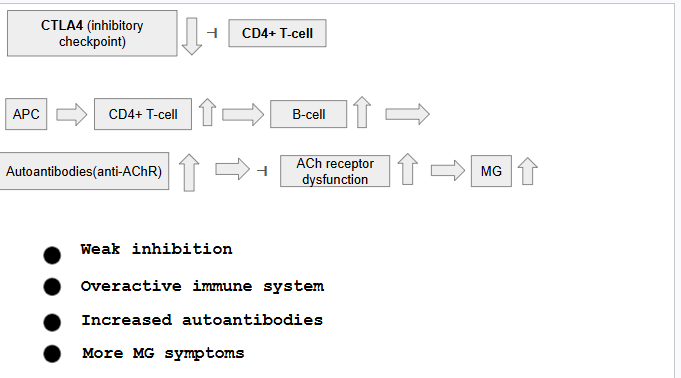
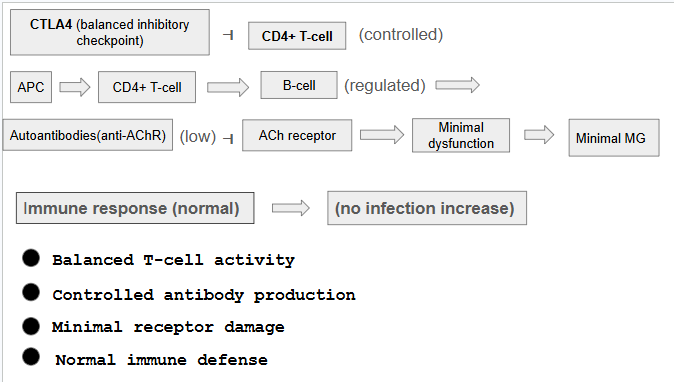
To understand how this happens, I modeled the immune system as a chain of events. First, special cells called antigen-presenting cells (APCs) activate immune cells known as CD4+ T-cells. These T-cells activate B-cells, which produce antibodies. In MG, these antibodies attack acetylcholine receptors, leading to muscle weakness.
A key part of my model focuses on a gene called CTLA4. CTLA4 acts like a “brake” on the immune system. It helps control how active T-cells become, preventing the immune system from overreacting.
I created three versions of this system to see what happens when CTLA4 changes:
- Low CTLA4 (weak brake): The immune system becomes overactive. T-cells and B-cells are highly activated, producing large amounts of harmful antibodies. This leads to more damage to acetylcholine receptors and more severe disease symptoms.
- Optimal CTLA4 (balanced brake): The immune system is properly regulated. T-cell activity is controlled, antibody levels stay low, and acetylcholine receptors remain mostly functional. At the same time, the immune system can still protect the body from infections.
- High CTLA4 (strong brake): The immune system is suppressed. Fewer antibodies are produced, which reduces damage to receptors and improves disease symptoms. However, because the immune system is weaker overall, the body becomes more vulnerable to infections.
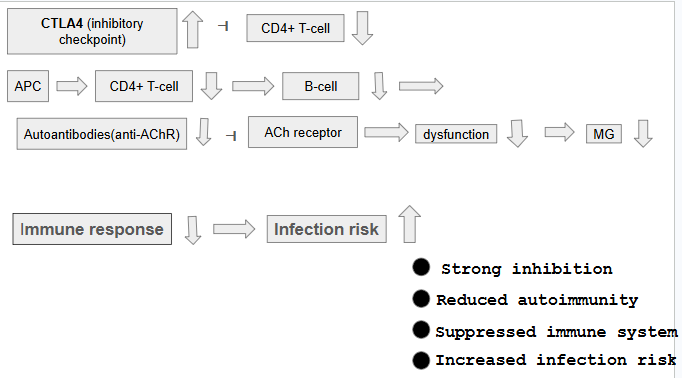
These models show that CTLA4 is an important control point in the immune system. Too little activity leads to autoimmune disease, while too much leads to a weakened immune response. Maintaining a balance is essential for keeping the body both protected and healthy.
The Quantitative Model.
To make this model measurable, I used a simple 1–10 scale to represent how active each part of the system is, so I could compare changes across the three states.
For example, in the low CTLA4 model, T-cell activity and antibody production are high, reflecting an overactive immune response. In the high CTLA4 model, these values are much lower, representing immune suppression. The optimal CTLA4 model falls in between, showing a balanced state where immune activity is controlled.
These values are not exact biological measurements, but relative estimates that help visualize how changes in CTLA4 affect the system. This allows for easier comparison between the three conditions and highlights the tradeoff between autoimmunity and infection risk.
Real-world application
CTLA4 is already targeted in treatments like Immune checkpoint therapy. These treatments increase immune activity to fight diseases like cancer, but they can also cause autoimmune side effects.
This creates a tradeoff between treating disease and maintaining a healthy immune system. My model helps explain why this tradeoff happens and highlights the importance of balancing immune activity.
key insight
Overall, my model shows that CTLA4 acts as a key control point in the immune system. Too little activity leads to autoimmunity, while too much suppresses immune function.
This suggests that maintaining a balanced level of CTLA4 could help improve treatments by reducing side effects while preserving effectiveness.
메타데이터
- post_id
- 6baac52c9730
- slug
- finding-balance-modeling-ctla4-in-myasthenia-gravis-6baac52c9730
- url
- https://medium.com/@lewfam/finding-balance-modeling-ctla4-in-myasthenia-gravis-6baac52c9730
- canonical_url
- https://medium.com/@lewfam/finding-balance-modeling-ctla4-in-myasthenia-gravis-6baac52c9730
- author_url
- https://medium.com/@lewfam
- status
- ok
- fetched_at
- 2026-06-11 11:25:07