It was never about the kids
Headlines of the week: a healthcare crackdown that keeps reaching further into adulthood, the small government party subpoenas kids’…
It was never about the kids
Headlines of the week: a healthcare crackdown that keeps reaching further into adulthood, the small government party subpoenas kids’ medical records, a Democratic split, and a few real wins. Our first weekly roundup as we look ahead toward Pride month.

Budapest Pride, June 2025. Photo: Vauia Rex, CC0, via Wikimedia Commons.
The loudest stories this week were primary results and graduation speeches. The most consequential one barely registered, so that’s where we’ll start.
The story that didn’t get enough attention
An 18-year-old college student named Aleksandra Vaca tried to refill her estrogen prescription at Northwestern Medicine in Chicago. Hours before her appointment, the hospital told her it would not prescribe estrogen until her 19th birthday, which happened to be later that same week. NBC News reported her story on May 26.
For years, the people restricting transition care have insisted they were protecting children. NBC’s investigation, built on more than 30 interviews, shows the restrictions now reach well into adulthood. The executive order that withholds federal funding from hospitals providing transition care defines a “child” as anyone under 19, and Northwestern told NBC it adheres to that order. It doesn’t stop at teenagers.
The Department of Veterans Affairs has ended transition care for any veteran not already on hormone therapy. Health and Human Services barred gender-affirming care from being covered as an essential benefit under the Affordable Care Act. Twelve states bar Medicaid from covering this care at any age. And the reach now extends to the federal and Postal Service health plans that insure some 11 million people, whose transition coverage was cut for anyone not already mid-treatment and is set to end entirely next year.
Elizabeth Gill of the ACLU called it the “abortion playbook,” passing enough restrictions that the care becomes impossible to access even where it stays legal. The goal, she said, is to “push trans people, both youth and adults, out of public life.” Over time, the administration and the Republican Party have done what every group that ever scapegoats a particular minority does, gradually transitioning their talking points from a focus on protecting children to a clear mission to eradicate the unwanted group from society altogether.
While I remain optimistic that they will ultimately fail because I don’t believe a majority of Americans want to see their trans neighbors or family members truly eradicated from society, the stakes obviously couldn’t be higher. Additionally, the laws they are able to pass and restrictions they are able to implement now are having very real and growing harms to LGBTQ people of all ages, so they are already achieving their goal of making life immensely harder for and further marginalizing all queer people.
The records grab
While the healthcare story is about cutting off care, this one is about the government going looking for the people who received it. This week, California families with transgender children sued to stop the Trump Justice Department from using a Texas grand jury subpoena to pull their kids’ private medical records out of state. Their argument is simple: a subpoena fishing for the medical files of children who have done nothing wrong is an intimidation tactic, and it works whether or not it ever produces a charge, because the point is to make families afraid to seek care at all.
The Democrats’ fork in the road
The political story of the week is a party splitting in real time over whether to retreat on trans rights or hold the line.
In California, days before the June 2 primary, billionaire gubernatorial candidate Tom Steyer (likely seeking to distract from how he acquired his billions) went out of his way to call out fellow Democrats on trans issues, which Erin in the Morning called one of the most emphatic pro-trans stances of the race.
His leading rivals have hedged in the face of polling that consistently shows an overwhelming majority of Americans believe sports participation should be restricted based on birth sex. Because California advances the top two finishers regardless of party, Steyer just bet that holding the line on what has emerged as a wedge issue at the national level is a winning position in California.
Even if he emerges with a top-two finish, It’ll be hard to say how much we can chalk that up to strategy and how much of it will be owed to Steyer’s record spending on his own campaign. According to CalMatters, “despite his opponents’ deep-pocketed donors, no one has matched the $213 million Steyer has spent on his own campaign, allowing him to blanket the airwaves with ads, pay influencers to post videos with him and send billboard trucks to drive around gas stations highlighting Becerra’s Chevron support.”
This leaves me wondering whether the real fork in the road for Democrats is trans rights, or whether we allow self-funded billionaires and centimillionaires with minimal records of civic participation to buy federal and statewide offices with ads that frame them as leftists.
The clearest sign of the retreat on more meaningful issues came from another blue state. New York’s enacted budget included nothing for trans care access, even as hospitals there scaled back under federal pressure. A Democratic trifecta wrote a budget and found room for everything except the patients losing care. While some Democrats try to hold the line in the face of crushing budget deficits driven by Federal austerity (amid record military spending), others are quietly abandoning us where it actually counts.
The same fault line ran through the primaries. In Georgia, Bentley Hudgins won about 66 percent of a Democratic primary in a safely blue district, putting them on track to become the state’s first out trans lawmaker, after running almost entirely on housing, transit, and wages.
In Texas, scandal-plagued Attorney General Ken Paxton beat Senator John Cornyn in a runoff, then trained his fire on his likely Democratic opponent, state Rep. James Talarico, a straight seminarian whom Republicans have spent the week smearing with anti-gay slurs for the crime of defending trans people. And Representative Julie Johnson, the first out LGBTQ+ person to represent a Southern congressional district, lost her runoff to former Rep. Colin Allred, a casualty of the state’s mid-decade gerrymander. Put those results side by side and the week reads like an argument the party is having with itself.
The evidence from the last year of elections says capitulation has not bought the wins its advocates promised. Worth setting against the gloom: the early Democratic leader in a 2028 presidential poll this week was Pete Buttigieg, the first out gay candidate to top (no pun intended) such a field. Polls this far out measure name recognition more than anything, but the symbolism of his lead cuts against the idea that the party has to retreat on LGBTQ issues.
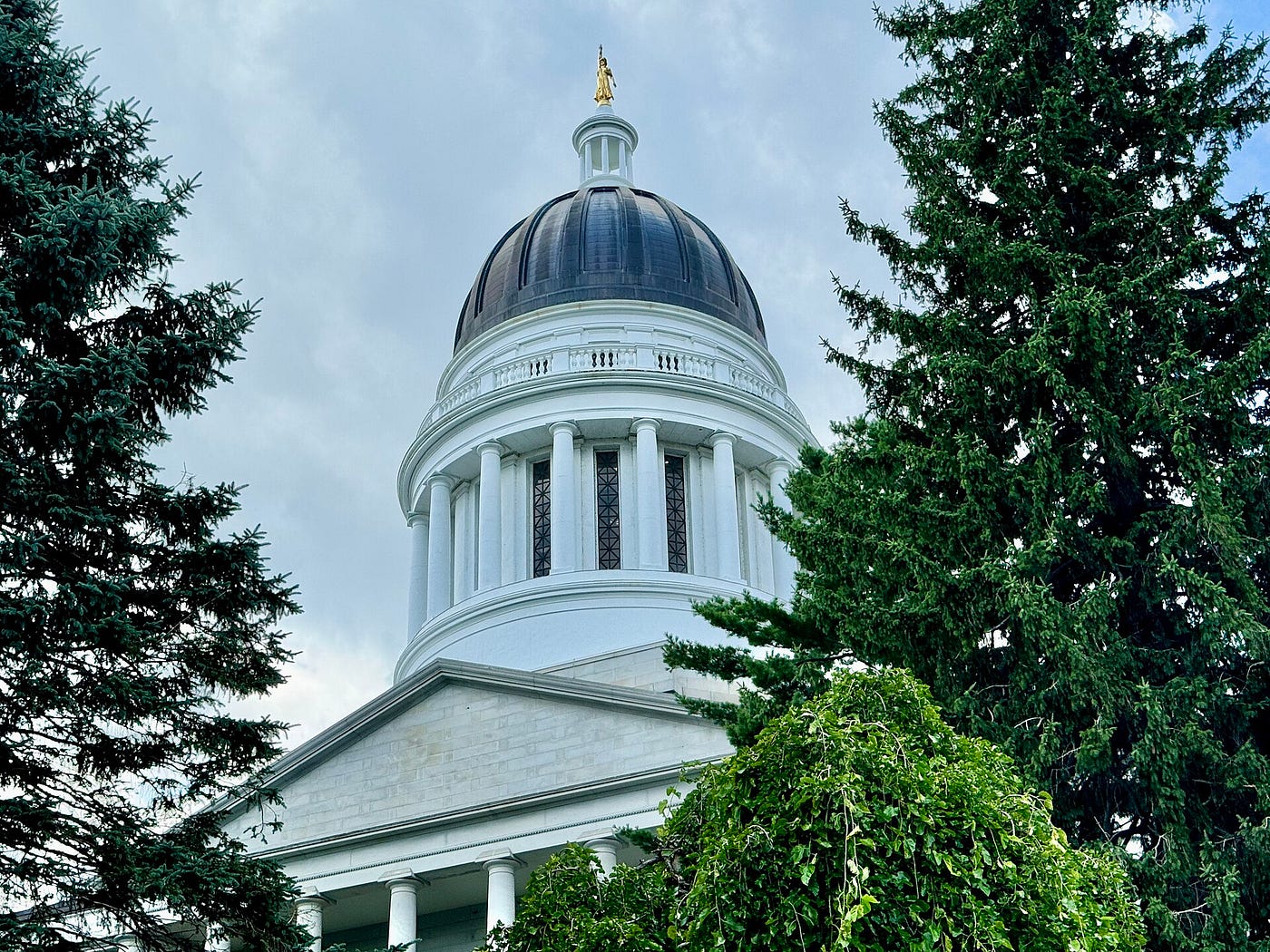
Maine State House, Augusta. Photo: w_lemay, CC BY-SA 2.0, via Wikimedia Commons.
Wins, losses, and the money behind the hate
It was a good week in the courts and abroad. In Maine, Secretary of State Shenna Bellows ruled that an anti-trans ballot measure will not appear in November, after 12,542 signatures were invalidated and left the campaign 532 short. Erin in the Morning documented the forgery and misconduct behind it, and named the machinery: the measure was bankrolled by billionaire Richard Uihlein, who put up $800,000.
The bigger wins were overseas. In Hungary, Budapest Pride will march in June for the first time since the parade was banned, after longtime prime minister Viktor Orbán was voted out this spring and the new government cleared it. In Kenya, the High Court ordered the government to begin recognizing trans people’s gender markers within 60 days.
England’s blood service reported a sharp rise in donations from gay and bisexual men under the individualized-risk model it adopted in 2021, with its own safety data showing no downside. That is the inclusive policy the people deleting public-health pages keep insisting is impossible. To round out the positive side of the news, a new ranking this week named Iceland the most trans-friendly country in Europe.
The losses abroad were real too. The UK’s equality regulator issued guidance amounting to a bathroom ban, which takes effect in 40 days without a vote. In Russia, police charged a 13-year-old with “LGBT propaganda.”
Anti-trans violence watch
Several distressing stories about trans people who were hurt or killed surfaced this week, here’s what we know. In Brooklyn, the community held a vigil for Eryka Caldwell, a 41-year-old Black trans woman fatally stabbed on May 17, where organizers spoke about why femicide “can’t be divorced from” the reality trans people face. In Kentucky, the body of Murry Foust, a 22-year-old trans man and art student, was found after a monthlong search, with a memorial scholarship now established in his name.
When these stories reach your feed, the kindest and most helpful thing you can do is separate what is known from what is rumored and uplift positive actions allies can take. If you want to do something concrete, the New York City Anti-Violence Project and Trevor Project do this work every day and are always in need of donations and volunteers.
Students take the stage
The week’s most hopeful stories came from graduation stages. In Mississippi, transmasculine salutatorian Jonas Hole delivered his address to cheers, even as administrators misgendered him and used his deadname, closing with the line that became the story: “Be yourself, no matter who tries to stop you.”
In Georgia, students elected Willow Polangco-Kenney, a trans-femme theater student, as prom king. The adults and institutions failed these kids. The kids were fine. They were the most composed people in the room.
It doesn’t stop with trans people
The CDC quietly removed its mpox-prevention guidance for the LGBTQ+ community this week, which the doctor who ran the 2022 federal mpox response called “high public health treason.” This is the same project as the healthcare crackdown, expressed through deleted data instead of denied prescriptions.
The same machinery is already reaching past trans people. This week the Department of Labor urged federal employees to report each other for doing diversity work, the kind of informant culture that accelerates authoritarianism. And the first full school year under a Texas law aimed at LGBTQ+ students just concluded, a reminder that yesterday’s headline becomes next year’s daily routine for a lot of kids. Watch how easily the same tools move from trans people to DEI to whoever is next.
The culture wars
Two readings off the cultural thermometer, pointing opposite ways. On one hand, Bad Bunny, in a piece for LGBTQ Nation, is treating his gender-bending style as protest, part of a long Puerto Rican tradition rather than a costume, and Irish singer-songwriter CMAT used her best-album win to speak up for trans people.
On the other, actor Alan Cumming told The National he feels the rising hostility “quite palpably,” and said staff at his Manhattan club have grown uneasy even in New York. This sentiment is validated by a recent homophobic attack in San Francisco’s Castro neighborhood. As the President of San Francisco’s Board of Supervisors (and my old boss), Rafael Mandelman said “People are looking to bash gays. They look for gay neighborhoods, they come to the gay neighborhoods, and we see bad things happening.”
Bad Bunny is normalizing gender fluidity to a degree I only could have imagined as a kid, and gays are still getting bashed in the Castro. Both are true at once, which is the strange duality of the moment in which we find ourselves.
The bright spot
I’ll end on the good news, because there is almost always good news worth paying attention to. The Montreal Victoire won the PWHL Walter Cup, and captain Marie-Philip Poulin scored the clincher with her wife, Laura Stacey, on the ice, reportedly the first time a married couple lifted the cup together. Seven queer players on the roster, and a pointed contrast with an NHL that still has no openly LGBTQ+ players (the only men’s professional sports league in North America that hasn’t crossed the threshold). Visibility like that is not a consolation prize. It is the thing the erasure project is trying to prevent.
That is the throughline of the whole week. The healthcare denials, the subpoena for kids’ records, the ballot measures, these are all components of the same coordinated strategy, designed to make existing as a trans person impossible faster than the courts can rule. The wins in Maine, Kenya, and Budapest prove that just as progress is not linear, no setback is permanent. And Pride Month starts tomorrow, at a time when corporate sponsors are pulling back across the country and we’re left to wonder whether we took rainbow capitalism for granted.
Rainbow Pride flag, Hillcrest, San Diego. Photo: Tony Webster, CC BY-SA 4.0, via Wikimedia Commons.
What you can do
Follow @transgenderschool on Instagram for regular updates on current events and informative posts. We’re planning at least a post a day this Pride month, each with lessons about different chapters in LGBTQ history.
Read the expanded version on our Patreon. Every Sunday we publish a longer edition there with additional subscriber-only analysis, including a deeper read this week on how the federal strategy fits together and where it is heading next. Help support what is currently a side project so we can continue to invest more time and resources into our content.
See you next Sunday.
메타데이터
- post_id
- 6bb76be28c9c
- slug
- it-was-never-about-the-kids-6bb76be28c9c
- url
- https://medium.com/@transgenderschool/it-was-never-about-the-kids-6bb76be28c9c
- canonical_url
- https://medium.com/@transgenderschool/it-was-never-about-the-kids-6bb76be28c9c
- author_url
- https://medium.com/@transgenderschool
- status
- ok
- fetched_at
- 2026-06-09 15:37:30