The Navigation Code Flowers Give Bees
By Dianthè Xue
The Navigation Code Flowers Give Bees
By Dianthè Xue
December 4, 2025
Bees are often hailed as nature’s hardest-working insects — and for good reason. Their role in pollination is pivotal to plant reproduction and ecosystem balance, making them indispensable to the natural world. As I researched insects, the way bees interact with their environment absolutely fascinated me. In this article, I want to take you into the world of bees and explore the amazing scientific principles behind their unique vision.
I. Introduction to bee’s visual systems
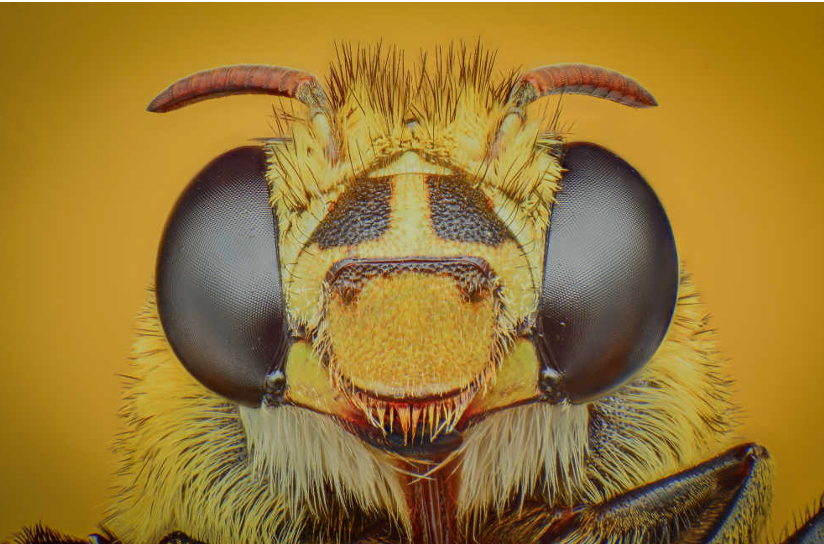
Bees have remarkable and complex visual systems, finely tuned by evolution to support tasks like navigation, foraging, and communication. Their vision is mainly built on two components: compound eyes and ocelli.

Eyes’ structures of bees
Each bee has two large compound eyes, with thousands of tiny units called ommatidia. Compound eyes firstly have wide field of view: It’s nearly 300°, allowing bees to detect predators or flowers almost all around them. Secondly, it can promise excellent motion detection. Bees process visual frames at around 200–300 Hz, far faster than humans (~60 Hz). This helps them stabilize flight and land on moving flowers. Thirdly, in terms of color vision, bees see in trichromatic UV-blue-green, including ultraviolet patterns on petals invisible to humans. This allows them to detect nectar guides and discriminate subtle flower differences.
On top of the head, bees have three simple eyes called ocelli. These ocelli aren’t like retinas in human eyes. They don’t form detailed images; Instead, they measure ambient light intensity and help with flight stability, especially during rapid maneuvers. Ocelli also contribute to sun compass navigation, allowing bees to orient even when clouds partially block sunlight.
II. The Optical Language Between Flowers and Bees
Flowers are not passive recipients of pollinators; they are visual engineers. They design signals, from color chemistry to nano-scale structures to attract bees. Here’s how the communication works.
(1) Nectar Guides
Many flowers contain flavonoids, chemical pigments that absorb or reflect UV light. To humans, these petals may look plain yellow or white. The flavonoids are concentrated in the vacuoles of the flowers’ epidermal cells. The best-known flavonoids are undeniably the anthocyanins, which provide red-purple-blue colors to most groups of plants.
Their vibrant colors originate from the molecule’s extensive conjugated π-electron system and a positively charged oxygen atom (oxonium ion). This conjugated system absorbs specific wavelengths of visible light, resulting in the rich spectrum of reds, purples, and blues.
Anthocyanin color is highly dependent on the pH of the plant cell vacuole where they are stored. In acidic conditions (common in ripe fruits like strawberries), they exist primarily as the red flavylium cation. As pH increases, they undergo structural transformations into colorless or blue quinonoidal bases. This explains how color can signal ripeness (often a pH shift) to pollinators and seed dispersers.

Chemical formula for Anthocyanin
Their bright colors provide visual cues to attract pollinators and to signal when fruit are ripe and ready to eat, so seeds may be distributed. Furthermore, their physiological roles extend beyond visual signals, and anthocyanins are produced in groups of plants lacking flowers and fleshy fruits, such as ferns.
To bees, they glow with UV patterns. Like arrows, rings, or radial lines, that point like runway lights toward the nectar source. What’s more mind-blowing is that these guides are highly resistant to camouflage. Trying to imagine, If we build an artificial flower, the bees can still be able to tell the real flower apart from the fake one.
(2) Petal Microfolds: Light-Controlling Microstructures

Flower pedals in both macroscopic and microscopic levels
The microscopic structures on flower petals, such as the convex, conical epidermal cells and fine cuticular nano ridges or striations, function as sophisticated, multi-modal devices that control both light reflection and tactile interaction for pollinators like bees. The conical cells act as micro-lenses, scattering incoming light to reduce harsh, specular glare and increase the path length of light within the pigment layer, which results in a more saturated and vibrant color signal that is easier for the bee to perceive consistently across various viewing angles.
Furthermore, in many species, the minute, semi-ordered nanoridges on the petal surface act as a diffraction grating, generating subtle iridescence — a shimmering structural color that creates a unique, highly visible ‘blue halo’ in the UV spectrum, serving as a critical optical signpost for the bee’s visual system.

Illustration of blue halo
Beyond visual cues, the textured surface provided by the conical cells also serves a crucial mechanical function by offering tactile feedback and superior grip for landing bees, allowing them to forage more effectively. In essence, evolution has transformed the flower petal into a precision optical and biomechanical instrument, finely tuned to the sensory capabilities of its primary pollinator, whose visual system is acutely sensitive to features like symmetry, contrast, and subtle reflection range.
(3) Floral Electric Fields: The Invisible Signal

Floral electric fields represent an overlooked yet pivotal sensory signal in plant-pollinator interactions, emerging as a key component of the co-evolutionary dynamics between flowering plants and pollinators like bees. These invisible fields are laid on three core explanations: the atmospheric potential gradient (APG), the triboelectric charging of bees, and the inherent electrical properties of plants.
The APG, a vertical electric field spanning the Earth’s surface and the upper atmosphere (typically ~100 V/m in fair weather), provides the foundational environmental context. As grounded organisms, plants accumulate negative charge via electrostatic induction in response to the APG’s positive atmospheric potential.
This charge distribution is not uniform across floral structures — sharp features such as petal edges, stamens, stigmas, and trichomes exhibit higher charge density due to their geometry, especially charge density is inversely proportional to surface curvature.

Finite-element modeling and electrostatic dusting experiments have visualized these heterogeneous fields, revealing that floral anatomy shapes their spatial structure, much like how petal color or shape signals resource availability.
Bees, in contrast, acquire positive charge through the triboelectric effect — frictional contact with air, floral surfaces, or their own body parts during flight.
Experiments placing bees on the triboelectric series confirm they occupy the extreme positive end, with no tested material inducing a negative charge. This positive charge, ranging from +30 to +50 pC, interacts with the flower’s negative charge, generating intense electric fields as the bee approaches the flower. These fields are far stronger than the threshold required to trigger mechanical and neural responses in bees’ sensory structures.
For pollinators, floral electric fields function as a multimodal cue that complements vision, olfaction, and touch. Bumblebees detect these fields via mechanosensory hairs on their bodies, which deflect in response to electric forces — even at field strengths as low as 0.77 V/m.
Beyond sensory detection, floral electric fields play a direct role in pollen transfer. As a positively charged bee approaches a negatively charged flower, electrostatic forces between the two bodies intensify, overcoming gravity and viscous drag to guide pollen grains. Modeling shows that pollen moves bidirectionally: from the flower’s negatively charged anthers to the bee’s positive surface, and from the bee to the flower’s receptive stigma.

This graph shows how scientists used electrostatic dusting to make the invisible electric fields around flowers visible.
First, they took five different types of flowers — Lilium (lily), Gerbera, Narcissus (daffodil), Bergenia, and Petunia. For each flower, they took a photo before doing anything (the left side of each pair) and another after dusting it with colored powder that had an electrostatic charge (the right side; the powder was blue or yellow in the bottom image).
The way the powder stuck to the flowers wasn’t random. More powder piled up in some spots than others, and this tells us something about the flower’s electric charge: the areas with more powder are where the flower had a stronger negative charge.
What makes floral electric fields a signal rather than a passive physical phenomenon is their adaptiveness. Like colors, fragrances, or nectar rewards, these fields are shaped by evolutionary pressures. Environmental factors such as humidity or wind modulate the efficacy of these signals, adding complexity to their ecological function.
III. What Is ‘Bee Purple’?
‘Bee Purple’ is a term used to describe a specific color that is highly visible and attractive to bees, but which the human eye cannot fully perceive. It is not a single, distinct color like red or blue, but rather a perceptual blend that is unique to the bee’s visual system.

Bees are trichromatic, meaning they see color by combining input from three types of color-sensitive photoreceptors, just like humans. However, the wavelengths they see are shifted. Humans see combinations of red, green, and blue light. On the contrary, bees see combinations of Ultraviolet (UV), Blue, and Green light. They lack the receptor for red light, which appears dark or black to them.
Bee purple is a color perceived by the bee’s brain when its UV-sensitive receptor and its Blue-sensitive receptor are stimulated simultaneously.
Many flowers, such as Evening Primrose and Black-Eyed Susan, have petals that absorb visible light but strongly reflect UV light in specific patterns. To a human, the flower might look plain yellow, but to a bee, the UV-reflecting area combines with the visible blue or yellow light to create patterns of “bee purple.” These patterns often form a nectar guide, directing the bee straight to the pollen and nectar reward. Because flowers rich in nectar often display colors in the blue and purple range (which includes the UV-blue combinations), bees are genetically and behaviorally primed to be highly attracted to this color.

What we see is never all that exists. The world is full of hidden colors, patterns, and signals, waiting for the right eyes to find them.
Reference:
https://livebeekeeping.com/bees/how-bees-see/
https://www.cam.ac.uk/research/news/petals-produce-a-blue-halo-that-helps-bees-find-flowers
메타데이터
- post_id
- 6bb878c262eb
- slug
- the-navigation-code-flowers-give-bees-6bb878c262eb
- url
- https://medium.com/@dianxue2009/the-navigation-code-flowers-give-bees-6bb878c262eb
- canonical_url
- https://medium.com/@dianxue2009/the-navigation-code-flowers-give-bees-6bb878c262eb
- author_url
- https://medium.com/@dianxue2009
- status
- ok
- fetched_at
- 2026-07-26 04:29:58