Mars and the Myth of Human Continuity
Colonizing another planet won’t save humanity. It will rewrite it.
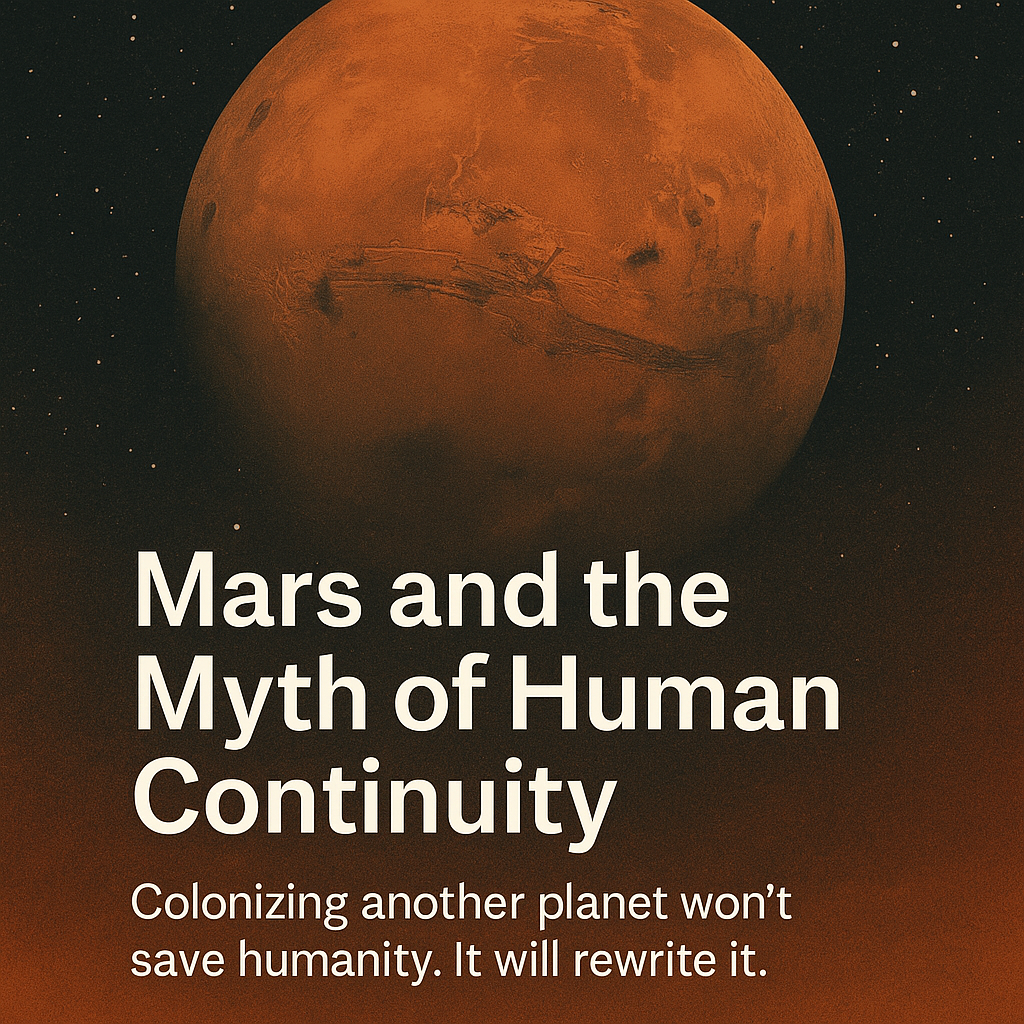
Mars and the Myth of Human Continuity
Colonizing another planet won’t save humanity. It will rewrite it.
Foreword
In an era where dreams of Mars colonization dominate headlines and inspire billion-dollar ventures, the conversation often centers on technological feasibility and survival logistics. But far less attention is paid to a deeper and more unsettling question: What exactly are we preserving when we talk about “saving humanity” by relocating it to another planet? This essay examines the philosophical, biological, and ethical implications of Martian colonization — not as a continuation of the human story, but as the quiet birth of something else entirely.
The Illusion of Continuity
To survive on Mars is to change. Everything about that world — its gravity, atmosphere, radiation levels, isolation, and distance from Earth — exerts evolutionary, psychological, and cultural pressures that we can only begin to comprehend. The first Martian settlers may carry Earth in their memories, muscles, and genomes, but their children will not. And their grandchildren? They may remember Earth the way we remember Eden: as myth.
We evolved over millions of years in Earth’s biosphere, finely tuned to its rhythms, pressures, gravity, and sunlight. Mars, by contrast, is an alien crucible. Long-term habitation there will necessitate not only physical adaptation but likely biomedical intervention: gene therapies, synthetic biology, artificial wombs, closed-loop nutrition systems. The beings born of such a system may be of human ancestry, but they will not be human in the full sense we understand today. Over generations, divergence is inevitable — biologically, psychologically, socially.
Even language, timekeeping, emotional expression, and social norms would begin to drift. A child born in a Martian dome, raised under artificial light, breathing synthetic air, would develop in an environment entirely foreign to all of human evolutionary history.
The Soft Dishonesty of the Mars Narrative
This reality is not lost on the scientists, engineers, and planners involved. Astrobiologists and space ethicists are aware of it; geneticists foresee it. And yet, it is rarely mentioned in the TED talks, whitepapers, or visionary manifestos of space entrepreneurs. Instead, the narrative remains wrapped in the comforting language of continuity. “We must ensure the survival of humanity,” we are told. The subtext — that what survives will no longer be us — is elided.
There is also an ideological layer: the myth of human continuity supports political and financial support. It is easier to fund a rescue mission than an experiment in post-human development. If space colonization were openly framed as a speculative break with human history, it might lose its mass appeal.
Survival vs. Identity
To survive is not necessarily to endure as we are. This distinction is crucial. When proponents of Martian colonization invoke the survival of the species, they often conflate biological persistence with civilizational continuity. But these are not the same.
The colonists of Mars may carry our DNA, our technologies, even our myths — but they will not carry our identity. In time, they will develop their own. The idea that we are “saving humanity” is comforting, but false. We are, at best, ensuring that something descended from humanity continues — in the same way that we are descended from Australopithecus.
The Ethics of Speciation
If we are consciously initiating the rise of a post-human species, do we not owe the public an honest reckoning? Should the myth of human continuity not be replaced with the truth of human transformation?
This is not merely a scientific concern, but a moral one. The children born on Mars will not have consented to their altered biology or their exile. Their inheritance will be engineered. And perhaps most provocatively: will they remain under the ideological control of Earth’s legacy, or evolve freely?
The Martian Mirror
Mars will not just shape the people who go there — it will reflect back to us who we really are. Our desire to “save” humanity by exporting it reveals a deep ambivalence about ourselves. Are we worth saving? Or are we already imagining a future in which something better takes our place?
What we send to Mars may carry our name. But what grows there will eventually forget it.
Conclusion: What Are We Becoming?
To send humans to Mars is an act of profound ambition. But we must stop pretending it is an act of preservation. It is, rather, a deliberate step into the unknown — not the salvation of our species, but the seeding of its successor.
And perhaps, if we can embrace that truth, we can begin to ask the deeper questions: not How can we survive?, but What are we becoming?
And if we are indeed becoming something else, then perhaps the final frontier is not Mars, but the courage to accept that we were never meant to last forever — only to leave something behind.
메타데이터
- post_id
- 6bbc8a882eed
- slug
- mars-and-the-myth-of-human-continuity-6bbc8a882eed
- url
- https://medium.com/crossing-thresholds/mars-and-the-myth-of-human-continuity-6bbc8a882eed
- canonical_url
- https://medium.com/crossing-thresholds/mars-and-the-myth-of-human-continuity-6bbc8a882eed
- author_url
- https://medium.com/@karl.altmann
- status
- ok
- fetched_at
- 2026-07-24 18:36:52