Google just standardized “How AI Agents read the web”. Here’s how we shipped it in a day.
Open Knowledge Format (OKF) v0.1 is live — and so is our support for it.
Google just standardized “How AI Agents read the web”. Here’s how we shipped it in a day.
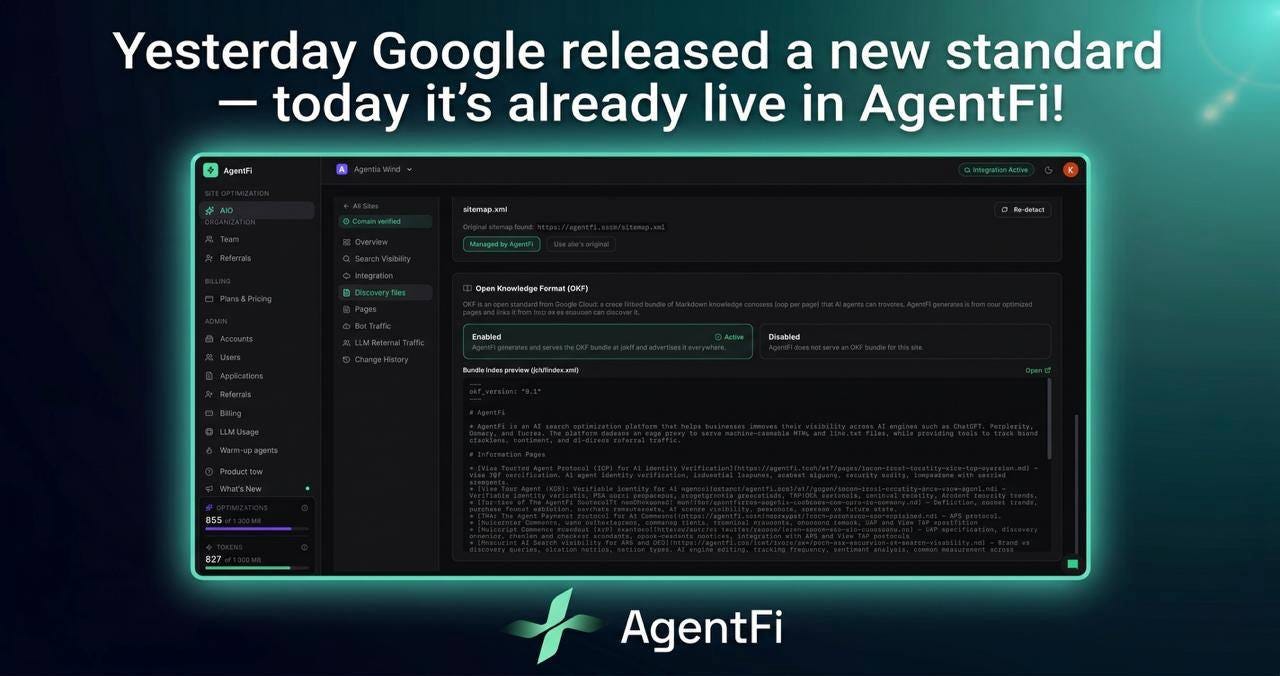
Open Knowledge Format (OKF) v0.1 is live — and so is our support for it.
There’s a quiet shift happening on the web. The primary reader of your content is no longer a person scrolling — it’s a machine. LLM crawlers and AI agents now account for a massive and growing share of web traffic and they don’t consume content the way humans do. They don’t browse. They retrieve, reason and cite.
For the past year, the web’s answer to this has been llms.txt. As of last week, there’s a more ambitious answer too: Open Knowledge Format (OKF), released by Google Cloud on June 12, 2026. We built support for it the next day. This is the story of what changed, why it matters and what you should do about it.
The problem: AI agents are reading a web built for humans
Your website was designed for human eyes — navigation menus, hero images, marketing copy and content scattered across dozens of pages held together by visual layout. None of that helps an AI agent. When a model tries to answer a question using your site, it has to scrape everything, guess what’s canonical and hope it cited the right thing.
The result is the problem every brand is now waking up to: you can be crawled without being cited correctly. Getting found is no longer the hard part. Being represented accurately in ChatGPT, Perplexity, Gemini and Claude is.
llms.txt: the map
In September 2024, Jeremy Howard proposed a simple, elegant fix: a single Markdown file at the root of your site called llms.txt.
The structure is minimal. An H1 with your project name, a short summary in a blockquote and H2 sections listing links to your most important pages with brief explanations. That’s it.
The idea is to stop forcing models to scrape your entire site and instead hand them a curated index: here are the canonical sources, here’s what’s worth citing. Many in the SEO and product community came to think of it as the AI-era equivalent of sitemap.xml and robots.txt rolled into one. Teams that adopted it through 2025 reported real gains in long-tail citations across Perplexity, ChatGPT Search and Claude.
But here’s the key limitation: llms.txt is a pointer, not the knowledge itself. It tells an agent where to look. It doesn’t structure what the agent finds when it gets there.
OKF: the library
That’s the gap Google Cloud engineers Sam McVeety and Amir Hormati set out to close with the OKF v0.1 specification.
Instead of a single file, OKF is a directory — a bundle of Markdown files. Each file represents exactly one concept: a database table, a metric, an API endpoint, a playbook, a dataset. Every concept carries a minimal YAML frontmatter block of metadata:
---
type: BigQuery Table
title: Orders
description: One row equals one completed customer order.
resource: https://console.cloud.google.com/...
tags: [sales, revenue]
timestamp: 2026-05-28T14:30:00Z
---
Below the frontmatter sits ordinary Markdown — headings, tables and crucially, links to other concepts.
Those cross-links are the whole point. They turn a flat folder of files into a genuine knowledge graph. An agent doesn’t read your content as disconnected text; it traverses it by relationship, following the connections between a metric and the table it comes from or an endpoint and the playbook that uses it. That’s far closer to how an agent actually reasons.
OKF didn’t invent this pattern — the “LLM-wiki” approach already showed up in tools like Obsidian and conventions like AGENTS.md. What Google did was formalize it into an interoperable, open standard with no lock-in to its own cloud. The full spec fits on a single page; you can hand it directly to your own AI agent.
They don’t compete — they pair
This is the part people get wrong. OKF is not a replacement for llms.txt and you don’t need to migrate off one to adopt the other.

llms.txt — OKF
The conclusion is simple: llms.txt is the pointer. OKF is the library. The ideal setup is to use both — and link to the root of your OKF bundle (say, /okf/index.md) from inside your llms.txt. Pointer leads to library.
Why we shipped it in 24 hours
At AgentFi, this is the exact problem we exist to solve: moving the web from human-first content to machine-readable knowledge. Our platform analyzes your site, generates your llms.txt and llms-full.txt, deploys them at the edge and tracks how often you actually get cited across ChatGPT, Perplexity, Gemini and Claude.
So when Google published OKF, supporting it wasn’t a roadmap debate — it was the obvious next move. A pointer is good. A pointer that leads to a structured knowledge graph is better. Adding OKF generation to what we already do means your data reaches agents not as a list of links, but as a connected, traversable library.
Spec published June 12. Live in AgentFi June 13.
What you should do this week
If you haven’t adopted llms.txt yet, start there — it’s the lowest-effort, highest-leverage move for AI visibility right now. If you already have it, the next step is to layer OKF underneath it: structure your most important concepts as a bundle and link to it.
The agentic web is being built right now, on top of standards being written this month. The brands that get represented accurately in AI answers a year from now are the ones structuring their knowledge today.
Want to see how your site looks to an AI agent — and get your llms.txt and OKF bundle generated automatically? Try it at **agentfi.tech**.
메타데이터
- post_id
- 6bbfd3024320
- slug
- google-just-standardized-how-ai-agents-read-the-web-heres-how-we-shipped-it-in-a-day-6bbfd3024320
- url
- https://medium.com/@AgentFitech/google-just-standardized-how-ai-agents-read-the-web-heres-how-we-shipped-it-in-a-day-6bbfd3024320
- canonical_url
- https://medium.com/@AgentFitech/google-just-standardized-how-ai-agents-read-the-web-heres-how-we-shipped-it-in-a-day-6bbfd3024320
- author_url
- https://medium.com/@AgentFitech
- status
- ok
- fetched_at
- 2026-06-22 05:41:33



