MIT and Columbia Researchers Just Cracked the Code on Amazon’s AI Shopping Algorithm
New research reveals the exact formula for winning in the Rufus era, and it’s not what most sellers think
MIT and Columbia Researchers Just Cracked the Code on Amazon’s AI Shopping Algorithm
New research reveals the exact formula for winning in the Rufus era, and it’s not what most sellers think
A joint research team from MIT and Columbia University just did something Amazon sellers have been dreaming about: they reverse-engineered how to rank in Amazon’s AI-powered shopping experience.
The study, published in November 2025, effectively simulates the Rufus environment using 52,165 real Amazon product listings paired with complex user queries. Their goal was ambitious but clear: find the mathematical formula for visibility in the AI-shopping era.
What they discovered should fundamentally change how you think about Amazon optimization.
The Heatmap That Changes Everything
The researchers created visualization heatmaps that reveal something striking about what separates winners from losers in AI-driven product discovery.
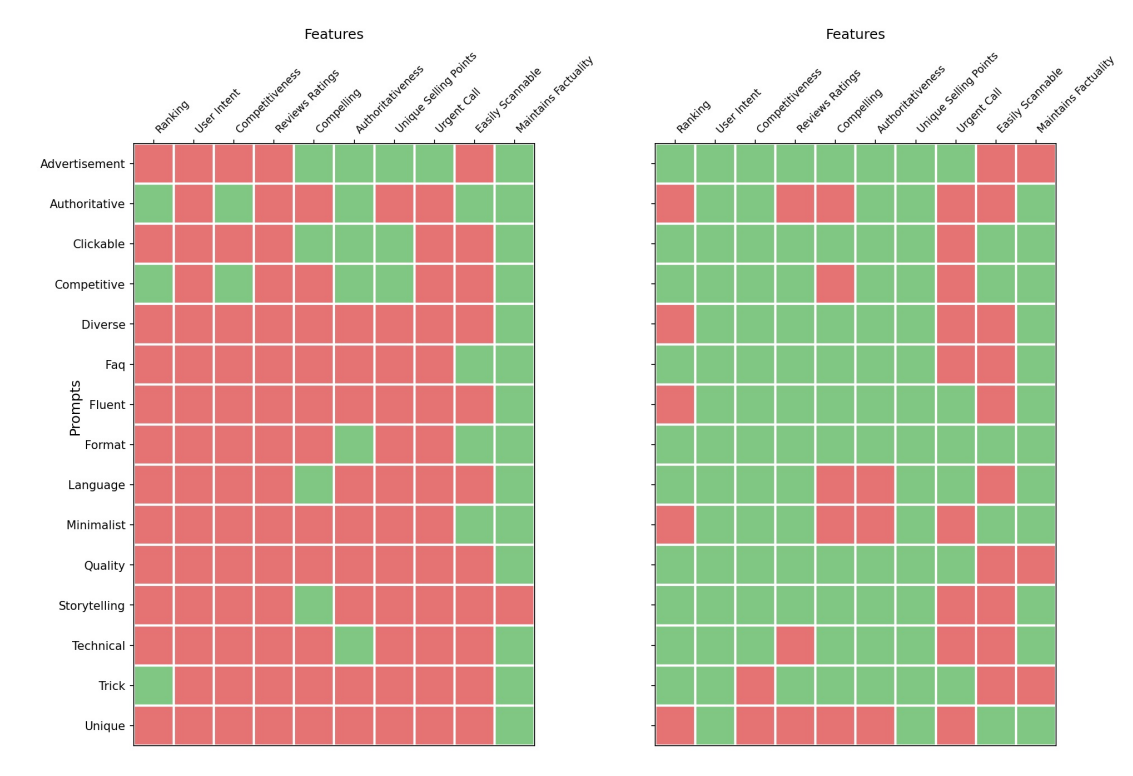
On the left side of their analysis, you see human optimization strategies. Messy, scattered, with red and green dots sprayed across the chart. This represents the chaos of traditional Amazon SEO: keyword stuffing here, random bullet point optimization there, inconsistent approaches everywhere.
On the right side? A completely different picture.
The AI optimization process forces all winning Amazon listings to converge on the exact same DNA. Solid green. Uniform. Predictable.
This isn’t random. It’s proof that there’s a specific formula at work.
Keyword Stuffing Is Dead
If you’re still cramming keywords into your titles and bullet points, stop.
The research makes it clear: to rank in a Rufus-driven world, your content must strictly adhere to what the researchers call a “Universally Effective Strategy.” This isn’t about gaming an algorithm. It’s about genuinely serving the AI’s understanding of what shoppers actually need. Moreover, as referenced in the study, “a large empirical literature shows that higher rankings translate strongly into increased clicks, conversions, and revenue, making GEO performance readily interpretable in economic terms.” As shown below, a GEO module rewrites product descriptions to enhance placement in generative-engine rankings.

Here’s what wins:
1. User Intent Alignment Answer why they searched, not just what they searched for. The AI is trying to understand the problem behind the query.
2. Direct Competitiveness Compare features against alternatives. The AI is helping shoppers make decisions, so give it the comparison points it needs.
3. Strict Factuality Zero fluff. Rufus appears to penalize vague claims and marketing speak. Specifics win.
4. Authoritativeness Use a confident, expert voice. The AI is evaluating credibility, not just keyword presence.
5. Easy Scannability Strict use of headers and bullet points. This isn’t just about human readability. It’s about AI parsing.
6. Unique Selling Points Focus on clear differentiation. What makes you different from the other 50 products the AI is considering?
7. External Evidence Leverage reviews and ratings for proof. The AI isn’t just reading your listing. It’s weighing social proof.
Here is their full list of “Features of Interest in Optimized Prompts.”

This Aligns With Everything We Know About AI Optimization
What’s fascinating is how closely this Amazon-specific research mirrors the broader frameworks emerging in Generative Engine Optimization (GEO) and Answer Engine Optimization (AEO).
The original GEO research from Princeton found that content with statistics, citations, and quotations increased visibility by up to 40% in AI-generated responses. The Amazon findings echo this: fact-density and external evidence outperform generic marketing claims.
The E-E-A-T framework (Experience, Expertise, Authoritativeness, Trustworthiness) that Google has emphasized for years? It turns out Amazon’s AI is looking for the same signals. Content that demonstrates genuine expertise gets surfaced. Content that reads like it was written by someone who’s never touched the product gets buried.
Recent AEO research shows that content with clear, direct answers in the first 40–60 words performs significantly better in AI citation. The Amazon study’s emphasis on “strict factuality” and “easy scannability” suggests Rufus operates on similar principles.
What This Means for Amazon Sellers
The implications are significant.
For years, Amazon success was about understanding A9, the traditional search algorithm that weighed keywords, sales velocity, and relevance signals. Sellers who mastered these mechanics thrived.
Rufus changes the game entirely.
AI shopping assistants don’t just match keywords to queries. They understand context, evaluate credibility, and simulate the decision-making process of a knowledgeable shopping assistant. They’re asking: “Would a smart friend recommend this product for this specific need?”
The sellers who will dominate in 2026 and beyond are those who stop optimizing for an algorithm and start optimizing for an AI that thinks like a discerning shopper.
This is the same shift happening across all of search. Traditional SEO is evolving into what practitioners are calling the “citation economy.” The goal is no longer just to rank. It’s to be trusted enough to be cited, quoted, and recommended.
Where to Go From Here
The research paper is publicly available for those who want to dig deeper: Read the full study and referenced sources.
But don’t stop there.
If you want to stay on the bleeding edge, read the patents. Study Amazon’s science publications on COSMO (their conversational shopping model). Follow the research. Look into the emerging GEO and AEO frameworks that are shaping how brands think about AI visibility across platforms.
The landscape is shifting fast. The sellers who invest time in understanding these fundamentals, not just chasing tactical hacks, will be the ones still thriving when the next wave of AI innovation hits.
School isn’t out for the pros.
메타데이터
- post_id
- 6bc7a3df798e
- slug
- mit-and-columbia-researchers-just-cracked-the-code-on-amazons-ai-shopping-algorithm-6bc7a3df798e
- url
- https://medium.com/@stefanobettaniPhD/mit-and-columbia-researchers-just-cracked-the-code-on-amazons-ai-shopping-algorithm-6bc7a3df798e
- canonical_url
- https://medium.com/@stefanobettaniPhD/mit-and-columbia-researchers-just-cracked-the-code-on-amazons-ai-shopping-algorithm-6bc7a3df798e
- author_url
- https://medium.com/@stefanobettaniPhD
- status
- ok
- fetched_at
- 2026-06-09 15:37:30