Moats in the Age of AI: Where Advantage Goes When Everyone Can Build
Physical infrastructure, permission, liability, workflow control, and live outcome data. A strategist’s field guide to enterprise…
Moats in the Age of AI: Where Advantage Goes When Everyone Can Build
Physical infrastructure, permission, liability, workflow control, and live outcome data. A strategist’s field guide to enterprise defensibility after the cost of code collapsed, with Porter’s Five Forces reworked, the stock-to-flow moat shift, and a board-level moat scorecard.
tl;dr — AI collapsed the cost of writing code by roughly 40x between 2023 and 2026, and with it the oldest moat in software. When anyone can build the feature, the feature stops protecting the business. This piece maps where defensible advantage actually goes next: physical infrastructure and power, regulatory permission, balance-sheet capacity, workflow control, network liquidity, and outcome data that compounds every time you use it. Buffett’s castle still stands. The water just moved. Inside: Porter’s Five Forces reworked for agents, the shift from stock moats to flow moats, a board-level moat scorecard, industry-by-industry breakdowns, and a playbook for auditing your own defensibility before a competitor with a frontier API does it for you.

Warren Buffett spent forty years describing great businesses as economic castles ringed by moats that keep competitors from wading in. For most of the software era, the moat was the code itself. Writing enterprise software was slow, expensive, and risky to replace, so the difficulty of building it became a wall that protected margins, pricing, and customer relationships.
That wall is thinner now. Between 2023 and 2026, the price of frontier-model inference (the cost of running a trained model to produce an output) fell by roughly a factor of forty, with published model APIs moving from about sixty dollars per million output tokens in 2023 toward well under a dollar in 2026 [1], [2], [15]. Agentic coding tools (AI systems that plan and execute multi-step programming tasks with limited human help) can now scaffold applications, refactor databases, translate schemas, and write tests that small teams used to spend months on [3]. When the marginal cost of generating software approaches zero, a product built mainly on the difficulty of writing software loses the thing that made it defensible.
The mistake worth avoiding is concluding that AI kills moats. It does something more specific and more useful to understand. It relocates them. As the ability to produce code, content, and generic analysis becomes abundant, durable advantage migrates toward assets that resist digital replication: power and compute, regulatory permission, balance-sheet capacity, workflow control, network liquidity, institutional trust, and data that compounds through live operation. This piece works through that migration in detail, defines the vocabulary as it goes, tests the evidence on both sides, and ends with a playbook and scorecard you can run against your own product lines. Research cutoff for current claims is July 16, 2026.

Part I. The Moat Problem
1. What a moat actually is
An economic moat is a structural condition that lets a firm sustain returns above its cost of capital by making entry, imitation, substitution, customer defection, or value appropriation by suppliers materially harder [4], [7]. The test is durability of excess returns, not product quality. A clean interface is a feature. A talented team is a capability. A six-month head start is timing. None of those is a moat unless it connects to something harder to copy.
The classic structural moats catalogued in industrial-organization economics are network effects, high switching costs, intangible assets such as brands, patents, and licenses, cost advantages, and efficient scale [4]. Software historically inherited a moat for free, because code was costly to write and painful to migrate. A useful way to feel the difference: an intuitive AI interface is a feature, while the legally mandated cost of migrating off a government-accredited classified network is a moat [24]. AI attacks the first category and leaves the second largely intact.
What this means. High margins and fast growth can reflect a temporary capability lead or plain market power rather than a barrier to entry. Leaders who assume their software complexity substitutes for structure are carrying more risk than their income statement shows.

2. What AI makes abundant
Foundation models (large, broadly capable models trained on massive datasets and adapted to many downstream tasks) plus open-weight ecosystems have collapsed the labor required for four things: software creation, content synthesis, generic professional knowledge, and routine business-process automation [1], [8]. Code generation, refactoring, and test writing now run semi-autonomously [3]. Many business processes turn out to be inferable from public information, which erodes the value of ordinary domain expertise.
Producing an output and producing a reliable outcome are different problems, and the gap between them is where value now lives. The evidence is consistent on this. In a large customer-support field study, access to a generative assistant raised issues resolved per hour by about fifteen percent on average, with the largest gains going to less experienced workers [8]. A later cross-industry randomized experiment found meaningful time savings on email and routine documents, while coordination-heavy work such as meetings barely moved [9]. A 2026 meta-analysis found moderate positive effects on programming productivity overall, with smaller gains in open-source and enterprise settings than in controlled experiments [10]. METR’s own developer-productivity work has cautioned that self-reported and experimental estimates carry selection bias and can overstate real-world uplift [14].
Agent benchmarks tell the same story from the reliability side. On WebArena, a realistic web-task environment, strong model-driven agents finished well below human performance on end-to-end tasks [11]. GAIA was built to test assistants on jobs that are simple for people but messy for machines, and early systems fell far short [12]. Gaia2, a more dynamic successor, still reports modest pass rates for state-of-the-art systems in asynchronous environments [13].
What this means. The cost of a prototype fell faster than the cost of a governed production system. AI compresses ideation and drafting. Integration, reliability, security review, exception handling, verification, and accountability stayed expensive [3].
3. Why traditional moats are weakening
Several classical advantages are degrading fast:
- Software features. The marginal cost of copying digital logic approaches zero as agentic developers reproduce features in days [3].
- Static proprietary datasets. Broad-corpus models and synthetic data can proxy reasoning once derived from historical hoards [6].
- Conventional SaaS switching costs. Migration pain used to rest on schema translation and retraining. Agents automate much of that [3].
- Generic subject-matter expertise. Basic consulting scripts and Tier-1 support are easy for models to replicate [8].
The cleanest cautionary case is Chegg. The edtech company spent a decade accumulating a proprietary library of textbook answers, a textbook stock-data moat. Within roughly thirty-nine months of ChatGPT’s launch, students routed around the subscription to free generative explanations and search-engine AI overviews, and Chegg lost close to ninety-nine percent of a fourteen-billion-dollar valuation [16]. The moat did not erode slowly. It evaporated.
What this means. If a competent engineer with a frontier API can reproduce your value proposition in a week, you hold a legacy distribution advantage on a countdown, not a structural barrier.
4. From stock moats to flow moats
This is the single most important reframing in the report, so it earns its own definitions.
A stock moat is an asset accumulated in the past: a legacy codebase, a historical dataset, a patent portfolio, a plant, a license. A flow moat is an advantage regenerated continuously by operating the business: fresh outcome labels, denser network liquidity, new fraud signals, more workflow context, faster evaluation cycles [5], [58].
AI accelerates the imitation half-life of static assets, so stock moats that are easy to digitize decay quickly. Flow moats hold because the training signal exists only if you control the workflow that produces it. A support agent that rewrites its own resolution playbook from live success and failure data compounds an advantage that a rival cannot buy off the shelf by licensing the same base model [5].
DECISION -> ACTION -> REAL-WORLD OUTCOME -> LABEL & EVALUATE
   ^                                                 |
   |_________ POLICY / MODEL / PROCESS UPDATE _______|
Stock moat = what you own at one instant.
Flow moat = what you accumulate per unit of time,
because you control the loop that
generates the outcome label.What this means. Redesign data architecture so every customer interaction makes the next one measurably better, and secure the contractual right to reuse those outcomes. Ownership at a single moment matters less than accumulation per unit of time.

Part II. What Remains Scarce
5. Atoms, physical infrastructure, and installed capacity
Software is infinitely replicable. Power, silicon, land, and interconnection are not. A language model cannot conjure a substation, a fab, or a right-of-way permit.
The capital numbers make the constraint concrete. Hyperscaler infrastructure spend is projected near six hundred ninety billion dollars in 2026 [17]. Microsoft alone planned roughly eighty billion dollars of AI-enabled data-center investment in a single fiscal year [20]. Even OpenAI, sitting at the frontier, added Google Cloud capacity to meet compute demand, which shows that model leadership does not remove infrastructure dependence [21]. TSMC expanded its US semiconductor commitment by another hundred billion dollars in response to AI demand [22].
Energy has become a binding constraint rather than a line item. EPRI estimated US data centers could consume up to nine percent of national electricity by 2030 under high-growth scenarios [19]. In 2024, Constellation Energy signed a roughly 1.6 billion dollar, twenty-year power purchase agreement with Microsoft to restart the Crane Clean Energy Center, the former Three Mile Island Unit 1, specifically to feed AI data centers [18]. By July 2026, New York imposed a statewide one-year moratorium on new large data centers over energy, water, and community concerns [23]. Permits and megawatts are now strategic assets.
What this means. Firms holding installed capacity, grid interconnection, and supply-chain access own a form of absolute scarcity. Asset-light models disrupt software; they cannot route around the physics of compute and energy. These moats are getting stronger.
6. Permission, rights, and institutional access
An AI can draft a banking contract. It cannot legally hold deposits. Permission assets, which are licenses, approvals, certifications, and clearances that grant the right to operate in a restricted domain, remain human and institutional [37].
FedRAMP illustrates the wall. The Class D authorization (formerly High) for cloud workloads requires more than four hundred security controls and agency sponsorship [24]. Plenty of startups hold strong models, yet only a small set of hyperscalers and defense contractors clear the bar to run classified workloads. The point sharpens in practice: in 2026 the Department of Defense expanded classified AI work to eight companies while a well-known frontier lab sat outside that particular circle amid an ongoing dispute, which shows that model capability and operating permission are separate assets [57]. No amount of clever code compiles its way past federal accreditation.
What this means. Treat permission as an exclusive, non-transferable asset and accumulate it deliberately: FedRAMP, FDA clearance, SOC 2, exclusive distribution rights. As software barriers fall, credentialing becomes the primary mechanism for blocking AI-native entrants.
7. Capital, balance sheet, and risk-bearing capacity
Analyzing risk got cheap. Absorbing risk did not. A model can underwrite a policy flawlessly, and originating that policy still requires a capitalized balance sheet to fund it and pay claims [32].
Low-cost funding, credit capacity, and working capital are durable advantages. In lending and insurance, the model supplies decision support while the enterprise intermediates the transaction with its own capital. As intelligence trends toward free, the relative value of capital efficiency and counterparty confidence rises. Apple offers a live example of the limit of interface strength: it discontinued its in-house Apple Pay Later product and shifted toward lending partners, which suggests that owning the consumer interface does not automatically confer underwriting, merchant integration, compliance, and balance-sheet discipline [43].
What this means. Advice is cheap and guarantees are expensive. A firm with a deep balance sheet can attach warranties, indemnities, and performance commitments to AI outputs that an unfunded startup cannot match. The balance sheet standing behind the algorithm carries the weight.
8. Trust, accountability, and liability
Cheap generation multiplies the number of possible mistakes, which makes verification and liability absorption more valuable, not less. In healthcare, when an AI suggestion contributes to a misdiagnosis and delayed treatment, liability lands on the institution and the physician, not the model provider [37], [38]. The established standard of care restricts unsupervised autonomous agents in clinical settings [38].
Small legal cases carry large strategic weight. A US appeals court rebuked a lawyer for submitting fabricated, hallucinated case citations [46]. Air Canada was held responsible for incorrect bereavement-fare information its chatbot gave a passenger, and had to pay [47]. Once a model’s output crosses from suggestion into representation or action, somebody has to stand behind it. That somebody becomes a moat when the firm has the auditability, legal discipline, and willingness to absorb the mistake.
What this means. Customers pay a premium to a provider that indemnifies them against hallucination, infringement, and operational failure. Reputation, audit trails, and legal structure become a service wrapper that a thinly capitalized entrant cannot replicate.
9. Distribution and ownership of demand
When supply goes to infinity, whoever owns the demand interface captures the value. As AI floods every category with content and applications, scarce customer attention becomes the bottleneck.
Amazon’s shopping agent, Alexa for Shopping (formerly Rufus), makes the dynamic visible. It intercepts a query, summarizes reviews, and recommends products inside the chat, often bypassing traditional search listings [39], [40]. Ask an agent for the best durable running shoe and it weighs reviews and price without ever surfacing brand marketing. Payment networks are moving to sit at the same chokepoint from the other side: Visa connected its network into ChatGPT so agents can shop and pay on a user’s behalf, an attempt to own settlement even as discovery shifts to agents [27].
What this means. Protect direct customer relationships with real intent. Default placement, ecosystem partnerships, and a trusted branded interface keep a firm from being demoted to a commodity API sitting behind someone else’s agent.
10. Network effects, standards, and liquidity
A network effect exists when a product grows more valuable as more participants use it. An agent can scrape a marketplace, and it cannot easily replicate liquidity (the density of buyers and sellers that makes transactions seamless) or the trust between them.
Payments show the cleanest version. Visa reported preventing roughly forty billion dollars of fraudulent transactions in 2023, backed by hundreds of millions of dollars in AI and data infrastructure [25]. Mastercard’s acquisition of Recorded Future added threat intelligence to the same logic: transaction networks are defended by fraud data and trust tooling, not scale and brand alone [26]. Adyen’s published off-policy evaluation work is the sharpest illustration, showing how a payments platform can use billion-scale historical transaction data to evaluate and improve recommendations before running live experiments, exactly the outcome-linked flywheel that cannot be purchased as a static file [28], [29]. A startup can build a fraud model, and without the live signal from millions of participants it starves for the fresh, diverse data the model needs.
What this means. Copying an interface is easy and reproducing participant liquidity is hard. Use AI to strengthen existing networks, turning cross-customer data into systemic improvements a single-tenant deployment cannot match.

Part III. What Compounds
11. Outcome-labeled data flows
Data earns defensibility on two conditions: competitors cannot obtain a substitute, and it improves a decision that changes a customer outcome. Raw volume matters less than causal relevance and operational feedback [29].
Outcome-labeled data links a prediction to the verified real-world result after an action. Upstart underwrites personal loans and continuously ingests actual repayment and default outcomes across changing macroeconomic conditions, recalibrating its models against its own macro index rather than a licensed generic dataset [30], [31]. Lemonade runs a tight loop between its lifetime-value model and customer acquisition, which helped drive its loss ratio to roughly sixty-two percent [32]. Licensing financial data cannot reproduce either loop, because the label only exists inside the workflow that produced the outcome.
What this means. Close the decision-action-outcome loop and secure the contractual rights to reuse it. When your system makes a recommendation, capture whether the user followed it and whether the result succeeded.
12. Encoded context and workflow control
As features become reproducible, defensibility moves from the interface to deep workflow integration. A system of record (the authoritative store of business data) holds organization-specific context: legacy architecture, undocumented customizations, permission hierarchies, and idiosyncratic business rules [6].
Agents need that exact context to act. An AI cannot reconcile an invoice without knowing a specific company’s approval policy. Encode that context and embed into the core workflow, and you rebuild switching costs on a new foundation. Epic’s position in healthcare shows the strength and the scrutiny it attracts at once: a US judge allowed antitrust claims to proceed on allegations that Epic controls access to the medical records of most Americans [35]. Whether or not every allegation holds, the strategic reading is plain, and control of the workflow through which information, permissions, and downstream processes move is far more defensible than the visible interface. Palantir’s growth expresses the same logic from the government and commercial side, where embedded operational workflows plus security and compliance compound over time [45].
The vocabulary worth internalizing runs system of record, then system of decision (software that shapes choices), then system of action (software that executes or triggers real work). Value climbs as you move toward action.
What this means. Being authorized to execute inside a specific enterprise beats knowing how the industry generally operates. Move from systems of record to systems of action and embed AI into the customer’s operational nervous system.
13. Institutional learning velocity
Dynamic capability theory holds that firms win by sensing change, seizing opportunity, and reconfiguring internal competencies faster than rivals [5]. In the AI era, that shows up as learning velocity.
Learning velocity is the rate at which an organization deploys an experiment, evaluates the errors, codifies the tacit knowledge needed to fix them, and pushes an updated model or policy into production. It runs on human-in-the-loop governance, instrumentation, and change management. AI speeds up the coding step, and institutional friction often controls the deployment step, which is where the real clock runs.
Klarna is the cautionary data point. The company cut marketing and support costs quickly with generative AI [41], then hit quality problems and rebuilt human capacity for sensitive cases, a pattern broader call-center reporting confirms [42]. Fast automation without quality control damaged trust, which is the asset the automation was supposed to serve.
What this means. Speed alone is not a moat, and the capability to compound learning faster than rivals, with governance intact, is a structural advantage. Convert individual expertise into institutional evaluations, policy engines, and automated tests.
14. AI cost position and operational scale
Running AI at scale creates its own economics. Sending every query to a frontier model produces unsustainable token bills. Scale advantages emerge from multi-model routing, caching, and fine-tuned smaller models. Route hard reasoning to a premium model and cheap classification to an open-weight model, and total cost of ownership drops sharply [15]. Large incumbents amortize the fixed cost of routers and evaluation harnesses across millions of users, driving marginal cost per successful outcome below what a startup can reach.
# Illustrative multi-model routing logic (cost position as a moat)
def route(task):
    if task.type == "classification" and task.risk == "low":
        return "open-weight-slm"        # ~$0.20 / 1M output tokens
    if task.needs_deep_reasoning:
        return "frontier-model"         # ~$15.00 / 1M output tokens
    if cache.has(task.signature):
        return "cache"                  # ~$0.00, served from prior result
    return "mid-tier-model"             # balance of cost and quality
# The moat is not any single model.
# It is the router + eval harness + cache, amortized over scale,
# that pushes cost-per-successful-outcome below a rival's floor.
What this means. Cost position is still a moat. Master efficient inference and multi-model orchestration and you operate profitably at price points that starve less disciplined competitors.
15. Counter-positioning and business-model advantage
Counter-positioning is a new entrant adopting a superior business model that the incumbent cannot copy without cannibalizing its own revenue [6]. AI aims this weapon squarely at per-seat SaaS pricing. If AI makes each worker productive enough to cut headcount, seat-based revenue shrinks with the customer’s payroll.
The market is repricing accordingly. By 2026, a large majority of SaaS companies had moved to usage-based or hybrid pricing [51], and vendors such as Intercom and HubSpot shifted toward charging per successful AI resolution, aligning revenue with delivered value [50], [52]. Klarna’s public statements about shrinking its workforce from thousands toward a far smaller number sharpen the stakes for any vendor whose revenue rides on seat count [53].
What this means. Stress-test pricing against AI-driven headcount reduction now. Hybrid and outcome-based pricing may compress margin short term, and it blunts a counter-positioned entrant before that entrant reaches scale.
16. Moat stacks and control-point ownership
Single advantages get bypassed. Durable defensibility comes from a moat stack, a mutually reinforcing set of advantages, anchored on control points, which are nodes in a value chain where a firm governs access, authorization, or settlement.
Combine physical assets with software intelligence, as Siemens does by pairing industrial controllers with AI digital twins (live virtual models fed by sensor data) that predict equipment failure thirty to ninety days out, and you get a cyber-physical position software alone cannot breach [48], [49]. Combine permission with liability absorption and neither a pure software startup nor a legacy industrial firm can easily replicate the whole. Payments stack liquidity, fraud data, and trust; healthcare stacks EHR workflow control, permission, reimbursement, and compliance.
What this means. Map the value chain, find the control points, and hold enough of them, physical interface, permission to act, and outcome data, that a rival cannot substitute the core.

Part IV. Strategy Frameworks for the AI Era
17. Porter’s Five Forces, reworked
Michael Porter’s framework judges industry attractiveness through five structural forces. AI changes the intensity of each, pushing power away from software creators toward infrastructure owners and end customers [4].
AI-ERA PORTER'S FIVE FORCES
-----------------------------------------------------------------------------
FORCE            DIRECTION            MECHANISM                 RESPONSE
-----------------------------------------------------------------------------
New Entrants     Up for software     AI coding lowers the      Secure permission,
                 Down for physical   cost of prototypes;       liability, and
                 / regulated         open models commoditize   physical assets to
                                     logic.                    block digital-only
                                                               entrants.
-----------------------------------------------------------------------------
Supplier Power   Up, concentrated    Frontier labs, GPU        Multi-model routing
                                     vendors, foundries, and   and open weights to
                                     energy remain few.        avoid lock-in.
-----------------------------------------------------------------------------
Buyer Power      Up                  Customers build internal  Move to outcome
                                     tools or bundle           pricing; embed in
                                     workflows with agents.    customer workflows.
-----------------------------------------------------------------------------
Substitutes      Up, sharply         The substitute is often   Sell guaranteed
                                     the customer's own agent  outcomes, not tools.
                                     stack or a bundled
                                     platform feature.
-----------------------------------------------------------------------------
Rivalry          Up                  Imitation half-life       Compete on trust,
                                     collapses; price          reliability, data
                                     compression follows.      exclusivity, workflow.
-----------------------------------------------------------------------------
What this means. The framework holds and the unit of analysis moves. Software creation stops being a barrier to entry. Profit accrues to firms that manage concentrated supplier power at the compute layer while insulating themselves from buyers who can now build their own tools.
18. Beyond Porter: a dynamic theory of moats
Porter explains static structure. AI demands dynamic theory. Teece’s dynamic capabilities framework describes how firms sense and reconfigure resources at speed [5]. Helmer’s Seven Powers highlights counter-positioning and process power, both newly relevant as AI rewrites cost structures [6]. Barney’s resource-based view still anchors the question of which resources are rare and hard to imitate [7].
A unified reading: static positions decay quickly, so a firm’s moat equals resource scarcity, meaning what it legally owns, multiplied by dynamic capability, meaning how fast it learns from outcome data. An asset that does not update through a closed feedback loop depreciates.
What this means. Combine Porter’s structural defensibility with the agile reconfiguration of dynamic capabilities. Neither alone survives rapid model improvement.
19. Where value accrues across the AI stack
The value chain stratifies, and economics skew toward the extremes.
VALUE ACCRUAL ACROSS THE AI STACK (hourglass) \ Energy & physical infrastructure HIGH capture (absolute scarcity) /
\ Semiconductors & compute HIGH capture (concentrated) /
\ Foundation models COMPRESSING toward commodity /
) Orchestration & data infra HIGH switching costs (
/ Applications & agents HIGH commoditization risk \
/ unless paired with workflow control, proprietary data, \
/ or outcome liability \Energy and physical infrastructure capture value through absolute scarcity [18], [19]. Compute and semiconductors capture heavily today, with durability tied to the capex cycle [22]. Foundation models trend toward commoditization as open weights close the gap [1]. Orchestration and data infrastructure sit at high switching costs, bridging models and private context. Applications carry the highest commoditization risk unless they integrate vertically or own distribution [39].
What this means. Application-layer businesses face margin compression without workflow control, proprietary data, or exclusive distribution. Avoid building entirely on standard model APIs with no proprietary layer.
20. The AI-era moat test
Score defensibility on three axes: scarcity, compounding, and value capture.
AI-ERA MOAT SCORECARD
-------------------------------------------------------------------------------
DIMENSION            STRONG (4-5)              WEAK (1-2)            EXAMPLE
-------------------------------------------------------------------------------
Data exclusivity     Closed-loop outcome       Public, licensable,  Upstart
                     data with reuse rights    or synthesizable     repayment data
-------------------------------------------------------------------------------
Workflow control     Embedded in a mission-    Point solution,      Epic / EHR
                     critical system of action swapped via API      record control
-------------------------------------------------------------------------------
Liability absorption Firm underwrites and      ToS absolves the     Clinical
                     guarantees the risk       firm of all risk     indemnity
-------------------------------------------------------------------------------
Supplier independence Multi-model routing,     Hardcoded to one     Model gateway
                     open-weight capable       proprietary model    architecture
-------------------------------------------------------------------------------
Physical / regulatory Owns assets or           Pure software, no    FedRAMP Class D
                     government licenses       regulatory barrier   authorization
-------------------------------------------------------------------------------
What this means. Score product lines honestly. A high-margin line with low scores is a prime disruption target and needs a deliberate pivot toward higher-friction assets.

Part V. Industry Applications
21. Financial services
Historical advantage. Charters, core deposits, underwriting expertise, regulatory relationships. AI commoditizes. Basic risk scoring, customer service, routine compliance drafting. Still scarce. Balance-sheet capital, regulatory accountability, closed-loop repayment data.
Upstart optimizes credit decisions with AI, and its moat rests on a proprietary dataset of tens of millions of repayment events across economic cycles that continuously retune the models [30], [31]. Executing a loan still requires capital-markets access and fair-lending compliance. Apple’s exit from in-house BNPL shows that interface strength does not substitute for underwriting, merchant integration, and balance-sheet discipline [43]. Regulation cuts both ways: the CFPB extending credit-card rules to BNPL both protects consumers and narrows margins, which favors incumbents that can bear the compliance load [44].
22. Healthcare and life sciences
Historical advantage. Clinical expertise, FDA approvals, patient networks, specialized equipment. AI commoditizes. Literature synthesis, first-pass diagnostic pattern matching, clinical documentation. Still scarce. Legal clinical responsibility, physical care delivery, patient trust, FDA clearance.
Courts hold the institution and physician liable, not the model, and the standard of care limits wholesale delegation of clinical judgment to AI [37], [38]. The strength side shows in adoption: Abridge deployed clinical documentation across roughly a hundred US health systems, and Butterfly earned FDA clearance for an AI gestational-age ultrasound tool, both cases where workflow embedment, validation, and clearance created defensibility [33], [36]. The fragility side shows in reporting on adverse events tied to AI-enabled surgical tools and the strain on oversight mechanisms [34]. Medical knowledge is increasingly accessible, and clinical authority, consent, reimbursement, workflow access, and liability stay scarce.
23. Retail and consumer commerce
Historical advantage. Brand, store footprint, merchandising, logistics. AI commoditizes. Product copy, generic recommendations, Tier-1 support. Still scarce. Fulfillment speed, inventory ownership, control of the AI shopping-agent interface.
Agents like Alexa for Shopping threaten to disintermediate brands by evaluating reviews and price directly [39], [40]. Klarna’s marketing savings were real, and its later retrenchment on support quality marks the boundary where trust and service still matter [41], [42]. Retailers now optimize for retrieval inside agent logic, and physical fulfillment plus hassle-free returns remain hard constraints agents cannot automate away.
24. Enterprise software and professional services
Historical advantage. High switching costs, feature breadth, consultant knowledge. AI commoditizes. Code generation, workflow automation, migration scripts, generic advisory [3]. Still scarce. System integration, security approvals, guaranteed business outcomes.
The application layer is under real pressure from open models, lower build costs, and platform bundling. Systems that sit inside approvals, records, incident response, billing, or compliance stay sticky because migration requires organizational change, permission redesign, and sometimes regulatory reassurance [35], [45]. The strongest vendors turn AI into deeper workflow ownership and measurable outcomes, and shift pricing toward usage or resolution [50].
25. Manufacturing, logistics, energy, and infrastructure
Historical advantage. Heavy capital, specialized machinery, supply-chain density. AI commoditizes. Basic scheduling, generic operational reporting. Still scarce. Physical assets, sensor networks, safety-critical control, energy supply.
Siemens builds digital twins fed by IoT sensor data to predict failures thirty to ninety days ahead [48], [49]. Here AI amplifies atom-based moats rather than dissolving them. As data-center demand lifts electricity use, firms with power, land, permits, fiber, and construction capacity gain leverage [19], [23].
26. Marketplaces, platforms, and digital ecosystems
Historical advantage. Buyer/seller liquidity, matching, trust systems. AI commoditizes. Search interfaces, content creation, vendor onboarding. Still scarce. Verified identity, settlement, fraud prevention, true liquidity.
Spinning up a marketplace interface is easy, and establishing two-sided liquidity is hard. AI raises fraud sophistication, which raises the value of centralized datasets that train detection models such as those behind Visa and Adyen [25], [28]. Agent-to-agent transactions push platforms to build APIs for autonomous purchasing rather than only human interfaces [27].

Part VI. The Enterprise Playbook
27. Auditing the existing moat
Separate structure from capability with four questions:
- Imitation half-life. If an open model reaches today’s frontier capability, how fast can a rival copy the core feature?
- Workflow mapping. Do we own the interface, the decision, or the action?
- Data exclusivity. Can synthetic data or web scraping replace our proprietary data?
- Model-progress exposure. Does our value depend on AI staying flawed, or does it improve as foundation models improve?
The honest version of the first question is the one that stings: what still protects our economics if a rival matches eighty percent of our visible features within six months? If the answer is not much, the moat is weak.
What this means. Run a brutal, evidence-based audit. Any advantage that relies on AI being bad at something will fail. Fund physical, regulatory, and network defenses instead.
28. Building an AI-era moat
Concrete moves:
- Secure outcome-data rights. Renegotiate contracts to train on the outcomes of interactions, not just the inputs.
- Assume liability. Offer indemnification and performance guarantees on AI outputs to raise the bar for risk-averse competitors.
- Move to systems of action. Execute the workflow through deep integrations across legacy systems rather than generating a report.
- Accumulate permissions. Pursue FedRAMP, FDA clearance, and SOC 2 as offensive weapons against nimble startups [24].
What this means. Stop shipping isolated AI features and direct investment toward control points: identity, settlement, liability, and physical execution.
29. Technology and data architecture for defensibility
Architecture is strategy. Avoid single-provider lock-in.
- Model portability. Run a unified gateway that swaps between providers and open weights on cost and capability [15].
- Proprietary evaluations. Build domain-specific eval harnesses. The ability to test a candidate model against ten thousand of your own edge cases is itself a defensible asset.
- Context over capability. Invest data engineering in retrieval-augmented generation (grounding model output in your own permission-aware corpus) rather than chasing raw model capability.
The design principle worth remembering: rent the reasoning, own the context and the evaluations. Build proprietary infrastructure only where it directly buys economic defensibility.
30. Organization, governance, and talent
AI handles generic tasks, and human judgment, accountability, and the codification of tacit knowledge stay scarce.
- Learning velocity. Convert top-tier human knowledge into policies, automated evaluations, and guardrails [14].
- Federated with central governance. Let business units experiment quickly while security and regulatory compliance stay centralized.
What this means. Exceptional people still handle exceptions and set strategy. Incentivize employees to encode their knowledge into the system, framed as productivity expansion rather than headcount reduction, so the codification actually happens.
31. Business models, capital allocation, and M&A
- Pricing. Move from per-seat toward usage-based or outcome-based models [50], [52].
- M&A. Buying a startup for its algorithms is buying a depreciating asset. Target workflow integrations, customer networks, regulatory licenses, and outcome-data flows.
What this means. Do not buy AI features, and do buy access, workflow, and distribution. Shift capital from redundant internal models toward the infrastructure, permissions, and liquidity needed to run them.
32. Measuring and governing the moat
Boards need a dashboard beyond standard financials, because ROIC is a lagging indicator of defensibility.
BOARD-LEVEL MOAT DASHBOARD
-------------------------------------------------------------------------------
METRIC                       DEFINITION                          READ
-------------------------------------------------------------------------------
Imitation half-life          Time for a rival to reproduce ~80%  Low = fragile
                             of the core offer                   differentiation
-------------------------------------------------------------------------------
Exclusive outcome-rate       Share of learning-relevant          High = compounding
                             outcomes generated in owned         flow moat
                             workflows
-------------------------------------------------------------------------------
Workflow control share       Share of customer process steps     High = strong
                             executed on the firm's platform     switching costs
-------------------------------------------------------------------------------
Model portability            Time and cost to swap providers     High = low supplier
                             without customer disruption         dependence
-------------------------------------------------------------------------------
Cost per successful outcome  Full delivery cost / SLA-passing    Captures real
                             outputs                             unit economics
-------------------------------------------------------------------------------
Trust incidents              Count and severity of harmful AI    Rising = eroding
                             errors or compliance failures       pricing power
-------------------------------------------------------------------------------
Moat-renewal investment      Capital into physical, regulatory,  High = mitigating
                             data, and workflow depth            decay risk
-------------------------------------------------------------------------------
What this means. Track integration depth, outcome loops, portability, and evaluation coverage, and the board can watch the forward-looking health of the flow moat instead of waiting for the income statement to reveal decay.

Part VII. The Future of Competitive Advantage
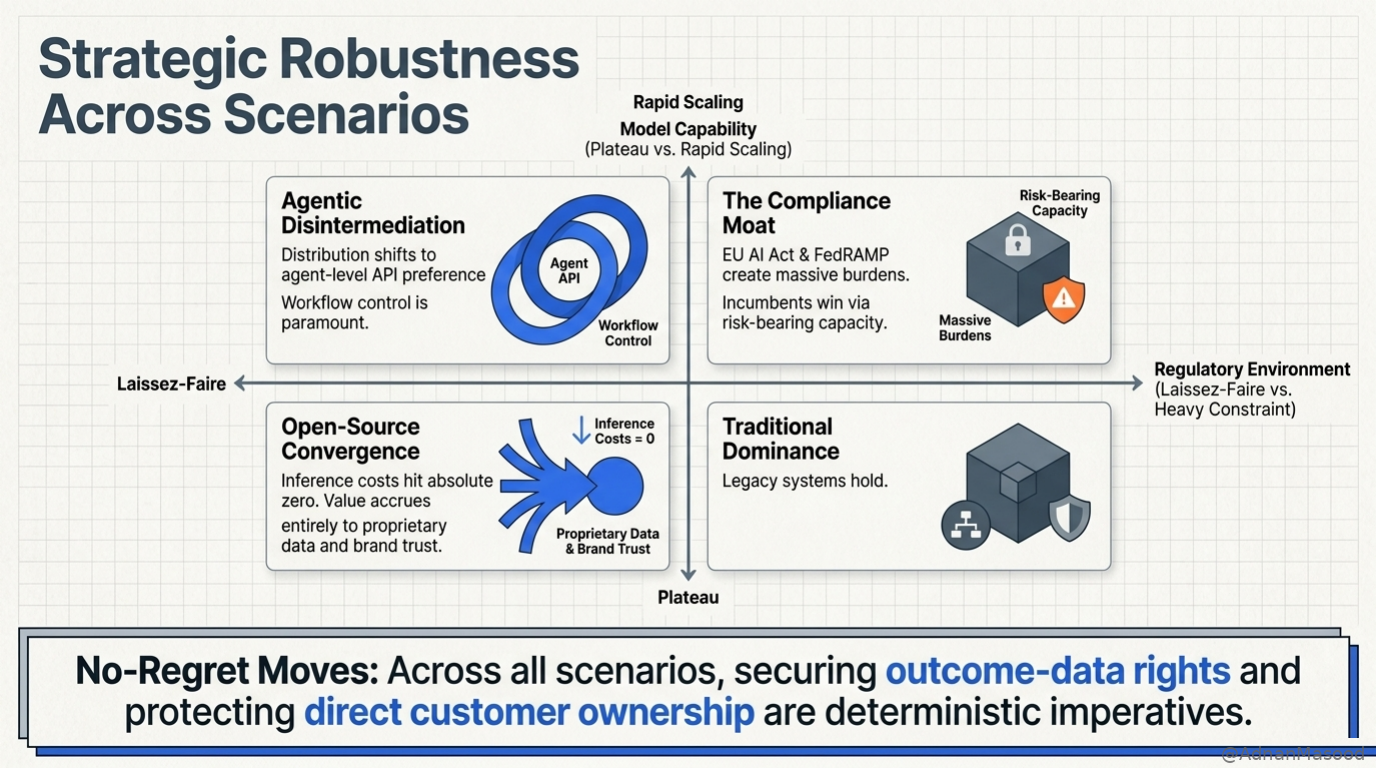
33. Strategic scenarios
- A. Rapid frontier progress. Proprietary models keep scaling. Moats rest on physical infrastructure, capital, and liability absorption as models replicate all software logic.
- B. Open-source convergence. Open weights match the frontier and inference cost collapses. Value accrues to applications with workflow control, proprietary data, and brand trust.
- C. Agentic disintermediation. Agents mediate purchasing. Distribution moats shift from human search optimization toward agent-level API optimization and preference [27].
- D. Heavy regulation. The EU AI Act, FedRAMP, and copyright litigation raise compliance burdens, and compliance and permission become the strongest moats [54], [55].
What this means. Do not bet on one technological outcome. Favor assets that hold value whether a closed lab or open weights ultimately wins.
34. No-regret strategic moves
Four actions pay off across every scenario:
- Protect customer ownership so agents cannot disintermediate the brand relationship.
- Secure outcome-data rights, always useful for fine-tuning and retrieval.
- Build model-independent evaluations so the firm can swap models safely as prices fall.
- Strengthen accountability so the brand is the trusted, liable entity amid unreliable AI output.
What this means. Technology forecasts are probabilistic, and operational readiness is a choice. These moves make a firm ready to exploit AI advances safely.
35. Competition, regulation, and public policy
Regulators are engaging AI concentration at the compute, model, and application layers, including an FTC inquiry into big-tech partnerships with leading AI startups [56]. The EU AI Act, with major obligations taking effect in August 2026, imposes transparency, watermarking, and compliance requirements [54]. In the US, copyright litigation against AI labs will decide whether training data is a liability or an entrenched moat for incumbents who can afford licensing [55].
What this means. Regulation cuts both ways. It protects citizens and it builds deep moats for incumbents able to bear the compliance overhead, which freezes out uncredentialed entrants.

Conclusion: from what you own to what you compound
Generative AI reset the economics of cognition. As the cost of producing software, analysis, and generic expertise trends toward zero, moats built on the difficulty of coding or the hoarding of static data decay in public view, with Chegg as the object lesson [16].
AI relocates moats rather than removing them. Defensibility migrates away from digital creation and toward the physical, institutional, and relational constraints of the real world: infrastructure that cannot be synthesized, outcome-labeled loops that compound in real time, permission and liability absorption that guard mission-critical decisions, and workflow integration that rebuilds switching costs.
One honest qualification belongs in the record. Model-layer moats do not vanish. Frontier development stays capital-intensive, infrastructure-dependent, and politically exposed [20], [22]. For most enterprises, those are supplier-layer moats rather than customer-layer moats, which is why strategy should not open with how to build the best model.
The board-level question worth putting on the wall:
What does the enterprise uniquely control, continuously learn from, and reliably convert into authorized customer outcomes that competitors cannot reproduce at the same rate or bear at the same risk?
That is the AI-era version of moat discipline.

Glossary
TERM                        PLAIN-LANGUAGE DEFINITION
-------------------------------------------------------------------------------
AI agent                    Software that perceives, reasons, and takes multi-
                            step actions toward a goal with limited human help.
Barrier to entry            Anything that makes it harder for a new firm to
                            compete profitably.
Closed-loop learning        Improvement driven by observing what happened after
                            a decision and feeding it back into the system.
Control point               A node in a value chain where a firm governs access,
                            authorization, or settlement.
Counter-positioning         A new entrant using a business model the incumbent
                            cannot copy without harming its own revenue.
Dynamic capability          A firm's ability to sense change and reconfigure
                            resources as markets shift.
Economic moat               A structural condition that sustains returns above
                            the cost of capital over time.
Evaluation (eval)           A structured test framework measuring whether an AI
                            system performs acceptably on important tasks.
Flow moat                   An advantage regenerated by ongoing operations
                            rather than an accumulated past asset.
Foundation model            A broad model trained on large data and adapted to
                            many downstream tasks.
Frontier model              The most capable available model generation at a
                            given time.
Generative AI               AI that creates new text, code, images, or audio.
Guardrail                   A rule or control that reduces unsafe AI behavior.
Imitation half-life         The time for a rival to reproduce most of a firm's
                            visible differentiation.
Inference                   Running a trained model to produce an output.
Learning velocity           The speed at which a firm turns new information into
                            governed operational improvement.
Liability absorption        The ability and willingness to bear legal or
                            financial consequences when a system fails.
Liquidity                   The density of participants that makes a market's
                            transactions seamless.
Model portability           The ability to swap model providers without major
                            customer disruption.
Moat stack                  A mutually reinforcing combination of moats.
Network effect              A product that grows more valuable as more people
                            use it.
Outcome-labeled data        Data tied to the verified result of an action.
Permission asset            A license, approval, or right to operate in a
                            restricted domain.
Retrieval-augmented         Grounding model output in specific, proprietary
generation (RAG)            data retrieved at query time.
Risk-bearing capacity       The balance-sheet ability to fund, insure, or absorb
                            downside risk.
Stock moat                  An advantage based on an accumulated past asset.
System of action            Software that executes or triggers real-world work.
System of decision          Software that shapes or makes decisions.
System of record            The authoritative source of business data.
Tacit knowledge             Know-how that is hard to write down or transfer.
Value capture               The share of created value a firm retains.
Workflow                    The ordered sequence of tasks, approvals, and
                            actions through which work gets done.
-------------------------------------------------------------------------------
Frequently Asked Questions
Does AI eliminate competitive advantage? No. It reduces the scarcity of some capabilities, mainly coding, drafting, and generic analysis, and leaves many scarce assets untouched: permission, power, workflow insertion, trust, and live outcome data. Field studies and benchmarks show real productivity gains alongside continued gaps in reliability and execution [8], [11], [13].
Is software still a moat? Sometimes, and much less often by itself. The more visible and reproducible the feature, the weaker the defense. Software becomes defensible when it sits at a governed control point inside a workflow or record system [35], [45].
Is proprietary data still a moat? Only when it is exclusive, current, legal to use, and linked to an outcome that matters commercially. Static warehouses are weaker than live data flows [16], [29].
Why does liability matter more in the AI era? Cheap generation multiplies possible mistakes. When customers need someone to guarantee accuracy, compliance, or recourse, the firms that can do so gain leverage [37], [46], [47].
Are subject-matter experts still valuable? Yes, and the scarce part shifts from general knowledge to judgment, exception handling, policy design, and accountability. Expertise scales best when encoded into systems [8], [14].
Are switching costs disappearing? Feature-based switching costs are under pressure as agents automate migration [3]. New switching costs form around embedded workflow, permissions, and accumulated AI context. Once a model has learned a company’s specific rules and exceptions, replacing it is disruptive [6].
Why does distribution matter more when production gets cheaper? Infinite supply makes scarce customer attention and trusted access the bottleneck, which hands pricing power to whoever owns the demand interface [27], [39].
Can regulation create a moat? Yes, when it creates durable permission or raises compliance cost, which favors incumbents that can absorb it. Regulation can also standardize markets and narrow excess returns [24], [44], [54].
Can open-source AI eliminate model-provider power? Open weights commoditize foundational logic and reduce proprietary-lab supplier power, which shifts advantage to firms that master orchestration, routing, and physical compute [1], [15].
Will customers build instead of buy? For narrow internal tools, increasingly yes. For regulated, high-liability, deeply integrated workflows, build stays harder than it looks, so mission-critical systems keep getting bought [3], [35].
Which AI-era moat is most durable? There rarely is one across all industries. Regulated high-stakes sectors reward permission plus trust plus liability. Marketplaces reward liquidity. Enterprise software rewards workflow control. Combinations of atoms, permission, liability, and live outcome data hold up best [18], [25], [37].
How should a startup compete against an incumbent? Through counter-positioning, adopting AI-native models such as outcome pricing that incumbents cannot match without cannibalizing seat revenue, then attaching a distribution or control-point strategy [6], [50].
How should a board measure moat strength? Track integration depth, exclusive outcome-rate, cost per successful outcome, model portability, trust incidents, and time to governed deployment, ahead of lagging financials [14], [29].
Appendix A. Enterprise moat audit questionnaire
AREA        QUESTION
-------------------------------------------------------------------------------
Strategy    Which gross margins rely purely on the difficulty of coding or
            synthesizing public information?
Product     Do our AI features execute workflows (systems of action) or merely
            summarize data (systems of decision)?
Data        Do we capture live outcome data, or sit on a static dataset that
            synthetic data can replace?
Technology  Are we locked to one model provider, or do we run a routing gateway?
Sales       Is pricing tied to headcount (seats) or to outcomes (resolutions)?
Operations  What is the imitation half-life of a new feature?
Finance     Do we use the balance sheet to guarantee outcomes?
Legal       Do contracts secure the right to train on customer outcome data?
Risk        Do we absorb liability for AI output, or push it to the user?
People      Do we incentivize employees to codify tacit knowledge?
Board       How do we track moat-renewal investment?
-------------------------------------------------------------------------------
Appendix B. Control-point mapping worksheet
Map the customer journey and name who owns each node: 1. Discovery (e.g., agent recommendation vs. direct search)
2. Identity (e.g., platform ID vs. enterprise SSO)
3. Permission (e.g., FedRAMP vs. open web)
4. Decision (e.g., AI underwriting vs. human officer)
5. Action (e.g., API execution vs. manual entry)
6. Transaction (e.g., checkout routing)
7. Settlement (e.g., payment rails)
8. Liability (e.g., insurer balance sheet)
9. Outcome loop (e.g., repayment / resolution data)A firm holding several of these usually beats one that supplies a
visible feature inside someone else's workflow.Appendix C. Data-moat evaluation framework
Assess each data asset across these vectors: Source Internally generated vs. scraped
Exclusivity Sole ownership vs. commercially available
Rights Contractual clearance to train
Recency Real-time vs. historical snapshot
Outcome linkage Tied to causal results vs. observational inputs only
Quality Verified labels vs. sparse or noisy
Coverage Real operating breadth vs. narrow or biased subset
Replaceability Proxies materially underperform vs. easy substitutes
Transferability Reuse tied to system position vs. easy customer export
Feedback speed Short loops vs. months
Economic value Improves pricing/approval/loss/retention vs. non-actionableAppendix D. Industry comparison matrix
INDUSTRY        AI-COMMOD  PERMISSION  PHYSICAL  LIABILITY  DISTRIBUTION  NET-EFFECT
-------------------------------------------------------------------------------------
Financial       High       High        Medium    High       High          High
Healthcare      High       High        Medium    High       Medium        Medium
Retail          High       Low         High      Low        High          Medium
Enterprise SW   High       Low-Med     Low       Medium     High          Low-Med
Manufacturing   Medium     Medium      High      High       Medium        Low
Infra / energy  Low-Med    High        Very high High       Medium        Low
Marketplaces    High       Medium      Low-Med   Medium     Very high     Very high
-------------------------------------------------------------------------------------
Appendix E. Selected evidence ledger
CONCLUSION                              SOURCES        CONFIDENCE  MAIN LIMITATION
-------------------------------------------------------------------------------
Feature and static-knowledge moats      [8]-[16],      High        Benchmarks do
are weakening                           [3]                        not map perfectly
                                                                   to live firms.
-------------------------------------------------------------------------------
Physical infrastructure is a            [18]-[23]      High        Vulnerable to
compounding moat                                                   low-compute
                                                                   algorithmic
                                                                   breakthroughs.
-------------------------------------------------------------------------------
Permission and compliance generate      [24], [57],   High        Subject to
powerful moats                          [54]                       political and
                                                                   regulatory shifts.
-------------------------------------------------------------------------------
Live outcome data beats static data     [28]-[32]     High        Diminishing
                                                                   returns as base
                                                                   models near
                                                                   perfect reasoning.
-------------------------------------------------------------------------------
SaaS seat pricing is exposed to AGENT   [50]-[53]     High        Assumes buyers
displacement                                                       accept switching
                                                                   friction.
-------------------------------------------------------------------------------
"AI can build anything" is directionally [11]-[14],   High        Case evidence is
useful and literally false in           [3]                        heterogeneous.
enterprise settings
-------------------------------------------------------------------------------
Methodology and limitations: this synthesis draws on primary regulatory filings, empirical financial data, peer-reviewed and working-paper research, and reputable reporting current through July 2026. Case selection carries potential survivorship bias. Forecasts on open-source convergence and regulatory enforcement rest on current trajectories. Productivity estimates rely partly on self-reported and constrained experimental data that may show selection bias [14].
References
[1] Stanford Institute for Human-Centered AI, Artificial Intelligence Index Report 2026. https://arxiv.org/abs/2606.15708
[2] “AI Token Futures Market: Commoditization of Compute and Derivatives Contract Design,” arXiv:2603.21690. https://arxiv.org/pdf/2603.21690
[3] “The Buy-or-Build Decision, Revisited: How Agentic AI Changes the Economics of Enterprise Software,” arXiv:2604.26482. https://arxiv.org/html/2604.26482
[4] M. E. Porter, “The Five Competitive Forces That Shape Strategy,” Harvard Business Review, vol. 86, no. 1, 2008.
[5] D. J. Teece, G. Pisano, and A. Shuen, “Dynamic Capabilities and Strategic Management,” Strategic Management Journal, vol. 18, no. 7, 1997. https://www.davidjteece.com/dynamic-capabilities
[6] H. Helmer, 7 Powers: The Foundations of Business Strategy. Deep Strategy, 2016. https://www.hustlebadger.com/what-do-product-teams-do/7-powers-establishing-your-competitive-moat/
[7] J. B. Barney, “Firm Resources and Sustained Competitive Advantage,” Journal of Management, vol. 17, no. 1, 1991.
[8] E. Brynjolfsson, D. Li, and L. Raymond, “Generative AI at Work,” arXiv:2304.11771. https://arxiv.org/abs/2304.11771
[9] E. W. Dillon, S. Jaffe, N. Immorlica, and C. T. Stanton, “Shifting Work Patterns with Generative AI,” arXiv:2504.11436. https://arxiv.org/abs/2504.11436
[10] S. Maier et al., “A Meta-Analysis of the Effect of Generative AI on Productivity and Learning in Programming,” arXiv:2605.04779.
[11] S. Zhou et al., “WebArena: A Realistic Web Environment for Building Autonomous Agents,” arXiv:2307.13854. https://arxiv.org/abs/2307.13854
[12] G. Mialon et al., “GAIA: A Benchmark for General AI Assistants,” arXiv:2311.12983. https://arxiv.org/abs/2311.12983
[13] R. Froger et al., “Gaia2: Benchmarking LLM Agents on Dynamic and Asynchronous Environments,” arXiv:2602.11964.
[14] METR, “Measuring the Self-Reported Impact of Early-2026 AI on Technical Worker Productivity,” 2026. https://metr.org/blog/2026-05-11-ai-usage-survey/
[15] “The LLM Pricing Collapse of 2026: How to Build When Models Cost Almost Nothing.” https://www.aimagicx.com/blog/llm-pricing-collapse-developer-guide-building-cheap-ai-2026
[16] “Chegg Lost $14 Billion to ChatGPT in Three Years,” European Business Magazine. https://europeanbusinessmagazine.com/chegg-stock-collapse-chatgpt-ai-disruption-2026/
[17] PIMCO, “AI Credit Expansion: Assessing the Micro and Macro Risks.” https://www.pimco.com/us/en/insights/ai-credit-expansion-assessing-the-micro-and-macro-risks
[18] Constellation Energy, “Constellation to Launch Crane Clean Energy Center,” 2024. https://www.constellationenergy.com/news/2024/Constellation-to-Launch-Crane-Clean-Energy-Center-Restoring-Jobs-and-Carbon-Free-Power-to-The-Grid.html
[19] Reuters, “Data Centers Could Use 9% of US Electricity by 2030, Research Institute Says,” May 29, 2024. https://www.reuters.com/business/energy/data-centers-could-use-9-us-electricity-by-2030-research-institute-says-2024-05-29/
[20] Reuters, “Microsoft Plans to Invest $80 Billion on AI-Enabled Data Centers in Fiscal 2025,” Jan. 3, 2025. https://www.reuters.com/technology/artificial-intelligence/microsoft-plans-spend-80-bln-ai-enabled-data-centers-fiscal-2025-cnbc-reports-2025-01-03/
[21] Reuters, “OpenAI Lists Google as Cloud Partner Amid Growing Demand for Computing Capacity,” Jul. 16, 2025.
[22] Reuters, “TSMC to Invest Another $100 Billion in US as Q2 Profit Blows Past Forecasts,” Jul. 15, 2026.
[23] Reuters, “New York Issues Moratorium on Data Centers,” Jul. 16, 2026. https://www.reuters.com/sustainability/new-york-issues-moratorium-data-centers-2026-07-16/
[24] Quzara, “FedRAMP Certification Classes A through D.” https://quzara.com/fedramp/certification-classes
[25] Reuters, “Visa Prevented $40 Billion Worth of Fraudulent Transactions in 2023,” Jul. 23, 2024. https://www.reuters.com/technology/cybersecurity/visa-prevented-40-bln-worth-fraudulent-transactions-2023-official-2024-07-23/
[26] Reuters, “Mastercard Bolsters Threat Intelligence Capabilities with $2.65 Billion Deal for Recorded Future,” Sep. 12, 2024.
[27] Associated Press, “Visa Plugs Its Payment Network into ChatGPT, Letting AI Agents Shop and Pay for Users,” Jun. 2026. https://apnews.com/article/d769dec86344cb4977c98789e8ec492f
[28] A. Egg, “Off-Policy Evaluation for Payments at Adyen,” arXiv:2501.10470. https://arxiv.org/abs/2501.10470
[29] Stripe, “Fraud Scores Explained: How Businesses Assess Transaction Risk.” https://stripe.com/resources/more/fraud-scores-explained
[30] Upstart, “2025 Annual Report.” https://ir.upstart.com/static-files/77673faa-918f-48b8-a6e2-d30846f896f2
[31] Upstart, “Upstart Streamlines UMI Reporting.” https://ir.upstart.com/node/13186/pdf
[32] “Lemonade Inc Earnings Call Transcript FY25 Q3,” StockInsights. https://www.stockinsights.ai/us/LMND/earnings-transcript/fy25-q3-c978
[33] Reuters, “Butterfly Network Gets FDA Clearance for AI Ultrasound Pregnancy Tool,” Mar. 30, 2026. https://www.reuters.com/business/healthcare-pharmaceuticals/butterfly-network-gets-fda-clearance-ai-ultrasound-pregnancy-tool-2026-03-30/
[34] Reuters, “As AI Enters the Operating Room, Reports Arise of Botched Surgeries and Misidentified Body Parts,” Feb. 9, 2026.
[35] Reuters, “Healthcare Software Giant Epic Must Face Rival’s Antitrust Lawsuit, US Judge Rules,” Sep. 8, 2025. https://www.reuters.com/legal/government/healthcare-software-giant-epic-must-face-rivals-antitrust-lawsuit-us-judge-rules-2025-09-08/
[36] Reuters, “Healthcare Startup Abridge Raises $250 Million to Enhance AI Capabilities,” Feb. 17, 2025.
[37] Bell Law Firm, “AI in Healthcare Is Accelerating, But Who Pays When It Fails?” https://www.belllawfirm.com/ai-in-healthcare-is-accelerating-but-who-pays-when-it-fails/
[38] Suffolk University JHBL, “The New Standard of Care? AI and the Future of Medical Malpractice Law,” Jan. 25, 2026. https://sites.suffolk.edu/jhbl/2026/01/25/the-new-standard-of-care-ai-and-the-future-of-medical-malpractice-law/
[39] Bain & Company, “Agentic AI in Retail: How Autonomous Shopping Is Redefining the Customer Journey.” https://www.bain.com/insights/agentic-ai-in-retail-how-autonomous-shopping-redefining-customer-journey/
[40] AMALYTIX, “Alexa for Shopping (formerly Amazon Rufus) 2026.” https://www.amalytix.com/en/knowledge/ai/amazon-rufus-guide-2026/
[41] Reuters, “Klarna Using GenAI to Cut Marketing Costs by $10 Million Annually,” May 28, 2024. https://www.reuters.com/technology/klarna-using-genai-cut-marketing-costs-by-10-mln-annually-2024-05-28/
[42] Associated Press, “AI Shakes Up the Call Center Industry, but Some Tasks Are Still Better Left to the Humans,” Sep. 2025.
[43] Reuters, “Apple to Discontinue ‘Buy Now, Pay Later’ Service in US as It Plans New Loan Program,” Jun. 17, 2024.
[44] Reuters, “US Consumer Watchdog Will Apply Credit Card Rules to Buy Now, Pay Later Companies,” May 22, 2024.
[45] Associated Press, “Palantir Books Its First $1 Billion in Quarterly Sales and Dodges DOGE Axe,” Aug. 2025.
[46] Reuters, “US Appeals Court Rebukes Lawyer over ‘Fake and Hallucinated’ Case Citations,” Jul. 10, 2026. https://www.reuters.com/legal/litigation/us-appeals-court-rebukes-lawyer-over-fake-hallucinated-case-citations-2026-07-10/
[47] Business Insider, “Air Canada’s Chatbot Gave a Passenger False Information, and the Airline Must Now Pay Compensation,” Feb. 2024.
[48] Siemens, “Digital Twin.” https://www.siemens.com/en-us/company/digital-twin/comprehensive-digital-twin-for-industry/
[49] “Digital Twin in Manufacturing 2026: The Plain-English Guide for Factories.” https://machinetoolnews.ai/digital-twin-in-manufacturing-2026/
[50] Fraction, “AI Is Killing SaaS Margins. Outcome-Based Pricing Is How You Get Them Back.” https://www.hirefraction.com/blog/ai-is-killing-saas-margins-outcome-based-pricing-is-how-you-get-them-back/
[51] OMNIUS, “SaaS Industry Trends Report 2026.” https://www.omnius.so/blog/saas-industry-report-2026
[52] KORIX, “6 AI Pricing Models Compared on Total Cost (2026 Guide).” https://korixinc.com/learning-center/ai-pricing-models-2026
[53] Final Round AI, “Klarna CEO Says AI Will Cut Workforce From 7,000 to 2,000.” https://www.finalroundai.com/blog/klarna-ceo-ai-cut-workforce
[54] Sidley, “EU AI Act Transparency Obligations: Preparing for Compliance by 2 August 2026,” Jun. 24, 2026. https://datamatters.sidley.com/2026/06/24/eu-ai-act-transparency-obligations-preparing-for-compliance-by-2-august-2026/
[55] BakerHostetler, “Case Tracker: Artificial Intelligence, Copyrights and Class Actions.” https://www.bakerlaw.com/services/artificial-intelligence-ai/case-tracker-artificial-intelligence-copyrights-and-class-actions/
[56] Associated Press, “FTC Opens Inquiry into Big Tech’s Partnerships with Leading AI Startups,” Jan. 2024.
[57] DefenseScoop, “DOD Expands Its Classified AI Work with 8 Companies Amid Ongoing Dispute,” May 1, 2026. https://defensescoop.com/2026/05/01/dod-expands-classified-ai-work-with-8-companies-excluding-anthropic/
[58] Arion Research, “The Agentic Advantage: How AI Agents Create Sustainable Competitive Moats.” https://www.arionresearch.com/blog/w85gxrax06wv20urokzqoe5natigmu
메타데이터
- post_id
- 6bc9d779ae7d
- slug
- moats-in-the-age-of-ai-where-advantage-goes-when-everyone-can-build-6bc9d779ae7d
- url
- https://medium.com/@adnanmasood/moats-in-the-age-of-ai-where-advantage-goes-when-everyone-can-build-6bc9d779ae7d
- canonical_url
- https://medium.com/@adnanmasood/moats-in-the-age-of-ai-where-advantage-goes-when-everyone-can-build-6bc9d779ae7d
- author_url
- https://medium.com/@adnanmasood
- status
- ok
- fetched_at
- 2026-08-28 02:21:44