Old MacDonald Had a Bot: 5 Robotics Shifts on the Farm
Practical ways robots are cutting costs, lifting yields, and giving farmers their most precious resource back — time.
Old MacDonald Had a Bot: 5 Robotics Shifts on the Farm
Practical ways robots are cutting costs, lifting yields, and giving farmers their most precious resource back — time.
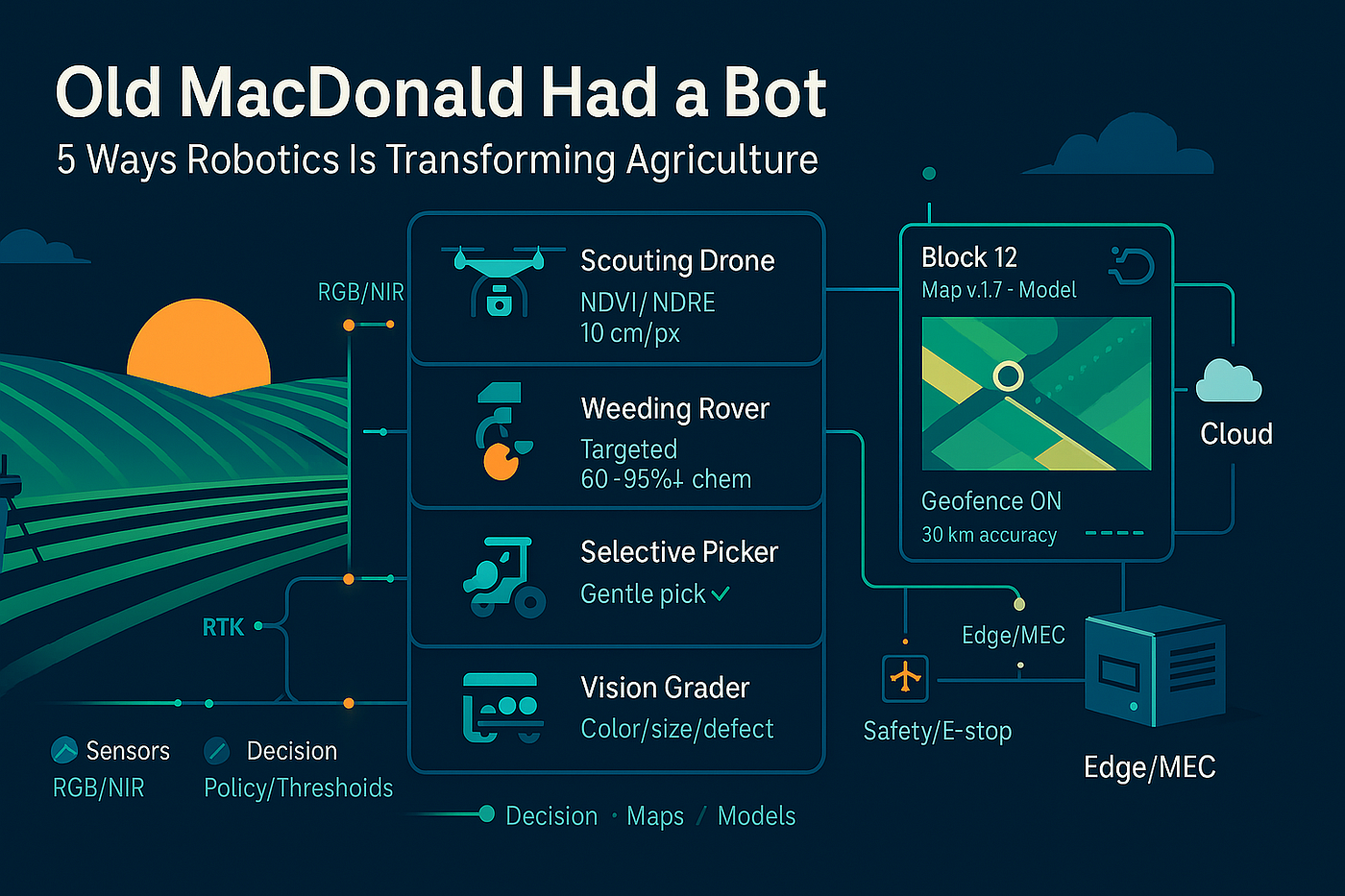
Five concrete ways agricultural robotics is transforming farms in 2025 — scouting, weeding, harvesting, autonomy, and grading — with diagrams and a tiny code snippet.
Short version? Modern farming isn’t about bigger tractors. It’s about smarter passes — machines that see, decide, and act with centimeter precision.
Let’s be real: agriculture margins are thin, labor is scarce, and the climate’s not waiting for our rollout plan. Robotics can’t solve everything, but it can remove the grind so skilled growers make better decisions, faster.
A quick mental model for “farm robots”
Most field systems look like this:
[Perception]  ->  [Decision/Policy]  ->  [Actuation]
  (RGB, NIR,       (thresholds,          (spray, cut,
   depth, RTK)      yield models)         pick, drive)

└────── Telemetry & Maps (edge/cloud) ──────┘- Perception identifies plants, pests, fruits, and rows.
- Decision converts pixels into prescriptions.
- Actuation applies chemical/mechanical action — or moves the vehicle.
- Telemetry ties everything to fields, blocks, and seasons.
Keep that picture handy as we walk the five big shifts.
1) Precision scouting: from “walk the rows” to “map the signal”
What’s changing: Drones and under-canopy rovers now deliver dense, consistent crop scouting. Multi-spectral cameras (RGB + NIR/RedEdge) flag stress before the eye can.
Why it matters: Early stress detection beats late rescue. Spotting a nitrogen deficit or water stress two weeks earlier can preserve both yield and quality.
How it works in practice:
- Drones run dawn flights for uniform light; orthomosaics produce NDVI/NDRE.
- Rovers roll mid-day under canopy, capturing close-ups to validate drone anomalies.
- Edge nodes at the farm stitch tiles and push maps to a web dashboard by lunch.
Field wisdom: The best ROI isn’t “perfect maps” — it’s consistent trend lines across time. That’s what turns image noise into decisions.
2) Robotic weeding & targeted spraying: chemicals as a scalpel, not a bucket
What’s changing: Vision-guided implements distinguish crop from weed in real time, then precisely act — micro-dosing herbicide droplets, mechanically knifing, or even firing brief laser pulses.
Why it matters: Chemical use drops 60–95% depending on crop/pressure. That’s money saved, operator exposure reduced, and resistance slowed.
Under the hood:
- High-speed cameras + LEDs freeze motion.
- A segmentation model marks weed pixels; the controller triggers nozzles or knives within ~30–80 ms.
- RTK keeps the toolbar on-row at 2–7 cm accuracy.
Let’s be real: This isn’t set-and-forget. You’ll still retune thresholds for soil color, residue, and time of day. But after a day of dialing in, the per-acre savings stack up.
3) Harvest assistance & selective picking: fewer bruises, better throughput
What’s changing: Soft-grip end-effectors and fruit-detection models now pick with consistency in strawberries, apples, tomatoes, and peppers. Where full automation isn’t ready, collaborative aids shine: conveyors that follow pickers, carts that auto-stage bins, or arms that handle repetitive reaches.
Why it matters: Harvest is where labor scarcity hurts most. Even a 20–30% productivity lift from assistance tools often pays back in a season for specialty crops.
Design trade-offs:
- Static orchards favor end-effectors tuned to one fruit + one trellis system.
- Mixed crops? Consider assistance robots first — less complex, broader ROI.
4) Autonomy for tractors and implements: the quiet revolution
What’s changing: Retrofit kits give existing tractors auto-steer, obstacle detection, and geo-fenced autonomy. Implements (sprayers, mowers, rippers) get their own controllers that cooperate with the tractor via ISOBUS/CAN.
Why it matters: The “second shift” becomes real. Machines work slow and safe at night, running tillage or mowing while people sleep.
A minimal autonomy diagram
RTK-GNSS + IMU  →  Localization  →  Path Follower  →  Steering/Throttle
Row camera      →  Row Tracker   →  Offset Control →  Implement Actuation
Lidar/Radar     →  Obstacle Check→  Slow/Stop      →  Alert + Resume
Safety note: Autonomy is policy plus hardware. Keep e-stop physical, radio, and software layers independent.
5) Post-harvest vision grading: quality as data, not guesswork
What’s changing: Conveyor cameras with depth and hyperspectral options grade size, color, defects, and internal bruising — at speed.
Why it matters: Better sortation means tighter grades, happier buyers, and cleaner pricing. It also closes the loop: defects link back to orchard block and pass, informing next season’s pruning, sprays, or harvest timing.
Bonus: Automated traceability labels and pack-out analytics cut end-of-day paperwork to minutes.
A tiny “prescription map” snippet you can adapt
Below, a compact example that converts NDVI and soil data into a variable-rate nitrogen prescription. Treat it as a pattern — your thresholds will differ by crop and region.
import rasterio
import numpy as np

# Inputs: NDVI.tif (0..1), soil_OM.tif (organic matter %)
with rasterio.open("NDVI.tif") as ndvi_src, rasterio.open("soil_OM.tif") as om_src:
    ndvi = ndvi_src.read(1).astype(np.float32)
    om   = om_src.read(1).astype(np.float32)
    profile = ndvi_src.profile

# Simple rule: more N where vigor is low, with soil OM discount
N_base = np.where(ndvi < 0.55, 120, np.where(ndvi < 0.7, 90, 60))  # lbs/ac
N_adj  = np.clip(N_base - (om * 5), 40, 160)  # reduce when OM is high

# Write prescription GeoTIFF
with rasterio.open("N_prescription.tif", "w", **profile) as dst:
    dst.write(N_adj.astype(np.float32), 1)
Commentary: This is not agronomy in a box. But it shows the workflow: fuse imagery + soil, apply rules, export a map the sprayer can ingest.
Costs, connectivity, and the stuff no one advertises
- Power & charging: Field robots sip watts, but base stations and edge GPUs don’t. Plan generator/solar or you’ll end up babysitting batteries.
- Dust & weather: IP ratings matter. Fans clog; enclosures fog. Budget maintenance time.
- Rural bandwidth: Edge-first processing (compress, summarize, upload later) beats streaming raw footage.
- Change management: The biggest lift is people, not silicon. A champion operator makes or breaks your ROI.
Quick buyer’s checklist you can reuse
1) Crop + task fit: is this robot proven on YOUR crop, trellis, and rows?
2) Map format: does it export shapefiles/GeoTIFFs your rig understands?
3) Night ops: lights, safety, and insect attraction (yes, it matters).
4) Spares: servos, belts, cameras—what’s on the truck vs. mail-order?
5) Support: who picks up the phone in week three of harvest?
6) Data: who owns it, where does it live, and when does it get deleted?
Tape this to the office wall. It prevents hopeful purchases from becoming expensive lawn ornaments.
You might be wondering: where to start?
Start with a single block and a single pain point. If weeds eat time, try vision weeding. If harvest is chaos, pilot a conveyor-follow robot. If quality is inconsistent, put a camera on your pack line.
Measure three things: cost per acre, hours saved, and variance reduced (yields, grades, rejects). If two of the three trend the right way, scale.
Bottom line
Robotics isn’t replacing farmers; it’s promoting them — from machine operators to system designers. The future farm is still human, just amplified: more data-driven, less back-breaking, and frankly, more resilient.
If this helped, follow for deep dives on specific platforms — or drop a comment with your crop and region. I’ll sketch a first-pass stack (scouting → decision → actuation) you can trial next season.
메타데이터
- post_id
- 6bd7619a69b2
- slug
- old-macdonald-had-a-bot-5-robotics-shifts-on-the-farm-6bd7619a69b2
- url
- https://medium.com/@jickpatel611/old-macdonald-had-a-bot-5-robotics-shifts-on-the-farm-6bd7619a69b2
- canonical_url
- https://medium.com/@jickpatel611/old-macdonald-had-a-bot-5-robotics-shifts-on-the-farm-6bd7619a69b2
- author_url
- https://medium.com/@jickpatel611
- status
- ok
- fetched_at
- 2026-08-05 01:07:45